Real de Catorce ia an area with quite a few silver mines in the state of San Luis Potosí, 144 miles north of the capital city.
The miners had to send the silver to the capital for coinage, for which they paid costs such as transportation, discounts, commissions and taxes, the settlers always had the idea of establishing a mint to avoid these complications, another problem was that the road from the town to the capital of San Luis Potosí had gaps and bad terrain which caused delays in the delivery of the ore and the return in silver coin, this caused a lack of circulating currency in Real del Catorce which in turn caused an overvaluation of the prices of silver and the circulating currency.
On 12 September 1861 the federal government approved[text needed] the erection of two mint in San Luis Potosí (although the San Luis Potosí mint was already in operation since the decree of 30 March 1827). A short time later, on 23 September, the contract for the lease of the Mint of San Luis Potosí for a period of ten years was signed, with the commitment to install new machinery.
Since the government united both mints as one, the lease contract for both mints went to Senator Cayetano Rubio, who led a group of powerful miners in the area, but due to the instability of the time he had to cede the contract (made up of all his shares) to the brothers Víctor and Anacleto García y Cortina of Cortina y Compañía. In order to establish the Catorce mint they partnered with Santos de la Maza and Francisco de la Maza{footnote}for more información on de la Maza, see Pedro Cosi de la Maza, “Don Santos de la Maza and The Mint of de Catorce”, in El Boletín, Vol. VI, No. 53, October-December 1966 , Sociedad Numismática de México (available on the USMexNA online library){/footnote}. Rubio's contract with the government was for 47,000 pesos in cash and 53,000 pesos in bonds, in addition to a loan to the government for 187,903 pesos with an annual interest rate of 6%, for a period of ten years,
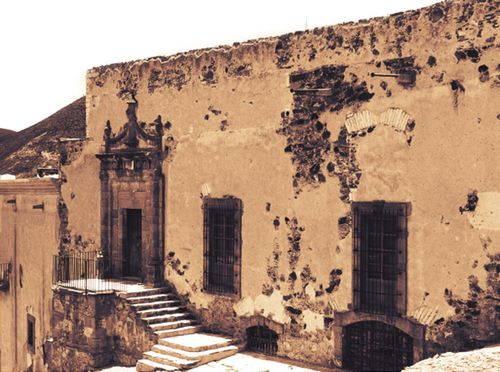
The minting machinery was purchased in Philadelphia from the Makers and Morgan Company, by Anacleto Terán and Anastasio García, the cost of the equipment was $80,000 gold pesos. All the tools were shipped and installed in the facilities that Santos de la Maza had built in the main square of the town, at a cost of $80,000. For a short time, the San Luis Potosí mint lent machinery to Catorce while the one they had requested arrived. In the same vein, a new lease was requested from President Juárez, which was granted for a new extension of ten years.
Despite the above, problems were not long in coming. At the end of 1863, a letter signed by the military commander, Manuel Bailen, arrived ordering the suspension of all work. There was great pressure in San Luis Potosí due to the arrival of the Imperialist forces, who had already taken the capital and secured its Mint. Real del Catorce was taken over from December 1863 to March 1866, with the mint closing in 1864, reopening the following year.
On 23 January 1864, the Juaristas fled from Matehuala and the Imperialists immediately entered Real de Catorce, On that same date, the cabildo of the capital of San Luis Potosí requested the closure of the Real del Catorce mint by the wishes of the Imperial Regency. On 11 December 1864, Juárez ordered the closure of the mint (despite it being in the hands of the Imperialists), and a counter-order for its opening was given on 3 January 1865.
During its period of operation (1863 to 1869), the Real de Catorce mint went through two wars: the War of Reform and the French Intervention. It is worth mentioning that from 1857 to 1861 there were ten governors of the state, a sign of the constant change of ideals of the time.
The mint began operations on 17 May 1863 by die-cutting the first silver coins of 2, 4 and 8 reales, There were small interruptions but the die-cutting work continued until 28 November. The Juaristas were in the town before leaving and witnessed the first coinage of the new mint, it is even said that President Juárez himself was present (hypothesis not confirmed).
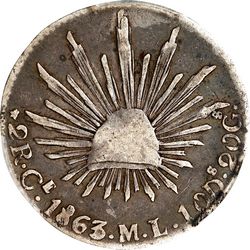
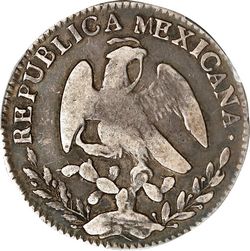
KM-374.1 2r 1863 Ce ML (Stack’s Bowers auction, 16 May 2023, lot 70509)
| Date | Asssayer | Recorded Mintage |
Comment |
| 1863 | ML |
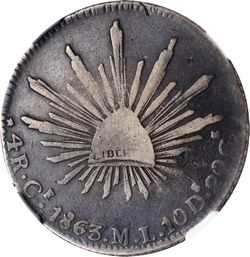
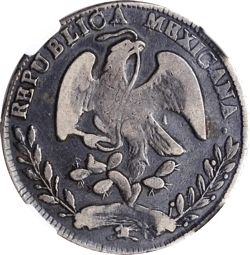
KM-375 4r 1863 Ce ML large C (Stack’s Bowers auction, 24 June 2021, lot 72358)
| Date | Asssayer | Recorded Mintage |
Comment |
| 1863 | ML | large C | |
| 1863 | ML | small C (illustrated below) |
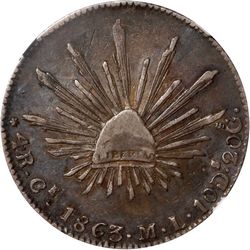
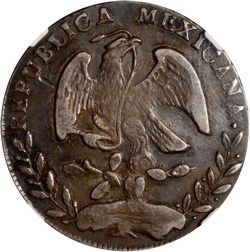
KM-375 4r 1863 Ce ML small C (Stack’s Bowers auction, 23 February 2022, lot 37442)
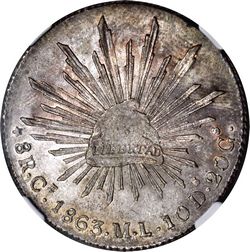
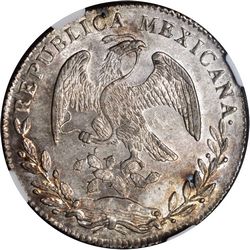
KM-377.1 8r 1863 Ce ML (Stack’s Bowers NYINC auction, 14 January 2017, lot 3162)
| Date | Asssayer | Recorded Mintage |
Comment |
| 1863 | ML |
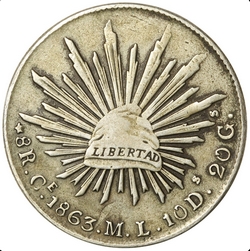
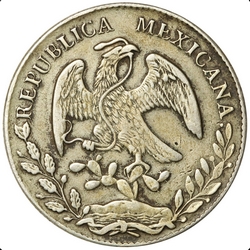

Counterfeit KM-377.1 8r 1863 Ce ML (Briggs & Bustos Counterfeit issues II, 10 August 2025, lot 61)
Cast silver. 39 mm in diameter, 26.86 grams, coin alignment. Two small rays beneath the cap, popularly known as “Dragon’s Teeth,” were introduced as an “anti-counterfeiting security feature” in 1867 at the Mexico City mint and later standardized across all mints until the 1880s. No official coin from 1863 bears this feature, which confirms this is a reproduction made after the original period. On the obverse, the eagle has a style more in line with issues from 1867 to the 1880s, with a slightly more robust body and well-defined feathering. Loss of border design, crude edge design. Metal composition: 88.49% Silver, 10.33% Copper, 0.91% Zinc, 0.14% Gold, 0.11% Lead.
Upon the arrival of Emperor Maximilian, fearful that Juárez's forces might take over the mint, he ordered its closure. Several letters were sent to the Emperor by the city council and citizens to revoke the decision, but Maximilian did not budge and the order stood.
In addition to these first complications, the governor of the state, Santos Degollado, imposed a forced loan of $20,000 on Real del Catorce: the leading miners as well as the city council refused to grant them, so Santos de la Maza was arrested. Due to this bad behaviour, a new forced loan for $35,000 was imposed shortly after, but as the coffers ce were almost empty, only less than half could be collected.
In August 1866 the town was again occupied by the Liberal colonel Pedro Martínez, the colonel's troops looted the town but found no more than 300 pesos, the soldiers broke into the facilities of the (now inactive) mint, stole machines and materials and broke the rest. It is important to mention that the minting presses had been moved to the capital in previous years, so the vandals only destroyed minor machinery.
The order to close the mint sent by Maximilian was administratively enforced in February 1866 through General Mejía with the main objective that the Juaristas could not make money. Months before, he had made administrative changes in the workforce of several mints, including Real del Catorce. Thus, in February 1866 he appointed Francisco Villar as assayer at Real del Catorce. Villar resigned shortly after, so in March of the same year Trinidad Gómez Gordillo was appointed assayer. However, neither of these has their initials on coins as "M.L." (Mariano León) appears on all issues.
In February 1865, the Prefect of the Empire, Darios de los Reyes, mentioned in a report that Real del Catorce mint represented losses to the treasury, compared to other mints, and requested that the contract be reviewed and nullified.
Due to all these complications, the town gradually lost its years of splendour, people closed their businesses and left, many moving to Matehuala taking advantage of the fact that it was also a relevant mining area. When Juárez restored the Republic, peace and security gradually returned, but stability was really consolidated in the last two decades of the nineteenth century during the administration of President Porfirio Díaz: In those years Real del Catorce returned to functioning, the mines re-opened and businesses returned to work.
The only date is 1863. Dunigan & Parker {footnote}Mike Dunigan and Parker, Resplandores, 1998{/footnote} argue that in 1864 and 1865 coins were dated 1863, so as not to offend the Imperialists, who had arrived in Mexico in 1864. On this same subject, Richard G. Doty{footnote}Richard G. Doty, 1992{/footnote} suggests that during the period of the Second Empire (1863-1867) multiple mints minted coins with dates prior to the intervention, such as Mexico City or Zacatecas, of which there is an abundance of coins from 1863, compared to other nearby years. This was because the tenants of the mint, not knowing how the precarious social, economic and political situation of the time would turn out, preferred to "shield" themselves and avoid trouble.
There is a possibility, according to Pradeau{footnote}{/footnote}, that copper coins were issued at the mint in mid-1864, since there is a document that obliges the citizens of the area to accept as official currency the copper coins are minted at the Mint[text needed].
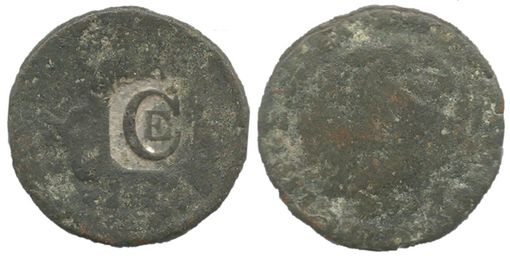 This coin{footnote}listed in Frank W. Grove, Tokens of Mexico, with number 2022{/footnote} was minted (or restamped) on cuartillas or octavos of San Luis Potosí dated in 1859. The diameter of the piece is 21 millimetres, the restamp "Ce" is the abbreviation of the mint. There are varieties in stamps, the rarest being the one with stars surrounding the "Ce".
Finally, the State Legislature decreed the closure of the Mint on 15 November 1869, approved by the governor of the state, General Mariano Escobedo. Minting operations ceased on 28 November 1869{footnote}Pradeau,(/footnote). In a last attempt at survival, the Legislature approved a request to maintain the assay office until 1872, the year in which all operations officially ended.
During its years of operations Real de Catorce minted currency for a total of 6,281,008.25 pesos, 95% of it in 8 reales coins. However, it seems that this amount refers only to the coins minted in 1863. Montejano Aguiñaga{footnote}Rafael Montejano y Aguiñaga, “Las Acuñaciones de El Real del Catorce, S.L.P.” in the Gaceta de la Sociedad Numismática de Monterrey, April 1980{/footnote} reports that the mint produced coins for $1,321,545 in 1865 and $167,860 pesos in 1866, which should probably be added to the previous amount. Pradeau, mentions that the mint was reopened on 16 February 1865, minting in that same month 65,000 pesos.
Pomposo Sanabria was an engraver in San Luis Potosí from 1827 to 1861, and worked for Real de Catorce from 1863. In the 8 Reales coins of 1863 we can find the variety "Ce/Pi" this is due to the fact that several dies from San Luis Potosí were re-used in Real de Catorce, with only the mint and assayer changed in the matrix. There is also a ML/C variety, that is, with the Catorce assayer Mariano León, on a coin previously used in San Luis Potosí by the assayer M.C. (Mariano Cataño).
As a final reflection we can find several reasons why this mint was not a success despite being in a rich mining area. The first was its proximity to the mint of the capital, San Luis Potosí. In history this proximity to other mints always ends badly, as happened to the mint of Tlalpan with that of Mexico City. A second reason was the the political situation, with the conflict between the pro-imperialist conservatives and the pro-Juárez liberals. Thirdly, Real del Catorce is in a complicated geographical area, which made it difficult to transport and distribute its silver. And finally, the mint had the envy of its neighbour in Mexico City. Before the mint was established in Real de Catorce all the silver was sent to the capital (which opened its mint in 1827: when this ceased it angered the capital's residents.
The building where the Mint was located was returned to Santos de la Maza, where it became his offices, known as "Casa Maza." Today it is the "Centro Cultural Real del Catorce" where cultural events are held.
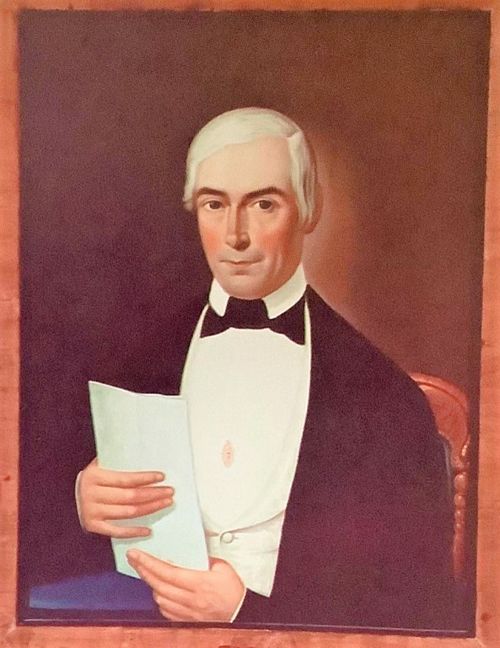 Santos de la Maza
| from | to | |
| 12 February 1861 | 28 November 1869 | Jorge Santos de la Maza, Miguel M. de Alavia and Viceme lrizan |
| Initial | Name | Began on | Left office on |
| ML | Mariano León{footnote}Mariano de León received an annual salary of $1,500 pesos for his services{/footnote} | 1863 | 1863 |
According to Ward{footnote}H. Ward, México en 1827, México, Fondo de Cultura Económica, pp. 601-603.{/footnote}, before the official establishment of the Potosi mint, most of the bars were sent to Zacatecas for minting, which is understandable if one considers that the Zacatecan mint was founded in 1824, before the one in San Luis Potosí.
During the first constitutional government in the hands of Ildefonso Díaz de León (25 March 1827-1828), the establishment of the Potosi mint formally begins. Decree 25 issued in San Luis Potosí on July 5, 1825{footnote}Archivo Histórico del Estado de San Luis Potosí (en adelante HESLP), Fondo Secretaría General de Gobierno (en adelanta SGG), Colección de Leyes y Decretos (en adelante CLD), Decreto 25, 5 de julio de 1825.{/footnote} establishes the Mint to seal metals in accordance with the laws of the matter, empowering to form contracts for establishment with companies or with some individual, and subject to the approval of Congress{footnote}M. Muro, Historia de San Luis Potosí, San Luis Potosí, Imprenta, Litografía y Encuadernación de M. Esquivel y Cía, 1910, t. 1, p. 405.{/footnote}.
The State declared by law of March 20, 1827 that the coinage duties would be the income of the government, in such a way that the project began with the supervision and interest of Díaz de León, then considered "capitalist of this city"{footnote}Periódico Oficial del Estado de San Luis Potosí, 12 de noviembre de 1887{/footnote}.
According to Gómez del Campo's review, the governor contributed with his own financial resources for such an enterprise, and according to León, he lent the first 100 silver bars to begin the minting; the product remained for years as a reserve fund{footnote}León, op. cit., p. 22; Periódico Oficial del Estado de San Luis Potosí, 12 de noviembre de 1887.{/footnote}. In its original version the House is conceptualized such as a coinage workshop, in which Manuel Ramos, who had been in the mint of Zacatecas and collaborated in the formation of the respective plans{footnote}León, op. cit., p. 21.{/footnote}, he was director of material works, in charge of the assembly of the machinery and director of the CECA{footnote}Periódico Oficial del Estado de San Luis Potosí, 12 de noviembre de 1887.{/footnote}, for decades.
The building it occupied was built from 1826 to 1828 in the 4th block of the 12th barracks, was inaugurated on 1 October 1827;
The House then had a director, accountant and engraver, as the highest positions for the salaries paid. On the other hand, the first assayer at that time was also of importance occupied by Juan N. Sanabria; the assayer of boxes was José Ignacio Carrillo{footnote}PO Ibid, 12 de noviembre de 1887{/footnote}. The positions – such as assayer and commissary general in charge of the inspection of the mints-{footnote}Decreto 16 de noviembre de 1824.{/footnote} were appointed by the general government by virtue of the fact that the House was within its competence.
The House opened activities on October 1, 1827 with the minting of silver coins; that of gold was not possible due to the scarcity of the metal in the state of Potosí{footnote}Periódico Oficial del Estado de San Luis Potosí, 26 de noviembre de 1887.{/footnote}.
On May 28,That year, copper coins worth 100,000 pesos were ordered to be minted, {footnote}AHESLP, SGG, CLD, Decreto 112, 28 de mayo de 1828.{/footnote} and a coin that was faced recurrent falsifications{footnote}Para la falsificación de moneda véase: I. Noyola, “La formación de un delito: fabricación y circulación de moneda falsa en San Luis Potosí, 1868-1909”, en Historia Judicial Mexicana. Criminalidad y delincuencia en México, 1840-1938, México, Suprema Corte de Justicia de la Nación, 2009, pp. 1-23.{/footnote}.
According to the law of October 23, 1835, the revenues belonged to the nation, so they were laid the foundations for the operation of a new system. Manuel Ramos, who had been director From the beginning of the CECA, it was supposedly removed to its liberal orientation; Ignacio de Lara, accountant of the Chamber, took his place. However, in 1844 Manuel Ramos returned to the directorship until the end of 1855, the year in which problems arose due to an inspection. Then it was the one who he had more years in the management of a mint in the country{footnote}E. Canudas Sandoval, Las venas de plata en la historia de México. Síntesis de Historia Económica siglo XIX, Universidad Juárez Autónoma de Tabasco, Editorial Utopí, 2005, t. II, p. 799{/footnote}.
The law issued on January 17, 1836 by the General Congress, determined that coinage ceased of another league that was not silver or gold. The minting of any other metal was prohibited so it was ordered to destroy the dies and minting instruments of other coins.
In 1846 the federal republic was re-established. The law of September 17, 1849 determined that the mints belonged to the federation. In 1849 General Santa Anna passed with his army for San Luis Potosí and collected 98 silver bars from the Mint, for which he left a message to the director stating that by virtue of the fact that the government did not send him resources for maintenance of his army, he saw the need to make that 'forced loan' that would serve for such Purposes{footnote}León, op. cit., p. 22.{/footnote}. The bars were valued at 110,000 pesos.
It is striking that he guaranteed that 'loan' with a legend where he committed his personal assets until the Ministry of Finance settled the debt. According to the information available, the general government liquidated 87,000 pesos, from the payment that the United States had carried out by the ceded territory.
The general government opened the possibility of leasing the San Luis Potosí Mint during the state government of Dr. Joaquín López Hermosa, in such a way that he tried to deal with the then president, General Ignacio Comonfort, the Potosí government was granted the lease of the mint, but without success{footnote}Periódico Oficial del Estado de San Luis Potosí, 3 de diciembre de 1887{/footnote}. Comonfort granted the lease to Cayetano Rubio, which refers to the disputes between characters, merchants, mining businessmen and officials for control of the coinage in the state of San Luis Potosí, which extended to Real de Catorce and involved characters of national politics and economy.
The resources obtained from the lease would be used for the expenses of military forces in the face of civil wars. So in the face of López Hermosa's failure, the government of Ignacio Comonfort granted the lease to Cayetano Rubio, then senator, on September 7, 1857. Rubio was a a man of politics and business; Many of its projects were carried out by supporting the militia and the army{footnote}J. O. Ávila Juárez, “Cayetano Rubio, hábil empresario u oportunista. Una historia de cómo se construyen redes empresariales en tiempos de crisis”, ponencia in extenso en XVI Encuentro del Asociación de Historia Económica del Norte de México, Universidad Iberoamericana, Torreón, Coahuila, 11-13 de octubre de 2007; “Cayetano Rubio y la problemática del agua en la Compañía Textil Hércules en el siglo XIX”, ponencia in extenso en I Coloquio de Empresa y Empresarios en México, siglos XVIII-XX, Disco Compacto, Santiago de Querétaro, Querétaro, 28 y 29 de mayo 2009.{/footnote}. With his company Casa Rubio Hermanos y Compañía, formed with his brothers Francisco de Paula, José María and Juan Nepomuceno, developed interests and investments in the center and north of the country. She teamed up with Joaquín María Errazu, who married Guadalupe Rubio, daughter of Cayetano{footnote}C. Rubio, Salinas del Peñón Blanco en el Departamento de San Luis Potosí, en ”Alcance al núm. 460 del Siglo XIX”, publicado el 14 de enero de 1843, reimpresión de Ramón Errazu”, Imprenta de Ignacio Cumplido, México, 1864, p. 9.{/footnote}, for the tobacco, salt and gunpowder business.
Rubio's lease cost 100,000 pesos, divided into two parts: 47,000 pesos in cash and 53,000 in national bonds. Rubio lent the government the sum of 187,903 pesos with interest of 6% per annum, and a mortgage guarantee for the building and machinery{footnote}León, op. cit., p. 23.{/footnote}. The contract included coinage in a radius of 100 leagues around; which of course covered the jurisdiction of Real de Catorce{footnote}Periódico Oficial del Estado de San Luis Potosí, 7 de diciembre de 1887{/footnote}.
On September 12, that is, five days after the signing, Rubio ceded half of the shares to the brothers Víctor and Anacleto García and the Tampico company Cortina y Compañía. In December of the same year, he ceded the other half to García and Cortina. It is evident then that Rubio He was an agent who interceded in the negotiation, since he did not carry out the project.
On September 23, 1861, the landlords applied for a new lease to the government of Benito Juárez, who grants the ten-year lease, which should end on the 31st 1871. Once again, four years were brought forward to resolve the political conflicts and the internal wars{footnote}Ibid, 7 de diciembre de 1887.{/footnote}.
García left for the United States in 1863 to look for new machinery in order to manufacture higher quality coins. The following year, the machinery produced by Morgan Orr & Co. of Philadelphia arrived to be installed in Real de Cartorce where it operated from 1865 to 1866.
It was at this historical juncture that García, Cortina and Company associated themselves with Santos and Francisco de la Maza in order to establish and manage the Casa de Moneda in Real de Catorce. Certainly the two houses were under the administration of the tenants García, Cortina and Cía, but it stands out a dispute over the interests surrounding the usufruct of metals and coinage between the summoned in San Luis Potosí and Real de Catorce.
The struggle between the interests of the merchants and mining businessmen located in the capital Potosina and those focused on Real de Catorce, led the latter to request support from Tomás Mejía while he remained in Matehuala, a fact that was worth it. The Mint of Real de Catorce was completed in January 1865, with a cost of approximately 80,000 pesos.
As in the Potosi mint, the director was Anacleto García, who indicates the same guideline, but at the same time an internecine struggle for coinage between the center and the north. For their part, the
employees hired to put the Real de Catorce mint into operation were also the who worked in San Luis Potosí, for example the administrator was Francisco de P. Segura –who had joined the House as a 'meritorious' since 1845–; the controller, Francisco J. Estrada; the assayer, Romualdo Obregón; the accountant, Francisco de P. Rentería; The faithful of coin, Crisóforo Jaime; the engraver, Pomposo Sanabria; Mariano de León attended the snare rehearsal of the mineral. This is explained by the importance of the mining area in the volume of production of silver in the state, since approximately 50% of the silver minted in San Luis Potosí came from of that mining space{footnote}Periódico Oficial del Estado de San Luis Potosí, 4 de abril de 1888{/footnote}, hence the resistance of the lessors of the Potosí mint to open another Mint.
At the closure of the Real de Catorce Mint, the machinery acquired for this purpose was transferred to that of San Luis Potosí. It should be remembered that the decree authorized the establishment of the ceca catorceña or the technological modernization of La Potosina, in such a way that the same partners landlords ordered its transfer to the capital of Potosí. For implantation in the Potosi mint, modifications were made to the building for coinage and locksmithing machinery{footnote}Ibid, 14 de enero de 1888.{/footnote}.
In the fact of technology transfer, two interesting phenomena can be perceived that contribute to the to knowledge about the dissemination of scientific and technological knowledge. It happens that the engine installed in the mint of Catorce was of short power because it used animal power, which caused slow production processes. With the new specifications on the diameter and weight of the shares and twentieth decreed in November 1866 and with the experience acquired in the trial processes and adaptation of the machinery, the installation in San Luis Potosí was more successful, in such a way that that the operation was extended to the locksmith's shop.
The closure of the Mint of Real de Catorce is conjunctural with the order (1864-1866) of that mints in the country that terminated their leases would be picked up by the government for its administration. The idea behind it is that with the rental of the houses the government it did not receive 4.42% for the coinage right; it was intended to recover mining in the high costs involved in coinage{footnote} M. E. Romero Sotelo y L. Jáuregui, Las contingencias de una larga recuperación. La economía mexicana, 1821-1867, México, DGAPA / UNAM, 2004, p. 109.{/footnote}. Then the direction would fall to the testers of boxes and the offices of the landlords would be abolished. This was the case in 1867 with the assay of boxes and the Durango Mint, then Guadalajara, Álamos, Guanajuato, Zacatecas, San Luis, Culiacán and Chihuahua.
The leasing of mints closely associated with the urgency of resources On the part of the State, it is in the debates on the convenience or not of the usufruct of coinage.
The law of 24 December 1871 authorising the export of gold and silver pulp from of several states, also prohibited the leasing of the mints that managed the federal government and the extension to those in force, as happened with that of the San Luis Mint Potosí. The contract of 1861 ended in August 1871, at which time José María Gómez del Campo was appointed inspector , who was in that position for about a year, but who played various positions between 1867 and 1887{footnote} José María Gómez del Campo se desempeñó como encargado de ensaye de cajas (de 1867 a 1874 cuando fue suprimido el cargo); visitador (1869): ensayador provisional de moneda (1870); interventor (dos períodos: 1870-1873 y 1876-1887); inspector federal (1871-1872); director (diferentes períodos); valuador (1873) y ensayador de barras (1877-1887).{/footnote}.
On March 26, 1872, permission was granted to export silver and gold from the state and it was extended the lease contract of the Potosi mint, for an indefinite period, under the observation of which would be in force until the loans and machinery acquired some time ago were paid. But the In September 1873, the general government ordered the recovery of the Guanajuato Mint. Zacatecas and San Luis Potosí, appointing the respective assayer of the box as directors. The On October 28 of that year, José María Gómez del Campo was in charge of the management{footnote} Periódico Oficial del Estado de San Luis Potosí, 14 de diciembre de 1887.{/footnote}.
From November the administration was already in charge of the general government, time in which that the machinery was repaired. A year later, the testing of devices, instruments and tools was attended for the wet method set out above. In June of that year, the testing of boxes was abolished.so everything that belonged to the Mint was merged.
In 1875 the general government administered the mints of Guanajuato, Zacatecas, San Francisco,Luis Potosí, Culiacán, Guadalajara, Durango, Chihuahua, Alamos, Hermosillo and Oaxaca. The administration The federal contract was terminated in May 1876, and a new lease contract was granted to private individuals according to the contract of 1872, so from the 23rd of that month it returned to lease;
On May 23, 1876, a new lease contract was proposed for the Potosí mint and in December 1879, the General Congress authorized adjusting the extension of lease contracts of the mints in the country. In the case of the Potosi mint, it stands out that there was no possibilities of paying the landlords what the government owed them, in such a way that in 1880 a five-year extension was granted and the lessee company was authorized to spend 25,000 pesos in technological improvements charged to the government's account.
In this context, on January 14, 1880, the lease of the House was extended. Again The government granted permission to use 35,000 pesos in technological reforms and 5,000 pesos for the acquisition of equipment and tools for the metal section. In January 1884 it was made new extension with the same conditions for investment in technology footnote} Periódico Oficial del Estado de San Luis Potosí, 24 de diciembre de 1887{/footnote}.
Based on the 1884 contract, an agreement was entered into for the acquisition of Belgian technology, in September 1886. The then manager of the House, Vicente Irizar and Francisco de P. Segura,
its director, negotiate with the tenants the acquisition of new technology, arguing that the repair and maintenance of the existing one represents higher costs. So they made contact with the director of the Brussels Mint, in order to receive advice on the purchase, importation and adaptation of technology footnote} AGN, Hacienda, Casa de Moneda, vol. 310, exp. 36, 1887, San Luis Potosí. Expediente sobre la solicitud de compra de la maquinaria por parte de la compañía arrendadora.{/footnote}. The idea was to make it in the image and likeness of the Belgian mint. In that year a Belgian mechanical engineer was in charge of receiving, assembling, placing and putting into European machinery. To make decisions about what type of technology would be imported, a study was made of the French, American and English offer footnote} Periódico Oficial del Estado de San Luis Potosí, 31 de julio de 1886.{/footnote}, so it was thought that the Belgian was superior footnote} El Estandarte, 5 de agosto y 28 de octubre de 1886.{/footnote}. For the placement of the new machinery, further adaptations were made to the building footnote} Periódico Oficial del Estado de San Luis Potosí, 14 de enero de 1888.{/footnote}.
The inauguration of the new machinery took place on April 11, 188768 with the presence of the governor Carlos Díez Gutiérrez and one of the most important merchants in the city. In September Of the same year, a steam engine with a power of 50 hp was also inaugurated, as well as Like another six-hp steam engine for locksmithing. The Official Newspaper mentions that the technology
reduced personnel footnote} Ibid, 11 de enero de 1888.{/footnote}, but if the registered workforce is compared, an increase will be seen.
The new machinery and the hypothetical efficiency in coinage time did not decrease the problems of the circulating currency related to copper coinage, especially the minting of cents unitary copper products, which put into circulation were depreciated by "commerce, to the extent that it has even paid for its export outside the state", as had happened with the last 10,000 pesos probably minted in 1878, and which, according to official information, circulated "almost in their entirety" in Zacatecas footnote} Ibid, 18 de junio de 1887.{/footnote}, so that there were problems in solving retail transactions.
In December of that year, a rumor spread that the government intended to collect the mints that were on lease footnote} Ibid, 11 de enero de 1888{/footnote}. At that time, the following are listed as contractors: Víctor García, Anacleto García, Francisco de la Maza, Joaquín de la Maza, Gregorio de la Maza footnote} Quienes exportaban sus barras de plata a través del puerto de Tampico y de Matamoros, ambos en Tamaulipas. Ibid{/footnote}, Antonio Gutiérrez Victory, Rafael Ortiz de la Huerta and the testamentary of Genaro de la Fuente. Vicente Irizar he was the manager and Rafael Ortiz de la Huerta the attorney-in-fact.
José María Gómez del Campo recognized the importance of mining and its relationship with houses of currency; he appreciated the role of the State as a promoter of coinage and its economic benefits for the income it generated to the coffers footnote} Ibid, 14 de marzo de 1888.{/footnote}; the recovery of Mexican mints for the public treasury was an issue that Matías Romero defended since 1869. However, Gómez del Campo marked the differences between the New Spanish government and the independent one, which had turned the mints into lucrative industrial enterprises. It referred to the leasing by the State, that it only left profits to those who exploited coinage without them existing for the government. So he defended the administration of the houses by the government.
In this decade, coinage faced various phenomena that were intensifying. One of these was related to the lack of money and its implications footnote} AHESLP, SGG, 1890, leg. agosto, 1 Se enfatizaba la falta de moneda de cobre para las transacciones en el municipio de Rayón.{/footnote}. The state government he made arrangements with the federal government to provide a solution to the minting of copper pages footnote} Periódico Oficial del Estado de San Luis Potosí, 15 de mayo de 1890{/footnote} and on the other hand there was talk of the suspension of the minting of fractional coins footnote} AGN, Hacienda, vol. 310, exp. 37, 1891, San Luis Potosí. Expediente relativo a la suspensión de acuñación de moneda fraccionaria{/footnote}. It was reported that in the district of Valles the copper coin had been amortized and the decimal system footnote} Periódico Oficial del Estado de San Luis Potosí, 24 de marzo de 1892{/footnote}.
Another problem is the depreciation of silver currency in the international market This happened from 1873 onwards, associated with the debate on the adoption of the gold monetary standard footnote} M. E. Romero Sotelo, “La reforma monetaria de 1905 y su impacto en la economía mexicana. Una análisis de corto plazo”, ponencia en XVI International Economic History Congress, Helsinki, Finland, 21 to 25 August 2006.{/footnote}. Uncertainty is an element present in the mentality of merchants, mining entrepreneurs and the subjects involved in the coinage business in San Luis Potosí footnote} Periódico Oficial del Estado de San Luis Potosí, 21 de septiembre de 1893{/footnote}. They explain the paralysis of many mining operations, imbalances in demand from major buyers of metal and the reduction of mining activities of extraction, to these phenomena. Other factors that affect the mining economy are the difficulties of agriculture due to the lack of rain footnote} Ibid, 19 de septiembre de 1894.{/footnote}.
On the other hand, in view of the permanent processes of authorization and extensions of leases Due to the absence of a homogeneous criterion on the management and control of Mexican mints, the The 1890s arrived as new provisional provisions while a regulation was issued general for assay offices that would replace the mints footnote} J. Y. Limantour, Secretaría de Estado y del Despacho de Hacienda y Crédito Público, a José María Gómez del Campo, Jefe de la Oficina Federal de Ensaye de San Luis Potosí, México, 13 de mayo de 1893; en Periódico Oficial del Estado de San Luis Potosí, 21 de mayo de 1893.{/footnote}.
The decline of the leases of Mexican mints is also understood from the variable policy, in which Matías Romero, as Secretary of Finance, promoted and consolidated the policy to terminate contracts. So, the houses of Durango, Hermosillo and Guadalajara they closed in 1895, that of Guanajuato in 1900, Zacatecas and Culiacán in 1905. The plan had a logic of centralization of coinage, which would be again in the hands of the Mint of the Mexico City footnote} D. López Rosado, Historia del peso mexicano, México, FCE, 1975.{/footnote}.
The San Luis Potosí Mint was finally closed in April 1893. However, Testing activities continued to be awarded to companies located in the state, such as the Mining Negotiation of Providencia de Charcas footnote} El Estandarte, 6 de enero de 1894.{/footnote}. Certainly, the functions of metal assay; the machinery was transferred to Mexico City.
As already stated, the building that housed the House was owned by the government, in such a way that when it was closed, the Ministry of Finance authorized its sale to Federico on October 15, 1901 J. Meade
The figure of Manuel Ramos as an agent who carries experience and knowledge transmutes to that of a dominant director, but with traditional features in management practices.
.
The appearance of characters such as Cayetano Rubio, a nationally renowned businessman and politician it is conjunctural in the beginning of administrative practice in private hands. Extended networks are transferred to the bosom of the House with the inclusion of external agents such as the Casa García, Cortina and Compañía de Tampico, as well as merchants and businessmen from Real de Catorce and San Luis Potosí, who remain in the portfolio of economic interests for decades.
The role of José María Gómez del Campo with various positions from 1867 to 1887 also it shows the incorporation of new interests and knowledge, which are forged to the sound of depreciation of silver and the return of the policies of centralization of coinage, which lead to the closure of the of the San Luis Potosí Mint in the 1890s.
| from | to | |
| l October 1827 | 23 October 1835 | Government of the State of San Luis Potosi |
| 23 October 1835 | 1857 | Government of the Republic of Mexico |
| 1857 | 12 September 1861 | Cayetano Rubio |
| 12 September 1861 | 16 March 1872 | Garcia Cortina y Cia. |
| 16 March 1872 | 15 September 1873 | Cia. Arrendaria de la Ceca de San Luis Potosi (Subsidiary of Sucesores de Larrache y Cia.) |
| l October 1873 | 1 June 1876 | Government of the Republic of Mexico |
| 1 June 1876 | 1 May 1893 | Sucesores de Larrache y Cia. |
José Ignacio de Lara {footnote}Diario del Gobierno, 24 June 1843{/footnote}
| Initial | Name | Began on | Left office on |
| SA |
Juan Nepomuceno Sanabria was a polymath. As well as being the first assayer of the San Luis Potosí mint, he was also a professor of "medical surgery" and had knowledge of architecture. He was responsible for the Cañada de Lobo aqueduct that in 1831 brought drinking water to the city. Sanabria was not paid for his work but was awarded a gold medal in the reverse of which read: "For his philanthropy, working gratuitously to supply water to the City (Por su philantropía, trabajando gratuitamente para surtir el agua a la Ciudad)”.He had in his heart “a great, generous, feeling that never stops within the petty limits of private interest."{footnote}{/footnote} In 1835 Sanabria wrote an article about the Mexican mints, in response to one published in a Mexico City newspaper in 1830. Sanabria, contrary to what was stated in the earlier article, defended the idea that mints served the federation. “When the states created their own mint,” he wrote, “the prices of silver increased because the coinage process became easier and numerous abuses disappeared, mining activity was protected, and the ambition of silver speculators was played down. Further along in his article, Sanabria addressed the extraction of capital from the country. He wrote that the nation was affected if the silver were exported in bullion form and not minted: |
1827 | 1842 |
| JS | Juan Nepomuceno Sanabria | 1827 | 1842 |
| PS |
Pomposo Sanabria Pomposa Sanabria was second engraver (grabador segundo) in 1843{footnote}Diario del Gobierno, 24 June 1843{/footnote}. |
1842 | 1843 |
| 1849 | |||
| 1857 | 1861 | ||
| 1867 | 1870 | ||
| AM | José Antonio Mucharraz | 1843 | 1849 |
| MC | Mariaño Catano | 1849 | 1860 |
| RO | Romualdo Obregón | 1859 | 1865 |
| FE | unknown | 1860 | |
| MO | 1863 | ||
| FC | unknown (possibly Francisco Camacho) | 1860 | 1863 |
| CA | Carlos Aguirre Gómez | 1867 | 1870 |
| LR | Luis G. Rojas | 1867 | |
| MH |
Manuel Herrera Razo In November 1879 Herrera Rasso obtained a leave of absence for three months and Blas Escontría substituted{footnote}La Libertad, 9 November 1879{/footnote}. |
1870 | 1885 |
| BE |  Blas Escontría de la Candelaria Blas Escontría de la Candelaria |
1879 | 1881 |
| MM | 1884 | ||
| LC | Luis Cuevas | 1885 | 1886 |
| MR |
Mariano Reyes Mariano Reyes was appointed assayer of San Luis Potosí in May 1889{footnote}El Siglo Diez y Nueve, Año XLV, Tomo 89, Núm. 14,450, 21 May 1886{/footnote} |
1886 | 1893 |
The assayers on its decimal coinage were:
| Initial | Name | Began on | Left office on |
| P or S | Pomposo Sanabria (engraver only) | 1867 | 1870 |
| G | Carlos Aguirre Gómez | 1867 | 1870 |
| H | Manuel Herrera Razo | 1870 | 1885 |
| E | Blas Escontría | 1879 | 1881 |
| C | Luis Cuevas | 1885 | 1886 |
| B | 1887 | ||
| R | Mariano Reyes | 1886 | 1893 |
| O | Juan R. Ochoa | 1870 | 1873 |
Diameter 12 mm. 0.845 g, 0.90277 silver
| Date | Engraver | Recorded Mintage |
Comment |
| 1842 | LR | ||
| 1843 | |||
| 1843/2 | |||
| 1844 | |||
| 1845 | |||
| 1845/3 | |||
| 1845/4 | |||
| 1847 | |||
| 1847/5 | |||
| 1851 | |||
| 1851/47 | |||
| 1854 | |||
| 1856 | |||
| 1857 | |||
| 1862/57 | illustrated below | ||
| 1862 |
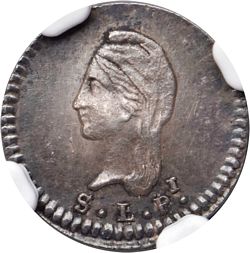
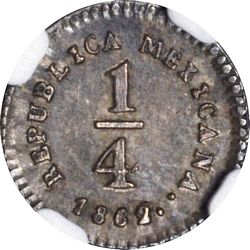
KM-368.7 ¼r San Luis Potosí 1862/57 SLPi (Stack’s Bowers Auction, 13 February 2019, lot 71494)
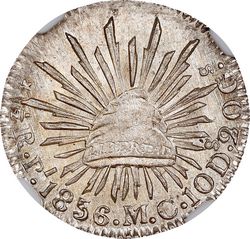
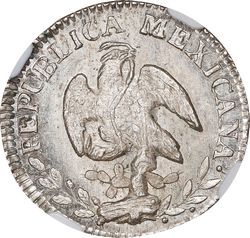
KM-370.10 ½ Real San Luis Potosí 1856 (Stack’s Bowers Auction, 21 October 2023, lot 71004)
Diameter 16 mm. 1.690 g, 0.90277 silver
| Date | Asssayer | Recorded Mintage |
Comment |
| 1831 | JS | ||
| 1831 | JS | I over P mintmark | |
| 1831 | JS | I over P mintmark, no ★ | |
| 1841/36 | JS | illustrated below | |
| 1841/38 | JS | reported | |
| 1842 | JS | ||
| 1842/1 | PS | illustrated below | |
| 1842/1 | PS/PJ | ||
| 1842 | PS | ||
| 18432 | PS | no * | |
| 1843/2 | PS | ||
| 1843 | AM | ||
| 1844 | AM | ||
| 1845 | AM | ||
| 1845/4 | AM | Pi mintmark (illustrated below) | |
| 1845/4 | AM | P mintmark (illustrated below) | |
| 1846/5 | AM | ||
| 1847/6 | AM | illustrated below | |
| 1848 | AM | ||
| 1849 | MC-AM | ||
| 1849 | MC | ||
| 1850 | MC | ||
| 1850/49 | MC | ||
| 1850 | MC | P mintmark | |
| 1851 | MC | ||
| 1852 | MC | ||
| 1853 | MC | P mintmark | |
| 1853 | MC | ||
| 1854 | MC | medal axis | |
| 1854 | MC | coin axis | |
| 1855 | MC | ||
| 1855/3 | MC | illustrated below | |
| 1856 | MC | ||
| 1856 | MC | P mintmark | |
| 1857 | MC | ||
| 1857 | PS | ||
| 1858 | MC | ||
| 1858 | PS | ||
| 1859 | MC | ||
| 1860/59 | PS | illustrated below | |
| 1861 | RO | ||
| 1862 | RO | ||
| 1862/1 | RO | ||
| 1863/2 | RO |
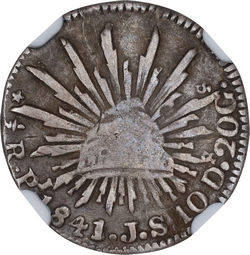
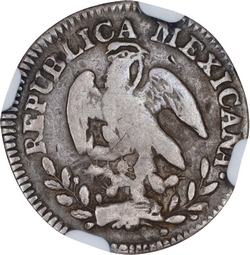
KM-370.10 ½r 1841/36 Pi JS (Stack’s Bowers Kirk Menczer Collection, 23 June 2026, lot 72220)
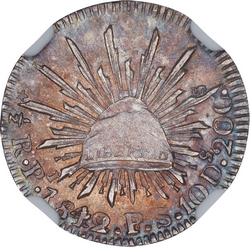
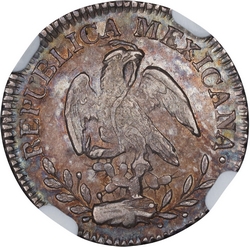
KM-370.10 ½r 1842 Pi PS (Stack’s Bowers Kirk Menczer Collection, 23 June 2026, lot 72222)
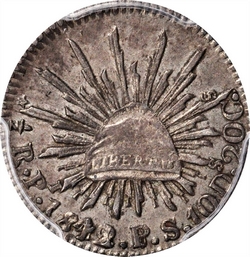
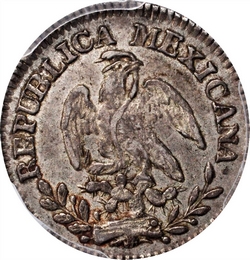
KM-370.10 ½r 1842/1 Pi PS (Stack’s Bowers auction, 22 October 2020, lot 72213)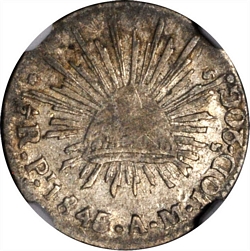
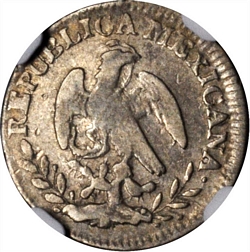
KM-370.10 ½r 1845/4 Pi AM (Stack’s Bowers auction, 13 February 2019, lot 71457)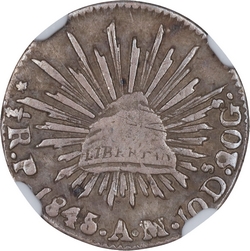
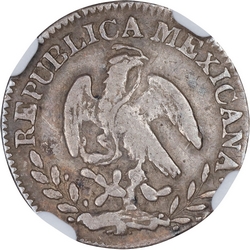
KM-370.10 ½r 1845/4 P AM (Stack’s Bowers Kirk Menczer Collection, 23 June 2026, lot 72223)
Very rare variety without "i" in mintmark.
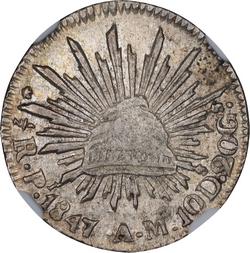
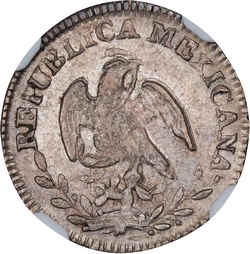
KM-370.10 ½r 1847/6 Pi AM (Stack’s Bowers Kirk Menczer Collection, 23 June 2026, lot 72225)
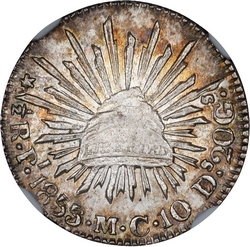
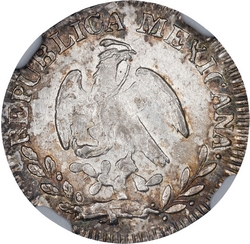
KM-370.10 ½r 1855/3 Pi MC (Stack’s Bowers Kirk Menczer Collection, 23 June 2026, lot 72230)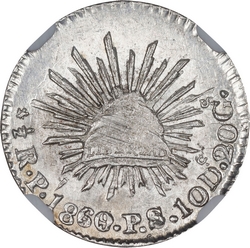
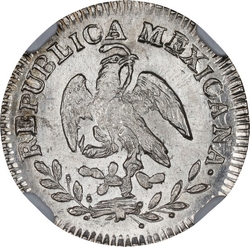
KM-370.10 ½r 1860/59 Pi PS (Stack’s Bowers Kirk Menczer Collection, 23 June 2026, lot 72237)
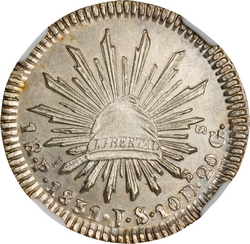
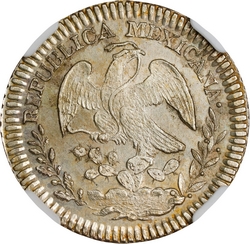
KM-372.9 1r 1831 Pi JS (Stack’s Bowers Kirk Menczer Collection, 23 June 2026, lot 72404)
"I" of mintmark very tall and on top of "P". Choice and sharply struck.
Diameter 20 mm. 3.380 g, 0.90277 silver
| Date | Asssayer | Recorded Mintage |
Comment |
| 1831 | JS | no ★ | |
| 1831 | JS | with ★ | |
| 1837 | JS | ||
| 1837 | JS | with ★ | |
| 1838/7 | JS | ||
| 1838 | JS | ||
| 1840/39 | JS | ||
| 1840 | JS | ||
| 1841 | JS | ||
| 1842 | JS | ||
| 1842 | PS | ||
| 1843 | AM | ||
| 1843 | PS | ||
| 1844 | AM | ||
| 1845 | AM | ||
| 1846/5 | AM | ||
| 1847 | AM | ||
| 1847/6 | AM | ||
| 1848/7 | AM | ||
| 1849 | SP | ||
| 1849/8 | SP | ||
| 1849 | PS | ||
| 1850 | MC | ||
| 1851/0 | MC | ||
| 1851 | MC | ||
| 1852 | MC | 2/1/0 | |
| 1852 | MC | ||
| 1853/1 | MC | ||
| 1853 | MC | ||
| 1854/2 | MC | ||
| 1854/3 | MC | ||
| 1855 | MC | ||
| 1855/4 | MC | ||
| 1856 | MC | ||
| 1857 | PS | ||
| 1857 | MC | ||
| 1858 | MC | ||
| 1859 | PS | ||
| 1860/59 | PS | ||
| 1860/59 | PS | S/C | |
| 1861 | PS | ||
| 1861 | RO | ||
| 1862 | RO | ||
| 1862/1 | RO |
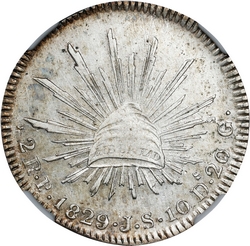
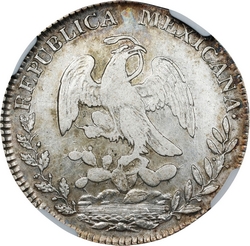
KM-374.11 2r 1829 Pi JS (Stack’s Bowers Kirk Menczer Collection, 24 June 2026, lot 73140)
"P" no "I" mintmark.
Diameter 27 mm. 6.670 g, 0.90277 silver
| Date | Asssayer | Recorded Mintage |
Comment |
| 1829 | JS | P mintmark | |
| 1830/20 | JS | P mintmark | |
| 1830/20 | JS | PI mintmark (illustrated below} | |
| 1837 | JS | ||
| 1841 | JS | ||
| 1842/1 | JS | ||
| 1842 | JS | ||
| 1842 | PS | ||
| 1843 | PS | ||
| 1843 | AM | ||
| 1844 | AM | ||
| 1845 | AM | reported | |
| 1845/4 | AM | ||
| 1846 | AM | ||
| 1849 | MC | ||
| 1850 | MC | ||
| 1850/49 | MC | illustrated below | |
| 1856 | MC | ||
| 1857 | MC | ||
| 1858 | MC | ||
| 1859 | MC | ||
| 1861 | PS | ||
| 1862 | RO | ||
| 1863 | RO | issued while Maximilian's forces controlled the mint (25 December 1863 - 25 December 1866) | |
| 1863/2 | RO | ||
| 1868 | PS | ||
| 1869/8 | PS | illustrated below |
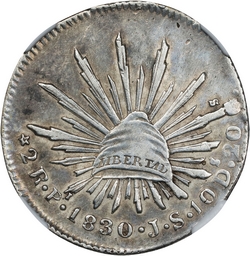
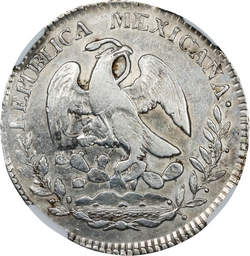
KM-374.11 2r 1830/20 Pi JS (Stack’s Bowers Kirk Menczer Collection, 24 June 2026, lot 73141)
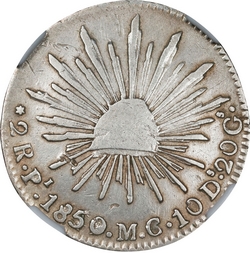
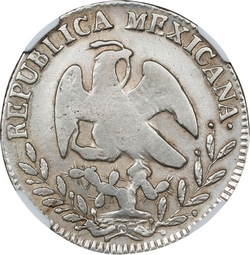
KM-374.11 2r 1850/49 Pi MC (Stack’s Bowers Kirk Menczer Collection, 24 June 2026, lot 73147)
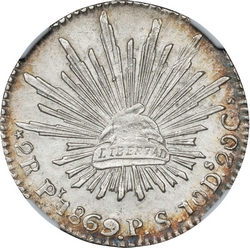
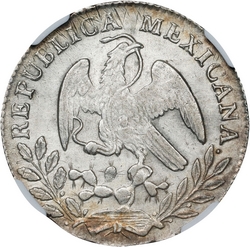
KM-374.11 2r 1869/8 Pi PS (Stack’s Bowers Kirk Menczer Collection, 24 June 2026, lot 73154)
Diameter 32 mm. 13.540 g, 0.90277 silver
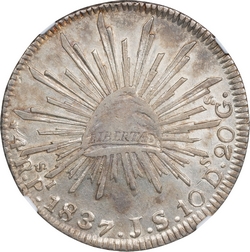
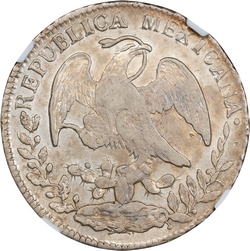
KM-375.8 4r 1847 Pi JS (Stack’s Bowers Kirk Menczer Collection, 24 June 2026, lot 73263)
Two year type with denomination "4 Rs".
| Date | Asssayer | Recorded Mintage |
Comment |
| 1837 | JS | 6 pointed ★ | |
| 1838 | JS | ||
| 1842 | PS | ||
| 1843 | PS | 3 cut from 8 punch | |
| 1843/2 | PS | round-top 3 (illustrated below) | |
| 1843/2 | PS | flat-top 3 (illustrated below) | |
| 1843 | AM | ||
| 1843 | PS | normal digits and date | |
| 1844 | AM | small s (illustrated below) | |
| 1844 | AM | large S (illustrated below) | |
| 1845 | AM | ||
| 1845/4 | AM | ||
| 1846 | AM | ||
| 1847 | AM | ||
| 1848 | AM | ||
| 1849 | PS | ||
| 1849 | MC/AM | ||
| 1849 | MC | ||
| 1850 | MC | ||
| 1851 | MC | ||
| 1852 | MC | ||
| 1853 | MC | ||
| 1854 | MC | ||
| 1855 | MC | ||
| 1856 | MC | ||
| 1857 | MC | ||
| 1857 | PS | ||
| 1858 | MC | ||
| 1859 | MC | ||
| 1860 | PS | ||
| 1861 | PS | ||
| 1861 | RO/PS | ||
| 1861/0 | PS | ||
| 1862 | RO | ||
| 1863 | RO | issued while Maximilian's forces controlled the mint (25 December 1863 - 25 December 1866) | |
| 1864 | RO | ||
| 1868 | PS | ||
| 1869 | PS | ||
| 1869/8 | PS | illustrated below |
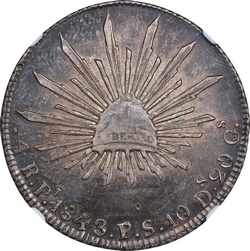
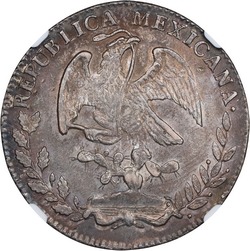
KM-375.8 4r 1843/2 Pi PS (Stack’s Bowers Kirk Menczer Collection, 24 June 2026, lot 73266)
round-top 3
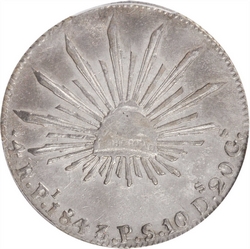
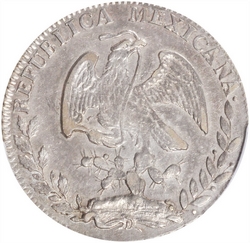
KM-375.8 4r 1843/2 Pi PS (Stack’s Bowers auction, 13 October 2021, lot 71517)
flat-top 3
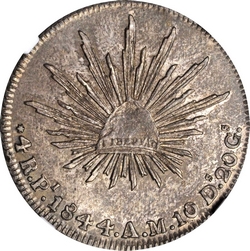
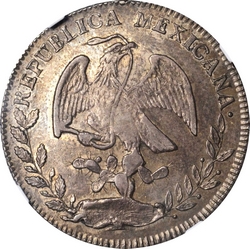
KM-375.8 4r 1844 Pi AM (Stack’s Bowers auction, 13 February 2019, lot 71221)
small s
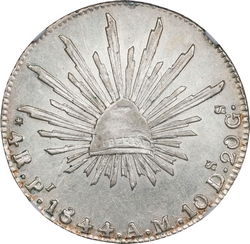
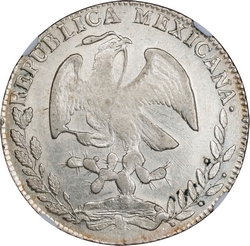
KM-375.8 4r 1844 Pi AM (Stack’s Bowers Kirk Menczer Collection, 24 June 2026, lot 73269)
large S
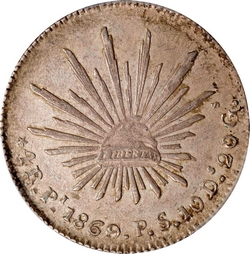
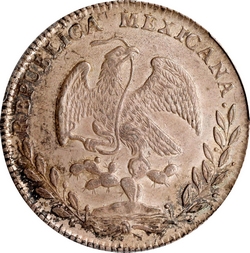
KM-375.8 4r 1869/8 Pi PS (Stack’s Bowers auction, 14 November 2022, lot 71753)
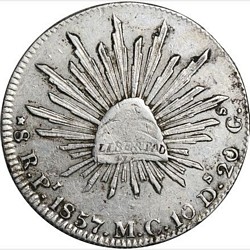
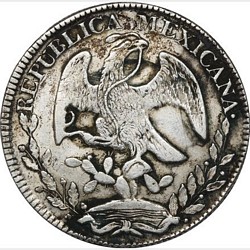
KM-377.12 8r 1857 MC (Briggs & Bustos)
Diameter 39 mm. 27.070 g, 0.90277 silver
| Date | Asssayer | Recorded Mintage |
Comment |
| 1827 | JS | ||
| 1828/7 | JS | ||
| 1828 | JS | ||
| 1829 | JS | ||
| 1830 | JS | centred cap and low cap varieties | |
| 1831/0 | JS | ||
| 1831 | JS | ||
| 1832/1822 | JS | ||
| 1832 /1032 | JS | illustrated below | |
| 1832 | JS | ||
| 1833/2 | JS | ||
| 1833 | JS | narrow date, planchet 37.5 mm | |
| 1833 | JS | wide date, planchet 38.5 mm | |
| 1834/3 | JS | ||
| 1834 | JS | centred cap and low cap varieties | |
| 1835 | JS | illustrated below | |
| 1835 | JS | 8 Rs denomination (illustrated below) | |
| 1836 | JS | ||
| 1836 | JS | 8 Rs denomination | |
| 1837 | JS | ||
| 1837 | JS | 8 Rs denomination | |
| 1838 | JS | ||
| 1838 | JS | 8 Rs denomination | |
| 1839 | JS | centred cap and low cap varieties | |
| 1839 | JS | 8 Rs denomination | |
| 1840 | JS | ||
| 1841 | JS | ||
| 1841 | JS | IP mintmark error | |
| 1842/1 | JS | ||
| 1842/1 | JS/PS | ||
| 1842 | JS | 1843 eagle style | |
| 1842 | PS | ||
| 1842 | PS/JS | 1841 eagle style | |
| 1843/2 | PS | round top 3 | |
| 1843 | PS | flat top 3 | |
| 1843 | AM | flat top 3 | |
| 1844 | AM | ||
| 1845/4 | AM | ||
| 1845 | AM | ||
| 1846/5 | AM | ||
| 1846 | AM | ||
| 1847 | AM | ||
| 1848 | AM | ||
| 1849/8 | PS/AM | ||
| 1849 | PS/AM | ||
| 1849 | PS | ||
| 1849 | MC/PS | ||
| 1849 | AM | ||
| 1849 | MC | ||
| 1850 | MC | ||
| 1851 | MC | ||
| 1852 | MC | ||
| 1853 | MC | ||
| 1854 | MC | ||
| 1855 | MC | ||
| 1856 | MC | ||
| 1857 | MC | ||
| 1857 | PS/MC | ||
| 1857 | PS | ||
| 1858 | MC/PS | ||
| 1858 | PS | ||
| 1859/8 | MC/PS | ||
| 1859 | PS/MC | ||
| 1860 | MC | ||
| 1860 | RO | ||
| 1860 | PS | ||
| 1861 | PS | ||
| 1861 | RO | ||
| 1862/1 | RO | ||
| 1862 | RO | round O in RO, with O/M | |
| 1862 | RO | oval O in RO | |
| 1862 | RO | 6 is an inverted 9, round O in RO | |
| 1863/2 | RO | ||
| 1863/93 | RO | ||
| 1863 | RO | issued while Maximilian's forces controlled the mint (25 December 1863 - 25 December 1866) | |
| 1863 | FC | ||
| 1864 | RO | ||
| 1867 | CA | ||
| 1867 | LR | ||
| 1867 | PS | ||
| 1867 | PS | ||
| 1868/7 | PS | ||
| 1868 | PS | ||
| 1869/8 | PS | ||
| 1869 | PS | ||
| 1870 | PS | ||
| 1873 | MH | ||
| 1874/3 | MH | ||
| 1874 | MH | ||
| 1875 | MH | ||
| 1876/5 | MH | ||
| 1876 | MH | ||
| 1877 | MH | 1,018,000 | |
| 1878 | MH | 1,046,000 | |
| 1879/8 | MH | ||
| 1879 | MH | ||
| 1879 | BE | ||
| 1879 | MR | ||
| 1880 | MR | ||
| 1880 | MH | ||
| 1881 | MH | 2,100,000 | |
| 1882 | MH | 1,602,000 | |
| 1882/1 | MH | ||
| 1883 | MH | 1,545,000 | |
| 1884/3 | MH | ||
| 1884 | MH/MM | ||
| 1884 | MH | ||
| 1885/4 | MH | 1,736,000 | |
| 1885/8 | MH | ||
| 1885 | LC | ||
| 1886 | LC | 3,347,000 | |
| 1886 | MR | ||
| 1887 | MR | 2,922,000 | |
| 1888/7 | MR | ||
| 1888 | MR | ||
| 1889 | MR | 2,438,000 | |
| 1890 | MR | 1,562,000 | |
| 1891 | MR | 1,184,000 | |
| 1892 | MR | 1,336,000 | |
| 1893 | MR | 530,000 |
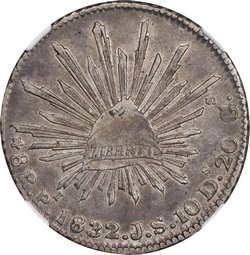
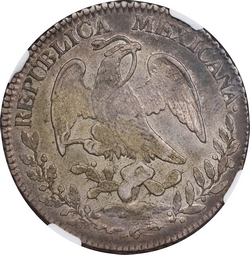
KM-377.12 8r 1832/032 Pi JS (Stack’s Bowers auction, 28 February 2024, lot 73282)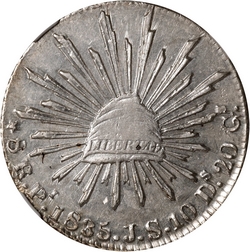
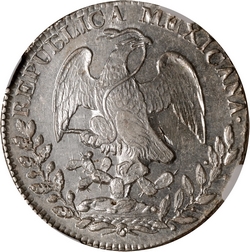
KM-377.12 8r 1835 Pi JS (Stack’s Bowers auction, 23 February 2022, lot 74695)
Denomination engraved as "8R".
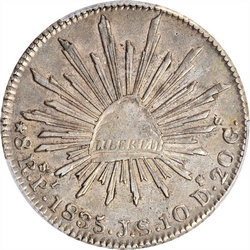
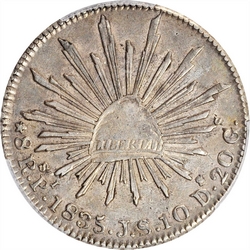
KM-377.12 8r 1835 Pi JS (Stack’s Bowers auction, October 2021, lot 71500)
Denomination engraved as "8 Rs".
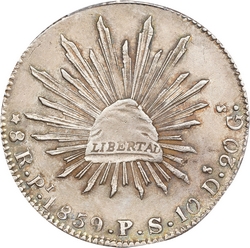
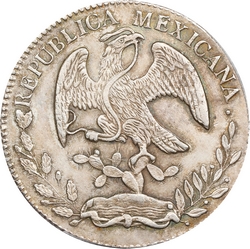
KM-377.12 8r 1859 Pi PS/MC (Stack’s Bowers auction, 28 February 2024, lot 73313)
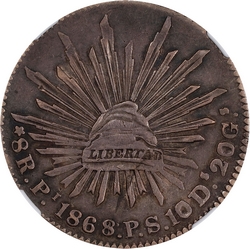
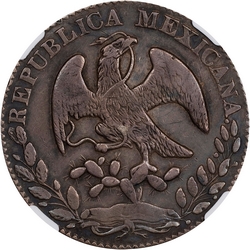
KM-377.12 8r 1868/P Pi PS (Stack’s Bowers auction, 31 October 2023, lot 70822)
The overdate displays the extremely unusual numeric (8) over alpha (P) arrangement.
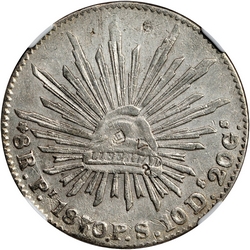
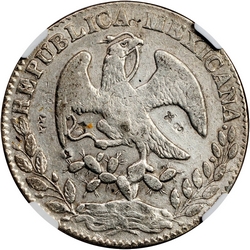
KM-377.12 8r 1870/69 Pi Ps (Stack’s Bowers Philadelphia ANA auction, 7 August 2012, lot 40691)
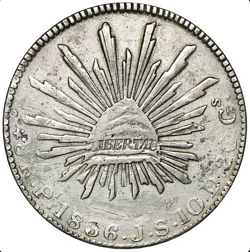
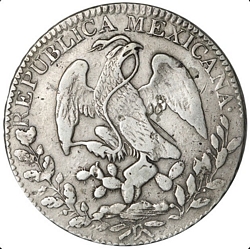
counterfeit KM-377.12 8r 1836 Pi JS (Briggs & Bustos Counterfeit issues II, 10 August 2025, lot 77)
Contemporary counterfeit, struck on a planchet of mixed composition. The engraving is notably similar to that of the official issues from the San Luis Potosí mint, though the overall design is slightly cruder, and the edge cord appears thicker than usual.