Struck shortly after the abdication and exile of the Emperor Iturbide, the design for the first reales coinage of the Republic was the Hookneck eagle (or Profile eagle), the first use on a coin of the Mexican eagle perched on a cactus devouring a snake.
The decree authorising the designs for the new coinage, on 1 August 1823, stated:
1.- The government will order that new matrices be produced, as soon as possible and by the best engravers, to replace those that until now serve for minting currency.
2.- The gold, silver and copper coins will have a common obverse, stamping on them the coat of arms of the Mexican nation with on the circumference the inscription REPUBLICA MEXICANA (MEXICAN REPUBLIC).
3.- On the obverse of the silver coins will be placed a cap on which is diagonally written LIBERTAD (FREEDOM), from whose center several bursts of light will emanate. They will also express their respective value, the place and year of their manufacture, the initials of the names of the assayers and their fineness.
4.- On the reverse of the gold coins will be a hand with a rod, at the upper end of which the cap of liberty will be placed, resting everything on an open book, with the inscription on the circumference LIBERTAD EN LA LEY (FREEDOM UNDER THE LAW), with the marks or signs that in the previous article are designated for the silver coins.
5.- On the obverse of the copper coins palms will be placed to form a border, and in the center (except for the fineness and the names of the assayers) the marks laid out in the preceding articles.
6.- The government will take care, at the time of publishing this decree, to make known to the public, that the fineness of gold and silver coins is the same as those of the Spanish government for the past forty years
The new dies did not arrive until 18 November 1823.
This design was used at only three mints and for a brief period: Durango in 1824, Guanajuato in 1824 and 1825, and Mexico City in 1823 and 1824.
An intensive study of these coins, Hookneck: El Aguil de Perfil, by Clyde Hubbard and David O’Harrow, was published in 1997.
The assayer was RL. The process of minting the 8 reales coins is discussed here.
| Date | Assayer | Recorded Mintage |
Comment |
| RL | |||
| 1824 | RL | illustrated below |
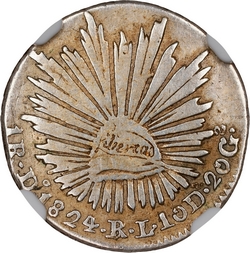
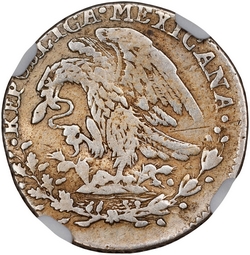
KM-371.1 1r 1824 Do RL (Stack’s Bowers Kirk Menczer Collection, 23 June 2026. Lot 72280)
HO-Type 1. Variety with reversed superscript "S".
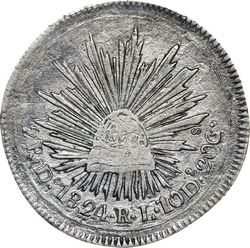
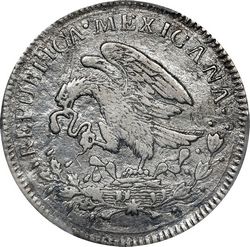
KM 373.1 2r 1824 Do RL (Stack’s-Bowers auction, 12 September 2023. lot 73316}
| Date | Assayer | Recorded Mintage |
Comment |
| 1824 | RL | mintmark Do | |
| 1824 | RL | Type I (dot before 2R) (illustrated below) | |
| 1824 | RL | Type II (no dot before 2R) (illustrated below) |
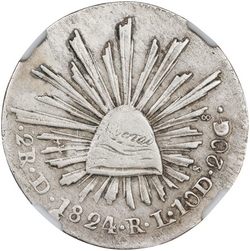
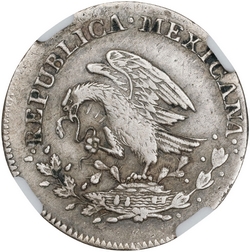
KM-373.2 2r 1824 Do RL (Stack’s Bowers Kirk Menczer Collection, 24 June 2026. Lot 73020)
HO-Type I. Variety with "D" mintmark and dot before "2R".
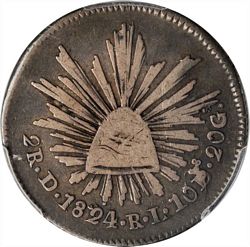
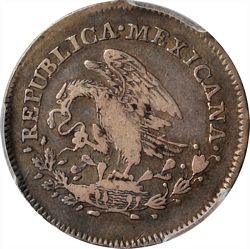
KM-373.3 2r 1824 D RL (Stack’s-Bowers auction, 22 October 2020, lot 72175)
HO-Type II. No dot before "2R"
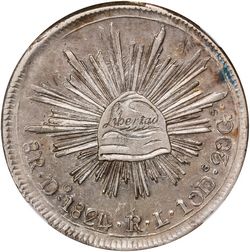
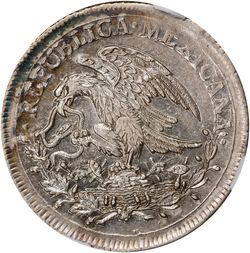
KM-376.1 8r 1824 Do RL (Stack’s-Bowers auction, 26 March 2026, lot 19436)
Type with defiant snake and medium “Libertad”.
| Date | Assayer | Recorded Mintage |
Comment |
| 1824 | RL | thin profile eagle, defiant snake, medium radiant Liberty cap | |
| 1824 | RL | thin profile eagle, defiant snake, small radiant Liberty cap (illustrated below) | |
| 1824 | RL | thin profile eagle, submissive snake, small radiant Liberty cap (illustrated below) | |
| 1824 | RL | thin profile eagle, submissive snake, large radiant Liberty cap | |
| 1824 | RL | thin profile eagle, folded snake, small radiant Liberty cap (illustrated below) | |
| 1824 | RL | thin profile eagle, folded snake, large radiant Liberty cap (illustrated below) |
KM-376.1 8r 1824 Do RL (Stack’s-Bowers auction, 26 March 2026, lot 19436)
Type with defiant snake and medium “Libertad”.
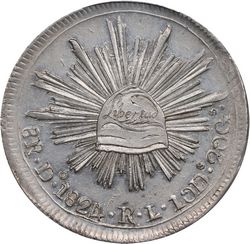
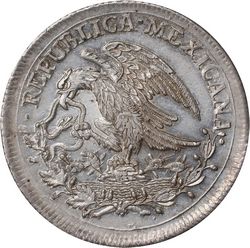
KM-376.2 8r 1824 Do RL (Stack’s-Bowers auction, 26 August 2025, lot 41382)
Type with defiant snake, staggered rays and small “Libertad”.
Variety with slightly offset cap to the right. Superscript "s" of Dineros is over an "o", while superscript "s" of Granos is between "G" and final stop of legend. Top prominent rays are slightly tilted left. Snake's body touches leftmost inner acorn. Hidden "P" on lower left of rock. Upper joint of right wing is below "B" of "REPUBLICA".
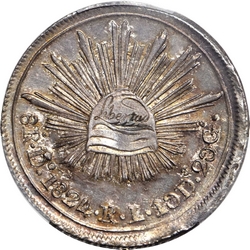
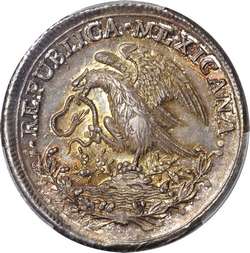
KM-376.4 8 Reales 1824 Do RL (Stack’s-Bowers ANA auction, August 2021, lot 41172)
Type with defiant snake and small “Libertad”.
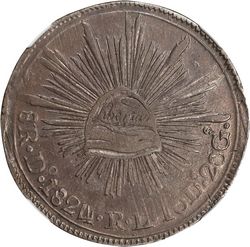
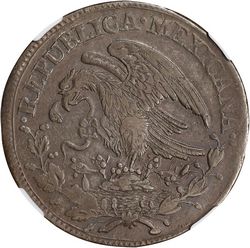
KM-376.3 8r 1824 Do RL (Stack’s-Bowers auction, 16 May 2023, lot 70237}
Typw with submissive snake, staggard rays and small “Libertad”, on small planchet
Variety with prominent upper rays very close to the peripheral border. Superscript "s" of Granos is above the right edge of "G", both superscript "s" are inverted. Rounded snake's head with oblique upward curvature of snake's body.
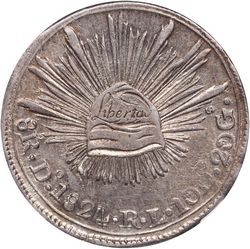
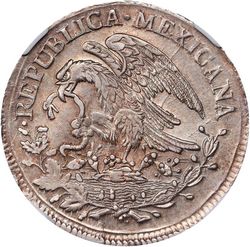
KM-376.5 8r 1824 Do RL (Stack’s-Bowers Hong Kong auction, 9 April 2025, lot 42455)
Type with folded snake and small “Libertad”.
Variety with dot between mintmark and date slightly offset towards date. Denomination and mintmark widely spaced, secondary ray overlaps with top primary ray. Large fold of snake curves slightly away from eagle. Rightmost berries of wreath are on stems that turn upwards.
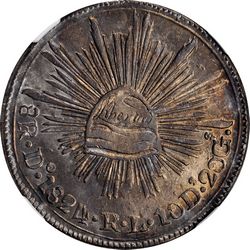
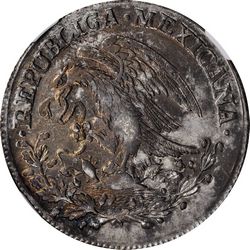
KM-376.6 8r 1824 Do RL (Stack’s-Bowers auction, 16 January 2021, lot 22277)
Type with folded snake and small "Libertad".
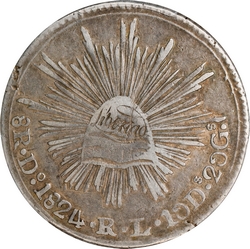
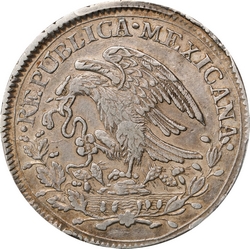
KM-376.6 8r 1824 Do RL (Stack’s Bowers auction, 26 March 2026, lot 19437)
Type with folded snake and large "Libertad".
The assayers were JJ (José Mariano Jiménez) and JM.
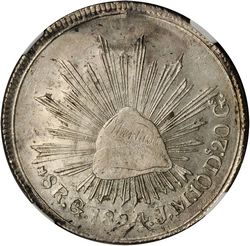
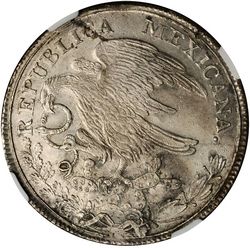
KM-A376.1 8r 1824 Go JM (Stack’s-Bowers Baltimore auction, 14 June 2011, lot 6376)
Full "Libertad" on cap.
| Date | Assayer | Recorded Mintage |
Comment |
| 1824 | JM | ||
| 1825/4 | JJ | illustrated below | |
| 1825 | JJ |
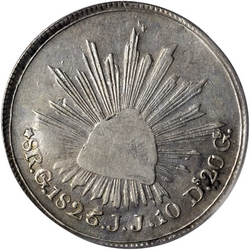
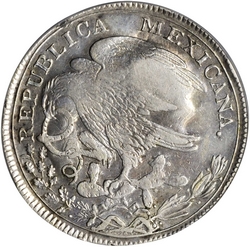
KM-A376.1 8r 1825/4 Go JJ/JM (Stack’s Bowers NYINC auction, 12 January 2019, lot 41205)
Traces of a 4 clearly visible beneath the last digit in the date. The "M" overassayer is faintly traceable just to the right of the second "J".
The assayer was JM (José García Anzaldo)
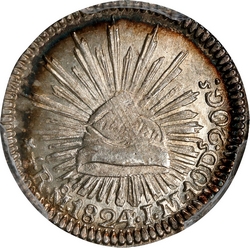
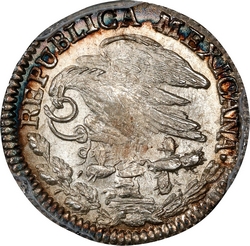
KM-369 ½ real 1824 Mo JM (Stack’s Bowers NYINC auction, 13 January 2023, lot 21223)
| Date | Assayer | Recorded Mintage |
Comment |
| 1824 | JM |
For discussion of a new Eagle die, see here.
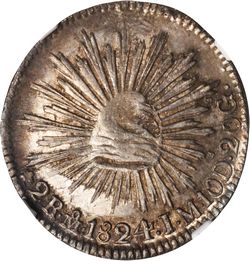
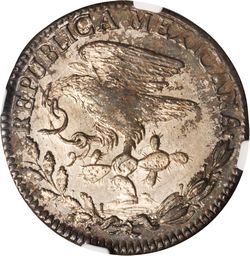
KM-373.4 2r Mexico City 1824 JM (Stack’s Bowers Baltimore auction, November 2014, lot 628)
| Date | Assayer | Recorded Mintage |
Comment |
| 1824 | JM |
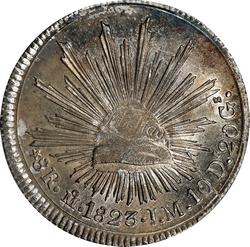
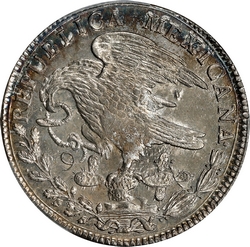
KM-A376.2 1823 Mo JM (Stack’s Bowers NYINC auction, 13 January 2023, lot 21221)
Variety with standard edge and flat top 3 in date.
| Date | Assayer | Recorded Mintage |
Comment |
| 1823 | JM | ||
| 1823 | JM | round-top 3 (illustrated below) | |
| 1824 | JM | illustrated below | |
| 1824 | JM | REPUBLICA engraved as REPULICA. The error is so noticeable that only five examples are known (illustrated below). |
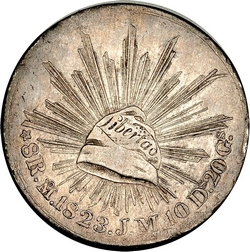
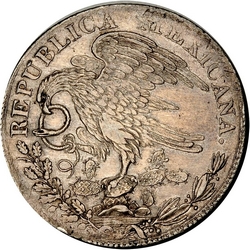
KM-A376.4 8r 1823 Mo JM (Ponterio NYINC auction, 7 January 2011, lot 79)
Extremely rare variety with round top "3" and full "J" in assayer letter. Same punches as used for the "Hookneck" 8 Escudos.
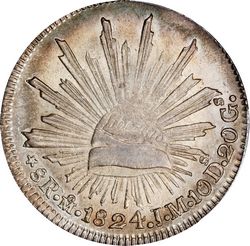
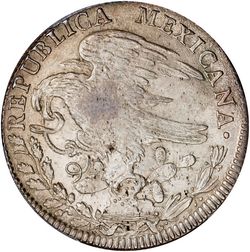
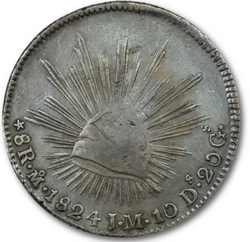
KM-A376.2 8r 1824 Mo JM (Stack’s-Bowers auction, 16 January 2026, lot 41097)
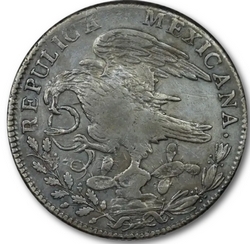
KM-A376.5 8r 1824 Mo JM REPULICA
The 8 Escudos die is the work of the illustrious Mexican engraver José María Guerrero, one of the last artistic heirs of the master Gerónimo Antonio Gil. At the end of 1823 the Government of the Mexican Republic held a contest in search of the design of the new coin that would be issued, in which recognized masters of engraving participated, among which Guerrero was the winner and it was his design that was chosen, being officially announced on 10 October 1823. The dies were completed until 4 December, leaving only 27 days for minting.
“In cataloguing the 1921 John Story Jenks sale, a sale that long functioned as a world coin reference work despite being a swan song in his illustrious career, Henry Chapman noted that the "hookneck" 8 escudos therein was "excessively rare, the only example I have seen in 45 years in this business." While more specimens have apparently appeared on the market since then, a comment such as this offers a glimpse of the state of the art in collection Mexican gold coins in the era that John Clapp and Waldo Newcomer were forming their illustrious cabinets. Of course, the 1823 Mexico 8 escudos still ranks as a great rarity, a famous one year type, and a favorite of collectors.”{footnote}{/footnote}
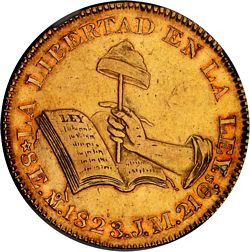
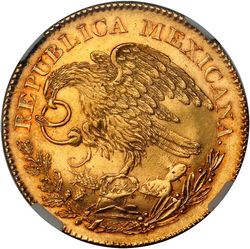
KM-382.1 8 Escudos 1823 MoJM (Ponterio & Associates 2011 NYINC Auction, 7 January 2011, Lot 131)
Curved tail on snake.
| Date | Assayer | Recorded Mintage |
Comment |
| 1823 | JM | curved tail | |
| 1823 | JM | looped tail (illustrated below) |
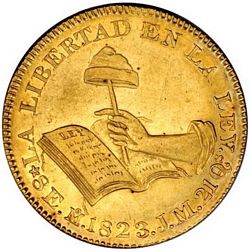
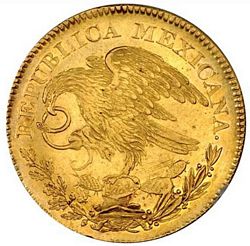
KM-382 8 escudos 1823 Mo (Stack’s-Bower Louis E. Eliasberg, Sr. Collection auction, 15 April 2005, lot 3256)
Type I obverse, cap points to A, Type I reverse, curled tail, moderately scarcer than its Type II counterpart.
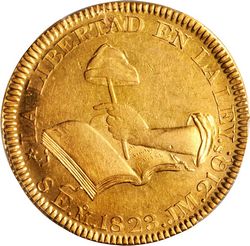
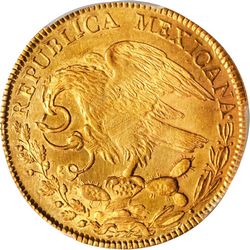
KM-382.2 8 Escudos, 1823 MoJM (Stack’s-Bowers Chicago ANA auction, August 2014, lot 1262)
Looped tail on snake: variety with the tail of the snake giving a complete turn, reverse with the tip of the cap pointing towards the letter "T" for "LIBERTAD". Of the two pairs of stamps that Guerrero engraved, this is the most complicated in every aspect, the statistics point to being almost twice as small in abundance, in addition to the fact that its minting presents a greater weakness in centers compared to the other variant.
The first coins of the Mexican Republic were the attractive “Hookneck”, or profile eagle coins, struck by the mints at Mexico City (Mo), Durango (Do) and Guanajuato (Go). They were somewhat inconsistently issued from 1823 to 1825 (i.e., whereas the Go mint was striking the Hookneck in 1825, the Mo mint had switched to the facing eagle in 1824{footnote}T.V. Buttrey and Clyde Hubbard, A Guide Book of Mexican Coins, 1822 to Date, sixth edition, Krause Publications, Iola, WI, 1992{/footnote}: poor internal communication within the new republic is the probable reason). The ½ real (Mo), 1 real (Do, rare), 2 reales (Do, Mo) and 8 realrs (Do, Go, Mo) were struck in silver, and the 8 escudo (Mo) was struck in gold. In general, the coins from the Mo mint are the more available of the series.
In my (probably ultimately futile and certainly slow moving) attempt to assemble a Republica type set, I acquired an 1824 Mo hookneck ½ real at a local coin show that put the ug in ugly. It is so ugly I have not even typed it in the excellent reference book Hookneck{footnote}Clyde Hubbard and David O’Harrow, Hookneck, privately published, 1997:/footnote}. I figured something better would come along, and sure enough, a nice looking VF appeared on eBay, and I obtained it without too much struggle or grief.
When the piece arrived, I happily plunged into Hookneck to type it. However, the longer I looked at it, the more I felt it wasn’t described in either Hookneck or the Supplement to Hookneck{footnote}Clyde Hubbard and David O’Harrow, A Supplement to Hookneck, privately published, 2001{/footnote}Hubbard and O’Harrow, 2001).
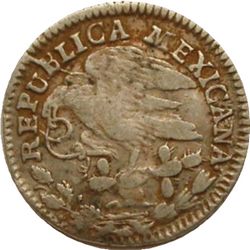
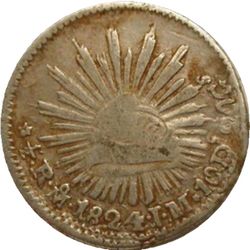
KM-369 ½ real 1824 Mo JM
The Liberty cap die is a Type 4 (p.58/59 in Hookneck). All the die markers are there, including the small tool mark to the right of the 1 in 1/2. This side is slightly double struck in the 10 Ds 20 Gs area and along the bottom rim, perhaps explaining why LIBERTAD is so weak on an otherwise nice VF coin.
The Eagle side, though, is obviously not a Type 4. It is closest to, but different from, the Type 2 die. This makes me think it was produced toward the middle or end of the die production, and is a sibling to the Type 2 die, cut when the engravers at the mint were used to making the die and had achieved some amount of similarity between the dies.
The differences with Type 2 are:
• P of REPUBLICA set higher than the E or B and slightly rotated clockwise relative to Type 2
• If you connect the tops of P and B in REPUBLICA, the U is lower than Type 2
• L of REPUBLICA is also slightly rotated clockwise relative to Type 2
• M of MEXICANA is set even with the E, not higher as in Type 2 (as far as I can tell from the plate in the book)
• The eagle left wing tip is more centered under the I of MEXICANA
• The first A in MEXICANA is set more even with the C and N, not raised like the Type 2
• The final A in MEXICANA might be repunched, or there are tool marks under the A. There also appears to be a tool mark to the left of the N in MEXICANA
• There are fewer water lines under the cactus than the Type 2
• The left center cactus pad has short spines, not the long spines on Type 2
• On the right cactus pad, the upper spines point to the right, not the left as on the Type 2
• The snake head terminates under the center of the letter E upright, unlike the Type 2 that terminates on the left side of the letter E upright in REPUBLICA
Finally, probably the biggest difference is that there is a die break through the B in REPUBLICA, from the rim through the B to the eagle wing, and along the top of the right wing to the left wing. It looks like it originated along the upright of the B, hence to the rim, and subsequently to the eagle wing.
Other details on the Eagle die seem fresh (the detail is not mushy, there are no clash marks or die chips, and there are no apparent flow lines or ridges, the appearance of which would indicate a worn die). This suggests to me the Eagle die cracked and failed relatively early in the striking, and they subsequently pulled it off and replaced it with the Type 4 Eagle die.
After email exchanges of descriptions and photographs with David O’Harrow, he agrees this is a new, previously unreported Eagle die. Due to the apparent early die failure, this also appears to be a rare variety, being the first time it has come to his attention in the 14 years since Hookneck was published. Continuing the numbering in the Supplement to Hookneck, this would be Eagle die Type 6 (new) matched with Cap die Type 4, making the sixth variety of the 1824 Mo Hookneck ½ real reported.
The actual standard diameter of the cuartilla (¼R) is 12mm and it has a weight of 0.846 grams.
The ¼R departed from the basic Cap & Rays design found on the ½R, 1R, 2R, 4R and 8R of the Republic. The obverse features a bust of the Goddess of Liberty along with the Mintmark and the Assayer Initials. The reverse features the denomination centered on the coin and surrounded by a legend showing the Date (at the bottom) and REPUBLICA MEXICANA around the rest of the perimeter.
Most issues use the initials L. R. Luciano Rovira, a student of Gordillo, was the die sinker at the Mexico City mint who created the dies either in 1841 or early in 1842. Rovira was also responsible for a 1841 pattern for a one centavo coin and various medals, including an 1836 medal of Michael de Santa María (Grove 77a), an 1842 medal honouring Santa Anna as 'BENEMERITO DE LA PATRIA, CAUDILLO DE LA INDEPENDENCIA Y FUNDADOR DE LA REPUBLICA (Grove 81a) and an 1843 Constitution medal (Grove 85a). In 6 July 1866 the Emperor Maximilian awarded Rovira the Medalla del Merito Civil (silver class) {footnote}La Sociedad, Tomo VI, Núm. 1,107, 7 July 1866{/footnote},
Other Assayer Initials used at some mints include:
PM (Patrick Murphy) at Guanajuato
RG (Rodrigo García) at Chihuahua
JG (Juan de Dios Guzman) at Guadalajara
MC (Manuel Cueras) at Guadalajara
One mint, San Luis Potosí, did not use Assayer Initials on the ¼R using instead the initials S. L. PI.
Mints that produced the cuartilla were:
| Mint | Year(s) |
| Chihuahua | 1843 |
| Culiacan | 1855 |
| Durango | 1842 & 1843 |
| Guadalajara | 1842-57 & 1862 |
| Guadalupe y Calvo | |
| Guanajuato | 1842-56 & 1862 |
| Mexico City | 1842-46, 1850, 1858-63 |
| San Luis Potosi | 1842-47, 1851, 1854, 1856-57, & 1862 |
| Zacatecas | 1842 |
Note that half of the mints that struck the ¼R produced them in only one or two years.
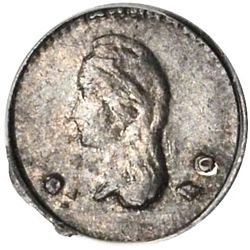
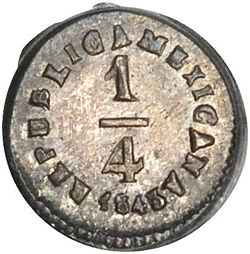
KM-368 ¼r Chihuahua 1843 CaRG (Stack’s Bowers Baltimore Auction, 28 March 2011, lot 8081)
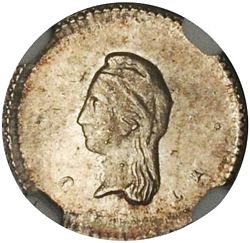
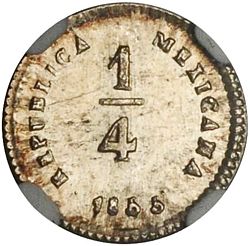
KM-368.1 ¼r Culiacán 1855 CLR (Stack’s Bowers Baltimore Auction, 28 March 2011, lot 8082)
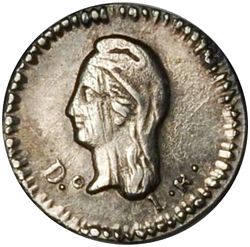
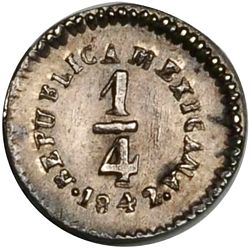
KM-368.2 ¼r Durango 1842 DoLR (Stack’s Bowers Baltimore Auction, 28 March 2011, lot 8083)
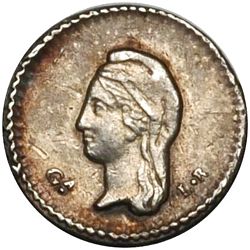
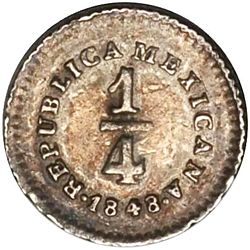
KM-368.3 ¼r Guadalajara 1848 GaLR (Stack’s Bowers Baltimore Auction, 28 March 2011, lot 8087)
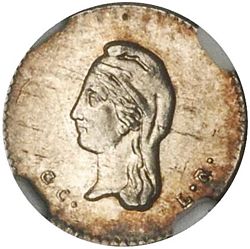
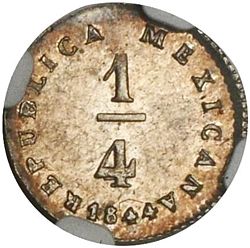
KM-368.4 ¼r Guadalupe y Calvo 1844 GCLR (Stack’s Bowers Baltimore Auction, 28 March 2011, lot 8090)
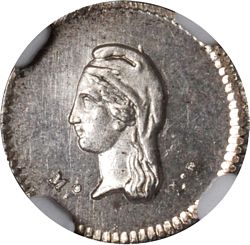
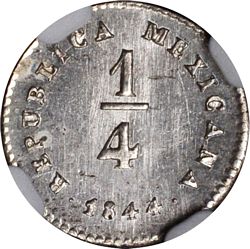
KM-368.6 ¼r Mexico City 1844/3 MoLR (Stack’s Bowers Auction, 13 February 2019, lot 71483)
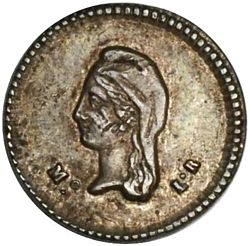
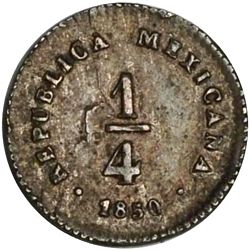
KM-368.6 ¼r Mexico City 1850 MoLR (Stack’s Bowers Baltimore Auction, 28 March 2011, lot 8105)
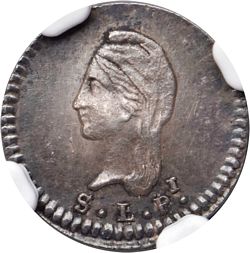
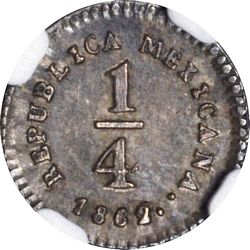
KM-368.7 ¼r San Luis Potosí 1862/57 SLPi (Stack’s Bowers Auction, 13 February 2019, lot 71494)
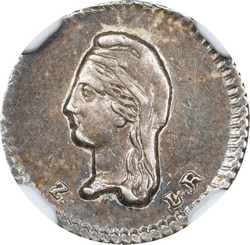
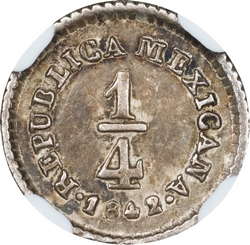
KM-368.8 1 ¼r 1842/1 Z LR (Stack’s Bowers Kirk Menczer Collection, 23 June 2026, lot 72061)
The medio real (½R) has long been a popular coin and researched by several different scholars in the field of Mexican numismatics. The outstanding works by Clyde Hubbard and David O’Harrow, Hookneck El Aguila de Perfil and the supplement Hookneck II are essential to any serious collector of that series and important to the ½R collector even though there is only one known issue of the Hookneck ½R, the Mo 1824 JM.
A total of either eleven or twelve different mints produced the ½R between 1824 and 1870. However, one of the intriguing aspects of the Republic ½R series is that despite the fact that small coins were essential Ito everyday commerce in 19th century Mexico only about half of those mints struck them in large numbers and/or with regularity. For those of you not familiar with the ½R even a cursory study of any catalog listing the ½R will show that Alamos and Estado de México produced the coin in only one year and the Chihuahua mint produced them in only two years. The single reported ½R from Alamos is dated 1862 and some controversy surrounds its authenticity (see further details below). Estado de México struck the coin only in 1829 even though it produced 8R in 1828, 1829 and 1830. Chihuahua struck the ½R only in 1844 and 1845 despite producing 8R from 1831 through 1895. This has been partially explained by some researchers who have reasoned that the Chihuahua 8R was struck, in the main, for export; and therefore the minors were not a priority. Another mint, Hermosillo, has only three reported dates – 1839 (not officially open then and there is some question as to its authenticity), 1862 and 1867. As far as we know; neither Catorce nor Oaxaca struck the ½R.
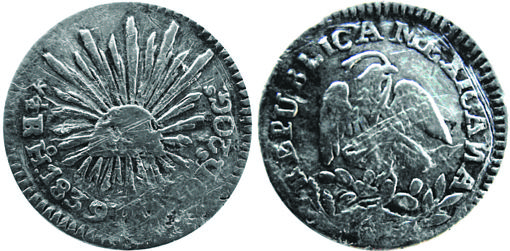 KM-372.7 ½r 1839 Ho PP
The above is the only ½R Ho 1839 PP I have seen. Note the broken star and the retrograde N in MEXICANA. The owner was kind enough to send a scan, but I have not been able actually to examine the piece and therefore make no claims as to whether or not it is genuine.
The standard Republic ½R is 16 mm in diameter and has a Fineness of 90.027% silver with a base metal of copper. The edge design is referred to as ornamental. Fineness is expressed as “10 DS 20 GS” (with the DS and GS being abbreviations for Dineros and Granos) and found as part of the legend on the Cap side of the coin. Twelve Dineros is pure silver and each Dinero can be divided into 24 Granos. Thus 10 DS 20 GS is 10 of a possible 12 Dineros plus 20/24 of another Dinero (when added together it comes to nearly 11/12) and calculates (260 ÷ 288) to be 90.27% silver when converted to the decimal system. The obverse features the ancient Aztec symbol of victory; an eagle grasping a water snake in its beak and its left claw (from the observer’s point of view) while using the other leg to stand on a cactus that is rising out of Lake Texcoco. Below and to the right are laurel branches, leaves and berries, to the left are oak branches with leaves and acorns. The legend around the top half of the outer perimeter reads REPUBLICA MEXICANA. Sometimes there is a dot after MEXICANA and sometimes there is not. The reverse features a Phrygian Cap with the word LIBERTAD (Liberty) in block letters across its base. Extending out from behind the Cap are Rays. Thus, the design signifies the dawning of liberty (freedom from Spanish rule) in Mexico. The reverse legend reads “★ ½R • MM • date • assayer initials • fineness • ” for example a Guanajuato ½R minted in 1828 would read: ★½R • GO • 1828 • J • M • 10 DS • 20 GS •. Note that this is the same format used by all denominations in the Cap and Rays series – this one as well as the 1R, 2R, 4R, and 8R. You should also be aware that there were several variances from mint to mint and even year to year within an individual mint such as no star, a six, seven or even eight pointed star instead of the normal five pointed one, irregular spacing in the legends, missing or improperly placed dots, reversed superscript “S” and even missing superscript “S“. In addition, there were over-dates, over-assayers, and re-punched stars, dots, mintmarks, dates, assayer initials, fineness numbers and letters which many collectors of the series find fascinating. Depending on how much detail one chooses to include in his/her collecting criteria, varieties can be almost endless as every separate set of dies, especially prior to 1854, was at least slightly different from those preceding and following. An interesting one is the number of berries and acorns in the wreath below the eagle. I have seen as many as six and as few as two. Some collectors use the term “Incomplete Wreath” to describe such a variety.
Mexico City is the only mint that struck a Hookneck ½R and all known examples bear the date 1824. It has always been a popular coin because of the Profile Eagle design and the fact that the style was used in only one year. The Facing Eagle style ½R specifications – diameter, weight, and fineness – remained the same as those of the Hookneck. Struck at either eleven or twelve different mints between 1825 and 1869 the ½R is one of the most popular coins for collectors specializing in the Republic of Mexico. As with the other denominations the ½R can usually be found in circulated condition rather easily and often for a pittance. However, you probably also know that there are some extremely rare mint date assayer combinations and aside from the more common (Mexico City, Culiacán, Guadalajara, Guanajuato, and Zacatecas mints, all have at least a few years where large numbers were produced) and/or hoard coins, Uncirculated specimens are difficult to locate. I am convinced that the reason for this is that the ½R was essential to everyday commerce among the populace and therefore entered circulation quickly. The list below shows the mints and the years they struck the ½R.
| Mint | Years Struck |
| Alamos | 1862 (note controversy surrounds the one reported specimen, some authorities say it is genuine while others say it is not) |
| Chihuahua | 1844-45 |
| Culiacán | 1846, 1848-49, 1852-54, 1856-58, 1860-63, 1867, 1869 |
| Durango | 1832-34, 1837, 1841-43, 1845-46, 1848-62, 1864, 1869 |
| Estado de México (Tlalpan) | 1829 |
| Guadalajara | 1825-26, 1828-32, 1834-35, 1837-62 |
| Guadalupe y Calvo | 1844-51 |
| Guanajuato | 1826-62, 1867-68, 1870 |
| Hermosillo | 1839, 1862, 1867 |
| Mexico City | 1824 (Hookneck)-36, 1838-63 |
| San Luis Potosí | 1831, 1841-63 |
| Zacatecas | 1826-63, 1869 |
The reason for not being specific as to the number of mints is that more than one notable numismatist believes the Alamos – ½R A 1862 P.G. – was never actually minted and that the one known example is not genuine. Note that Superior Stamp & Coin Company, in the Miguel Muñoz Sale II in June 1979, claimed that the 2R was the only minor minted at Alamos. Regardless of one’s position as to the authenticity of the coin, it is most unlikely that a collector will ever have the chance to own it, as it is thought to be a unique specimen. Thus, if you consider it genuine, you have to go into the medio real series knowing that in all likelihood you will not ever complete either a Type (by mint) or an MDA (Mint-Date-Assayer) set.
At this time, as far as we know, neither Catorce nor Oaxaca struck the ½R.
The die styles within the basic Type are fascinating to those of us bitten by the Mexican coin bug. One of the first issues to be addressed is that most catalogs and references refer to the Hookneck as a specific Type. I would argue that it is a Style rather than a Type. Obviously, whether one chooses to designate it a Type or a Style has no effect on the popularity or value of the Hookneck die style. The argument for calling it a die style is that it has the same basic design elements as any of the Facing Eagle style. For example it has the eagle grasping a snake in one talon and its beak while perched on a cactus that is rising out of Lake Texcoco. The lower half of the perimeter has oak branches, leaves and acorns to the left and laurel branches, leaves and berries to the right. The upper half of the perimeter has the legend REPUBLICA MEXICANA. On the Cap side it has the Liberty Cap with the word LIBERTAD across it with rays extending out from behind it. The Cap side legend reads – ★ ½R • MO 1824 • J • M • – so other than the fact that the eagle is facing on one and profile on the other and that there are some differences in the Cap I believe both the Hookneck and the Facing Eagle should be considered different styles of the same Type.
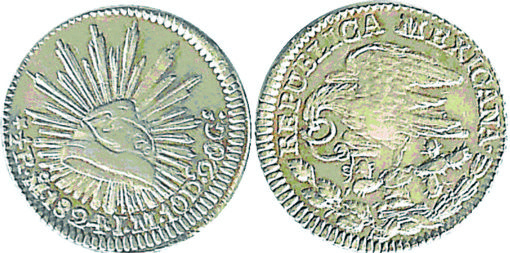 Hookneck Eagle style
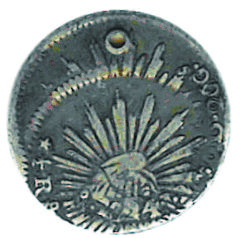
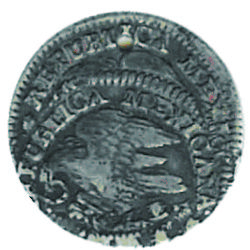
Double struck example
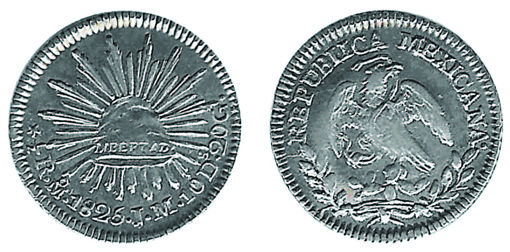 Facing eagle style
Any of the mints that have fairly long production runs show a number of different die styles over time, and occasionally in the same year. Below are two examples:
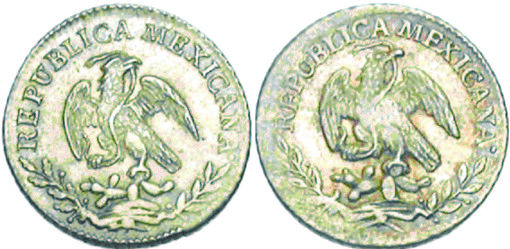 Eagle of 1827 Eagle of 1828/7
The first is a Mexico City 1827, while the second is Mexico City 1828/7. A simple examination reveals obvious differences including but not limited to:
• 1828 eagle is bigger and more robust
• Upper beak on 1827 has more of a hook to it
• No lower beak on the 1828
• Right wing is smaller and sharper on the 1827
• Snake’s upper body is noticeably closer to the top of the eagle’s head on the 1827
• Oak leaves on the 1828 are less defined (almost rounded like the laurel leaves)
• There are subtle but noticeable differences in the letters of the legend as well as how they were punched.
Obviously, most serious collectors can find additional differences, but my point is that one can see the difficulty that the die sinker had engraving/punching the dies by hand. Obviously, whenever a mint had to change dies because of wear, damage or some other reason, a new set of dies that had to be prepared by hand would be at least slightly different.
Interestingly, we can see that with rarer examples the die style does not always change. Compare the two Chihuahua ½R pieces below. I have studied both extensively “in the flesh” and as far as I can determine, the Eagle side and the Cap side dies are the same for both coins except the date was changed for the 1845 though I found no trace of an overdate. Due to the toning, some details were not picked up on the reproductions of the coins. By the way, those are the only two High Grade Chihuahua ½Rs of which I am aware.
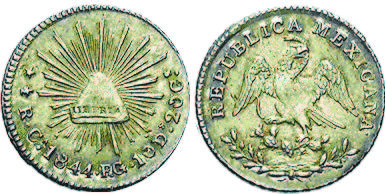 KM-370.1 ½r 1844 Ca RG
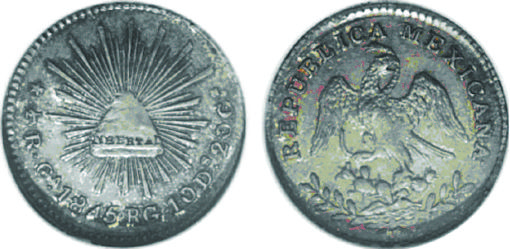 KM-370.1 ½r 1845 Ca RG
Note that several of the rays on the 1845 are not quite as sharp as those on the 1844, whether that was due to wear on the dies, the strength of the strike or a combination of both has not yet been determined. The same applies to the wings on the Eagle side.
Variety collectors can enjoy the ½R series as long as they choose to continue collecting. Three mints – Mexico City, Guanajuato and Zacatecas – produced many, many varieties and a high percentage of them were undoubtedly unintentional. That is not to say that some of the other mints did not also produce varieties, it is just that those three seem to have an abundance of them. That can probably be explained by the fact that Mexico City, Guanajuato and Zacatecas struck the largest numbers of the ½R. There are some well known and popular varieties including several over dates, over assayers, and errors. One of the first of what I consider to be a major error variety occurred at Guanajuato in 1828. That year there is an over date, 1828/7, plain date 1828, assayer initials MJ and MR. However, what is really interesting is that there is a combination denomination error 2/1 instead of ½ and mintmark error “G” only instead of a small “o” inside the opening of the G. Later we find a regular denomination but the “G” only remains even with the MR assayer. I have studied both the inverted denomination and the assayer MR with the “G” only and found traces of something inside the opening of the G, but cannot state definitively that it is the elusive missing “o” in either one. Unfortunately, I have never seen a High Grade (Extra Fine or better) example of either variety, so my conclusions remain somewhat speculative.
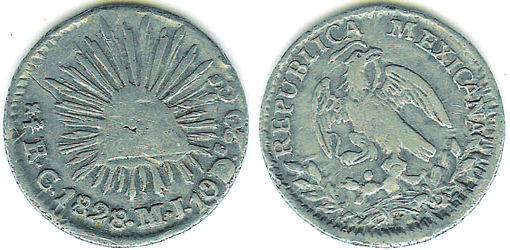 ★ 2/1R • G•1828•M•J•
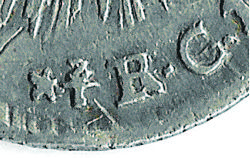 Close up of inverted denomination and G only mintmark
Another interesting variety from the Mexico City mint (it has been overlooked/unreported by standard references including the Clyde Hubbard and Theodore Buttrey, A Guidebook of Mexican Coins 1822 To Date, as well as the latest 2008 North American Coins & Prices A Guide to U. S., Canadian and Mexican Coins, 17th Edition from Krause Publications) is the MO 1841 ML which has two stars (★ ★) in the Cap side legend. By the way I am aware of one such coin in Mint state.
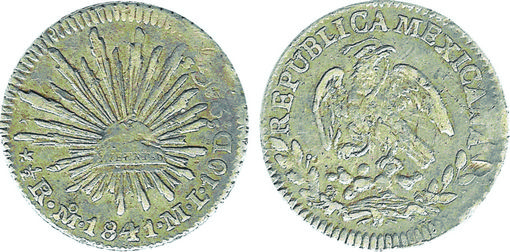
★ ★ ½R • Mo •1841• M • L• Two Stars variety
Yet another unmentioned one from Zacatecas is the ½R Z 1833 OM. First on the Cap side legend we have a six-pointed star - ★ - next we have a 2/1 that has been corrected to a ½, and lastly we have a large assayer initial M when compared to the assayer initial O and the rest of the legend. Keep in mind that the ½R mintmark for Zacatecas is a Z only through 1856. Also, the one pictured below is a Choice Mint state example so it will give the reader some idea of just how crude many of the early issues were.
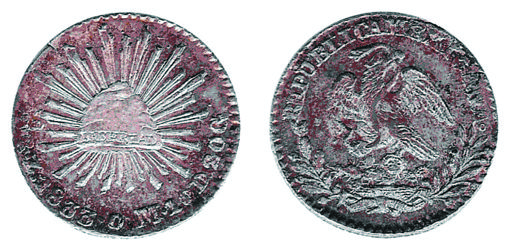 ★ ½R • Z .1833 • O • M • (Note large M assayer initial)
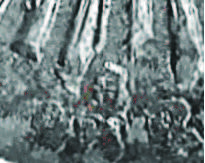
Close up of ½ over 2/1. The loop of 2 is plainly visible as it was not fully removed after the error had been noticed and “corrected.”
The author also thinks there is one from Hermosillo that is worthy of discussing, namely what is usually referred to as the overdate 67, 6/ inverted 6 and 7/1. While I agree that the 6 is over an inverted 6, the properly oriented 6 is more weakly defined than the inverted 6 to the point that some even think it is an inverted 6 over a normal 6. While that is interesting, what is even more so is the claim of 7/1. Even a cursory study shows that it is much more likely that the 7 is over a 2 rather than a 1. Compare the numeral that the 7 is punched over to the 1 that starts the date. The first 1 does not have a base on the “1” while the numeral under the 7 – if it is a 1 – has a wide base causing one logically to conclude that a different punch was used to make it. Thus, one can deduce that the 7 is over a 2 rather than a 1 without a base. A further argument that it is a 7/2 is that Hermosillo did not strike a ½R in 1861 while it did produce one is 1862 but none between 1862 and 1867. All examples of the 1862 that I know of are a plain date 1862. Interestingly, there is no argument that the assayer initials P and R are over the assayer initials FM and the 1862 issue has the assayer initials FM. Therefore, I would argue that the correct attribution should be 1867, 6/ inverted 6, 7/2 and PR/FM.
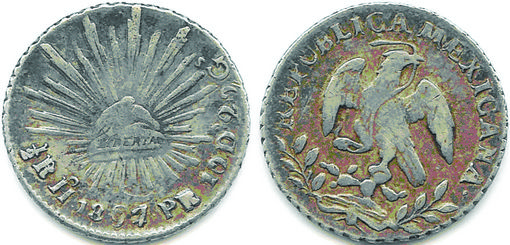 ½R Ho 1867 PR 10 DS 20 GS “6 over inverted 6, 7/2, PR/FM”
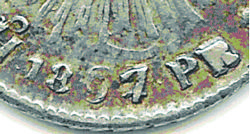 Cap side enlarged to show detail better
Note incomplete legend, no star and close study shows no dots (those appearing to flank the date are not actually dots but dings caused by circulation). The legend is crude; the superscript O of the mintmark is not complete nor is it centred above the uprights of the H. The attempt at removing the inverted 6 was so poorly done that it appears to be over the properly oriented 6 which is high compared to the rest of the date; the numeral under the 7 more closely resembles a 2 than a 1: in fact there seems to be a slight roundness at the top of the 7 as well as a ball shaped piece under the left side of the horizontal part of the 7 resembling that on the 2 of 20 GS; thus the assertions that it is actually a 7/2. The PR/FM is weak but discernible. The indentation appearance between the 7 and the rays coming form the bottom of the cap is from clashed dies.
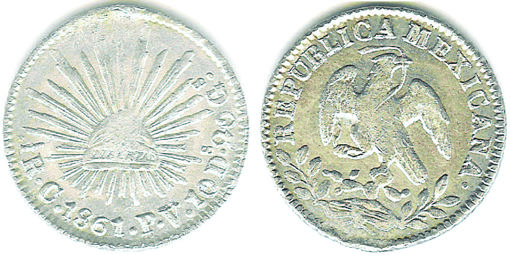 ★ 1/1R • C.1861.P.V.
Here is a popular error variety struck at Culiacán (appears in more than one year). Note the denomination of 1/1R instead of a ½R (most catalogs say is it an 1 instead of a ½ but clearly it is a 1/1). Note also the very low Micro Star.
For a consideration of the rarity of Alamos ½ real see here.
For a listing of the Chihuahua ½ reales see here.
For a consideration of the rarity of Chihuahua ½ reales see here.
For a listing of the Culiacán ½ reales see here.
For a consideration of the rarity of Culiacán ½ reales see here.
For a listing of the Durango ½ reales see here.
For a consideration of the rarity of Durango ½ reales see here.
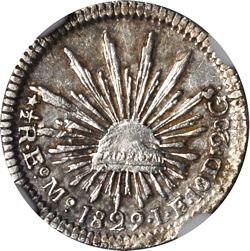
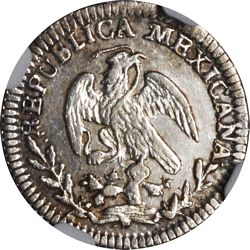
KM-370.4 Estado de México ½ Real, 1829-EoMo LF (Stack’s Bowers auction, 13 February 2019, lot 71390)
For the single listing of the Estado de México ½ reales see here.
For a consideration of the rarity of Estado de Mêxico ½ reales see here.
For a listing of the Guadalajara ½ reales see here.
For a consideration of the rarity of Guadalajara ½ reales see here.
For a listing of the Guadalupe y Calvo ½ reales see here.
For a consideration of the rarity of Guadalupe y Calvo ½ reales see here.
For a listing of the Guanajuato ½ reales see here.
For a consideration of the rarity of Guanajuato ½ reales see here.
For a listing of the Hermosillo ½ reales see here.
For a consideration of the rarity of Hermosillo ½ reales see here.
For a listing of the Mexico City ½ reales see here.
For a consideration of the rarity of Mexico City ½ reales see here.
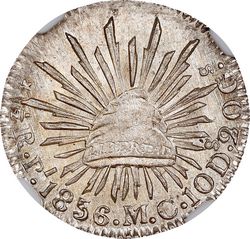
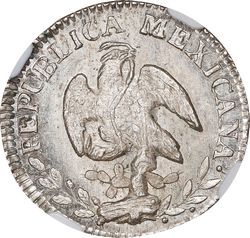
KM-370.10 ½ Real San Luis Potosí 1856 (Stack’s Bowers Auction, 21 October 2023, lot 71004)
For a listing of the San Luis Potosí ½ reales see here.
For a consideration of the rarity of San Luis Potosí ½ reales see here.
For a listing of the Zacatecas ½ reales see here.
For a consideration of the rarity of Zacatecas ½ reales see here.
The ‘Facing Eagle’ variety of Mexican Republic ½ reales was produced from 1825 thru 1869, and was a replacement for the ‘Hookneck Eagle’ variety which had only been produced in 1824. The challenge of collecting ‘Facing Eagle’ ½ reales is undeniable, as there are a large number of hidden rarities and even more grade rarities. Those collectors who focus their attention on the series for a good number of years will ultimately be rewarded with a collection that is worthy of deep admiration.
‘Facing Eagle’ half reales were struck at 11 mints (12 if you count Alamos). Each mint struck half reales for a different subset of dates during this period. Republic ½ reales were made of .903 fine silver, and were supposed to weigh 1.69 grams. Mexican mints at this time were run for a profit, and production of half reales was an unprofitable (but mandated) denomination to produce. Due to this, quality control in the production of half reales was substandard, and as a result the weight of uncirculated half reales tended to vary slightly from coin to coin. It should be noted that the silver content and weight for Iturbide, ‘Hookneck’, and ‘Facing Eagle’ Republic ½ reales were all the same as was the case for earlier portrait Spanish Colonial ½ reales.
New collectors of ½ reales are at a tremendous disadvantage because unlike experienced collectors, they rely heavily on the misleading information in current price guides. It is very difficult for new collectors to have courage to effectively compete with advanced collectors for choice ½ reales. Scarce and rare coins are often unrecognized by new collectors. When alerted to a coin‘s true rarity by the seller, most new collectors lack the confidence to pay a fair price because it may be many times what the price guide lists for it.
Advanced collectors of the series have a great advantage over new collectors because in many instances they possess detailed notes from years of observation. When questions arise, the advanced collectors have a good network of fellow collectors whose knowledge can be tapped.
Rarity is not currently well recognized. Most collectors assume that coins from certain mints are rarer than others, thus deserving of a higher price. Given the same rarity, a Date/Assayer/Mint (DAM) from Guadalupe y Calvo will sell for more than a DAM from Zacatecas. Variable prices based on rarity are reasonable, but only if data on relative mint rarity is accurate.
There are many varieties, especially in the early DAMs. Some varieties may be rare, even though the normal DAM is common. For the sake of simplicity, the DAM supplement does not address rarity of varieties.
Where possible, I reveal the following information about the coins produced by each mint:
1) Number of DAMs produced, and the regularity of production
2) Number of common DAMs for the mint
3) Rarity estimation for the mint‘s coins
4) Strike quality by date range
5) Engraving quality
6) Available varieties
7) Availability of high-grade coins
8) Number of assayers.
Knowing relative rarity and various quirks from mint to mint will allow new collectors to more accurately determine which coins to buy, and which may be worth paying a premium for. They will be better armed to compete with other collectors for good pieces that may seem overpriced, but in reality are not.
The only date for this mint is 1862. All examples from this date are supposedly contemporary counterfeits, which does not matter much because they are Extremely Rare (XR). I have never seen one, but would still love one in my collection.
Two DAMs were produced at this mint (1844 and 1845), and both are rare. Prices are far higher than the rarity alone would justify because of demand from mint type collectors (Prices are always higher for coins from mints that produced for very few years).
A type collector looking for a high-grade example from this mint would have to settle for an 1844 in XF. Be prepared to pay $3,000 or more for such an example. In 2007 a few high-grade examples, previously unknown, appeared on the market. It may be another decade before they reappear for sale.
No varieties were produced for either of these two dates. The dies appear to have come from the Guanajuato mint as all have Soho design features. Coincidentally, by 1844 Guanajuato was well on its way to phasing out use of the Soho dies. (Soho dies refer to the design produced in England in 1835 for the Guanajuato mint. In addition to producing the design, it is also widely believed that at the time Guanajuato illegally smuggled hundreds of English made Soho dies into Mexico. )
Great strikes and high quality engraving make high-grade examples beautiful to look at. The trouble is most collectors will never see one available for sale from this mint.
There was intermittent production of ½ reales in Culiacán. Between 1846 and 1869 there were only 15 DAMs produced. Intermittent production is usually an indicator of scarcity among its products, and such is the case here. Four of these dates are common, and coins from this mint can generally be considered Scarce.
It would be easy for a type collector to obtain an example of a Culiacán ½ real in high grade, but most dates are rarely if ever seen in high grade. Chances are good that if you have any Culiacán ½ reales they are dated 1860 or 1861.
Very few of the BU examples are spectacular looking, having subdued luster, and weak strikes. Strike quality is usually low to moderate, caused by weak striking pressure and rust damaged dies. Engraving quality of the dies and punches was generally very good.
Many DAMS have varieties, but few of them command a high premium. Some of the overdates from this mint are among the most obvious overdates possible, with no attempt to hide the old date. This mint never had a major style change. If it were not for the scarcity of coins from Culiacán and the audacious overdates, there are mints that are more fun to collect.
There were two assay initials used during this time by Culiacán (CE and PV), but no dates have more than one assayer.
There was intermittent production of ½ reales in Durango. Between 1832 and 1869 there were only 28 DAMs produced. None of the Durango ½ reales are common, and coins from this mint can generally be considered Very Scarce.
The strike quality is low in the 1830s and most of the 1840s. The main problems are twofold:
1) the low relief of the Paris dies,
2) low striking pressure.
I suspect that they had acquired dies directly from Paris in 1832, and were never resupplied with more. Running the presses at low pressure was their attempt to preserve the dies. The low strike pressure is probably responsible for the unusually high proportion of low-grade coins from this mint, as their ½ reales wore out prematurely. Engraving quality of the dies and punches was generally very good.
It would be very challenging for a type collector to obtain an example of a Durango ½ real in BU, as only a handful or so BU examples exist. Most dates are rarely seen even in XF. Later date BU examples can have spectacular appearances. I have an 1864 in MS64 that is stunning to look at, but the cost was several thousand dollars.
Most DAMS have numerous varieties. There are so many varieties that few of them command a high premium. Overdating was so common in the 1840s that for some of the dates it is difficult to identify them without pictures of other coins of the same date.
There were five assay initials used in the production of ½ reales by Durango (RL, RM, JMR, CP, and LT). Coins with the RL assay initials were probably struck in Paris, and sent to Mexico as sales samples. Coins with the JMR assay initials sell at a substantial premium. Coins using two different sets of assay initials were struck in only two years.
KM-370.4 Estado de México ½ Real, 1829-EoMo LF (Stack’s Bowers auction, 13 February 2019, lot 71390)
This mint produced coins for three years, but ½ reales were only produced in 1829. Due to demand from type collectors, and the coin‘s rarity, ½ reales from Estado de México are extremely expensive. This mint was owned by the state of Mexico, and was mere miles away from the Federal mint in Mexico City. The mint was closed prematurely by the state because it was losing money.
The strike quality is high, but for most people that does not matter because they are generally only available in Good or Very Good condition. AU grade examples exist, but are Very Rare and very highly sought after.
The single DAM has no varieties that I have ever seen.
Guadalajara was a consistent producer of ½ reales, missing production in only 1827, 1833 and 1836. Between 1825 and 1862 there were 39 DAMs produced. Only four of the Guadalajara DAMs are common, and coins from this mint can generally be considered Scarce to Very Scarce.
The strike quality for Guadalajara is great during the 1820s, 1830s and the first half of the 1840s. Starting in 1848 thru 1862 there were problems with rusty dies. High-grade examples from this period do not have cap or eagle breast details, only raised dots from rust pits.
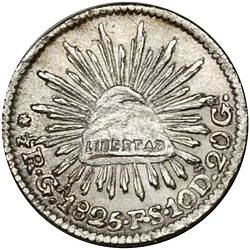
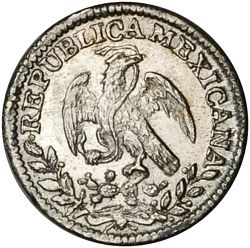
KM 370.5 ½ real Guadalajara 1825 GaFS (Stack’s Bowers Baltimore auction. April 2011. lot 8133)
1825 GaFS is one of the few early dates from this mint that can be found in high grade
It is easy for a type collector to obtain an example of a Guadalajara ½ real in BU, but the date will most likely be 1860 or 1861. The only high-grade DAM possible to get in the 1820s would be 1825. BU examples from the 1820s and 1830s exist, but I have never been offered one for sale. Even XF or AU coins from this period are Rare to Very Rare. It is not until the 1840s where BU examples can be found by the dedicated collector with average connections in the Mexican collecting community. My sincere advice to people wanting to pursue ½ reales collecting is to never pass up purchasing ANY high-grade Guadalajara example unless it is an 1860 or 1861.
Guadalajara varieties are numerous, mostly consisting of overdates and mid-year cap design changes. Unusually, some of the varieties that command the greatest premium are a few of the DAMs that do not have an overdate that year.
There were four assay initials used in the production of ½ reales by Guadalajara (FS, LP, JG and MC). Coins with the LP assay initials were only struck in 1831, and are VERY VERY RARE. Anyone trying to collect one coin from each assayer would probably NEVER get an LP example. Coins were struck four years using two different assay initials.
Guadalupe y Calvo was a consistent producer of ½ reales during its short run from 1844 thru 1851. The collector community is confused about rarity from this mint, thinking that all dates are equally scarce. Despite this, the more available dates from this mint sell at a significant premium from what their actual availability would justify. My experience would lead me to believe that the 1845 and 1847 are the most available. Several of the other dates are far more difficult to acquire than are commonly thought. Coins from this mint can generally be considered Very Scarce. As with most of the other mints, ½ reales do not exist in as great a number as do 1 reales.
The strike quality for Guadalupe y Calvo is less than good. High-grade examples that I have seen exhibit weak cap and eagle breast details, indicating the use of lower pressure on the presses. In 1849 there appeared to be a small problem with rusty dies, but I do not see that in later years. Engraving and sinking of the number and letter punches seems to be a bit cruder than for the main mints.
It would be almost impossible for a type collector to obtain an example of a Guadalupe y Calvo ½ real in BU, but a small number of the dates are available in XF or possibly AU. A few BU examples do exist, appearing at auction every five to ten years.
As far as I know, there are only two varieties (both overdates) from this mint. These are generally worth buying if you ever see one, but at present do not command a premium.
There was only one assay initial used in the production of ½ reales by Guadalupe y Calvo (MP).
There was uninterrupted production of ½ reales in Guanajuato. The only break in production was during the years of Maximilian‘s reign, when the country produced decimal coinage. Between 1826 and 1868 there were 44 DAMs produced. As a rule of thumb, mints that have uninterrupted production of a series will usually produce coins in vast quantities. Of the Guanajuato ½ reales, 29 DAMs are common. Despite the number of common DAMs, ½ reales are probably only half as numerous as the 1 reales or 2 reales from Guanajuato for the same dates. Coins from this mint can generally be considered Uncommon.
The strike quality from 1826 thru 1843 was good. A surprising number of higher-grade example coins, even though in only XF condition, still have full details on the caps and eagle‘s breast. This is mostly lost on today‘s collectors because very few coins higher than XF still exist, except for just a few dates. Starting in 1844 and 1845 there were problems of low strike pressure and rusty dies. The Guanajuato eagle struck from 1844 to 1853 is especially beautiful if you can ever find an example fully struck. Such examples should command a significant premium, but today do not. Starting again in 1850 thru 1858 strike quality vastly deteriorated due to rusty and eroded dies. BU coins from this period are relatively available, but really well struck coins are scarce. Examples from 1859 thru 1868 are usually well struck.
Engraving quality from 1826 thru 1836 was poor. Once they started using the Soho dies in mid 1835 thru 1844, engraving quality was excellent but that is because most of the dies were made in England. Engraving quality after 1844 was far better than in the early years of the mint. In the last decade of production engraving was on par with Mexico City.
It is pretty easy for a type collector to obtain an example of a Guanajuato ½ real in BU, mainly because of the availability of the 1838, and the later 1850s and 1860s. Many BU coins from 1838 are stunning in appearance if they have not been cleaned, but those from the 1850s and 1860s often do not have an exceptional appearance. There are FAR FEWER BU examples from Guanajuato than there are from Mexico City.
Guanajuato is by far the most exciting of the mints to collect by DAM and variety!!! The number of years with multiple assayers, midyear design changes, and numerous varieties are unmatched in the series. Many of the varieties sell for large or small premiums, but most of the overdates do not. The thrill of the hunt for Guanajuato varieties cannot be overstated!
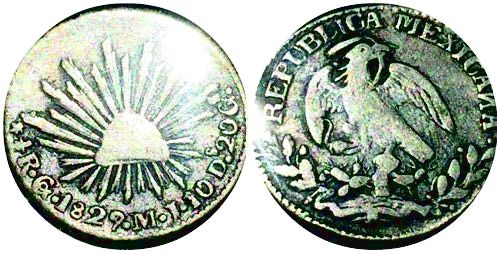 KM-370 ½r 1829 Go MJ
This is one of the most interesting and rare varieties of the series. Note the reversed ‘N’ in ‘MEXICANA’
The five DAMS that have engraving errors all sell for a very high premium.
1829 reversed ‘N‘ in ‘MEXICANA‘
1831 ‘II‘ in ‘REPUBIICA‘
1832 ‘II‘ in ‘REPUBIICA‘
1834 ‘10Ds 0Gs‘
1839 ‘REPUBLIGA‘
There were an amazing eight assay initial combinations used in the production of ½ reales by Guanajuato (MJ, JG, MR, PJ, PM, PF, YE and YF). Coins were struck in three years using two different assay initial combinations, and in 1828 three different assayer combinations were used.
There was very sporadic production of ½ reales in Hermosillo, caused by its late authorization to mint silver and the break in production during the years of Maximilian‘s reign, when the country produced decimal coinage. Between 1839 and 1867 there were only three DAMs produced. 1839 is generally considered to be a contemporary counterfeit, but due to its rarity it does not matter much to collectors. If I were offered the coin I would buy it. Half reales from Hermosillo can generally be considered rare. Far more 1 reales from this mint were produced than ½ reales.
The strike quality was good, but does not matter much since only low-grade coins can usually be found. A type collector would stand virtually NO CHANCE of ever acquiring a high-grade example from Hermosillo. Even many of the lowgrade examples are pierced or damaged. If you could ever locate an example in VF, buy it without hesitation. My highest-grade example is in VF, but it has a hole at the top.
Engraving quality of the letter and number punches was very crude. These resulted in several varieties in 1867. Dies with the central design must have come from Culiacán because these features are well engraved.
There were three assay initial combinations used in the production of ½ reales by Hermosillo (PP, FM and PR).
There was nearly uninterrupted production of ½ reales in Mexico City. The only break in production was 1837. Between 1825 and 1863 there were 42 DAMs produced. Of the Mexico City ½ reales, 35 DAMs are common. Overall, coins from this mint can generally be considered Common.
The strike quality from 1826 thru 1838 was excellent. All higher-grade examples exhibit full details on the caps and eagle‘s breast. This is surprising given that the design in this period had a pretty high relief, which points to high striking pressure. Starting in 1839 thru 1844 there were sporadic problems of minor rust on the dies, but the strike pressure continued to be pretty good. Starting in 1845 there was a slight design change where the eagle and cap had a lower relief. From 1845 onward, it is relatively more uncommon to see full details on the cap and eagle. In the future fully struck BU examples from 1845 thru 1863 may command a slight premium. Starting again from 1854 thru 1860 there were sporadic problems with minor rust on the dies.
Engraving quality from Mexico City was Good to Excellent. The only imperfections I have seen are periodic repunched numbers or letters, and punching the letters and numbers in a nonperfect arch.
BU examples of Mexico City ½ reales are more widely available for most DAMs than is the case for coins from any mint for any of the 1, 2, or 4 reales. It is very easy for a type collector to obtain an example of a Mexico City ½ real in BU. There must have been numerous small hoards of ½ reales surfacing over the decades for so many dates to be still available in high grade.
I would highly recommend trying to assemble a collection of each of the Mexico City DAM in high grade (XF to BU). This is the only mint and the only denomination in all of the Republic era where such a collection would be possible for dedicated collectors. Granted that some of the dates are not available in BU, but you could still choose a well struck XF or AU. It took me over ten years to acquire every DAM in high grade from Mexico City in my collection I do not believe it would be significantly more difficult today since many inexperienced collectors try to buy only the highest MS grades possible, rather than having an eye for condition rarities below MS60.
Mexico City has a moderate number of varieties, mainly due to short die life in the 1820s and early 1830s, and periodic mid-year style changes. If you want a challenge, try collecting 1825 and 1826 Mo half reales by die variety. It would be inexpensive and very enjoyable. I tried this and found close to 30 different dies from each date. Since many current collectors consider this a boring mint, most varieties currently sell for little to no premium.
Mexico City takes the record for the mint with the greatest number of different assay initial combinations used in the production of ½ reales. There were 11 different combinations used (JM, MJ, ML, MM, MF, RC, GC, GF, FH, TH and CH). Coins were struck in four years using two different assay initial combinations. In years where multiple assayers produced coins, there is a higher probability that one or more of them will be uncommon to rare.
San Luis Potosí was a consistent producer of ½ reales, after its ten-year halt in production from 1832 thru 1840. From 1831 thru 1863 there were 29 DAMs produced. The number of DAMs from this mint was high mainly because of the number of years with more than one assayer combination. Only two of the San Luis Potosí DAMs are common. Coins from this mint can generally be considered Rare, mainly due to the large number of great rarities from this mint, and the small number of common and uncommon DAMs.
The strike quality for San Luis Potosí coins is very high during the entire production run. If you ever get a BU example from this mint, it will be beautiful with frosty cap and eagle on most examples.
It is possible for a type collector to obtain an example of a San Luis Potosí ½ real in BU mainly because of a hoard of BU coins from the early and mid-1850s that is now widely disbursed among collectors. The only high-grade DAMs possible to get in this series are from this period. BU examples from 1831 exist, but none have ever been offered to me. BU examples from the 1840s may exist, but I have never been offered one for sale. Even XF or AU coins from this period are Rare to Very Rare. It is possible to get high-grade examples from the 1860s but at a much higher price.
There are a moderate number of San Luis Potosí varieties, mostly consisting of overdates, over-assayers, and mint superscripts. Owing to the rarity of the average DAM, varieties usually do not command much of a premium.
There were five assay initial combinations used in the production of ½ reales by San Luis Potosí (JS, PS, AM, MC and RO). In 1842, 1843, 1857, 1858 and 1862 there were two combinations of assayer initials used.
There was uninterrupted production of ½ reales in Zacatecas. The only break in production was during the years of Maximilian‘s reign, when the country produced decimal coinage. Between 1826 and 1869 there were 43 DAMs produced.
As a rule of thumb, mints that have uninterrupted production of a series will usually produce coins in vast quantities, but here is an anomaly. Half reales from Zacatecas are almost unobtainable compared to its other minor denominations. A possible reason for this scarcity was proposed to me in a conversation with Dave Busse about ten years ago. He said many of the Zacatecas ½ reales were slightly overweight by his measurements, and he accounted for their scarcity due to melting at the time by people who wanted to make a bit of money.
Only five of the Zacatecas ½ reales are common. Overall, coins from this mint can generally be considered Scarce to Very Scarce. At the current time very few people are aware of this and the prices do not adequately reflect their scarcity.
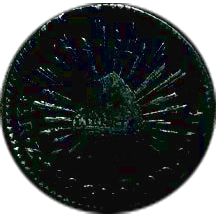
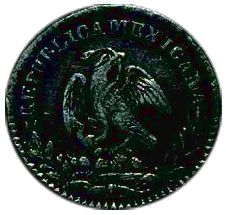
Early dates from Zacatecas in high grade are a rare find. Note the full detail on cap and eagle despite only being in XF condition
The strike quality from Zacatecas was good. There does not seem to be a problem with striking pressure on the vast majority of high-grade examples I have seen. I see no evidence of rusty dies except in 1869. It is likely the case that after 1863, with a five-year period without use, they let the half real dies deteriorate.
Engraving quality was always average or less, especially in the early years thru 1836 when the punches were sometimes pretty crude. There is an interesting feature with the production from 1860 thru 1863, when the assayer was ‘VL’. In every instance that I have seen the ‘V’ is always an upside down ‘A’, showing a reluctance to invest in punches when needed.
It is possible for a type collector to obtain an example of a Zacatecas ½ real in BU, mainly because of the availability of 1860 ZsVL and 1869 ZsYH examples. BU examples of other dates are very difficult to find. You would have to build a lot of relationships among fellow collectors and dealers to stand any chance of obtaining a few examples. There are FAR FEWER BU examples from Zacatecas than there are from any of the other major mints.
Zacatecas produced fewer varieties than many other mints did. Most are overdates, and a few punch varieties. Due to the scarcity of coins from Zacatecas its varieties do not command premiums.
There were seven different assay initial combinations used in the production of ½ reales by Zacatecas (AZ, AO, OV, OM, MO, VL and YH). Coins were struck in four years using two different assay initial combinations.