Philip V Proclamation medals
Philip V was king from 1700 to 1746 (with a slight interruption in 1724 when he ceded the throne to his son Louis I, who died the same year).
Until now, four medals of this king have been identified; three corresponding to Mexico City and one to Veracruz. The obverse of all of them derive from the bust of the Monarch made for the Cadiz medal of 1700, which is listed by Adolfo HerreraHerrera, Adolfo. (1882). MEDALLAS DE PROCLAMACIONES Y JURAS DE LOS REYES DE ESPAÑA. Madrid, España: Imprenta de Manuel Ginés Hernández, Impresor de la Real Casa, under number 1. The reverse, in the case of the medals of Mexico City, immortalize the coat of arms of the City and in the case of Veracruz, the San Juan de Ulúa Fortress, as interpreted by José Toribio MedinaMedina, José T. (1917). MEDALLAS DE PROCLAMACIONES Y JURAS DE LOS REYES DE ESPAÑA EN AMÉRICA. Santiago de Chile: Impreso en Casa del Autor..
A curious case occurs with the medal listed by Frank W. Grove as PV-13, since there is evidence of the existence of a perfect manufacturing medal in terms of its engraving and execution details. Benjamin Betts described her as “… A very fine work in strong relief…”. Currently known as the “mother medal”, it is so perfect and so similar in execution to the Cádiz medal that it could be that this mother medal was made in Cádiz and was transferred to Mexico City as an example of the medals that were to be made.
Mexico City
A royal decree was sent to the Noble and Loyal City of Mexico directing them to proceed with proclamation ceremonies for King Philip V. In compliance with the decree, the Viceroy of Mexico City stated in a letter dated 12 March 1701 that the proclamation ceremonies would commence as soon as possible. The festivities began 4 April with more than 500,000 pesos spent on the festival.
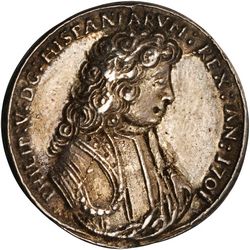
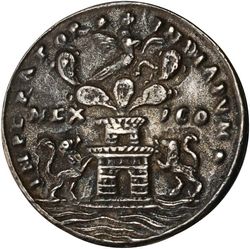
PV-1 Cast and Chased Silver Proclamation Medal (Stack’s Bowers NYINC Auction, January 2015, lot 1001)
Considered to be the first medal of Mexico. The prototype of this medal traces back to the 1700 Philip V proclamation of Cadiz . The obverse of the 1700 Cadiz proclamation was used to produce the obverse mold with only the final digit in the date being changed to a "1". The reverse mold was created locally in Mexico City accounting for its debasement in style and lettering. Generations of this basic casting were also used for the 1701 Medal of Veracruz below as well as the later Mexico City medal of Louis I.
Veracruz
According to a letter dated 15 May 1701, a number of silver medals were thrown from a platform by Lucas de Llano Salazar after oath taking ceremonies which occurred on 11 April 1701.
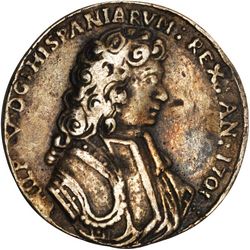
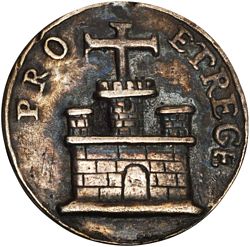
PV-6 Cast Silver Proclamation Medal (Stack’s Bowers NYINC Auction, January 2015, lot 1002)