The Texas Jola
During the War of Independence San Fernando de Bexar was the capital of Texas, a province of New Spain. It was also headquarters for the military commander, and the Governor of the Province.
For many years there had been a shortage of minor coinage throughout New Spain. This was mainly caused by the mint's failure to coin a sufficient quantity, and most that were coined were shipped to Spain. The nearest treasurer's office was located some three hundred miles away. The only new money coming in was for the payroll for the military, and the government This amounted to about five to fifteen thousand pesos. In order for the military man to buy merchandise, or pay his bills the merchant would quite often not have the exact change, and gave him credit, or tokens of some type, which other merchants would not accept. This created a situation in which the buyer could not spend his money where desired, and he was unable to get full value. The shortage of small coins soon spread to the whole community, resulting in hardships for many, including the merchants. This also led to hoarding of small good money by many.
1817
As a result of this shortage of small coins, the leaders and officials of the community prevailed upon the Governor to permit the coinage of a small copper coin. On 29 March Lt. Col. Manuel Prado, then Military Commander and Governor, authorized[text needed] Manuel Barrera, a merchant and jeweler to mint 8,000 copper coins with a value of ½ realBexar Archives. Once the coins were minted, a public notice was posted,
“Our neighbour Don Manuel Barrera having petitioned to this government the milling of five hundred pesos in total containing his name and surname; this government has accepted this individual’s solicitation to mill five hundred pesos in total, with a value of half a real for each for use in purchases and sales and should circulate in the commerce of this city and no one should decline to accept them. I sign this in San Fernando de Bexar on the 29th day of the month of March in 1817 to advise the public”.
The process of manufacture as primitive, using a steel die, or mold, to strike an imprint on the blank copper planchet with a hammer.
Seven 1817 examples are known, from three different obverse dies. The amorphous reverse die of all seven coins appears the same, or at least similar, with a five-pointed incuse star (the first use of the Lone Star)..
Die I
One die has the four digit date 1817
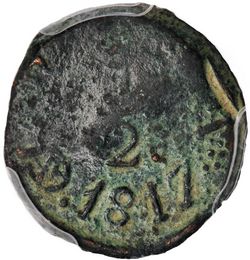
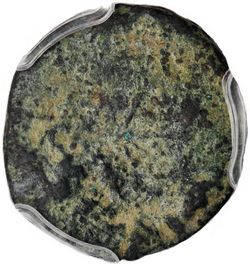
1817 jola (Stack’s Bowers Philadelphia auction, 7 August 2012, lot 11155)
This present piece matches Bevill and Stern's Figure 1 James Bevill, Paper Republic: The Struggle for Money, Credit and Independence in the Republic of Texas. 2009, a piece discovered in the mid-1960s "with a metal detector at the site of Mission San Bernardo, adjacent to San Juan Bautista at the modern-day town of Guerrero, Mexico, near Eagle Pass," a site just a mile or two from the Texas border at the Rio Grande. The same site yielded another example, Bevill and Stern's Figure 2, struck from a very similar but distinct die (die II), with an abbreviated date. Both share the same sort of planchet fabric, angled edges, and crude hand-cut die work. The inscription was ‘M. BARRERA’.
Die II
Another obverse die, clearly cut by the same hand, has an abbreviated 817.
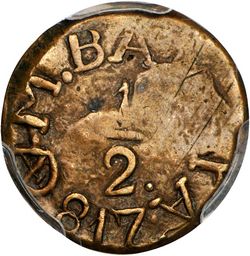
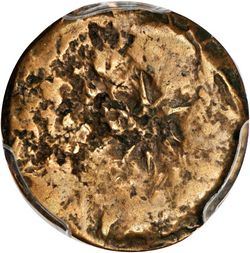
1817 jola (Stack’s Bowers Baltimore auction, 16 November 2012, Lot 6720)
The obverse reads M. BA ... RA, with the central denomination of 1/2 and a three-digit date of 817. The monogram left of the date appears to be AED, though it is identified as AD (i.e. anno domini)
Die III
Bevill and Stern's Figure 3, a piece found at the Presidio La Bahia near Goliad, Texas, is texturally similar, though engraved in retrograde; Bevill posits that it is a trial strike, accomplished before the engraver had mastered the art of intaglio engraving
The low survival rate of the 1817 jolas can be explained in part by their withdrawal from circulation on the order of local authorities on 6 December 1818 (see below).
1818
In May 1817, the Viceroy of New Spain, Juan Apodaca appointed Antonio Martínez Governor and Military Commander of the Province of Texas, to succeed Lt. Colonel Manuel Prado, who had been in office only a short time. On 30 November 1818, José Antonio de Ia Garza, the Postmaster, made an application to Governor Martínez for a permit to coin and circulate money in the town[text needed]Bexar Archives.
Señor Governor
I, Don Jose Antonio de la Garza, Postal Administrator of this City appear before Your Highness and declare: That due to the extreme scarcity of monetary change in this land, we have been experiencing a notable hinderance to the public, and wishing to overcome this want as soon as my faculties may permit it, I have therefore decided to make up to five hundred pesos in copper coins of monetary denominations. They are to be circulated only in this City and are to be of half a real value each. They will be engraved with the first letters of my name and last name and this year’s date as soon as Your Highness may grant the necessary consent so that I may verify this as soon as possible. I therefore entreat Your Highness to grant me the necessary permission if no just cause may impede it.
San Fernando de Bexar – 30 November 1818.
Jose Antonio de la Garza
De la Garza was awarded the monopoly by a decree{text needed} dated 6 December 1818, after he had complied with the requirements of the Governor.
DECREE Being that he who represents the bond is present, and being that the corresponding certified copy (testimonio) was presented in proper form before the judges, it may therefore be filed in the records under the proper heading. The jolas minted by the resident Don Manuel Barrera, with my permission, are to be collected and retreated without causing prejudice to the citizen Barrera.
I authorize the representative of Don Jose Antonio de la Garza to mint the five hundred pesos he wishes to mint with the said letters of his first and last name. He may also mint any more coins over the said five hundred he may be able to pay bond on within the framework of said concession.
(The bond) shall be filed with the Ayuntamiento until the congruous act of minting the coins of half a real value each (and no more) may be accomplished so that this concession may be valid.
Martínez
De la Garza’s bond [text needed] read:
In the City of San Fernando de Bexar, capital of the Province of Texas, on the fifth day of December eighteen hundred eighteen. Before me, Jose Maria Sambrano, Alcalde Ordinario of First Vote, and the second Alcalde, Don Felipe Enrique Neri, the Baron de Bastrop (acting with witnesses to our proceedings due to the lack of a Notary within the Law), appeared in his own person Don Manuel Yturri Castillo, a merchant of this City to me well known and declared: that by these present he does bind himself, plain, clear and evident, unto the person of Don Jose Antonio de la Garza, a resident of this City, so that by said act he may be permitted to mint in this land the referred' amount of five hundred pesos in copper coins of half real value each engraved with the first letters of his name and this year’s date. Said coins are to be retreated by Don Jose Antonio de la Garza upon my suspension of this bond, at which time he shall replace them with silver coins upon the request by any person whom-so-ever from whatever point destiny might carry the coins to. He will also assure payment on any amount of coins over the said five hundred that may appear. In order to avoid such an occurrence however, he shall deliver the seal or stamp with which the coins are to be engraved so that it may he deposited in a convenient place. Furthermore, he binds his person and belongings, present and future, unto the fulfilment of the herein stated renouncing all his rights and exemptions favourable to him, and submits himself unto the judgements and decisions of His Majesty’s judges here or anywhere else so that all the herein stated may be bound and enforced as judgement passed to the effect.
He then renounced his personal rights (fueros) and the law Circumvenerit de Jurisdiction Omnium Judicum and with said understanding signed the same before us, the aforementioned judges and witnesses to the proceedings which we certify is true in fee simple.
Jose Maria Sambrano
The Baron de Bastrop
Manuel Yturri Castillo
witness:
Gaspar Flores
witness:
Salvador Carrasco
The governor then issued a public notice[text needed]:
As Don José Antonio Lagarza (sic), a resident of this City, has presented his petition to mint five hundred copper coins, and considering the harm caused to consumers by the lack of change or coins of small denomination (for which reason they prefer not to spend even a peso without necessity), I have therefore authorized the said Don José Antonio to mint the five hundred pesos in coins of half a real value each, engraved with his initials, which are to be circulated in this town for the benefit of its commerce. Henceforth, the previously (town) circulated coins minted by Don Manuel Barrera are to be taken out of circulation. Any person having any of the said Barrera coins is to present them within twelve days to Don José Antonio de la Garza who shall exchange them for the newly minted ones.
For its due effect and public notice, I order the present to be published and posted at the usual places.
Bexar – 6 December 1818
Interestingly for such a rare issue, there are several known die varieties of the 1818 jolas. All examples bear the same basic design, which is virtually identical to that used to produce Barrera's 1817 coinage. The obverse exhibits the initials of the issuer J.A.G. above, the fractional denomination 1/2 oriented sideways in the middle and the date below. The reverse design is very simple with the five pointed Lone Star of Texas stamped into the planchet. A small raised dot is present near the centre of the star. The De la Garza coinage of 1818 is also known on both small and large size planchets. The small-planchet jola has an incuse five-pointed sta, whilst the large-planchet variety has a raised five-pointed star. The weights and diameters are not consistent.
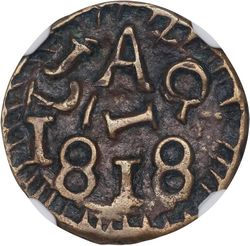
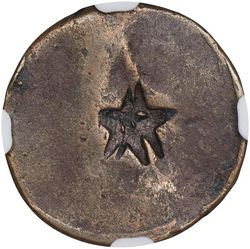
1818 jola small planchet (Stack’s Bowers auction, 18 November, 2024, lot 1327)
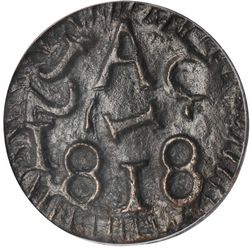
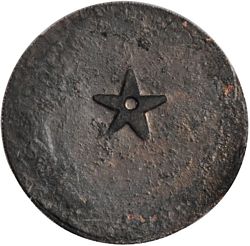
1818 jola small planchet (Stack’s Bowers Chicago ANA, 13 August 2011, lot 7179)
All indications are the jolas were in use from December 1818 until Mexico's independence in 1821. At this time it is believed that de la Garza redeemed as many of the 8, 000 jolas that would have been minted. The accepted belief is that, in fear of having to redeem the jolas twice, de Ia Garza bagged and buried the jolas in the San Antonio river. Support for this theory appeared when 60 of these coins were discovered in 1959 during excavation work.