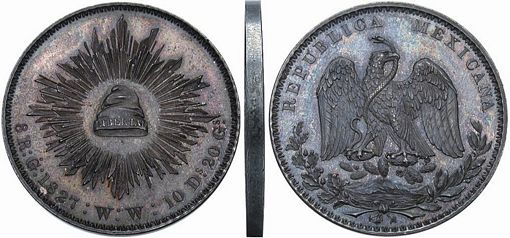
 1827 Guanajuato Pattern 8 Reales
(image courtesy of Richard Ponterio)
Among the most classic designs of all Mexican 8 Reales patterns are those designed at the Royal Mint by the famous English engraver William Wyon. The story of these coins is an interesting saga that spans nearly six decades and involves three different mints, Guanajuato, Alamos and Hermosillo. Our story begins with the mint of Guanajuato which began operations during the War of Independence as a provisional mint equipped with less than standard machinery. The production of coinage from this facility was sub standard in comparison to well-equipped mints such as Mexico City.
Shortly after Mexico gained its independence, the mint of Guanajuato was leased to the Anglo Mexican Mint Association. This British firm was closely related to the Anglo Mexican Mining Association, which began serious mining operations in the region in the 1820s. They acquired the mint as a means of refining and minting silver from their mining operations in the region. It became immediately apparent to the Anglo Mexican Mint Association that the facilities in Guanajuato were in dire need of modernization. It is important to note that both the mint and the mining operations in this region were controlled by English firms. For this reason, the natural choice for purchasing minting machinery was through Matthew Boulton and the Soho Mint.
The Anglo Mexican Mint Association took control of the Guanajuato mint in June of 1825. By August of that year negotiations had already begun to acquire new equipment from England. On 18 August a request was made for the estimated costs of a package consisting of four coining presses, eight punch presses for making planchets, a die multiplying press, as well as various other items necessary for the minting of coinage. Although state-of-the-art-steam powered coining presses were available at the time, specific requests were made for presses that could be adapted to either steam or horsepower since the scarcity of fuel (namely coal) in Guanajuato, made the operation of a steam press impractical. It is important to note that the original request for machinery did not include or mention coining des or hubs (this request came later).
Inevitably, the original request for machinery proved too ambitious for the Anglo Mexican Mint Association and a more modest order was placed. The second request was put together consisting of two coining presses, three punch presses for making planchets, one milling machine and a die multiplying press. All of the new equipment was to be operated by hand rather than with steam power. The request was granted and machinery was shipped to Guanajuato in October of 1827. The dies and pattern coinage are another story.
On 4 March 1826, an official from the Anglo Mexican Mint Association made an inquiry with the Soho mint regarding the purchase of master punches for the purpose of producing dies for the Guanajuato mint. In doing so, the Anglo Mexican Mint Association as well as the Soho mint crossed the line of legality. In accordance with Mexican law, all tools used in the creation of coining dies were to be directly acquired from the Mexico City mint. During this period, the Mexico City mint would send out master dies to the branch mints where the dies were then made locally. This proved to be an expensive and time consuming process. The Anglo Mexican Mint Association’s solution to this was to have the Soho mint produce dies and hubs. This would save them a great deal of time as well as a tidy sum of money.
The task of engraving the dies was given to William Wyon, one of the most talented and noted engravers ever to work in England. Although the design elements remained the same as those of other Mexican mints, the artistic style of Wyon’s work was dramatically different. The workmanship is nothing short of spectacular for the time with its neatly detailed design done in the neoclassical style for which Wyon was famous. The dies are remarkably well executed, the lettering used in both the obverse and reverse legends are neatly cut and precise. Struck with a medallic die axis; the piece bears a plain edge and has a very sharp upset rim with ornate denticles struck with the care and precision that is more reminiscent of contemporary English medals. They were undoubtedly struck with the state-of-the-art steam powered coining presses available at the Royal Mint in London. In fact, Buttrey{footnote}T.V. Buttrey & Clyde Hubbard, A Guide Book Of Mexican Coins 1822 to Date{/footnote} states that the patterns were struck in London and the coins and dies were then sent to Mexico in 1827.
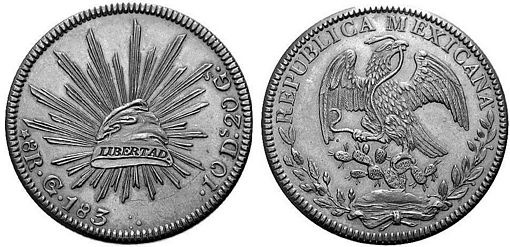 Pattern / trial strike from unfinished Soho mint die’ for the Guanajuato mint.
The second die style ordered by the Anglo Mexican Mint Association
(image courtesy of Richard Ponterio)
This is where the story takes an interesting turn. As previously mentioned, hubs and die making materials were required by law to be acquired directly from the Mexico City mint. As fate would have it, the dies and coins were considered illegal contraband and seized by customs agents at the port of Veracruz while attempting to enter Mexico. Surely the artistic beauty of the dies was one of their condemning factors as they were easily recognizable as not being a product of the Mexico City mint. Although a major setback, this unfortunate set of events did not stop the Anglo Mexican Mint Association from purchasing further dies and hubs from Soho. In 1829 the firm shipped an actual pair of Guanajuato dies to England for the purpose of replication. In the request it was stated that the dies must be virtually identical to the Mexico City product, however of a more refined style and quality. Production of the new dies began 5 January 1830. Coins of this new die style were produced at Guanajuato from 1830 until 1843.
So what became of the original dies and hubs designed by William Wyon that were confiscated in Veracruz? One would speculate that such illegal contraband would have been destroyed after seizure; however this was not the case. In fact, it has long been known that either the dies or hubs later resurfaced in Hermosillo more than half a century later and were used to produce patterns dated 1882. What remained unclear is where were they for the previous 50+ years.
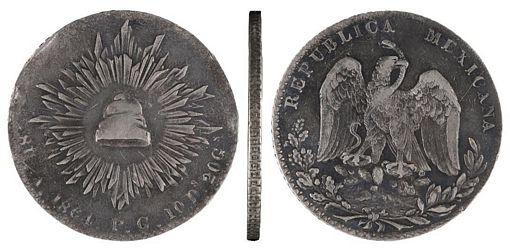 1864 Alamos Pattern 8 Reales of the William Wyon design
The discovery of an Alamos pattern dated 1864 sheds some light on the subject. Totally unpublished in any numismatic reference and believed to be unique, the existence of this pattern only recently came to light. It was brought to us through one of our foreign contacts who acquired it as part of a larger collection in Europe. Clearly it was manufactured using either repurposed dies intended for Guanajuato, or by manufacturing new dies using the original William Wyon hubs. This pattern dated 1864 has a unique claim of being the first 8 Reales pattern of the Alamos mint, as it was produced the very first year of 8 Reales production. Also unique is the fact that it is the only known pattern for this branch mint from any period. The legend has been neatly placed below the cap and ray, having been executed with what appears to be the punches used to produce 2 Reales. The letters PG for Pascual Gaxiola, the assayer at the Alamos mint in 1864, are present after the date. The strike and edge reeding are quite different than the 1827 English made pattern for Guanajuato which as mentioned are plain edge and produced with a stem press. The Alamos piece is more consistent with later Hermosillo pieces showing evidence of screw press manufacturing and the usage of an edge milling machine. Thus, the present coin was unquestionably produced in Mexico rather than England.
The circulated condition of this piece perhaps suggest its use as a pocket piece. It seems unlikely that a coin of such dramatically different style would have remained in circulation long enough to sustain this degree of wear. Being that the coin surfaced in Europe, along with the fact that the mint was contracted to a foreign company leaves one to wonder if this piece belonged to some foreign entrepreneur who held a position at the mint and carried it as a keepsake or memento. This part is best left to the imagination
 Original William Wyon master hub
Banco de México Collection
 Original William Wyon master hub
Enlargement of defaced legend
Banco de México Collection
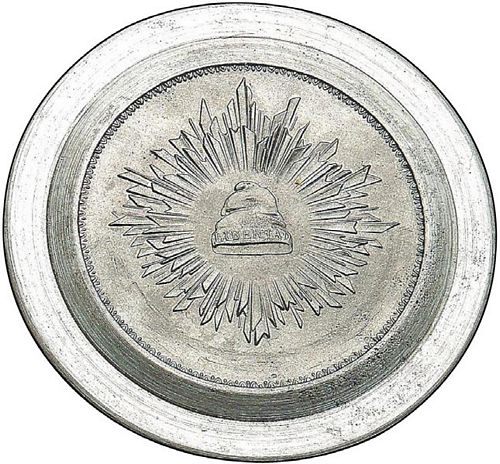
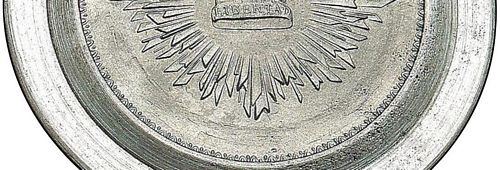
Further insight can be gained by examining the original master hub designed by William Wyon (now housed in the Banco de México collection). Clear evidence of intentional defacement is seen from 9 to 3 o’clock to remove the legend intended for Guanajuato. This explains why the piece produced by the Alamos mint and later pieces produced by the Hermosillo mint differ in their legend arrangement and punch size. It is unclear (at least to me) how or when the Banco de México came to be in possession of the Wyon hub. It is plausible that the hub was shipped to Mexico City in the 1890s with other dies and equipment after the Hermosillo mint closed in 1895 and has remained with the Banco de México since that time. What remains unclear is exactly how the hubs which were seized by customs officials in Veracruz made their way some 1,200+ miles to the state of Sonora more than three decades after they were confiscated. Perhaps the most plausible explanation is that somehow during the French intervention the hubs were removed from where they were being stored in Veracruz. The timeline would seem to fit as the French began their bombardment of Veracruz in early 1863, and the hubs were used in Alamos the following year. The pristine condition of the hubs suggests that they may have been still packed in the original white wax used during shipping from England. Certainly they were covered in some substance to prevent oxidation. Regardless, serviceable hubs for coinage manufacture would have been worth a tidy sum of money on the open market.
 1882 Hermosillo Pattern 8 Reales
(image courtesy of Richard Ponterio)
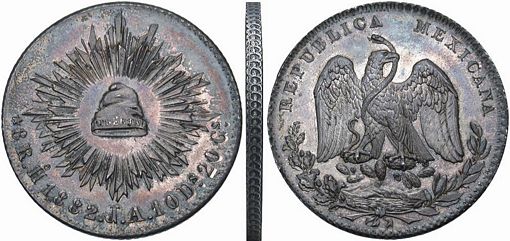
The 1882 Hermosillo patterns are much like the 1864 Alamos pattern in terms of how they were manufactured. Both were produced with a screw press after the planchets were edged with milling machinery. In fact the edge of the 1882 Hermosillo is identical to regular circulation issue from this year. The legend below the cap and rays was produced with identical punches used on contemporary Hermosillo 8 Reales between 1876 and 1880. The assayer’s initial “J.A.” are consistent with that of Jesus Acosta, the Assayer at the Hermosillo mint from 1877 to 1883.
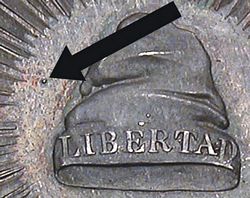
There are identical defects within the dies, which appear on coins from all three mints. Most noticeable is a small raised dot directly to the left of the liberty cap. This can also be seen on the 1864 Alamos; however, is slightly less noticeable due to the coin being circulated. Exactly how the hubs went from from Alamos to Hermosillo seems a bit easier to comprehend. Both mints are located in Sonora and both were leased either in full or part to Robert R. Symon of the English firm Symon & Cia during the period these coins were produced.
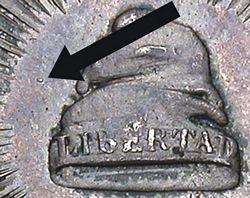
Die defect on 1827 Go Die defect on 1882 Ho
(imagies courtesy of Richard Ponterio)
{footnote}Alberto Francisco Pradeau, The Mexican Mints of Alamos and Hermosillo, NNM, No 63, American Numismatic Society, New York, 1934{/footnote}
In the annual report of the Secretary of the Treasury to Congress dated February of 1844, page 28, he says: "The federal government in order to prevent the constant smuggling of gold and silver that was taking place from the States of Sonora and Sinaloa through the seaports of Guaymas and Mazatlán, issued an order whereby the export duty on metals was considerably reduced , but the miners complained of the enormous distance from their mines to the existent mints, the risk involved in transportation and the subsequent delay at the mint, and as no gold or silver was allowed to be exported unless coined, smuggling continued. In order to stop this leakage, the federal government by Presidential Proclamation dated 16 February 1842, ordered the resumption of the mint at Hermosillo (closed since 1835), and encouraged the state government to promote the establishment of this mint, authorizing the state to levy a forced loan, or to enter into an agreement with private interests or individuals, to bring about the desired results, notifying the federal government about the conclusions reached, for its official endorsement." (Free translation.) This order has reference to the private coining operations of Mr. Santoyo during the years 1832 to 1837, which were carried on in a most primitive manner by means of hand punches. The central government considered this establishment a true mint, but realizing that it might not be an efficient one, authorized the state to negotiate a loan or to enter into an agreement with private parties, whereby an adequately equipped mint could be operated in Hermosillo. However, nothing was done about the re-establishing of the mint in that city until 1851, and the State of Sonora did not coin money in any metal from the year 1837 until the mint was re -opened in Hermosillo in 1851.
The mint in Hermosillo was established in 1851 by Mr. Robert R. Symon and his co -workers, Mr. Sebastian Camacho and Mr. Quintin Douglas. The mint was leased for a period of twenty years beginning in 1851 and ending 1871. All my efforts to obtain a copy of this lease have been futile, but it was my good fortune to discover a piece of information given by Mr. Antonio Peñafiel who found that the mint at Hermosillo began operations in 1852. The existence of such operations was unknown to the treasury department at Mexico City until 1861, as no reports were sent to the federal government previous to that time. This is not strange; at that particular period of Mexican history the states functioned as sovereign and independent units and had the right to legislate and issue their own coinage. It is also not surprising that the records of mintage of both Alamos and Hermosillo are not found in the archives of the State of Sonora , because from 1830 to 1885 the state was in a constant turmoil, having to combat the Apache Indians on the nort , the Yaqui Indians on the south, and having besides to put up with constant strife of warring political parties, certain of which burned priceless records in order to escape prosecution. At any rate, the mint of Hermosillo was leased to private individuals until 1871 or 187 , and neither the state nor the federal government derived any revenue for the first ten years, nor, so far as is known, for the second ten years .
From reports sent to Congress, 28 September 1868, by Mr. Matias Romero, then Secretary of the Treasury, we learn the following:
1. That the State of Sonora entered into a contract with Mr. Robert R. Symon, leasing the mints of Hermosillo and Alamos for a period of twenty years beginning 3 January 1851.
2. The state guaranteed the lessee that no federal, state, or municipal taxes were to be assessed against the lessee for the first ten years, and only one per cent for the second ten years.
3. The state was to allow the importation free of duty of the machinery, implements, reagents, etc. needed in the erection and to be used in the operation of the proposed mints.
4. The state was to permit the unlimited coinage of gold, silver and copper.
5. The lessee promised to purchase at his own expense the necessary machinery, implements, reagents, etc. for the establishment and the successful operation of a mint at each one of the cities mentioned (Alamos and Hermosillo.)
6. At the termination of the contract the lessee promised to turn over to the state the mint machinery, implements, reagents, etc. which from then on would become state property.
During the French intervention in Mexico (1864-1867) the State of Sonora was in part occupied by the Imperialist forces (chiefly the cities of Hermosillo and Alamos) and as the Imperial Government, with Maximilian at its head, did not approve of the terms formerly agreed upon by the Republican State Government, it became necessary for the lessee to go to Mexico City and make new arrangements with the sub-Secretary of the Imperial Treasury, Don Esteban Villalba. No copy of this document is obtainable. At the expiration of the original lease made by the State of Sonora with Mr. Robert R. Symon, and which I believe ended in 1871, Mr. Symon turned over the mints of Hermosillo and Alamos to the federal government. This act was in compliance with the terms of the original lease, in which it was stipulated that after twenty years the machinery, implements, chemicals, etc. would become the property of the nation. But the federal government, for reasons unknown to me, was unable to operate these mints at a profit, and it showed an operating loss each year . This peculiar circumstance, was the chief reason for leasing the mints anew (1876 ) to a company headed by Mr. Symon , as can be seen by the following Presidential Proclamation:
Sebastian Lerdo de Tejada, Constitutional President of the United States of Mexico , to his constituents, be it known:
that by virtue of the prerogative extended by the Law of April 28th, of the present year, the Executive decrees the following:
Article one: The contract of this same date, made by the minister of Finance with the firm Robert R. Symon & Company, leasing to the latter the mints of Hermosillo, Alamos and Culiacan, is hereby approved.
Therefore this order shall be printed, published and circulated to be complied with in due manner.
Given at the National Governmental Palace at the City of Mexico, this twenty -ninth day of August of the year 1876.
Signed -Sebastian Lerdo de Tejada.
Shortly after this contract was made known to the public, the newspapers of Sonora and Sinaloa engaged in a bitter controversy opposing the leasing of the mints to private individuals, claiming that the mining interests of the two states would suffer; also, that the federal treasury would sustain a heavy loss, as the three mints had been leased for a period of three and a half years for only twenty thousand dollars. Foremost among the oppositionists was the newspaper El Occidental edited at Mazatlán, Sinaloa, which in its number of 7 October 1876, had a scorching article criticizing the leasing of the mints to private individuals. This attack was not left unanswered by the men in power, and in the Boletin Oficial of the State of Sonora, published in the city of Ures, then capital of the state, in its edition of 27 October 1876, there appeared the following counter-attack under the heading of "Casas de Moneda" (Mints ): "The opposition newspaper 'El Occidental' published in Mazatlán, in its number of the 7th instant charges that the federal government has made a grave mistake in leasing the mints of Hermosillo, Alamos, and Culiacan , and that this act will create a hardship to the miners and mining industry.
"We believe that there is no basis to this charge, and we are positive that in leasing the said establishments, the federal government has taken into consideration and consulted the economic side of the problem as well as the public welfare.
"Since the last lease expired the government took over the aforementioned mints and from that time an ever increasing operating expense and loss has been reported in connection with these mints. So the government in leasing them for twenty thousand dollars for a three and a half year period, will not only be saving itself additional expenses and losses, but in reality will be that much money ahead.
"On the other hand, the taxes on the mining industry will continue the same as before; so, where is this terrific blow, that according to the newspaper 'El Occidental' the Mexican miner will receive ?
"Frankly, we are unable to understand the marked opposition of the last few days to every act of the National Executive, creating imaginary wrong doings for which there is no foundation. The object cannot be other than to mislead the unsuspecting public, and to bring about dissension among the gullible, and thus start a war of personalities. In short, this seems to be the motive impelling the press of the opposition which usually is against the legitimate aspirations of the Mexican people ."
The above information was obtained from the archives of the State of Sonora through the courtesy of Mr. Rodolfo Tapia in charge of the "Tesoreria General del Estado " (State Treasury) and of Mr. Ramon E. Corral, clerk in charge of the archives. It was transmitted to the Secretaria de Hacienda y Crédito Público , Departmento de Biblioteca, Archivos y Publicaciones (Treasury Department ) of the Republic, with which the author has been in constant correspondence for a period of over two years. The treasury department in turn transcribed the information given to the Hon. Director of the Mint at Mexico City, and on 2 June 1933, the following response was sent: "In reference to the copy of the contracts asked for, allow us to inform you that they do not exist in this office. It may appear strange that these documents are not to be found in the archives of the government, but from unofficial sources the Director of the Mint has learned that when the government rescinded the contracts in 1893, the lessees were allowed to take the contracts pertaining to each mint." (Free translation.) It is hardly credible that the contract entered into for a period of three and a half years and expiring in 1879 or 1880 would have been given back to the lessee in 1893 unless extended in the meantime. However, after two and a half years of effort one must accept this answer as final. Perhaps in a not distant future these documents will come to light, as it is my belief that these documents exist.
Let us at this time engage in an estimate that might give us an idea of the possible profit obtained by the leasing firm. The Hon. Matias Romero, Secretary of the Treasury in 1868 and who published his "Geographical and Statistical Notes on Mexico" while in Washington (1898) has this to say about mints and duties on silver, page 27: "Under the Spanish laws all silver paid a duty; and as most of it was coined, that duty was levied on coinage, and the exportation of bullion was prohibited; but of course a great deal was smuggled, both during the Spanish rule and still more when Mexico was opened to foreign trade after our independence. When I occupied for the first time the Treasury Department of Mexico in 1868, it seemed to me an outrage against the mining industry of the country to require the miners, especially those who were far removed from the mints, to take their bullion to the mints, and from there to the ports to be exported to London, where it was often again turned into bullion; and as the contracts made with the lessees of the mints did not allow the free exportation of bullion, I proposed and succeeded in having enacted a law for the purpose of allowing bullion to be exported, provided that it paid the coinage duty at the respective customs houses for the benefit of the mint's lessees; and this condition of things, extraordinary as it may seem, was a great relief to the silver producers, and continued until the Mexican government could recover all the mints and be free to legislate on the "subject." There were thirteen mints in the country to coin the silver extracted from our mines, which, in the precarious condition of the Mexican treasury , were sometimes rented to private parties who advanced a sum that seemed large enough at that time , although it was a trifle in comparison to their profits, as they collected. a duty of nearly four and a half per cent upon the amount of bullion coined, and they credited to the government only one and a half per cent of the same."
From the above statements (which one must consider authoritative because of their source) and the fact that Mexico is one of the largest producers of silver in the world (having produced up to 1900 about half of the world's supply) one can readily see that three per cent of the silver mined went to the lessees of the min as net profit, as the law that Mr. Romero caused to be enacted, permitted them to collect on the strength of their contracts, without even seeing the metal, without the expenses of minting, collecting, vigilance, and risks . We are entirely in accord with the newspaper 'El Occidental' when it complained of the leasing of the mints for a period of three and a half years for only twenty thousand dollars, when the profit in any one year was nearly double this amount, as follows:
| Total coinage of the mint of Hermosillo for the years 1877, 1878 and 1879 | $ 2,127,810.50 |
| Total coinage in Alamos during the above mentioned period | 2,822,038.20 |
| Total coined in the mint of Culiacan for the same period | 2,782,136.00 |
| Total coined in the three mints during a period of only three and not three and a half | 7,731,984.70 |
| Judging that 4½% was charged for coining or duty as allowed by their contracts the amount collected was | 347,939.31 |
| If from this amount the one and a half per cent had been paid to the government , it would have been | 115,979.77 |
| As the government only received | 20,000.00 |
| There was a loss to the national treasury of | 95,979.77 |
and this was for a period of three years only. No doubt the loss was much greater because the contract was for three and a half years.
Once before, another Secretary of the Treasury, Mr. Bonifacio Gutierrez in 1849 had shown the fallacy in the government's leasing the mints to private individuals. The national treasury lost nearly a million dollars in revenue by leasing three fully equipped mints as is shown by the following:
| The mint of Guadalupe y Calvo, was leased for a period of ten years to the Compañia Mexicana de Guadalupe y Calvo and exempted of all taxation. It would have paid the government for the first four years of operation the sum of | $227,563.96 |
| The mint of Guanajuato was under lease to the Compañia Anglo -Mexicana for a period of fourteen years. During the first five years and eight months, due to the onerous terms of the lease, the government sustained a loss of revenue totaling | $360,071.18 |
| The 19th of September, 1842 the government leased the mint of Zacatecas to the firm Manning and Marshall for a period of fourteen years. During the first five years and two months the operation of this mint resulted in a loss of revenue to the state amounting to the sum of | $332,036.61 |
From 1842 to 1893 practically all the mints of Mexico were leased, and in every instance the terms of the various contracts were extremely advantageous to the lessees and detrimental to the government. Looking back , all one can see is a total disregard of the country's interests.
The statement made by the official Bulletin of the State of Sonora in defending the action of the government, in leasing the mints of Alamos, Hermosillo and Culiacan - because from 1871 to 1876 there had been an ever increasing operating expense and loss - can be explained only by the incompetency or dishonesty of the political appointees in charge of these mints. Either alternative is a reflection upon the favorites in charge of their operation.
From the records of the Secretary of the Treasury, Francisco Mejia , presented to Congress 16 September 1875, covering the fiscal year of 1874-75, page 169, the author has obtained the following: "As I stated a year ago , the government has resumed the operation of ten of the eleven mints, and the only one not taken over by the government is the one at Mexico City, the lease of which will not expire until April 1st, 1877. Since the government took over the operation of the mints there has been a constant increase of revenue derived from this source as can be seen by the following comparative statement:
Revenue obtained by the operation of the mints during
| the fiscal year of 1872-73 | $259,431.58 |
| the fiscal year of 1873-74 | 410,361.03 |
| the fiscal year of 1874-75 | 942,054.19 |
The revenue obtained by the government during the fiscal year of 1874-75 is $682,622.61 more than the government would have received had the mints continued to be leased to private individuals, and when the mint of Mexico City is taken over by the government, the total revenue received from the operation of the mints will by far exceed a million dollars."
In the same report quoted above, page 170, is found a table giving the net profit for the ten mints of the Republic for the fiscal year of 1874-75 as follows:
| For the mint of Alamos | $41,454.70 |
| For the mint of Culiacan | 59,721.06 |
| For the mint of Hermosillo | 7,553.81 |
Where, then, is the "ever increasing operating expense and loss referred to by the 'Boletin Oficial'? According to this information , the Treasury Department received during one single year a net profit of $108,729.57 for the above mentioned mints, and the statement made by the Official Bulletin seems very suspicious. It is unbelievable that with this information on hand, the President of the Republic, Hon . Sebastian Lerdo de Tejada, would have given his official endorsement to a contract by which for the mere trifle of $20,000 the Government leased three profitable mints for a period of three and a half years, and it is far less excusable for the Secretary of the Treasury, Mejia, to submit the contract of 9 August 1876, for Presidential approval, knowing well that its terms were unjust to the Republic, and on the face of his own statements of eleven months before, it becomes criminal.
The lesson so clearly pointed out by the Secretary of the Treasury, Mr. Bonifacio Gutierrez, and so costly to the country, was never learned by the rulers of Mexico.
Among the numerous compilers of Mexican numismatics, four stand foremost: Don Manuel Orozco y Berra; Don José M. Garmendia; Don Javier Stavoli and Don Antonio Peñafiel. The four have been accepted by the Mexican Government as authorities on the subject, and the only records in the national archives about coinage are those compiled by these men.
Orozco y Berra has the most complete numismatic history up to 1868; Garmendia from 1874 to 1883; Stavoli from 1883 to 1895; and Peñafiel until 1900. However, the figures quoted by these men show an enormous variance and as an example we shall take the years of 1877-78 and 79 for the mints of Hermosillo, Alamos and Culiacan, and compare just two of them.
Figures given by Don José M. Garmendia
| Year | Hermosillo | Alamos | Culiacan |
| 1877 | $ 789,980.58 | $ 925,634.00 | $ 824,202.00 |
| 1878 | 877,998.00 | 1,055,818.75 | 886,362.00 |
| 1879 | 557,010.00 | 770,298.15 | 941,181.00 |
| Totals | 2,224,988.58 | 2,751,750.90 | 2,651,745.00 |
| Total amount coined | $7,628,484.48 |
As compared with the figures given by Don Antonio Peñafiel , we have :
| Year | Hermosillo | Alamos | Culiacan |
| 1877 | $ 814,519.50 | $ 1,084,186.50 | $ 933,837.00 |
| 1878 | 737,176.00 | 956,295.40 | 912,015.00 |
| 1879 | 576,125.00 | 781,556.30 | 936,284.00 |
| Totals | $2,127,820.50 | $2,822,038.20 | $2,782,136.00 |
| Total amount coined | .$7,731,994.70 |
showing a difference between the two of $ 103,510.22 for the three years. This being the case , to which shall the student of Mexican numismatics turn in search of reliable information? As each man worked at different periods it is reasonable to suppose that he was correct on the figures obtained during his term of office. I have used in this monograph the figures of all four, and I have accepted the figures given by Messrs . Garmendia and Stavoli as the most dependable for their particular period because they were at the head of the department of coinage at the time.
Let us go a step further and consider the approximate cost of the mint in Hermosillo. The mint building and machinery of Culiacan had cost the government in the neighborhood of $40,000.00 and judging by the total yearly coinage which is so similar in these three houses, the plant at Hermosillo cost the lessees that much. Not having available the amount of coinage for the first nine years we shall take the coinage of 1861-62 as typical of the coinage in the previous years and multiplied by nine we obtain the total approximate coinage for the period 1851-1861 of $1,959,109.83.
| And had the lessee paid the customary 14 % duty assignable to the government, it would have been | $29,386.65 |
| And as the coinage of copper for the years of 1861 and 1862, amounted to $73,449.84, and having in my possession coins of this mint of 1859 and 1860 it is justifiable to assume that at least an equal amount was coined in the two previous years | $73,449.84 |
| Deducting from this amount 10 % for the metal and cost of coinage | $7,344.98 |
| One can assume that the net profit on this coinage was not less than | $66,104.86 |
| Which gives an approximate net profit to the lessee of | 95,491.51 |
| Deducting the original cost of the machinery , etc | 40,000.00 |
| Leaving a net gain on what the lessee would have paid to the government had the one and a half per cent been imposed upon him as was customary in the other mints | $ 55,491.51 |
As I said previously this is only an estimate and for this reason I have exaggerated the expense side of the account considerably, and on the other hand, I have taken the minimum production. It is very probable that the machinery did not cost over $ 20,000.00 and while it was propelled by steam engines, it was quite rudimentary and not at all expensive. In this connection, it is well to bring before readers the fact just related to me by Don Julio Bouchet, an old resident of Hermosillo , that the first time the machinery was placed in operation, they blew the whistle, and as the people of the town had never heard anything like it, itcreated considerable commotion.
| from | to | |
| 1851{footnote}Different sources disagree on the date of this "opening" and those in charge of its administration, thus: 25 August 1860 by Quentin Douglas and associates. 3 January 1861 by Quintin Douglas and William Miller. 20 August 1860 by William Miller, Quintin Douglas, and Robert Symon.{/footnote} |
||
| 28 April 1876 | 1895 | Robert R. Symon & Compañía |
The assayers{footnote}list updated{/footnote} of the mint were:
| Initials | Name | Begins on | Ends on |
| PP | Pedro Peimbert | 1835 | 1836 |
| CE | 1862 | ||
| MP | Manuel Onofre Parodi | 1866 | |
| PR or R | Pablo Rubio | 1866 | 1875 |
| FM |
Florencio Monteverde Monteverde was director of the mint from 19 October 1871 to 27 November 1876. |
1871 | 1876 |
| AF or F | Alejandro Fourcade | 1876 | 1877 |
| JA or A | Jesús Acosta | 1877 | 1883 |
| R | Guadalupe Rocha | 1877 | |
| FM or M | Fernando Méndez | 1883 | 1886 |
| A | 1884 | ||
| FG or G |
Fausto Gaxiola Rojo was born in Sinaloa in 1861. Fausto was also in local politics. He was the 2° alternative delegate for Ures in the XV and XVI state congress (1895 to 1899) and was elected to the Hermosillo town council in 1901. After the mint closed he was Jefe of the Oficina Federal de Ensaye in Hermosillo in 1902{footnote}La Constitución, Periódico Oficial, Tomo XXV, Núm. 61, 31 December 1902{/footnote}. When Norberto Domínguez left the Culiacan mint to become Director General de Correos, Gaxiola was named to replace him, bur declined{footnote}El Tiempo, Año XX, Núm. 5854, 17 April 1903{/footnote}. He died in Mexico City on 30 June 1926. |
86 | 1895 |
Among the directors of the mint were Don Florencio Monteverde; Don Felizardo Torres; Guillermo Parrodi and Don Gustavo Torres. They were really federal auditors, but I have not been able to find the year or years in which each one served in that capacity.
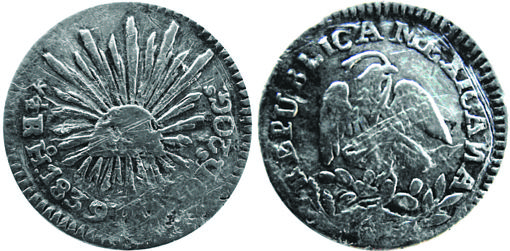
KM-372.7 ½r 1839 Ho PP
Retrograde N in MEXICANA
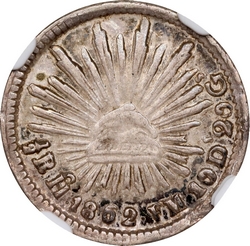
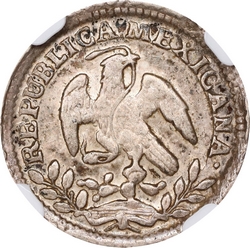
KM-370.8 ½r 1862 Ho FM (Stack’s Bowers Kirk Menczer Collection, 23 June 2026, lot 72169)
Diameter 16 mm. 1.690 g, 0.90277 silver
For a consideration of the rarity of Hermosillo ½ real see here.
| Date | Asssayer | Recorded mintage | Comment |
| 1839 | PP | unique | |
| 1862 | FM | ||
| 1867/1 | PR/FM | 6 over inverted 6 (for discussion, see here) | |
| 1867/2 | PR |
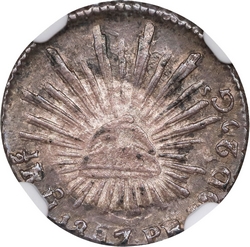
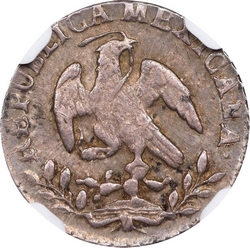
KM-370.8 ½r 1867 Ho PR/FM (Stack’s Bowers Kirk Menczer Collection, 23 June 2026, lot 72170)
Diameter 26 mm. 3.380 g, 0.90277 silver
| Date | Asssayer | Recorded mintage | Comment |
| 1862 | FM | ||
| 1867 | PR | small 7 over 1 | |
| 1867 | PR | large 7 over small 7 | |
| 1867 | PR | no crossbar in H of mintmark | |
| 1867/1 | PR | illustrated below | |
| 1868 |
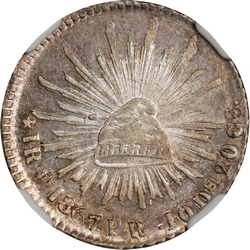
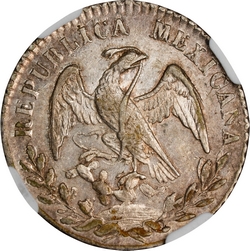
KM-372.7 1r 1867/1 Ho PR (Stack’s Bowers Kirk Menczer Collection, 23 June 2026, lot 72384)
Sonora Cap and Eagle.
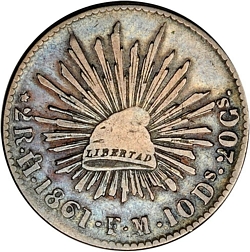
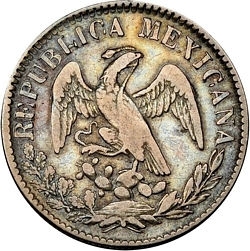
KM-374.9 2r 1861 Ho FM (Ponterio Baltimore auction, 28 March 2011, lot 8277)
Diameter 27 mm. 6.760 g, 0.90277 silver
| Date | Asssayer | Recorded mintage | Comment |
| 1861 | FM | ||
| 1862/52 | FM/CE | Ho mintmark | |
| 1867/1 | PR/FM | illustrated below | |
| 1867 | PR | Escudo edge |
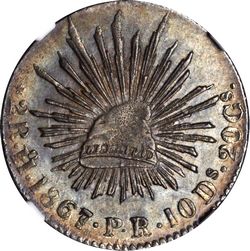
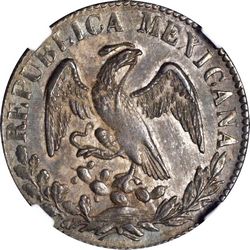
KM-374.9 2r Hermosillo 1867/1 Ho PR/FM (Stack’s Bowers auction, 13 February 2019, lot 71276)
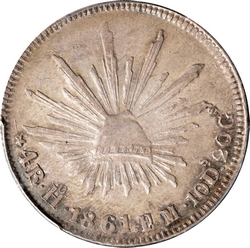
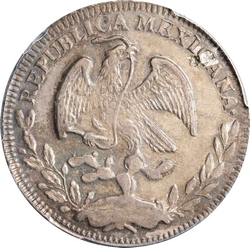
KM-375.5 4r 1861 Ho FM (Stack’s Bowers auction, 26 August 2022, lot 34177)
Diameter 32 mm. 13.540 g, 0.90277 silver
| Date | Asssayer | Recorded mintage | Comment |
| 1861 | FM | ||
| 1862 | FM | two known | |
| 1867/1 | PR/FM | ||
| 1867 | PR |
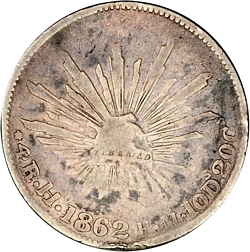
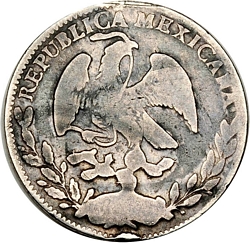
KM-375.5 4r 1862 Ho FM (Ponterio Baltimore auction, 28 March 2011, lot 8376)
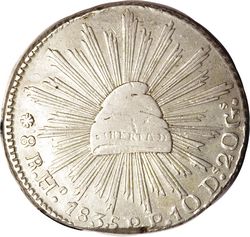
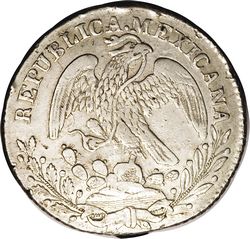
KM 377.9 8 reales 1835 Ho PP (Heritage Long Beach auction, 19 September 2008, lot 21741)
Diameter 39 mm. 27.070 g, 0.90277 silver
| Date | Asssayer | Recorded mintage | Comment |
| 1835 | PP | For a commentary on these three early issues, see here |
|
| 1836 | PP | ||
| 1839 | PR | ||
| 1861 | FM | Ho mintmark (narrow H), reeded edge | |
| 1861 | FM | Ho mintmark (wide H), reeded edge | |
| 1862 | FM | Ho mintmark, reeded edge, snake's tail right | |
| 1862 | FM | Ho mintmark, normal edge, snake's tail left | |
| 1862 | FM | Ho mintmark, normal edge, snake's tail left. long ray over 8R | |
| 1863 | FM | Ho mintmark | |
| 1864 | FM | ||
| 1864 | PR | ||
| 1865 | FM | issued while Maximilian's forces controlled the mint (29 July 1865 - 12 September 1866) | |
| 1866 | MP | ||
| 1867 | PR | ||
| 1868 | PR | ||
| 1869 | PR | ||
| 1870 | PR | ||
| 1871/0 | PR | ||
| 1871 | PR | ||
| 1872/1 | PR | ||
| 1872 | PR | ||
| 1873 | PR | 351,000 | |
| 1874 | PR | ||
| 1875 | PR | ||
| 1876 | AF | ||
| 1877 | AF | 410.000 | |
| 1877 | GR | ||
| 1877 | JA | ||
| 1878 | JA | 451,000 | |
| 1879 | JA | ||
| 1880 | JA | ||
| 1881 | JA | 586,000 | |
| 1882 | JA | 240,000 | |
| 1882 | JA | ||
| 1883/2 | JA | 204,000 | Ho mintmark |
| 1883/2 | FM/JA | Ho mintmark | |
| 1883 | JA | Ho mintmark | |
| 1884/3 | FM | ||
| 1884 | FM | ||
| 1885 | FM | 132,000 | |
| 1886 | FM | 225,000 | Ho mintmark |
| 1886 | FG | Ho mintmark | |
| 1887 | FG | 150,000 | Ho mintmark |
| 1888 | FG | 364,000 | Ho mintmark |
| 1889 | FG | 490,000 | Ho mintmark |
| 1890 | FG | 565,000 | Ho mintmark |
| 1891 | FG | 738,000 | Ho mintmark |
| 1892 | FG | 643,000 | Ho mintmark |
| 1893 | FG | 518,000 | Ho mintmark |
| 1894 | FG | 504,000 | Ho mintmark |
| 1895 | FG | 320,000 | Ho mintmark |
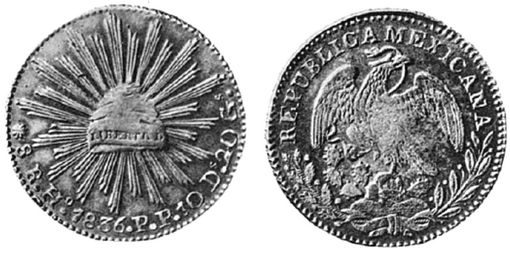 KM 377.9 8 reales 1836 Ho PP
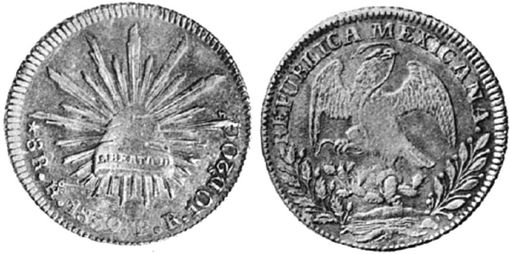 KM 377.9 8 reales 1839 Ho PR
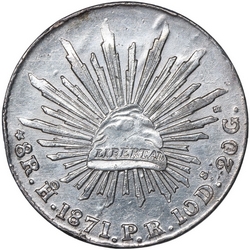
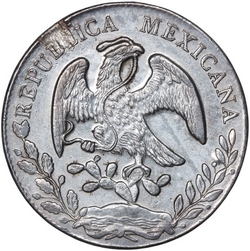
KM-377.9 8r 1871 Ho PR (Briggs & Bustos auction, 31 August 2025, lot 299)
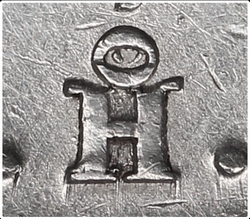 Variety with a large horizontal “O” over a small vertical “o” in the mintmark.
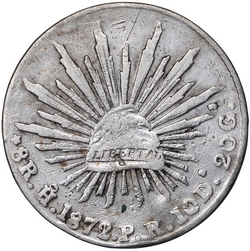
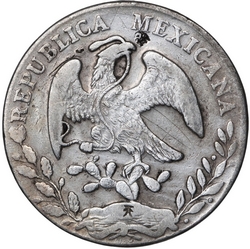
KM-377.9 8r 1872/1 Ho PR (Briggs & Bustos auction, 31 August 2025, lot 300)
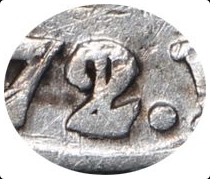 Extremely clear overdate.
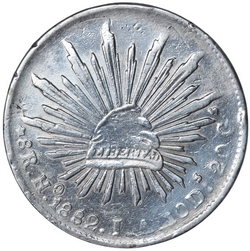
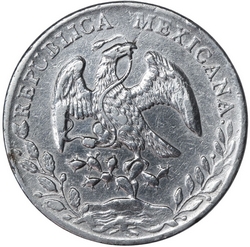
KM-377.9 8r 1882 Ho JA (Briggs & Bustos auction, 31 August 2025, lot 302)
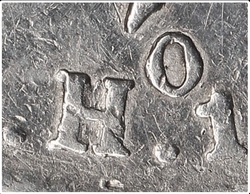 Scarce variety, with the mintmark featuring an “O” after the “H”.
By Pablo Luna Herrera{footnote}based on his website eldatonumismatico
On 16 July 1835, the Governor of Sonora, Manuel Escalante y Arvizu, issued a decree authorizing the issue of currency and the corresponding public offering for the lease of a mint in Hermosillo.
Prior to this, in May 1835, Hermosillo had requested matrices from Mexico City (in the understanding that they would be the copper cuartillas that they had been minting), but due to the urgent need for funds and because of the long distances to the capital Hermosillo decided to manufacture its own dies, starting on 1 November 1835. Some sources suggest coinage began on 18 November 1835. Although it was desired to mint gold, so far only silver 8 reales are known, for that couple of years.
On 23 December 1835 the Ministry of Finance condemned the coinage in Hermosillo without its authorization or official dies, asserting that these had been sent to Sonora months before, and ordered the suspension of work and the restricting of circulation of the coins already produced. The government of President Antonio López de Santa Anna quickly ordered the governor of the state, Manuel Escalante y Arvizu, to put an end to the illegal coinage, stating that the state governments had powers over copper coinage, but not silver coinage.
On 25 January 1836 Sonora reported that it had complied with the orders, and added that little currency had been minted because the scales had broken down. Some sources mention 50,000 to 70,000 pieces, with two different dies used for 1835.
KM 377.9 8 reales 1835 Ho PP (Heritage Long Beach auction, 19 September 2008, lot 21741)
KM 377.9 8 reales 1836 Ho PP
On all these pieces the assayer was Pedro Piembert, PP, the same assayer who was in charge of the official coinage almost thirty years later with the opening of the mint. The few known examples show wear and tear, so these coins did come into circulation.
The coins were withdrawn from circulation, melted down in Hermosillo and others were taken to Mexico City where they suffered the same fate, though some managed to survive. The government removed Eduardo Santoyo from office in 1836 for contempt of authority, employees were fired, and the mint was closed (apparently). On 28 May 1836, a decree was issued[text needed] that held Santoyo responsible for such issues.
Santoyo with his family retired to live in Guaymas, his copper coin continued to circulate throughout the territory until 1859, when negotiations began for the Hermosillo Mint to start operating again, melting down the previous coin to make the new one.
On 28 January 1837, the new governor of Sonora, Rafael Elías, asked Eduardo Santoyo to return to Hermosillo to "revive" the Mint, but Santoyo was too offended to return to minting work.
KM 377.9 8 reales 1839 Ho PR
In 1839, without Santoyo, a new 8 reales coin was minted, dated in that same year, and with certain changes. For example, the coin has finer details than the previous ones and in the mint mark the "O" is above the "H" and not as before it was on the right.
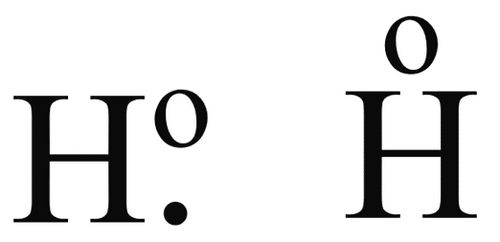
Dunigan and Parker{footnote}Mike Dunigan and J. B. Parker, Resplandores, Cap and Rays 8 Reales of the Republic of Mexico 1823-1897, Superior Stamp and Coin, Beverly Hills, 1997{/footnote} mention that the assayer could be Pablo Rubio, PR, arguing that the change in the mint mark demonstrated a second attempt to obtain authorization for minting silver coin in Hermosillo. This mint mark is the same as the one used in 1864, by the same assayer Pablo Rubio.
A ½ real 1839 is also known.
Finally, the Hermosillo Mint was closed on 29 November 1839.
Diameter 23 mm. 6.770 g. 0.8750 gold
| Date | Asssayer | Comment |
| 1861 | FM |
Diameter 30 mm. 13.540 g. 0.8750 gold
| Date | Asssayer | Comment |
| 1861 | FM |
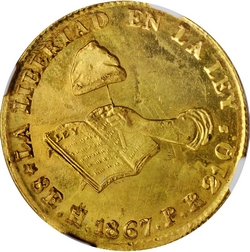
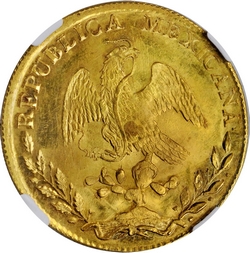
KM-383.8 8E 1867 Ho PR (Stack’s Bowers auction, 6 August 2020, lot 21474)
Diameter 37 mm. 27.070 g. 0.8750 gold
| Date | Asssayer | Comment |
| 1863 | FM | Ho mintmark |
| 1864 | FM | |
| 1864 | PR/FM | |
| 1865 | PR/FM | issued while Maximilian's forces controlled the mint (29 July 1865 - 12 September 1866) |
| 1867 | PR | |
| 1868 | PR | |
| 1869 | PR | |
| 1870 | PR | |
| 1871 | PR | |
| 1871/8 | PR | illustrated below |
| 1872/1 | PR | illustrated below |
| 1873 | PR |
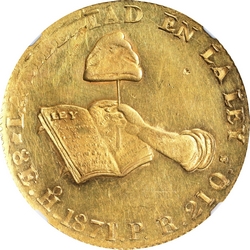
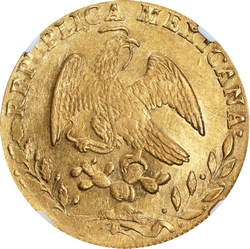
KM-383.8 8E 1871/8 Ho PR (Stack’s Bowers auction, 17 August 2024, lot 44443)
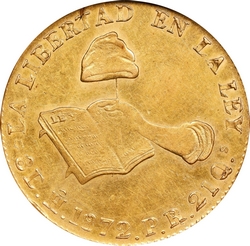
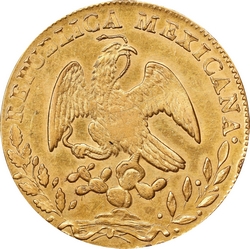
KM-383.8 8E 1872/1 Ho PR (Stack’s Bowers auction, 18 April 2024, lot 43329)
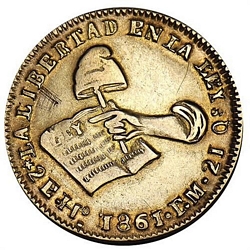
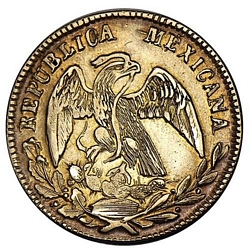
KM-380.7 2E 1861 Ho FM contemporary counterfeit (Ponterio auction, 11 January 2010, lot 1312)
“A contemporary counterfeit that was struck from the same reverse die as the coin offered in our 14 June 1993 auction, lot 367 that was withdrawn once it was determined to be a counterfeit. Somewhat crude die work, lightly cleaned but probably good enough to pass unnoticed.
In Richard A. Long's Gold Coins of the Early Mexican Republic 1823-1873 he notes that there have been a few appearances of this date and denomination from the Hermosillo Mint and all are extremely rare, but he also cautions that there have also been a few counterfeits of this date and mint and thus scrutiny is required. The coin that appeared in our 1993 auction noted above was dated 1862 Ho FM, and apparently was not issued by that mint for circulation in 1862. The counterfeiter apparently did not know this and used the reverse die from the present coin to continue with the nefarious process”.