Suriana
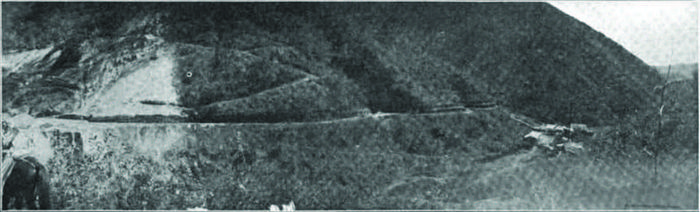
The Suriana Mining and Smelting Co., Guerrero, Mexico, showing mine (mid and upper left), and smelting plant (right), from the horse trail in, with horse in left corner, 1910The Engineering and Mining Journal, 1 October 1910, Hill Publishing Co., NY, NY, pp.663-664, photo of mine and plant, p.663,
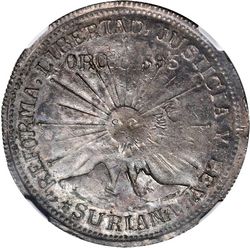
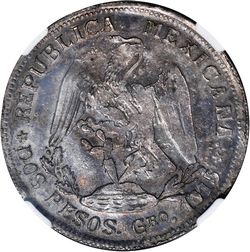
KM-665 Suriana $2 (Stack’s-Bowers Baltimore Auction, 16 November 2012, lot 11447)
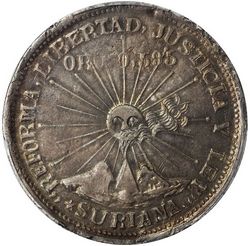
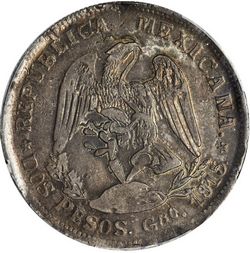
KM-665 Suriana $2 (Briggs & Bustos sale IX, 13 September 2024, lot 51:
ex. Ponterio & Associates sale 127, 20 September 2003, lot. 626)
According to several authors, it was General Adrián Castrejón, who ordered the production of “$2 coins in a camp near Campo Morado, modifying the popular reverse design with the radiant sun over two mountains and a volcano, substituting the locality of *Co Mo* (Campo Morado) for the legend *SURIANA. 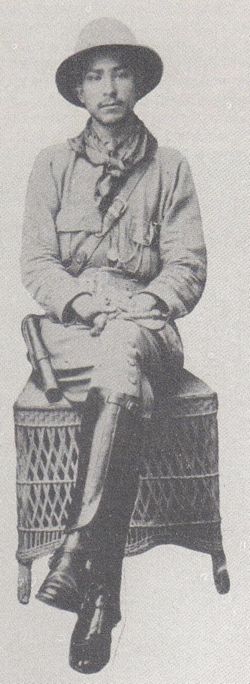 Castrejón was born in Apaxtla, , Guerrero, on 6 June 1893. On 2 July 1911,he joined the troops of Lieutenant Salvador González and later, under the orders of General Jesús H. Salgado, operated in the states of Guerrero and Morelos. In 1913 he organized his own guerrilla to operate against Victoriano Huerta and in favor of Emiliano Zapta; took Juchitlán, Guerrero, and was promoted to Lieutenant Colonel. He took part in operations in Guerrero, Michoacán, the Estado de México and Morelos. In 1918 he joined the forces of General Fortino Ayaquica Rangel, operating in the state of Puebla. On 10 April 1919 he accompanied Emiliano Zapata on his visit Jesús Guajardo at the Hacienda de Chinameca, where he was wounded without being able to save Zapata's life. After Zapata’s murder Castrejón remained loyal to the Suriano movement. He died in Mexico City on 15 March 1954.
A more detailed description, it is worth mentioning that the SURIANA were struck with an obverse die GB-177, something very similar happening with the reverse as it follows the same pattern of GB-177 in which the “locality” is framed in the lower part between stars, although in the case of Suriana it only has one at the beginning. Another particular detail of this issur is the culmination in point nine of the sun's rays, which is unique to this issue. About the type: It is mind-boggling that despite how extremely scarce it is today, at its time of production it was perhaps very trivial, the design pursued and managed to be, if not the most aesthetic, one of the most pleasing and emblematic of all the designs of revolution. In an exhaustive search by Briggs & Bustos, they located no more than 15 pieces.