Similarity of Die Details Between the Mainland Spanish Mints and the Mexico City Mint in the Early 1500s
by Cori Sedwick Downing
The Mexico City mint began making silver coins for the New World in the spring of 1536. The first viceroy, Don Antonio de Mendoza, oversaw a large area encompassing parts of modern-day North America, Central America, Mexico, and the Caribbean called New Spain. In addition to his other duties, he was responsible for the operation of the new mint, the first in Spanish America. He appointed Francisco del Rincón, who was already in Mexico, to the post of assayer and foundryman. Don García Manrique, the Conde de Osorno, arrived with Mendoza to become the first treasurer, by royal appointment. The first die-sinker, Antón de Vides, was appointed by Mendoza and served for the first two years of mint operation, about the same as the tenure of the first assayer, Rincón.
The die-sinker was responsible for producing the dies from which coins would be struck, and he received punches, or in- dividual elements, from Spain. They were not made locally, at least not at the beginning. This is important to note because of a similarity in style between punches from some of the Spanish mints-mostly the Granada mint where Mendoza came from—and the newly created Mexico City mint.
Historical Context
The marriage of Ferdinand and Isabel in 1469 in Spain heralded the unification of the Spanish crown under one rule, and the War of Castilian Succession from 1475 to 1479 affirmed Isabel as successor to the crown of Castile, previously held by Isabel's half-brother, Henry IV. As the so-called Catholic Monarchs (los Reyes Católicos), Ferdinand and Isabel consolidated their kingdom. In the next twenty years, they would oversee the expulsion of the Moors from the southern Iberian Peninsula and the conquest of Granada. Finally, the Catholic Monarchs issued the Alhambra decree in 1492 (Pragmática de 1492) ending the Moorish presence in Granada and forcing Spanish Jews to convert to Christianity or face expulsion. Another decree in 1497 (Pragmática de 1497) influenced how the seven remaining Spanish mints of Burgos, Coruña, Cuenca, Granada, Segovia, Seville, and Toledo would coin money. Thus, it is common practice to refer to Spanish coinage minted under the Catholic Monarchs as either before or after the decree of 1497. The designs would also last well into the next period of rule, which was chaotic until consolidated under Charles I, the grandson of the Catholic Monarchs, and Joanna, their daughter (who was insane and a ruler in name only).
Spanish Coin Designs Before and After the Decree
Coins from 1475, when Isabel became the rightful heir of Castile, to well past 1497, when a decree specified new mint standards, are undated but can be easily identified by design differences. Prior to 1497, coinage bore a shield with the simple quartered lions and castles (for the House of Trastámara to which both Isabel and Ferdinand belonged), while after 1497 the coins bore a shield containing elements of old and new territories (Castile, León, Aragón, Granada), the so-called shield of the Catholic Monarchs.
Mintmarks and assayer marks became required elements as did the introduction of the yoke (yugo, for Isabel, spelled Ysabel) and sheaf of arrows (flechas, for Ferdinand). Lettering was Gothic, as before the Pragmática de 1497, but over time the let- tering evolved to Latin. There were other changes that do not really pertain here.
Design Similarities Between Spain and Mexico City Coinage
Some of the similarities of design elements between the Spanish mints, particularly the Granada mint, and the newly created mint at Mexico City may be due to Viceroy Mendoza's involvement. He was authorized to design copper coins, so it is not hard to imagine that he would have had some influence on silver coins as well, given his experience:
The decree for the founding of the Mexico City mint set no design for the copper coinage as it had for the silver. Rather, it ordered the viceroy, as "a person who... has had experience in this matter, having been our Treasurer of the mint of Granada," to order the design and metal for the copper coins, to have them minted, and to send a report on them to the Council of the Indies. (Robert Nesmith, author of The Coinage of the First Mint of the Americas at Mexico City, 1536-1572, p. 40.)
Shield Design
The carryover designs may go back even further than Mendoza's involvement, all the way to the Trastámara shield that was used on Spain coins minted before 1497. Below illustrates the simple castles/crowned lions design minus the pomegranate (which symbolized Granada, not yet fully under the complete control of the monarchy).
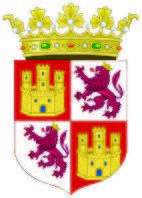
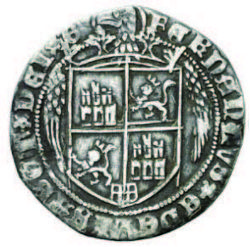
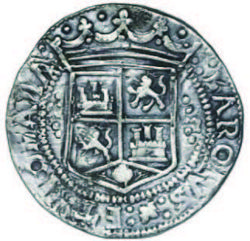
Trastámara shield (in Spain prior to 1497) Pre-1497 shield (Segovia 1 real) Mexico City shield (1536 and after)
Gothic Lettering
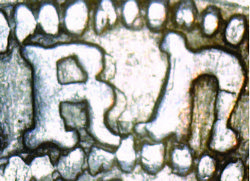
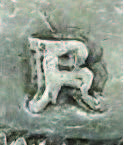
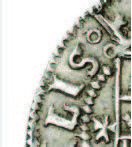
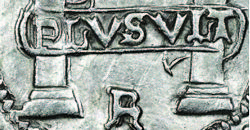
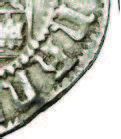
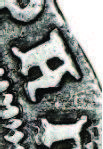
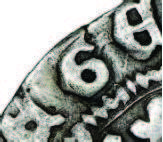
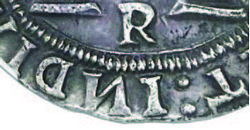
Gothic lettering found on coins from the mainland Spanish mints is very similar to lettering found on the earliest coins at the Mexico City mint under the first assayer, Francisco del Rincón (Assayer R). This is not surprising, especially considering Viceroy Mendoza's affiliation with the Granada mint.
 |
 |
|
| Gothic R detail from 2 reales, Granada mint (Sedwick Treasure Auction #26, November 2019. lot 553) |
Gothic R detail from 3 reales, Mexico City mint (Sedwick Treasure Auction #22, November 2017. lot 517) |
 |
 |
|
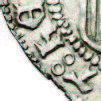
| Gothic L and S detail from 1 real, Granada mint (Sedwick Treasure Auction #26, November 2019, lot 561) |
Gothic L and S detail from 2 reales, Mexico City mint (Ponterio Auction #150, August 2009, lot 9087) |
 |
 |
|
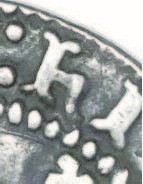
| Gothic H detail from 2 reales, Granada mint (Sedwick Treasure Auction #26, November 2019, lot 553) |
Gothic H detail from 2 reales, Mexico City mint (Sedwick Treasure Auction #23, May 2018. lot 692) |
 |
 |
|
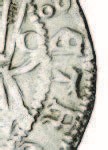
| Gothic ET detail from 2 reales, Granada mint (Sedwick Treasure Auction #26, November 2019. lot 553) |
Gothic ET detail from 3 reales, Mexico City mint (Sedwick Treasure Auction #12, October 2012, lot 897) |
 |
 |
|
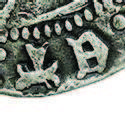
| Gothic AN detail from 1 real, Granada mint (Sedwick Treasure Auction #26, November 2019. lot 561) |
Gothic AN detail from 3 reales, Mexico City mint (Sedwick Treasure Auction #24, November 2018, lot 664) |
 |
 |
|
| Gothic G (mintmark for Granada) from 1 real, Granada mint (Sedwick Treasure Auction #26, November 2019. lot 561) |
Gothic G detail from 4 reales, Mexico City mint (Sedwick Treasure Auction #24, November 2018, lot 664) |
Latin Lettering
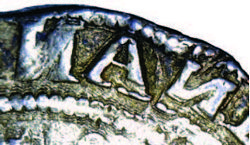
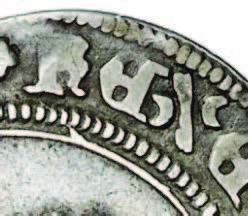
Coins from mainland Spanish mints and the Mexico City mint eventually changed to Latin lettering instead of Gothic. A curiosity from the Mexico City mint is the rather common appearance of the Latin letter N in retrograde. It should not be surprising that a retrograde N can also be found on coins minted in Spain, both at Granada and Seville mints. There is also a Granada mint retrograde S, as is true of Mexico City as well. Below are examples of the retrograde N from the Granada and Mexico City mints.
 |
 |
|
| Retrograde N detail from 2 reales, Granada mint (Sedwick Treasure Auction #26, November 2019, lot 554) |
Retrograde N detail from 4 reales, Mexico City mint) (Sedwick Treasure Auction #25, May 2019. lot 650) |
Cross Potent
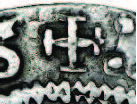
The cross potent is a cross with a crossbar at the end of each of its arms, and it was featured in the design of all mainland Spanish mint coinage at 12 o'clock on the reverse side as a start/stop for the legend. It was also used in Mexico City under Francisco del Rincón, but only on the earliest 3 reales coins, which were some of the first coins issued by that mint. After that, a special letter X took its place until the cross potent was revived in the issues of assayer P.
 |
 |
|
| Cross potent detail from 1 real, Granada mint (Sedwick Treasure Auction #26, November 2019, lot 558) |
Cross potent detail from 3 reales, Mexico City mint (Sedwick Treasure Auction #24, November 2018, lot 664) |
Use of Letter X
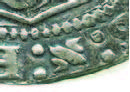
The letter X has been somewhat controversial. In Spain, the letter was not used on coin designs until after the 1497 decree, when it was used to complete the obverse legend FERNANDVS ET ELISABET D G REX ET REGINA and its variations. The royal decree which laid down laws for minting practices in Mexico City (Pragmática de 1535) stated that the legend should read CAROLVS ET JOANA REGES HISPANIE ET INDIARVM, or whatever part could be included. Thus, there was no need to use an X punch; instead, it was used as a separator, or stop, between words in the legend on certain denomi- nations (all but the 3 reales) and only under the first assayer, Francisco del Rincón. Once the next assayer (P) took over, the designs and letters changed completely, and only Latin lettering was used.
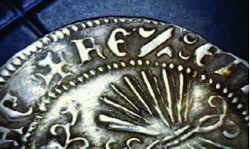
It has been theorized that the Mexico City X was an aleph, the first letter in the Hebrew alphabet, perhaps as a veiled symbol planted by conversos or Jews who had converted to Catholicism after the Reconquest in 1492. (See A Hebrew Letter on the New World’s First Coins? by David L. Nathan, M.D.) This seems unlikely, and a simpler explanation would be that the X that had been used at the mainland Spanish mints (at least at Burgos and Granada) was re-purposed in Mexico City. This unusual-looking X is made of three elements: a diagonal line (either from the top left to the bottom right or bottom left to top right) and two symbols in each of the remaining corners to give a stylized appearance of the letter X.
Below are examples of the letter X from the Burgos and Granada mints, followed by Mexico City mint. Note the similarity of design:
| Burgos | Granada | Mexico City | ||
 |
 |
 |
||
| 1 real like Mexico City X (Aureo Auction #322, November 2018. lot 128) |
1 real like Mexico City X (Sedwick Treasure Auction #26, November 2019. lot 558) |
X detail on 4 reales, Mexico City mint (Sedwick Treasure Auction #13, May 2013, lot 932) |
It is not hard to imagine that there would be a carryover of designs from at least the Granada mint in Spain, where Mexico's first viceroy and overseer of mint operations, Antonio de Mendoza, worked before coming to the Americas. Gothic lettering was the first lettering we see on coins from Mexico City, namely the ¼, ½, 1, 2, and 3 reales. Not long after, the 3 reales was discontinued in favor of 4 reales coins, and those coins show a mixture of Gothic, crude, and later Latin lettering as punches broke or wore out. The similarity of design of the Gothic punches between the Granada mint and the Mexico City mint is evident, and while we do not know a lot about the inner working of the Mexico City mint, we can let the coins tell us a story.