Mexican coins used in the East
Java
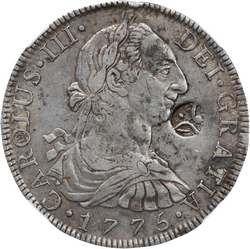
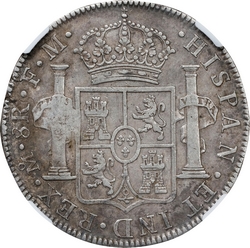
KM-184.1 Ducaton (Taler, Daalder), ND (ca. 1772-89) (Stack’s Bowers auction, 16 December 2024, lot 44536)
Countermark: "Jawa" in Arabic script, applied to a 8r 1775Mo FM of Charles III (KM-106.2).
Madras, India
In Madras bust 8 Reales had their edges shaved down, were re-edged and were completely overstruck.
New South Wales
When the colony of New South Wales was founded in 1788, it ran into the problem of a lack of coinage. Foreign coins, including British, Dutch, Indian and Portuguese, were common in its early years, but much of this coinage left the colony by way of trade with visiting merchant ships. Barter was a necessity amongst the colonists, with the most popular, rum, becoming an unofficial currency. One of the first attempts to restrict the practice was by Governor Philip Gidley King, who on 19 November 1800 set an arbitrary price for foreign coinage (the Spanish dollar was given a value of five shillings), but there was never enough of it. The practice of using rum as a currency was prohibited by Governor Bligh in 1806, eventually culminating in the overthrow of the government in the Rum Rebellion.
To overcome this shortage of coins, Governor Lachlan Macquarie took the initiative of using £10,000 in Spanish dollars sent by the British government to produce suitable coins. These coins to the value of 40,000 Spanish dollars came on 26 November 1812 on HMS Samarang from Madras, via the East India Company.
Instead of releasing them into general circulation where they would be spent on goods arriving on merchant trade ships from all over the world and thus leave the colony almost as quickly as they arrived, Macquarie decided to solve the currency crisis by making these Spanish dollars a New South Wales currency.
So after consultation with the Judge Advocate and other officials, Governor Macquarie had a convicted forger named William Henshall cut the centres out of the coins and counter stamp them, thus making them useless outside the colony.
Henshall had worked as a metal plater and cutler in England. He arrived in the colony of New South Wales after being sentenced in 1805 to seven years transportation for his involvement in counterfeiting. He provided authorities with information about other forgers and ways of combatting the crime in exchange for an assurance his wife and family would accompany him to New South Wales. Henshall was granted an absolute pardon on 12 September 1812, six months before his sentence was due to end.
Macquarie provided Henshall with a workshop in the basement of a building known as ‘The Factory’, near the corner of Bridge and Loftus streets, by the eastern bank of the Tank Stream.
Macquarie initially anticipated that the task of converting the 40,000 Spanish coins would take three months, but the project took over a year to complete. Henshall had to experiment with making the necessary machinery, which proved difficult. It seems that a drop hammer, as opposed to a screw press, was used to stamp the coins.
The central plug (known as a dump) was valued at 15 pence, and was restruck with a new design (a crown on the obverse, the denomination on the reverse). Henshall inscribed his initial between the words ‘FIFTEEN’ and ‘PENCE’. The holey dollar received an overstamp around the hole ("NEW SOUTH WALES 1813" on the obverse, "FIVE SHILLINGS" on the reverse).Again. Henshall incorporated his ‘H’ initial into the spray of leaves of the counterstamp design.
The combined nominal value in New South Wales of the holey dollar and the dump was 6 shillings, 3 pence, or 25 per cent more than the value of a Spanish dollar; this made it unprofitable to export the coins from the colony.
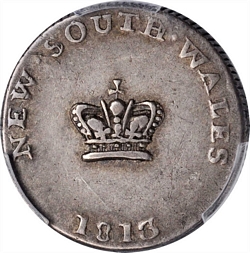
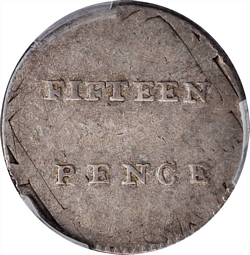
KM-1.3 15 Pence (Dump) 1813 (Stack’s Bowers auction, 15 January 2021, lot 20060)
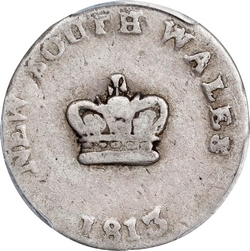
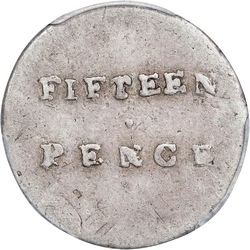
KM-1.4 15 Pence (Dump) 1813 (Stack’s Bowers auction, 14 August 2024, lot 42001)
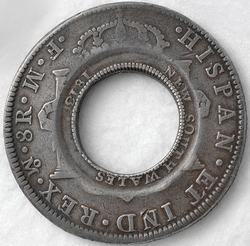
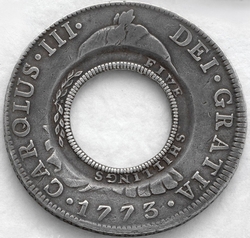
Of the 40,000 Spanish dollars imported, 39,910 holey dollars and 39,910 dumps were made, with the balance assumed to have been spoiled during the conversion process. On 1 July 1813 Governor Macquarie issued a proclamation that the money should be legal tenderThe Sydney Gazette and New South Wales Advertiser, 10 July 1813.
The first batch of new coins was delivered to Deputy Commissioner-General David Allen on 25 February 1814. The final batch was delivered in August of the same year.
Henshall left the colony for England in 1817. It is not known what became of him.
From 1822 the government began to recall the coins and replace them with sterling coinage. By the time the holey dollar was finally demonetised in 1829, most of the 40,000 coins in circulation had been exchanged for legal tender and melted down into bullion. Experts estimate that only 300 holey dollars and 1000 dumps remain. Of the almost 300 known holey dollars, the majority of the host coins were struck in Mexico.
Sumenep
Sumenep was a sultanate on Madura island in the Dutch East Indies (now Indonesia).
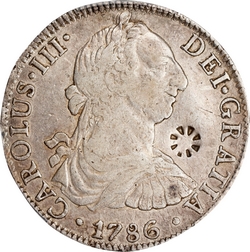
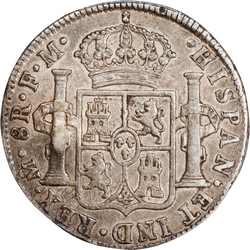
KM-201.3 (Stack’s Bowers auction, 18 April 2024, lot 43355)
A Type S6 8-Pointed star countermark on a 8r 1786 Mo FM (KM-106.2a).
Thailand
This interesting and seldom encountered issue should be considered the first Crown size coin of Thailand. Several Royal proclamations were issued specifically pertaining to the use and exchange of foreign silver "Flat coins" that were imported for trade. Initially, the exchange rate fluctuated as the supply of imported specie could not keep up with the demand of re-minting them into Pot Duang (Bullet coinage). The 7 January 1857 decree finally stipulates that a fixed rate of exchange was one Tamlung one Baht (five Baht) to three foreign silver coins and that they could be exchanged at the Royal Treasury. Since different types of foreign coins were being imported many merchants were hesitant to accept them in trade at the prescribed rate. Later several more decrees were issued to try to address the hesitation of the merchants refusing to accept them in transactions even going so far as penalizing those who declined them. Eventually, the most common coin in circulation at the time, the Mexican "Dollar", often referred to as "Bird" coins became the standard being marked on the obverse with the Chakra wheel and Mongkut emblems.
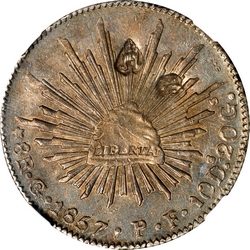
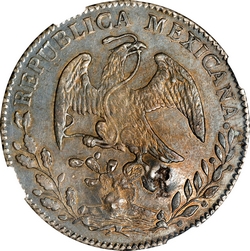
KM-C-141.6 Trade Dollar, ND (1858-60) (Stack’s Bowers NYINC auction, 13 January 2023, lot 21454)
Mongkut and Chakra countermarks applied to 8r 1856 Go PF (KM-377.8). The countermarks, in typical fashion for this issue, are uneven on the obverse with the characteristic "melting spot" on the corresponding reverse.
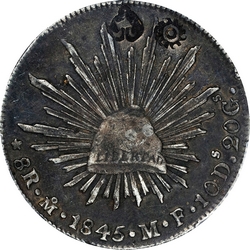
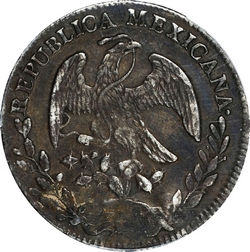
KM-C-141.8 (Stack’s Bowers NYINC, 13 January 2024, lot 53308)
Mongkut and Chakra countermarks applied to a 8r 1845 Mo MF (KM-377.10).
Timor
In Timor the mark of the Order of Jesus Christ our Lord and Savior was applied to all genuine Cap and Ray 8 Reales.