Counterfeit silver Ejército del Norte $1 (1915)
by Scott Doll
Introduction
The next in my series of articles on counterfeit detection for Mexico Revolutionary coinage will focus on the counterfeit silver 1 peso with a date of 1915 from the state of Chihuahua. The Guthrie-Bothamley catalog number for an authentic coin is GB-72 and the Carlos Amaya catalog number is A-CH-86. Although this is not a rare coin, it is a variety that is very collectible and popular since it is one of only a small number of large crown size silver coins minted during the Mexican Revolution. The original strikes are also one of the higher quality and well-designed coins from the Revolution. With all that said, I would say this is a good target coin for counterfeiters. Based on my observation, the fakes only show up sporadically at coin shows or on eBay. If a coin becomes available and you are looking to possibly buy it, it is well worth the effort to really look over the coin since there are some relatively well-made counterfeits and a collector could be easily fooled.
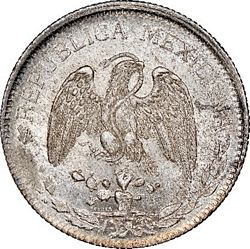
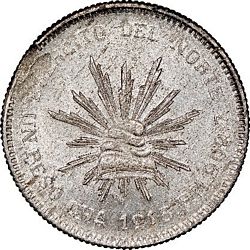
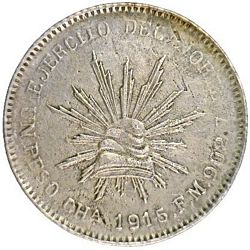
Genuine Example (Struck)
State of Chihuahua Silver 1 peso (1915) Reeded Edge,
25.90 g, 39.30 mm
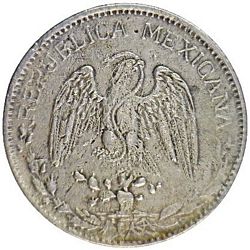
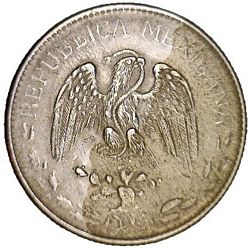
Counterfeit Example #1 (Cast)
State of Chihuahua Silver 1 peso (1915) Reeded Edge,
26.95 g, 37.82 mm
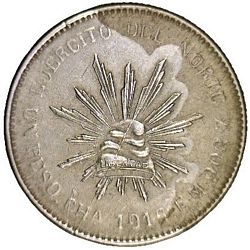
Counterfeit Example #2 (Cast)
State of Chihuahua Silver 1 peso (1915) Reeded Edge,
30.55 g, 39.03 mm
General Observations
Overall, the quality and strike of the genuine coin is superior, however a better made cast coin such as Counterfeit #2 comes close in quality for coin details albeit with a rough surface while counterfeit #1 has very weak details with a very rough surface of pitting and pimples, typical of many cast coins.
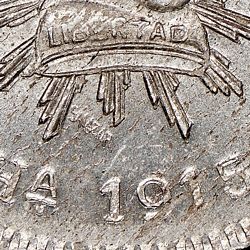
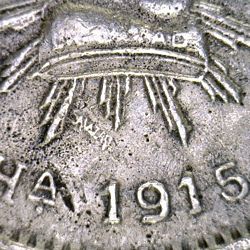
Genuine Counterfeit #1 Counterfeit #2
Many genuine strikes of this variety have streaky planchets which are visible on both sides of the coin while other genuine strikes have a smoother surface and may or may not have slight streakiness. Cast examples have rough and generally uneven surfaces throughout, although cast Counterfeit #2 does have a rough surface as well as some slight planchet streakiness which came through from the base coin during the cast process and can be seen within some of the darker areas of the planchet.
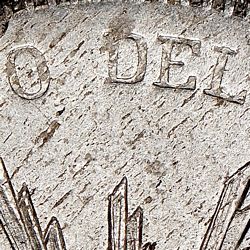
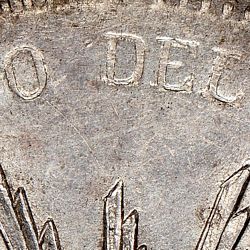
Genuine Examples
Far left specimen which has a streaky planchet while the genuine example on the right shows a smoother surface with no streaking or planchet issues.
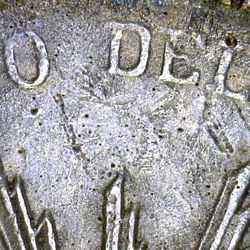
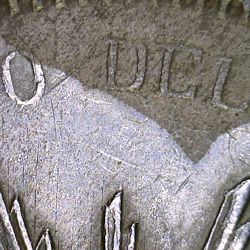
Counterfeit Examples
Far left specimen shows obvious cast characteristics, while the example on the right has a smoother, still uneven surface but does have some slight streakiness in some of the darker areas of the planchet.
Obverse and Reverse Attributes Differences
Since most of the counterfeit examples seen in the market are cast from genuine Chihuahua 1 peso coins, the obverse and reverse design attributes will be the same on both coins highlighted within this article. In the case of Counterfeit #1, the coin details on the letters and designs elements are not as sharp compared to Counterfeit #2 due to the crudeness of the cast. However, if you review each counterfeit coin closely, you will see that the base case utilized was the same variety as a genuine struck Chihuahua peso coin.
Edge Differences
Although the genuine strike and the pair of counterfeit coins discussed here are attributed with a reeded edge, there are several slight differences that I feel are worth noting. The genuine coin has very straight and evenly placed reeding throughout the edge, while both fakes are more inconsistent. Counterfeit #1 has more random, unevenly spaced reeding, while counterfeit #2 was made with much more consistent and closer reeding spacing more like the genuine strike. Regarding Counterfeit #2, a majority of the reeding has a very thin groove or notch located across the top of the reeding. This thin groove is not seen on the genuine strike, nor on Counterfeit #1. Reviewing the edge on these fakes may not be enough to determine a counterfeit with a high degree of confidence: however, it is simply one of the attributes you have at your disposal to help make an educated decision on authenticity.
See the following close-up images for a better view of each coin example.
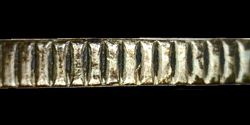
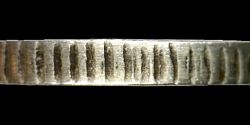
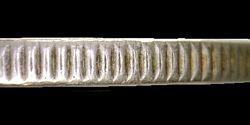
Genuine Counterfeit #1 Counterfeit #2
Although there are other attributes that might help highlight the differences between a genuine and a counterfeit of this variety, the information mentioned above should suffice as the key points to review when you come upon one of these coins.
Summary
The modern counterfeits of a 1915 State of Chihuahua silver 1 peso are generally not that well manufactured: therefore, it should only be considered a somewhat dangerous counterfeit. In the case of Counterfeit #2, it may fool the novice collector as well as some seasoned collectors, compared to Counterfeit #1 which should not fool anyone. When looking to purchase a coin of this variety, the key thing to do is to closely examine the entire coin and review the attributes outlined within this article so you can make an educated judgment on authenticity.