Pre-Columbian Series – Toltec Collection – Silver 1 Oz. (Uncirculated & Proof)
by Alberto Rodriguez
Foreword
In the earliest articles of this series, I set out to illuminate the artistry and complexity of Mexico’s Pre-Columbian 1 ounce silver coins, specifically to trace their lineage, their myths, and their uncertain survival. Along the way, I have come to believe that collecting alone is not enough. We, as collectors, inherit not just coins, but the responsibility to tell their story.
Today’s numismatic landscape often rewards speed over substance, one where flipping replaces studying, and price charts overshadow provenance. Yet behind every coin lies a silence that deepens each year Banco de México remains opaque about the truth. There are no official accounts explaining which specific year restrikes were made (in the case of designs across multiple years), how many survived the great melts, or even how the series was envisioned in its entirety. That silence is an invitation and a challenge.
If the mint will not tell the story, then it falls to us. Our task is not to invent numbers or embellish truth, but to bring light where none exists. We may never pinpoint exact mintages or reconstruct every restrike, but we can strive to present the most faithful reflection of reality, one that is built through evidence, dialogue, and the collective work of serious collectors who care about more than value.
The six articles in this series were never meant to be definitive tables of record. Rather, they represent an honest pursuit of clarity and a living archive for those who come after us. Because in the absence of transparency, even an imperfect truth, told with integrity, becomes an act of preservation.
Introduction
Released in 1998, the sixth and final Pre-Columbian set honors the Toltecs, whose civilization centered on Tula in today’s state of Hidalgo. With a population around 40,000, the Toltecs flourished from the mid-9th to the 12th century, leaving an archaeological zone of ball courts, pyramids, and residences. Their most renowned monument is the Temple of Tlahuizcalpantecuhtli (Morning Star), also known as the Pyramid of Quetzalcóatl, which is capped by the famous Atlantean figures: warrior statues wearing butterfly-shaped breastplates and carrying atlatls (spear-throwers). Carvings along the pyramid show jaguars, coyotes, and eagles consuming human hearts.
The Toltecs built a respected educational tradition that drew students from as far as Central America. They cultivated maize and cotton (legend says in naturally bright colors), traded widely, especially obsidian, and maintained martial dress that included breastplates, shields, and headdresses. Their religion was polytheistic, venerating deities such as Tlaloc (rain), Centéotl (corn), Itzpapálotl (“Obsidian Butterfly,” a fearsome warrior goddess), and Tonatiuh (sun). Rituals included human sacrifice, notably heart extraction at the Morning Star temple.
Much Toltec history comes through Aztec texts, where history and legend mingle, highlighted most famously by the tale of Quetzalcóatl, who ruled among the Toltecs as a man and departed with a promise to return; later Aztecs linked that prophecy to Cortés. Architectural parallels between Tula and Chichén Itzá hint at close ties or trade. The Toltec polity declined in the 12th century, likely under Chichimec invasion. Tradition holds the last ruler, Huemac, led survivors toward Chapultepec, where Toltec remains have been found. Modern study of Tula began in the 1940s with excavations by Jorge Acosta.
Before delving into this installment, it is worth revisiting two recurring factors that have long obscured a clear understanding of mintages within the Pre-Columbian series. As noted in previous articles, most coin directories and reference catalogs list only the original mintages from the years of first release, omitting the officially published restrikes later issued by the Banco de México. In reality, the Pre-Columbian series continued to be struck intermittently through 2011, covering dates from 2000 onward.
A second consideration, what I have come to call the “Melted Factor”, is equally important. Collectors and dealers in both Mexico and the United States have observed that during the parabolic silver rally of 2010–2011, an estimated 35–50% of the silver Pre-Columbian coins were melted for bullion. Contemporary accounts from Mexican collectors and archived forum discussions support this, noting that many pieces were treated as little more than spot-priced silver, often showing surface marks from acid testing.
Taking this Melted Factor into account provides a truer sense of the surviving population today. Based on feedback from earlier articles, proof issues have historically maintained a premium and are therefore less affected, likely toward the lower bound of the estimate (~35%), whereas the Brilliant Uncirculated coins, often handled as bullion, probably suffered closer to the 50% melt range. Collectors increasingly report that high-grade uncirculated examples have become far more elusive than their proof counterparts.
Jaguar
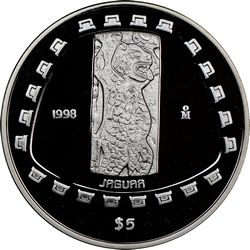
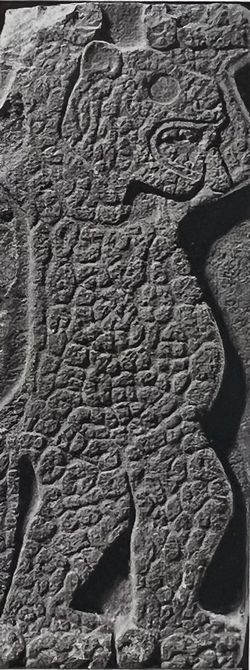 The 1998 one ounce silver Jaguar coin features a design adapted from a bas-relief sculpture housed in Mexico City’s National Museum of Anthropology. It portrays a jaguar, a sacred symbol in Mesoamerican culture, carved in geometric form on a temple column associated with Quetzalcoatl-Tlahuizcal. Struck in both Brilliant Uncirculated and Proof finishes, the coin represents one of the final four silver releases in the Pre-Columbian series.
Jaguar – Brilliant Uncirculated (BU) Variety Overview
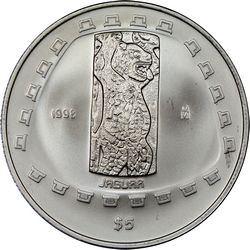
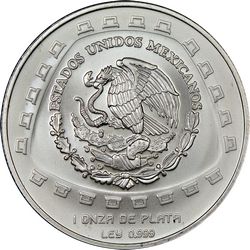
KM-663 1998 1 oz silver, $5 (MMR) Brilliant Uncirculated
The Brilliant Uncirculated coin has as reverse a sculpture of a Jaguar at the center of the field with the date to the left, the mintmark to the right (MMR), and JAGUAR in the exergue below. An ornamental border surrounds the trapezoidal field with N$5 below. There is only a single 1998 issue, unlike earlier Pre-Columbian collections which released identical designs across multiple years.
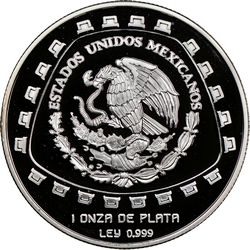
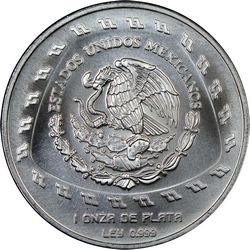
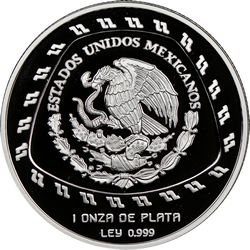
The obverse of the coin displays the national coat of arms with the eagle facing left with its feathers resembling plates of armor on the center of a horizontal oval field. Above it is the legend ESTADOS UNIDOS MEXICANOS, and below it, a half-wreath of oak and laurel. Surrounding the field is an ornamental border. Below the border is displayed 1 ONZA DE PLATA, and further below LEY 0.999.
According to the Whitman Encyclopedia of Mexican Money, there were 5,800 original strikes for the 1998 issue of the 1oz silver Jaguar coin. The three primary sources typically referenced in these matters: the Standard Catalog of World Coins, the Whitman Encyclopedia of Mexican Money, and Numista again show slight but notable discrepancies for this Toltec design.
For 1998, Whitman lists 5,800 original strikes, Numista reports 6,000, and the Standard Catalog of World Coins matches Whitman at 5,800. As in prior cases across the Pre-Columbian series, even these relatively close figures highlight the persistent challenge of reconciling original mintage records from Banco de México’s archives versus later numismatic estimates. While the variation here is modest compared to other issues, I continue to rely on Whitman’s figure of 5,800 for official reporting, following the same convention established throughout this series for consistency and source continuity.
Banco de México’s published restrikes for this design total 1,300 coins, bringing the grand total to 7,100 pieces. Unlike earlier series entries such as the Disco de la Muerte or Brasero Efigie, there is no ambiguity of cross-year restrikes or split mintages. All evidence and catalog listings confirm that the Jaguar was a single-year issue minted exclusively and marked 1998.
Applying the melted factor discussed in prior articles, estimating that 35–50% of these coins no longer survive, we arrive at the following:
| 1oz Silver MS Pre-Columbian Series - Jaguar | |||||
| Original Mintage | Restrikes | Total Including Restrikes | Estimated Minimum Surviving | Estimated Maximum Surviving | |
| 1998 5 Pesos MMR | 5,800 | 1,300 | 7,100 | 3,550 | 4,615 |
Jaguar – Proof Variety Overview
KM-663 1998 1 oz silver, $5 (MMR) Proof
The 1oz Jaguar silver Proof shares the same coin elements as its Brilliant Uncirculated counterpart but is further distinguished by a mirrored inner field and border area on both sides with a raised and frosted denomination on the reverse as well as a raised and frosted legend on the obverse. Similar to the Brilliant Uncirculated, only a 1998 variety was released for the Proof edition of this coin design.
Again, the same three principal reference sources each provide slightly different figures for this Toltec design. For 1998, Whitman lists 4,300 original strikes, Numista reports 4,800, and the Standard Catalog aligns again with Whitman at 4,300. While this variation is relatively minor compared to the discrepancies seen in earlier Pre-Columbian issues, following the same approach applied across prior analyses in this series, I have defaulted to Whitman’s figure of 4,300 original strikes for consistency and reliability.
Banco de México’s published restrike data show 1,150 additional Proof pieces issued under this design, bringing the cumulative total for the 1998 Jaguar Proof to 5,450 coins. Applying the same melted-loss factor, yields the following estimated survival range:
| 1oz Silver PF Pre-Columbian Series - Jaguar | |||||
| Original Mintage | Restrikes | Total Including Restrikes | Estimated Minimum Surviving | Estimated Maximum Surviving | |
| 1998 5 Pesos MMR | 4,300 | 1,150 | 5,450 | 2.725 | 3,543 |
Quetzalcóatl
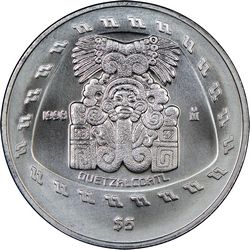
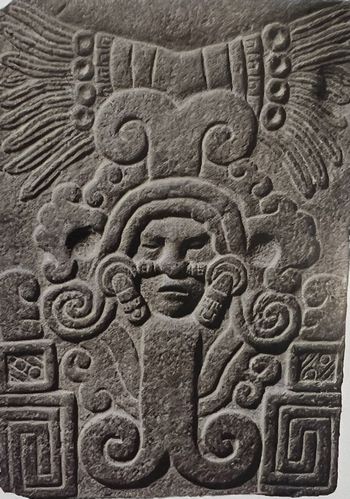 The 1998 1-ounce silver Quetzalcóatl coin honors the birth of Ce Acatl Topiltzin Quetzalcóatl, the legendary Toltec leader whose influence shaped early Mesoamerican civilization. Its design reproduces a bas-relief from the National Museum of Anthropology in Mexico City, depicting the serpent deity surrounded by emblematic motifs of power and renewal.
Tradition holds that Quetzalcóatl guided the Toltecs in founding a prosperous and enlightened society by uniting military strength, territorial expansion, and cultural achievement. He is remembered for promoting the cult of the serpent and for his effort to end human sacrifice during his reign. The border design of the coin reflects this legacy, incorporating a belt-like motif drawn from ancient Toltec iconography.
Issued in 1998 and denominated 5 pesos, the Quetzalcóatl was struck both in Brilliant Uncirculated and Proof finishes.
Quetzalcóatl – Brilliant Uncirculated (BU) Variety Overview
KM-665 1998 1 oz silver, $5 (MMR) Brilliant Uncirculated
The Brilliant Uncirculated coin has as reverse of a sculpture of the birth of Quetzalcóatl at the center of the trapezoidal field, with the date to the left, the mintmark to the right (MMR), and QUETZALCOATL in the exergue below. An ornamental border surrounds the trapezoidal field with N$5 displayed below. Like all its Toltec counterparts, there is only a single 1998 issue.
Whitman lists 7,100 original strikes, Numista reports a lower figure of 5,000, and the Standard Catalog of World Coins again aligns with Whitman at 7,100. While the variation here is broader than that seen with some other Toltec issues, such discrepancies are not uncommon in this series due to differences between Banco de México source records and later numismatic consolidations. Consistent with the methodology applied throughout this project, I have defaulted to Whitman’s figure of 7,100 originals, reflecting both its internal consistency and the source’s close alignment with official mint archives.
Banco de México’s published restrike data indicate 2,000 additional coins produced for this design in subsequent years, bringing the total mintage to 9,100 pieces. Like the Jaguar and other Toltec entries, the Quetzalcóatl was strictly a single-year design, exclusively dated with 1998, and there is no evidence of cross-year re-dating.
Applying the melted-loss factor, estimating that 35–50% of all pieces have since been lost, melted, or otherwise untraceable, we can derive the following estimated survival range:
| 1oz Silver MS Pre-Columbian Series - Quetzalcóatl | |||||
| Original Mintage | Restrikes | Total Including Restrikes | Estimated Minimum Surviving | Estimated Maximum Surviving | |
| 1998 5 Pesos MMR | 7,100 | 2,000 | 9,100 | 4,550 | 5,915 |
Quetzalcóatl – Proof Variety Overview
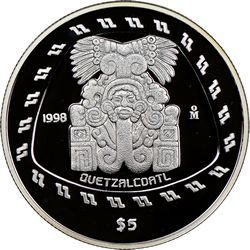
KM-665 1998 1 oz silver, $5 (MMR) Proof
The Proof varieties share the same coin elements as its Brilliant Uncirculated counterpart but are further distinguished by a mirrored inner field and border area on both sides with a raised and frosted denomination on the reverse as well as a raised and frosted legend on the obverse. Similar to the Brilliant Uncirculated, only a 1998 variety was released for the Proof edition of this coin design.
For 1998, Whitman lists 3,900 original strikes, Numista reports a higher figure of 4,800, and the Standard Catalog again agrees with Whitman at 3,900. Although these discrepancies are narrower than those seen in some earlier Pre-Columbian issues, they remain significant enough to warrant evaluation. Again I have adopted Whitman’s figure of 3,900 as the authoritative base mintage due to its alignment with the official mint documentation and its long-standing citation in Don Bailey’s published research.Banco de México’s published restrike data show an additional 1,600 Proof coins struck in subsequent years, bringing the combined total for the 1998 Quetzalcóatl Proof issue to 5,500 pieces. As with the Brilliant Uncirculated counterpart, all Quetzalcóatl Proof coins were issued solely for the 1998 design year, with no re-dated or multi-year variations reported.
Applying the same melted-loss factor yields the following estimated survival range:
| 1oz Silver PF Pre-Columbian Series - Quetzalcóatl | |||||
| Original Mintage | Restrikes | Total Including Restrikes | Estimated Minimum Surviving | Estimated Maximum Surviving | |
| 1998 5 Pesos MMR | 3,900 | 1,600 | 5,500 | 2,750 | 3,575 |
Sacerdote
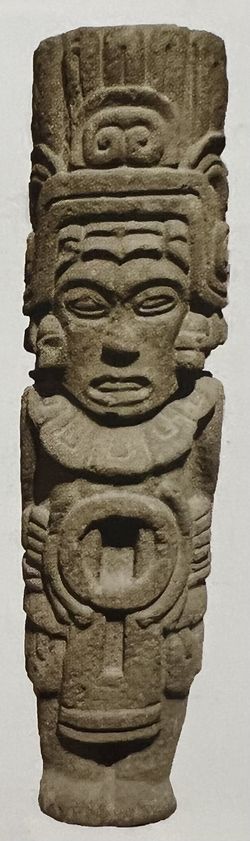 The 1998 1-ounce silver Sacerdote (Priest) coin portrays one of the distinguished Atlantean figures of the Toltec civilization’s monumental stone columns carved in human form that once stood atop the Temple of Tula. This particular depiction represents a Toltec priest, a figure of profound spiritual and social influence.
In Toltec culture, priests held elevated status as intermediaries between humankind and the divine. They adopted the attributes and virtues of the gods they served, embodying religious authority and the guardianship of sacred knowledge. The border motif encircling the coin is derived from the intricate ornamentation found on ancient Toltec vestments, symbolizing devotion and the continuity of ceremonial tradition.
Issued in 1998 and denominated 5 pesos, the Sacerdote was struck in both Brilliant Uncirculated and Proof finishes.
Sacerdote – Brilliant Uncirculated (BU) Variety Overview
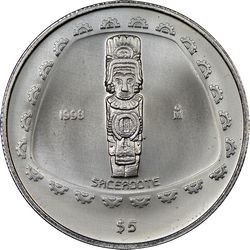
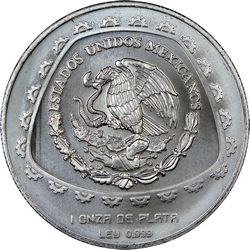
KM-664 1998 1 oz silver, $5 (MMR) Brilliant Uncirculated
The Brilliant Uncirculated coin features an Atlantean priest figure at the center of the reverse design. The date appears to the left, the mintmark to the right (MMR), and the word SACERDOTE is inscribed in the exergue below. An ornamental border surrounds the trapezoidal field, with $5 displayed at the base. Like all its Toltec counterparts, there is only a single 1998 issue.
The obverse bears the national coat of arms of Mexico: an eagle facing left with feathers resembling plates of armor, grasping a serpent atop a cactus, all set within a horizontal oval field. The legend ESTADOS UNIDOS MEXICANOS arcs above, with a half-wreath of oak and laurel below. This is framed by an ornamental border. Below the border is the inscription 1 ONZA DE PLATA, with LEY 0.999 further below.
For 1998, Whitman lists 7,800 original strikes, Numista reports 5,000, and the Standard Catalog of World Coins again agrees with Whitman at 7,800. Although the disparity here is modest compared to some earlier Pre-Columbian entries, it continues to illustrate the small but persistent inconsistencies among major numismatic sources. Again I have adopted Whitman’s figure of 7,800 as the reference mintage.
Banco de México’s published restrike records include 1,000 additional pieces, bringing the total mintage for the Sacerdote Brilliant Uncirculated issue to 8,800 coins. Applying the same melted-loss factor (35–50%) produces the following estimated survival range:
| 1oz Silver MS Pre-Columbian Series - Sacerdote | |||||
| Original Mintage | Restrikes | Total Including Restrikes | Estimated Minimum Surviving | Estimated Maximum Surviving | |
| 1998 5 Pesos MMR | 7,800 | 1,000 | 8,800 | 4,400 | 5,720 |
Sacerdote - Proof Variety Overview
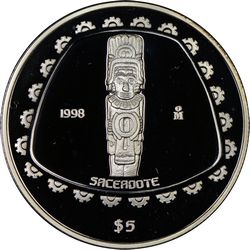
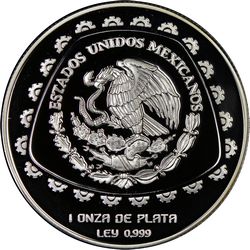
KM-664 1998 1 oz silver, $5 (MMR) Proof
The Proof varieties share the same coin elements as their Brilliant Uncirculated counterpart but are further distinguished by a mirrored inner field and border area on both sides with a raised and frosted denomination on the reverse as well as a raised and frosted legend on the obverse. Similar to the Brilliant Uncirculated, only a 1998 variety was released for the Proof edition of this coin design.
For 1998, Whitman lists 3,800 original strikes, Numista reports 4,800, and the Standard Catalog of World Coins aligns with Whitman at 3,800. While this degree of variance is modest compared to earlier Pre-Columbian issues, it nonetheless reflects the small discrepancies that persist across catalog sources. Consistent with the approach taken throughout this series, I have adopted Whitman’s figure of 3,800 originals as the definitive count.
Banco de México’s restrike records list an additional 1,400 Proof coins for this design, resulting in a cumulative total of 5,200 pieces. The Sacerdote Proof, like its Brilliant Uncirculated counterpart, was dated exclusively with 1998, with no evidence of multi-year dates.
Applying the same melted-loss factor yields the following estimated survival range:
| 1oz Silver PF Pre-Columbian Series - Sacerdote | |||||
| Original Mintage | Restrikes | Total Including Restrikes | Estimated Minimum Surviving | Estimated Maximum Surviving | |
| 1998 5 Pesos MMR | 3,800 | 1,400 | 5,200 | 2,600 | 3,380 |
Serpiente Con Craneo
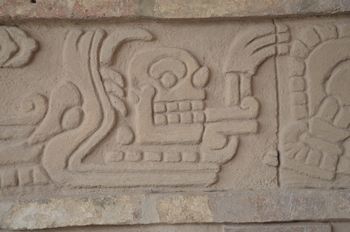 The 1998 1-ounce silver Serpiente con Cráneo (Serpent with Skull) coin features a striking and symbolically powerful motif of the Toltec civilization. The design reproduces a section of the Coatepantli, or Serpent Wall, from the ancient Toltec city of Tula. The original bas-relief depicts a serpent devouring a human skull, a dramatic emblem of death and rebirth deeply rooted in Mesoamerican spiritual symbolism. The border design encircling the coin’s field mirrors ornamental elements drawn from Toltec armor associated with depictions of the god Quetzalcóatl, reinforcing the sacred link between life, death, and divine transformation.
Issued in 1998 and denominated 5 pesos, the Serpiente con Cráneo was struck in both Brilliant Uncirculated and Proof finishes.
Serpiente Con Craneo – Brilliant Uncirculated (BU) Variety Overview
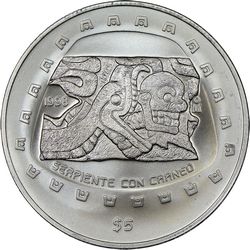
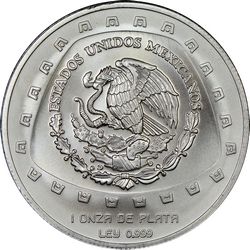
KM-666 1998 1 oz silver, $5 (MMR) Brilliant Uncirculated
The Brilliant Uncirculated coin features a serpent devouring a human skull at the center of the reverse design. The date appears to the left, the mintmark right (MMR), and the inscription SERPIENTE CON CRANEO is engraved in the exergue below. An ornamental border surrounds the trapezoidal field, with $5 displayed at the base. The design was only released with a 1998 date.
The obverse displays the national coat of arms. The legend ESTADOS UNIDOS MEXICANOS arcs above, with a half-wreath of oak and laurel below. This is framed by an ornamental border, followed by the inscription 1 ONZA DE PLATA, with LEY 0.999 appearing underneath.
For 1998, Whitman records 8,700 original strikes, Numista lists a notably lower 5,000, and the Standard Catalog of World Coins once again agrees with Whitman at 8,700. Following the same evaluative framework applied across this series, I have adopted Whitman’s figure of 8,700 as the definitive count, based on its long-standing credibility and correlation with archival mint references.
Banco de México’s restrike data indicate an additional 1,000 Brilliant Uncirculated pieces were produced, bringing the total mintage to 9,700 coins.
Applying the standard melted-loss factor, estimating that 35–50% of the total mintage has since been lost, melted, or otherwise unaccounted for, produces the following estimated survival range:
| 1oz Silver MS Pre-Columbian Series - Serpiente Con Craneo | |||||
| Original Mintage | Restrikes | Total Including Restrikes | Estimated Minimum Surviving | Estimated Maximum Surviving | |
| 1998 5 Pesos MMR | 8,700 | 1,000 | 9,700 | 4,850 | 6,305 |
Serpiente Con Craneo – Proof Variety Overview
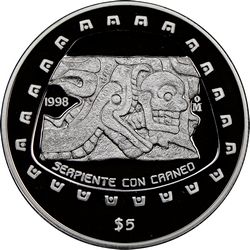
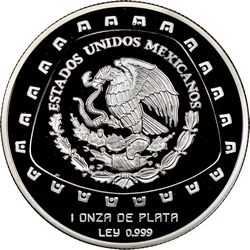
KM-666 1998 1 oz silver, $5 (MMR) Proof
The 1oz Serpiente Con Craneo silver Proof shares the same coin elements as its Brilliant Uncirculated counterpart but is further distinguished by a mirrored inner field and border area on both sides with a raised and frosted denomination on the reverse as well as a raised and frosted legend on the obverse. Similar to the Brilliant Uncirculated, only a 1998 variety was released for the Proof edition of this coin design.
For 1998, Whitman lists 4,100 original strikes, Numista reports 4,800, and the Standard Catalog again aligns with Whitman at 4,100. While these discrepancies are modest, they reflect the same cataloging inconsistencies that persist across the Pre-Columbian Series, likely stemming from differences in record interpretation and later data consolidation. As in prior analyses, Whitman’s figure of 4,100 is taken as the authoritative mintage.
Banco de México’s restrike records identify an additional 1,450 Proof coins issued for this design, yielding a combined total of 5,550 pieces. Applying the melted-loss factor produces the following estimated survival range:
| 1oz Silver PF Pre-Columbian Series - Serpiente Con Craneo | |||||
| Original Mintage | Restrikes | Total Including Restrikes | Estimated Minimum Surviving | Estimated Maximum Surviving | |
| 1998 5 Pesos MMR | 4,100 | 1,450 | 5,550 | 2,775 | 3,608 |