Hooknecks
Struck shortly after the abdication and exile of the Emperor Iturbide, the design for the first reales coinage of the Republic was the Hookneck eagle (or Profile eagle), the first use on a coin of the Mexican eagle perched on a cactus devouring a snake.
The decree authorising the designs for the new coinage, on 1 August 1823, stated:
1.- The government will order that new matrices be produced, as soon as possible and by the best engravers, to replace those that until now serve for minting currency.
2.- The gold, silver and copper coins will have a common obverse, stamping on them the coat of arms of the Mexican nation with on the circumference the inscription REPUBLICA MEXICANA (MEXICAN REPUBLIC).
3.- On the obverse of the silver coins will be placed a cap on which is diagonally written LIBERTAD (FREEDOM), from whose center several bursts of light will emanate. They will also express their respective value, the place and year of their manufacture, the initials of the names of the assayers and their fineness.
4.- On the reverse of the gold coins will be a hand with a rod, at the upper end of which the cap of liberty will be placed, resting everything on an open book, with the inscription on the circumference LIBERTAD EN LA LEY (FREEDOM UNDER THE LAW), with the marks or signs that in the previous article are designated for the silver coins.
5.- On the obverse of the copper coins palms will be placed to form a border, and in the center (except for the fineness and the names of the assayers) the marks laid out in the preceding articles.
6.- The government will take care, at the time of publishing this decree, to make known to the public, that the fineness of gold and silver coins is the same as those of the Spanish government for the past forty years
The new dies did not arrive until 18 November 1823.
This design was used at only three mints and for a brief period: Durango in 1824, Guanajuato in 1824 and 1825, and Mexico City in 1823 and 1824.
An intensive study of these coins, Hookneck: El Aguil de Perfil, by Clyde Hubbard and David O’Harrow, was published in 1997.
Durango
The assayer was RL. The process of minting the 8 reales coins is discussed here.
1 real
| Date | Assayer | Recorded Mintage |
Comment |
| RL | |||
| 1824 | RL | illustrated below |
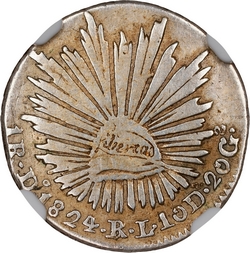
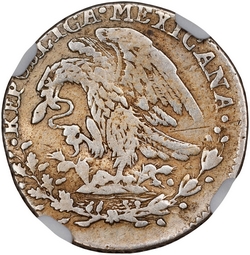
KM-371.1 1r 1824 Do RL (Stack’s Bowers Kirk Menczer Collection, 23 June 2026. Lot 72280)
HO-Type 1. Variety with reversed superscript "S".
2 reales
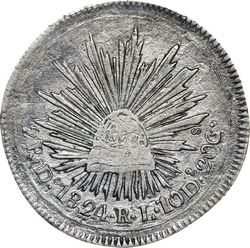
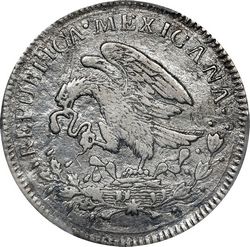
KM 373.1 2r 1824 Do RL (Stack’s-Bowers auction, 12 September 2023. lot 73316}
| Date | Assayer | Recorded Mintage |
Comment |
| 1824 | RL | mintmark Do | |
| 1824 | RL | Type I (dot before 2R) (illustrated below) | |
| 1824 | RL | Type II (no dot before 2R) (illustrated below) |
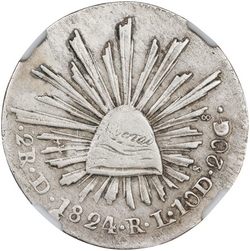
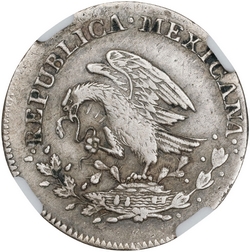
KM-373.2 2r 1824 Do RL (Stack’s Bowers Kirk Menczer Collection, 24 June 2026. Lot 73020)
HO-Type I. Variety with "D" mintmark and dot before "2R".
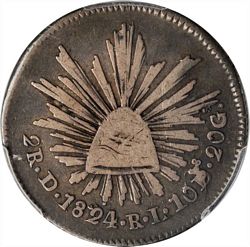
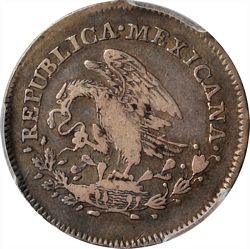
KM-373.3 2r 1824 D RL (Stack’s-Bowers auction, 22 October 2020, lot 72175)
HO-Type II. No dot before "2R"
8 reales
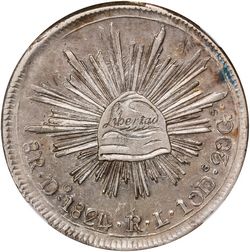
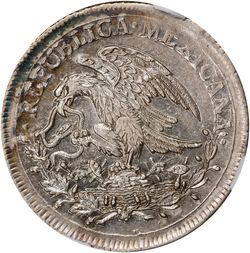
KM-376.1 8r 1824 Do RL (Stack’s-Bowers auction, 26 March 2026, lot 19436)
Type with defiant snake and medium “Libertad”.
| Date | Assayer | Recorded Mintage |
Comment |
| 1824 | RL | thin profile eagle, defiant snake, medium radiant Liberty cap | |
| 1824 | RL | thin profile eagle, defiant snake, small radiant Liberty cap (illustrated below) | |
| 1824 | RL | thin profile eagle, submissive snake, small radiant Liberty cap (illustrated below) | |
| 1824 | RL | thin profile eagle, submissive snake, large radiant Liberty cap | |
| 1824 | RL | thin profile eagle, folded snake, small radiant Liberty cap (illustrated below) | |
| 1824 | RL | thin profile eagle, folded snake, large radiant Liberty cap (illustrated below) |
KM-376.1 8r 1824 Do RL (Stack’s-Bowers auction, 26 March 2026, lot 19436)
Type with defiant snake and medium “Libertad”.
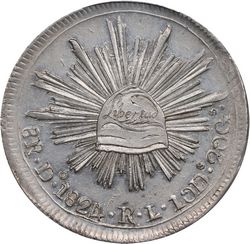
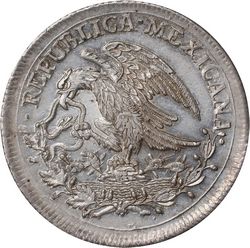
KM-376.2 8r 1824 Do RL (Stack’s-Bowers auction, 26 August 2025, lot 41382)
Type with defiant snake, staggered rays and small “Libertad”.
Variety with slightly offset cap to the right. Superscript "s" of Dineros is over an "o", while superscript "s" of Granos is between "G" and final stop of legend. Top prominent rays are slightly tilted left. Snake's body touches leftmost inner acorn. Hidden "P" on lower left of rock. Upper joint of right wing is below "B" of "REPUBLICA".
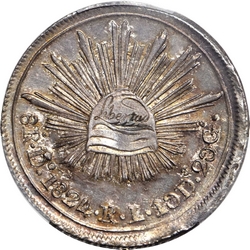
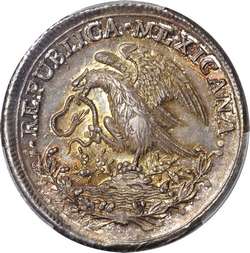
KM-376.4 8 Reales 1824 Do RL (Stack’s-Bowers ANA auction, August 2021, lot 41172)
Type with defiant snake and small “Libertad”.
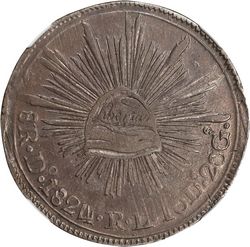
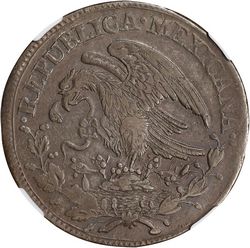
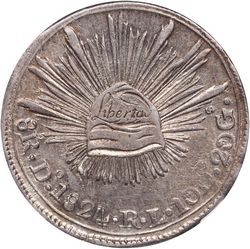
KM-376.3 8r 1824 Do RL (Stack’s-Bowers auction, 16 May 2023, lot 70237}
Typw with submissive snake, staggard rays and small “Libertad”, on small planchet
Variety with prominent upper rays very close to the peripheral border. Superscript "s" of Granos is above the right edge of "G", both superscript "s" are inverted. Rounded snake's head with oblique upward curvature of snake's body.
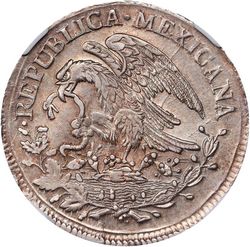
KM-376.5 8r 1824 Do RL (Stack’s-Bowers Hong Kong auction, 9 April 2025, lot 42455)
Type with folded snake and small “Libertad”.
Variety with dot between mintmark and date slightly offset towards date. Denomination and mintmark widely spaced, secondary ray overlaps with top primary ray. Large fold of snake curves slightly away from eagle. Rightmost berries of wreath are on stems that turn upwards.
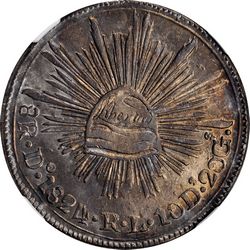
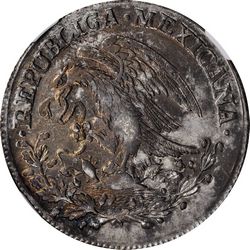
KM-376.6 8r 1824 Do RL (Stack’s-Bowers auction, 16 January 2021, lot 22277)
Type with folded snake and small "Libertad".
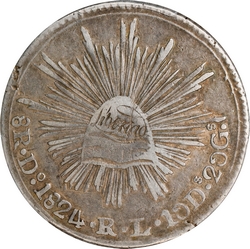
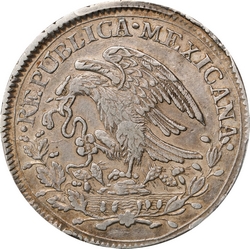
KM-376.6 8r 1824 Do RL (Stack’s Bowers auction, 26 March 2026, lot 19437)
Type with folded snake and large "Libertad".
Guanajuato
The assayers were JJ (José Mariano Jiménez) and JM.
8 reales
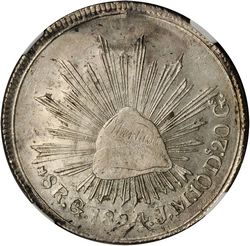
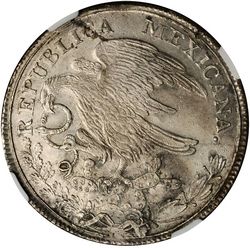
KM-A376.1 8r 1824 Go JM (Stack’s-Bowers Baltimore auction, 14 June 2011, lot 6376)
Full "Libertad" on cap.
| Date | Assayer | Recorded Mintage |
Comment |
| 1824 | JM | ||
| 1825/4 | JJ | illustrated below | |
| 1825 | JJ |
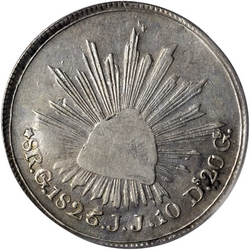
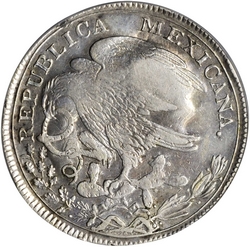
KM-A376.1 8r 1825/4 Go JJ/JM (Stack’s Bowers NYINC auction, 12 January 2019, lot 41205)
Traces of a 4 clearly visible beneath the last digit in the date. The "M" overassayer is faintly traceable just to the right of the second "J".
Mexico City
The assayer was JM (José García Anzaldo)
Half real
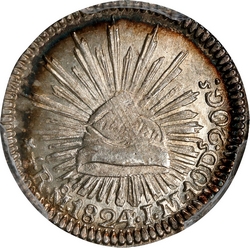
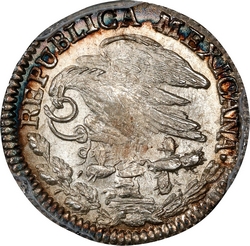
KM-369 ½ real 1824 Mo JM (Stack’s Bowers NYINC auction, 13 January 2023, lot 21223)
| Date | Assayer | Recorded Mintage |
Comment |
| 1824 | JM |
For discussion of a new Eagle die, see here.
2 reales
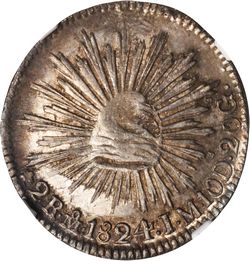
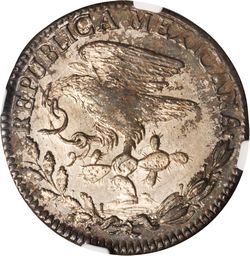
KM-373.4 2r Mexico City 1824 JM (Stack’s Bowers Baltimore auction, November 2014, lot 628)
| Date | Assayer | Recorded Mintage |
Comment |
| 1824 | JM |
8 reales
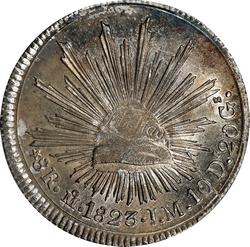
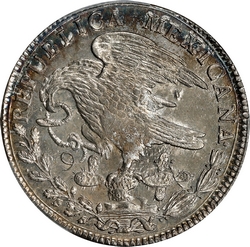
KM-A376.2 1823 Mo JM (Stack’s Bowers NYINC auction, 13 January 2023, lot 21221)
Variety with standard edge and flat top 3 in date.
| Date | Assayer | Recorded Mintage |
Comment |
| 1823 | JM | ||
| 1823 | JM | round-top 3 (illustrated below) | |
| 1824 | JM | illustrated below | |
| 1824 | JM | REPUBLICA engraved as REPULICA. The error is so noticeable that only five examples are known (illustrated below). |
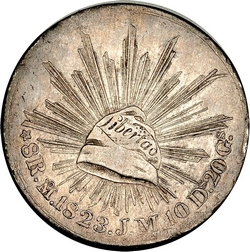
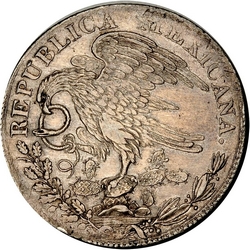
KM-A376.4 8r 1823 Mo JM (Ponterio NYINC auction, 7 January 2011, lot 79)
Extremely rare variety with round top "3" and full "J" in assayer letter. Same punches as used for the "Hookneck" 8 Escudos.
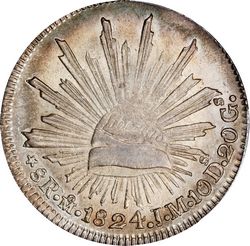
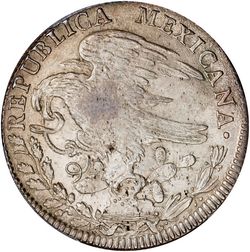
KM-A376.2 8r 1824 Mo JM (Stack’s-Bowers auction, 16 January 2026, lot 41097)
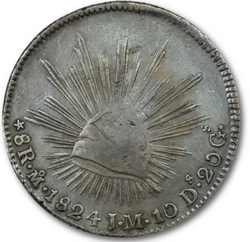
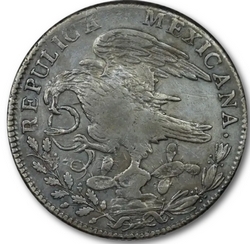
KM-A376.5 8r 1824 Mo JM REPULICA
8 escudos
The 8 Escudos die is the work of the illustrious Mexican engraver José María Guerrero, one of the last artistic heirs of the master Gerónimo Antonio Gil. At the end of 1823 the Government of the Mexican Republic held a contest in search of the design of the new coin that would be issued, in which recognized masters of engraving participated, among which Guerrero was the winner and it was his design that was chosen, being officially announced on 10 October 1823. The dies were completed until 4 December, leaving only 27 days for minting.
“In cataloguing the 1921 John Story Jenks sale, a sale that long functioned as a world coin reference work despite being a swan song in his illustrious career, Henry Chapman noted that the "hookneck" 8 escudos therein was "excessively rare, the only example I have seen in 45 years in this business." While more specimens have apparently appeared on the market since then, a comment such as this offers a glimpse of the state of the art in collection Mexican gold coins in the era that John Clapp and Waldo Newcomer were forming their illustrious cabinets. Of course, the 1823 Mexico 8 escudos still ranks as a great rarity, a famous one year type, and a favorite of collectors.”
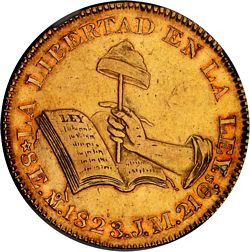
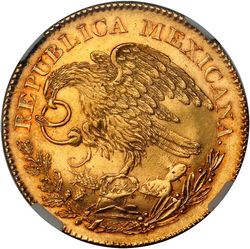
KM-382.1 8 Escudos 1823 MoJM (Ponterio & Associates 2011 NYINC Auction, 7 January 2011, Lot 131)
Curved tail on snake.
| Date | Assayer | Recorded Mintage |
Comment |
| 1823 | JM | curved tail | |
| 1823 | JM | looped tail (illustrated below) |
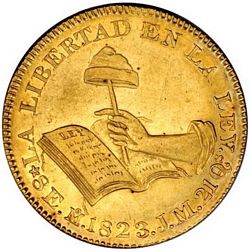
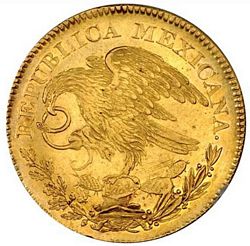
KM-382 8 escudos 1823 Mo (Stack’s-Bower Louis E. Eliasberg, Sr. Collection auction, 15 April 2005, lot 3256)
Type I obverse, cap points to A, Type I reverse, curled tail, moderately scarcer than its Type II counterpart.
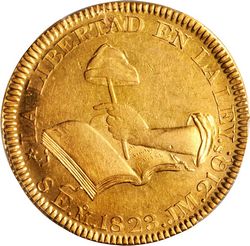
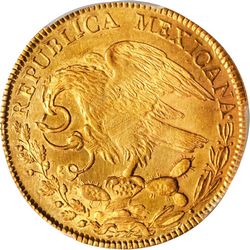
KM-382.2 8 Escudos, 1823 MoJM (Stack’s-Bowers Chicago ANA auction, August 2014, lot 1262)
Looped tail on snake: variety with the tail of the snake giving a complete turn, reverse with the tip of the cap pointing towards the letter "T" for "LIBERTAD". Of the two pairs of stamps that Guerrero engraved, this is the most complicated in every aspect, the statistics point to being almost twice as small in abundance, in addition to the fact that its minting presents a greater weakness in centers compared to the other variant.