The Genesis of the First Mexican Cent of 1841
by Pablo Luna Herrera
Prologue
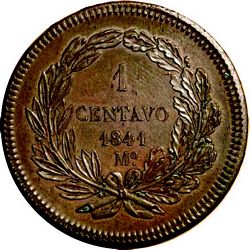
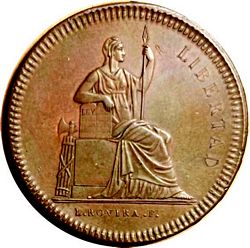
The 1841 centavo has been mentioned in nearly every catalog and reference work, but most descriptions are only a few lines, leaving major questions unanswered. Indeed, Doctor Guzmán Sánchez Schmitz, who wrote the prologue of my bookPablo Luna Herrera, In the midst of chaos and discord. The genesis of the first Mexican cent of 1841, available from World Numismatics and Briggs and Bustos, and was one of the main collaborators of this work, described this coin as “puzzling”, and he explained that to solve the puzzle we must address the complex social, economic, legal, and political scenario of the moment, aspects that influenced the birth and death of this first Mexican decimal proposal.
Background. Understanding the chaotic situation of the currency in those years
During the Mexican First Empire, production of copper coins was approved, through the decree of 11 June 1822; and a year later on 1 August 1823, with the establishment of the Republic, the production of copper coinage was again authorized. However, neither decree was ever enforced.
Moreover, according to Article 50, fraction XV of the Constitution adopted on 4 October 1824, and a subsequent legislative decree of 16 November 1824, the state governments were authorized to operate mints within their respective territories. Nonetheless, the federal government retained the prerogative to grant authorization for the minting of copper coin. Consequently, a national copper coin was not implemented.
On 29 March 1829, a national copper coin was introduced in three denominations: a quarter (1/4), eighth (1/8) and sixteenth (1/16) of a real. The first quantity approved was for only 600,000 pesos. The reason for striking copper coins were:
1. A means to stabilize the short supply of the minor denominations
2. A means to obtain higher earnings
3. To provide confidence in the new coinage and thus help stabilize prices
4. As political propaganda to enhance local governments
5. To redeem Colonial copper struck from the War of Independence and local pawn and store coins (Hacienda tokens) and
6. To encouraging mining.
Nevertheless, the production of federal copper coins soon began to rise to alarming levels.
At that time the government had no control over provincial mints, and the capital did not have knowledge of the weight, fineness, and quality of local copper issues. The problem of counterfeits had its roots in the deficient surveillance of state mints and their leaseholders.
For that reason, the law of 7 January 1837 devalued all copper coinage by 50% and halted production nationwide. The process of minting a new national and unique copper coin would commence following strict guidelines established for amortization, which would involve the withdrawal and replacement of existing coins.
Introduction. A brief look at the political, social and financial situation of Mexico in 1841
The primary challenges Mexico faced in that year were:
1. The bankruptcy of the public treasury.
2. More than twenty finance ministers between November 1841 and July 1846.
3. The lack of monetary uniformity and the disarticulation of a fiscal system.
4. The Mexico City mint was in a state of decline, with outdated equipment and machinery.
5. The practice of minting copper was a fraudulent scheme designed to benefit the government with profits reaching up to 175%. In other words, the intrinsic value of production was significantly lower than the face value of the coin in circulation.
6. The issue of the authorization of copper coinage (to replace the old coins) had been a pending issue since 1837.
7. Coins’ value fluctuates due to their lack of a stable value, regardless of the denomination engraved on them.
The proposal for a new copper coin in 1841
I believe it is essential to review the preliminary knowledge the other authors have documented before disclosing new information. Thus, Pardeau, in his Historia Numismática de México de 1823 a 1950Alberto Francisco Pardeau, Historia Numismática de México de 1823 a 1950, 1957, Vol. I, p. 369 stated):
“…Production for half a million pesos, without a fixed design, was ordered on July 1, 1841, [...] the new coin was not minted due to the government that authorized its issue was overthrown on September 28, 1841. […] Despite diligent research, the attempt to locate a description of the copper coin from 1841, authorized by the decree of July 1, 1841, proved unsuccessful. A specimen with the year 1841 is documented, which is likely the coin in question […] The reverse of this specimen features a closed wreath, with the inscription in the circumference. 1 CENTAVO– 1841 – Mo […] The author’s criteria indicate that this is the first instance of the word “Centavo” being used on coins. Although the term was not yet an official denomination in 1841, it was not until the law of March 1861…”
Also, José Manuel SobrinoJosé Manuel Sobrino, La Moneda Mexicana. Su Historia, 1989, p 64 mentions:
“…On July 1, 1841, it was decreed that all copper coins would be withdrawn from circulation within 18 months. Concurrently, authorization was granted for a new copper coin for a mintage of half a million pesos. However, the minting of this new coin was unsuccessful due to the revolution against President Anastasio Bustamante in September 1841, which was subsequently replaced by Antonio Lopez de Santa Anna.
A specimen of the likely authorized coin by the decree of July 1, 1841, is known. This specimen is noteworthy as it marks the inaugural instance of the term “centavo” being inscribed on a Mexican coin, signifying a preliminary endeavor to adopt the decimal system…”
The existence of this coin and its notable similarity to the Octavo de Real (1/8) are rooted in two significant decrees issued during the final semester of 1841. Despite their release within the same period, the circumstances surrounding their issue were remarkably distinct.
On one side, the decree of 1 July 1841 was issued by Presidente Anastasio Bustamante, a member of the Conservative party. The decree mentioned that authorized the new copper coin does not specify design. However, this decree was not enforced as Bustamante was overthrown by Sant Anna through the Plan de Tacubaya.
On the other side, a second decree of 24 November 1841, was issued by President Antonio López de Santa Anna, a member of the Liberal party: on this occasion the design of the coin is known, the eighth of real minted in that same year. The copper coin approved would have a equivalence and intrinsic face value comparable to the 1829 one-year type. This was the official government response for the copper amortization trouble, pending since 1837.
In the explanatory memorandum of the 24 November decree Santa Anna argues that the old copper coinage had an imaginary value, very distant from the intrinsic value, of the metal from which it is formed. Therefore, the amortization and existence of counterfeits were the main reasons to produce a new coin.
Possible reasons for the existence of a cent coin dated 1841
We all agree that this coin has been the subject of considerable controversy and debate among historians and numismatists, given the date is too early for its adoption of the decimal system in Mexico.
Further, according to some authors there were several attempts to introduce the decimal system as early as 1853, 1854 and 1857.
The book presents seven hypotheses and arguments they explore the potential origin of the coin from various perspectives, including economic, political, social and numismatics aspects. Some of them have been previously published in other works, while others offer novel insights.
For instance, tax and tariff charges had employed the centavo for transaction since 1837. In other words, the centavo functioned as a form of payment and a monetary unit.
Furthermore, the new coin was seen as a way to solve the economic crisis of those days.
New information about the creation of the 1841 cent
Throughout my book, newspapers became one of the primary sources of information in the investigation, spreading light on significant aspects related to the coin. They also offer insights into the public’s perception of the issue. The Mexico City newspaper El Siglo Diez y Nueve documented many initiatives to solve the monetary situation, related to minting a centavo. On 15 November this newspaper reported that the production of centavos was a highly likely scenario. The proposal was categorically rejected due to several perceived disadvantages. The main subjects of disapproval were:
• Problem of the divisions of denominations.
• The lack of coins with exact values between the two monetary systems.
• The disparity between tlacos and cents.
For the reasons stated above, the primary challenge in implementing the decimal system was the arithmetic problems. It would have been necessary to carry out a complete monetary reform that would alter the current denominations, as happened with the law of 15 March 1857 and 15 March 1861 that successfully introduced the decimal system.
On 18 November a brief mention is made to produce cents, half cents and paper money. This confirms that there was an interest in decimalizing the currency: moreover, this suggests that the issue was not simply unnoticed by society. This is important since other experimental specimens were conceived as private matters and therefore not widely known. In this case the issue of cents as a circulation proposal was well known.
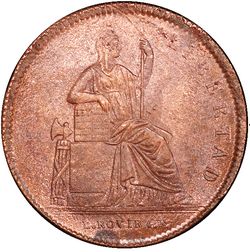
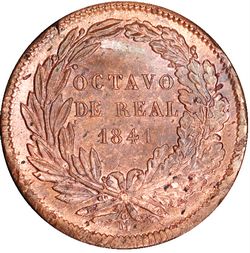
Octavo de Real 1841
On 24 November, El Siglo Diez y Nueve reported the official decree for the issue of the Octavo. This marks the conclusion of the amortization plans.
Numismatic data and statistics
In the book I refer to over 20 records from the last century concerning the appearances of this specimen, along with information regarding its dimensions, metal and characteristics. Some of the findings are:
• The coin is documented in copper, silver (probably using 4 reales planchets) and white metal (probably painted copper).
• The weight ranges from 12 to 16 grams.
• The diameter is 30 to 32 millimeters.
• The edge can be found smooth, inscribed with Republica Mexicana, and milled.
How many specimens are known to survive today? I would estimate a maximum of 12.
Conclusion
The 1841 cent was not a proposal that emerged spontaneously: there exists documented evidence that supports its introduction during that period. Introducing new decimal currency necessitated a significant investment of time and a comprehensive redesign of all coinage; moreover, the social, political and economic conditions at the time proved to be less than ideal for the successful implantation of this innovation.