The SUD coinage of Morelos and a new SUD classification system
by Max A. Keech
Introduction
This article reviews the history of Morelos’ SUD coinage issued during the Mexican War for Independence in the period 1811-1814. It then introduces a new SUD classification system that successfully catalogs Morelos’ entire SUD coinage within six major types with each type containing one to four subtypes. A downloadable SUD coinage tree/flow chart is provided to assist the collector. At the USMexNA convention in October 2026 we will review this classification system and put it to use classifying a group of Morelos’ copper SUDs. In my forthcoming book, 270+ major SUD varieties are individually listed along with their rarity.
Summary
From 1811-1813, General José María Morelos’ forces conducted four military campaigns throughout the southern coast, Tierra Caliente and Oaxaca regions. During this period Morelos struck and cast SUD style coinage at several locations. While a variety of design styles were employed, they all prominently display the SUD legend, a reference to his campaigns to liberate the southern provinces. Morelos’ copper SUD coinage is quite common today, while his cast silver coinage is scarce, and his struck silver SUDs are rare. In the pages that follow, this article explores the ornate and non-ornate copper and silver SUD coinage and proposes a new classification system for the SUD coinage of Morelos.
Campaigns of Morelos
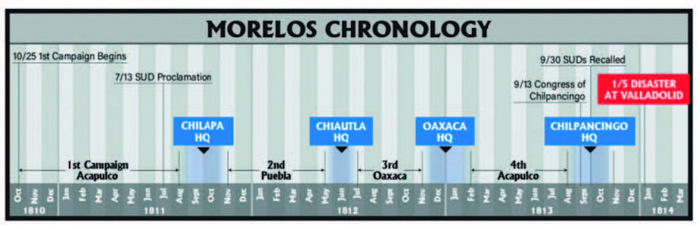
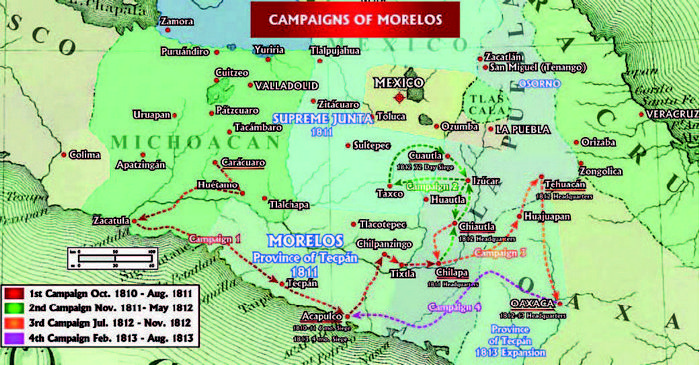
At the direction of Father Miguel Hidalgo, Morelos began the first of his campaigns in October 1810. Following a six-month siege of the Royalist fortress at Acapulco, Morelos headquartered in Chilapa from August through November 1811. Morelos also left armed garrisons in the towns of Zacatula, El Veladero (Acapulco), Chilpancingo and Tixtla, and was reported to control a copper mine near Tecpán. It is during this period, in mid to late 1811, that Morelos began striking copper and silver ornate style SUDs.
Initial SUD Coinage
Morelos was in constant need of funds to arm, cloth, feed and pay his troops. On 13 July 1811, Morelos issued a proclamation in Tixtla authorizing the coinage of a copper currency redeemable in gold or silver:
Don José María Morelos, General for the Conquest of the South, in agreement with his lordships, gentlemen of the American National Congress, Don Miguel Hidalgo, and Don Ignacio Allende, etc. Being my obligation to provide as much as possible for the necessary support of our troops, and lacking the currency of silver and gold for their assistance, I have decided by decree of this day that in the city of Our Lady of Guadalupe, in the province of Tecpán, copper coins shall be struck for use in trade, in the form of a promissory note that will be honored by our national treasury upon completion of the conquest, or sooner, at such time as we have sufficient silver or gold coins, which is not difficult, since the mines will already begin to be worked.
And we will not allow the struck and to-be-struck coins to leave this kingdom for another. And so that this copper coin will have the same value as silver and gold coins and will be paid by our national treasury, they must have the following characteristics: their size, slightly larger than the current silver coins of the Mexican mint, withcorrespondingthickness; the seal, ononesidewillbeanarrowwithaninscriptionatthefootpointing to the corresponding wind, which is from the South; and on the other side, it will have a mark that in one piece forms MOS, which is an abbreviation for Morelos, and above it, the value of the coin, whether it is a peso, tostón, peseta, real or medio.
And so that the national treasury does not incur expenses for coins not struck, a book of individual accounts of the struck coins will be kept in the treasuries. Consequently, no one without my or the National Congress’s permission may strike coins, whether it is the same or different, under the penalty of twice the amount in silver and gold of the sum struck. And if they do not have goods to pay the fine, they will suffer continuous imprisonment until the aforementioned copper coins are collected. And since this currency is a secure promissory note that our national treasury must pay upon presentation, it should have the same value and estimation as if it were made of silver or gold, and serve for all transactions and contracts of purchases, sales, promissory notes, collections and payments, etc., throughout this kingdom, as the Mexican coin has served and continues to serve. And to make it effective, the coin shall begin to be minted at the treasury in the aforementioned capital, and will continue in other treasuries as needed, of which notice will be given to the public. And to avoid confusion with the copper coins used in stores, I command the owners of such stores to collect all copper coins and give their fair value in silver coins to those who turn them in. For now, only wooden coins will continue to be used in stores, as has been the custom in many places in this kingdom, for the convenience of the poor. And to prevent fraud against the store owners who use wooden coins, they must obtain a license from this authority for the amount of coins they wish to mint, which will be granted to them for a small fee that they will contribute to the support of the troops, in proportion to the amount they intend to mint.
And so that everyone will be aware of this order and no one can claim ignorance, I order that this provision be published by proclamation in this canton and in the other places in the province of Tecpán andthe surrounding areas in the southLemoine Villicaña, Ernesto (1965), Morelos: Su vida revolucionaria a través de sus escritos y de otros testimonios de la época. UNAM, Mexico, doc. 12, pp. 176-177. Translation by DeepL and author..
Morelos’ second campaign of November 1811 through May 1812 is best known for his near demise during the Royalist siege of Morelos’ encampment at Cuautla. With his forces near starvation following the 72-day encirclement, Morelos narrowly escaped and was able to reestablish himself at Chiautla where he remained until the start of his third campaign in July 1812. The third campaign resulted in Morelos’ capture of the rich city of Oaxaca on 25 November 1812, and is considered his greatest success. During these 1812-1813 campaigns copper SUD coinage was struck at numerous locations in an expanding array of non-ornate styles. Morelos also struck, and cast, a more limited emission of silver SUD coinage. The circulation of copper coinage in large quantities, of differing styles, led to inevitable counterfeiting on a massive scale. To combat this counterfeiting, copper issues were recalled and counterstamped in late 1813 with Morelos’ monogram.
SUD Coinage
Based on Morelos’July 1811 proclamation, we know that SUD coinage began in Tecpán. Copper and silver half, one, two and eight reales were struck and/or cast in various locations along the southern coast, the Tierra Caliente and Oaxaca regions from 1811 through 1814. Struck SUDs were coined in copper and silver using hundreds of dies of differing types and varieties. Copper SUD denominations of two and eight reales are by far the most plentiful of Morelos’ coinage. Struck silver coinage, which is quite rare today, was produced in multiple locations from the same dies used to strike copper coinage whenever silver was available.
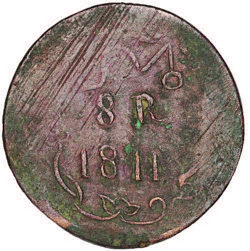
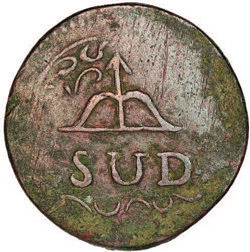
1811 Ornate Copper 8 Reales
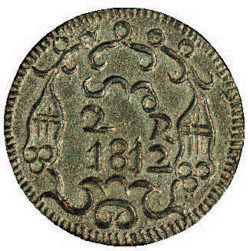
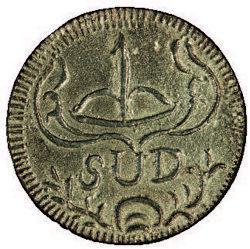
1812 Cast Silver 2 Reales
Cast SUD coinage was predominately silver, in a well-executed ornate design, used specifically for casting. We refer to this coinage as Morelos’ standard, fine style ornate cast coinage. These fine style cast silver SUDs were produced in denominations of half, one, two and eight reales. They are somewhat scarce but obtainable, with patience, in nice condition. In addition to these standard, fine style cast SUDs, there are also crude cast silver SUDs which appear to be one-off issues utilizing struck copper SUDs as casting models or madres.
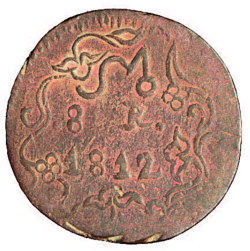
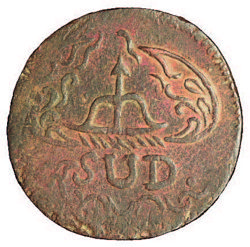
Ornate Style SUD 8 Reales
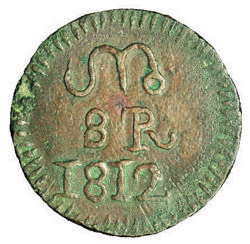
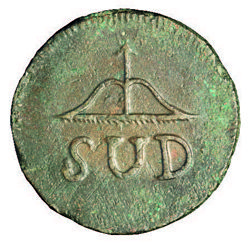
Non-Ornate Style SUD 8 Reales
SUD Design
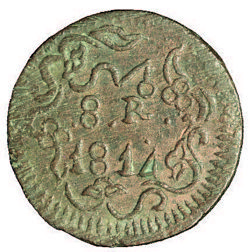
Historically referred to as SUDs, the reverse prominently displays the inscription SUD below a bow and arrow. SUD (south or southern wind) refers to the southern provinces Morelos’ campaigns intended to liberate. The obverse has the monogram of Morelos, denomination of the coin and its date. These features would remain constant for all SUD issues of 1811-1814, but other design aspects would vary considerably during 1812 and 1813. The initial 1811 eight reales style is designated ornate due to its complex rendering of what many believe are grapes, leaves and tendrils surrounding the inscriptions on both the obverse and reverse sides. This ornate style SUD coinage began in Tecpán and Chilpancingo and would be continually struck from 1811 through 1814 in both silver and copper. A similar version of the ornate design was used for the casting of silver coinage. During 1812 and 1813, several simplified, non-ornate designs were introduced. The non-ornate SUD types eliminated the complex ornate grape leaf devices surrounding the inscriptions and present varying aspects of the bow, arrow and borders.
Morelos’ SUD coinage designs are more consistent than commonly realized, especially in 1813-1814. In numerous letters, Morelos mentions his desire to maintain a standardized design to minimize counterfeiting. Yet, contemporary counterfeits flourished and today represent approximately 10% of the non-ornate style SUDs encountered. These often-crude counterfeits play a significant role in the collector’s impression of a chaotic and careless SUD coinage.
Where were SUDs Struck?
Morelos issued an edict on 30 September 1813, which recalled copper SUD coinage for counterstamping. This decree gives us some insight into the locations of SUD coinage. Morelos’ edict proclaims that copper SUDs not minted at Tlalchapa, Chilpancingo and Oaxaca were to be recalled for examination and counterstamping. Ornate and *T*C* style SUDs are rarely counterstamped, hence the author concludes that ornate and/or *T*C* style SUDs were minted in Tlalchapa, Chilpancingo and Oaxaca. Conversely, we can also conclude that the simplified, non-ornate style SUDs were struck at locations other than Tlalchapa, Chilpancingo and Oaxaca, as these non-ornate SUDs are commonly found with Morelos counterstamps. Morelos’ decree was apparently aimed at copper eight reales as those are the only denomination counterstamped in large quantities.
Morelos’ 1811 decree authorizing SUD coinage specified Tecpán as the minting location, yet his 1813 decree does not mention Tecpán at all. It is probable that Morelos’ relocated the mint, or workshop, to nearby Chilpancingo sometime after initial SUD production began. On 25 November 1812, Morelos’ forces would take Oaxaca and join Chilpancingo in producing ornate style coinage as described in a Morelos’ letter dated 29 December 1812. In early 1813 *T*C* style SUDs were struck. In the June 20232 journal, we examine the possible role of Tlalchapa and Supreme Junta member Father Sixto VerduzcoVerduzco is sometimes spelled Berdusco, his paternal spelling preferred by Spanish historians of the War for Independence (consistent with Berdusco’ signature). We have reluctantly chosen to utilize the familiar Verduzco to avoid confusion for most readers. Verduzco is the spelling commonly used by both English and Spanish sources, including Bancroft. in this event. In early 1814, Oaxaca, under former Supreme Junta President Ignacio López Rayón’s command, began striking copper SUDs with “OAXACA” and “O.X.A.” legends.
Non-Ornate Style SUDs
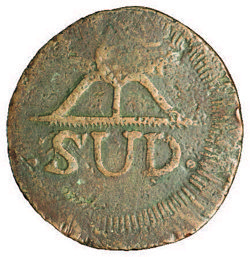
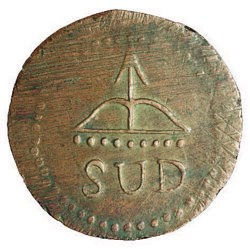
Plain Fields Dotted Border
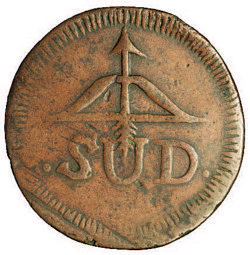
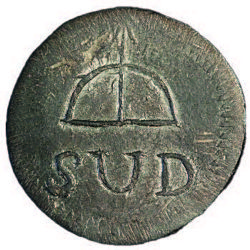
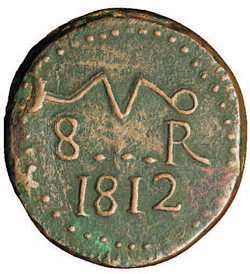
Feathered Arrow Circular Bow 3-Diamonds (8…R)
Based on Morelos’ September 1813 decree, we know that non-ornate style eight reales were minted in locations other than Tlalchapa, Chilpancingo and Oaxaca. But where? Non-ornate style SUDs were only produced in 1812 and 1813, with most produced in 1812. This period is during Morelos’second, third and fourth campaigns. Morelos’ headquarters during these campaigns included Chilapa, Chiautla, Tehuacán and possibly Cuautla. It is likely that non-ornate SUDs were struck in these headquarters’ locations and possibly othersWhile Morelos was in Cuautla during the siege, Insurgent prisoners reported to Royalist authorities that coinage was not struck in that location.. The five SUDs pictured above represent the major types of non-ornate style SUDs. They are the plain fields, dotted border, feathered arrow, circular bow and 3-diamonds (8…R) types. These distinctive designs must have conveyed their minting locations in 1812-1813 but absent new documentation, we are unable to make specific assignments today.
By 1814 only ornate and Oaxaca style SUD eight reales were still being struck or cast. Struck copper SUD eight realesdated 1814 are common while cast silver examples are quite rare. These were likely produced by Morelos in his stronghold of Chilpancingo, and possibly in Tlacotepec and other locations, during the early months of 1814 following his catastrophic defeat at Valladolid. Struck silver SUDs dated 1814 have not been recorded.
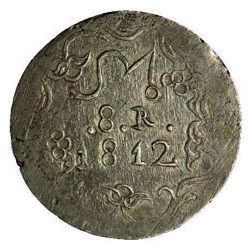

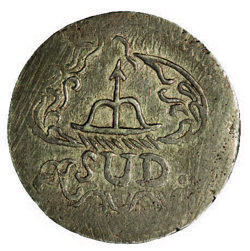
Struck 1812 Silver SUD 8 Reales
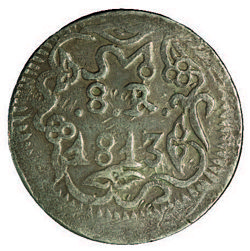
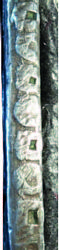
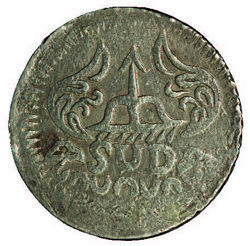
Struck 1813 Silver SUD 8 Reales
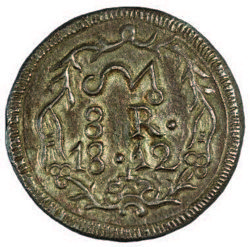

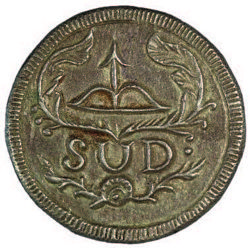
Cast 1812 Silver SUD 8 Reales
SUD Manufacture
Copper planchets were cast before striking and evidence of this casting is often present. Edges were filed in the typical Insurgent fashion. Fields were also occasionally filed, presumably to smooth over rough areas. Silver coinage was also struck on cast silver planchets, which typically show evidence of filing in the obverse and reverse fields, as well as on the edges. This filing is often misinterpreted as adjustment marks. There was no attempt to regulate the weight of silver SUDs, so it is more likely that the filing was instead intended to “clean up” casting roughness. This filing is prominent on all struck silver SUD eight reales but generally not visible on the rare struck silver minors. The edges of cast silver SUDs were also filed in the fashion typical of all Insurgent cast silver issues. These distinctive edges allow the experienced numismatist to distinguish genuine cast coinage from cast counterfeits. In 1813, colonial style edges were applied to the struck silver eight reales after striking, resulting in a slightly upturned edge.
Classification of SUD Coinage
There were approximately 1,000 different die pairs used to strike SUD coinage, most of which were used to coin copper two and eight reales. While some die pairs are similar, there are literally hundreds of substantively different varieties. The challenge of an effective classification system has long vexed numismatists. In 1971, after studying 4,000+ copper SUDs, José Luis Franco C. proposed a classification system based on the characteristics4
of the bow, string and arrow. Franco proposed a complicated numbering systems with over 100 major SUD typesFranco C., José Luis, “Variations in the Bow and Arrow of the Coins of General Morelos, 1811-1814” in El Boletin Numismático Vol. IX, No. 73, Oct-Dec 1971, pages 150-161. Franco’s classification system has remained virtually unused even though one is needed now, as much as it was 50 years ago! To assist the collector and cataloger, a new classification system of SUD coinage is offered below. It divides SUDs into six major types and then layers in a few subtypes and major varieties.
The Six Types of SUDs
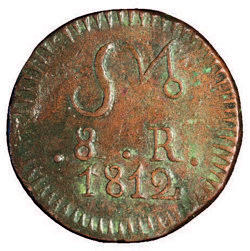
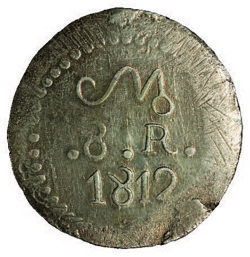
Type 1: Ornate Type 2: Plain Fields Type 3: Dotted Border
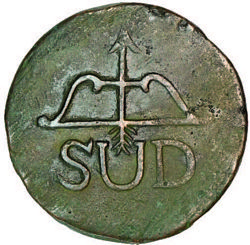
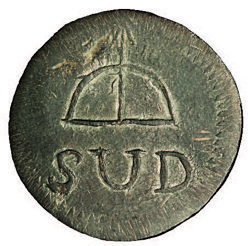
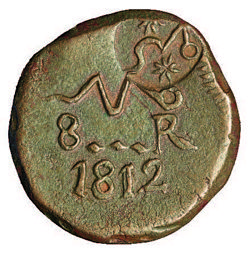
Type 4: Feathered Arrow Type 5: Circular Bow Type 6: 3 Diamonds (8...R)
Each of the six major types of SUDs pictured is distinct and each was likely struck at a single location. This does not mean, however, that two different types were not struck at the same location. Most SUDs can be quickly and easily assigned to one of these six types and then to a subtype defined below. The six types are ornate, plain fields, dotted border, feathered arrow, circular bow and 3-diamonds (8…R). Together these six types capture the major coinage styles that are encountered for struck copper and silver SUDs, particularly for eight reales. Design variety is more limited for minor denominations where the engraver had less room to express his work. Even so, we encounter copper two reales for all six of the SUD types. Cast silver SUDs are almost exclusively of the ornate type.
Type 2 Plain Fields SUD Subtypes
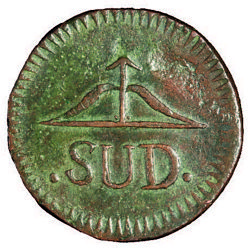
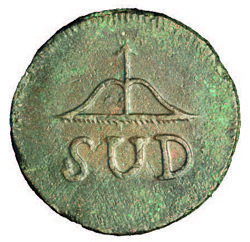
2.1 No Bowlines 2.2 Bowlines Right
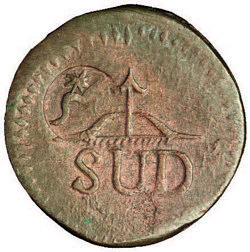
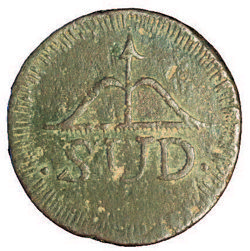
2.3 Bowlines Left 2.4 Bowlines Straight
Type 3 Dotted Border SUD Subtypes
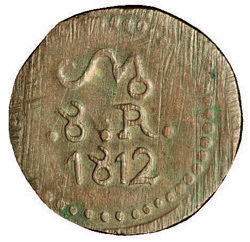
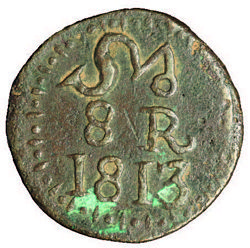
3.1 Dots Only 3.2 Dots & Dashes
Type 4 Feathered Arrow SUD Subtypes
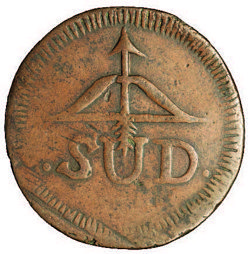
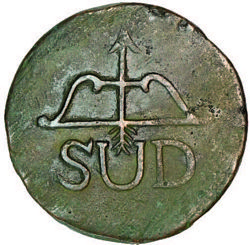
4.1 Regular Bow 4.2 Oaxaca Bow
SUD Subtypes
Ornate and plain fields type SUDs constitute the majority of all SUDs, accounting for 58% and 30% respectively. Many of these ornate and plain fields type SUDs display short lines originating from the bowstring, the die engraver’s representation of a quivering bowstring. Using these bowlines, we can divide the large population of ornate and plain fields SUDs into subtypes based on the presence, or absence, of lines on the bowstrings, and the direction the lines slant (i.e. no bowlines, bowlines right, left or straight). We also have two distinctive subtypes for both the dotted border and feathered arrow type SUDs. The dotted border type SUDs can be divided into those with dots only, and those with dots and dashes. The feathered arrow type SUDs can be divided into those with a regular bow, and those with a Oaxaca style bow. Taken together, our six SUDs types produce a total of 14 subtypes which are depicted on the following coinage tree.
SUD Coinage Tree
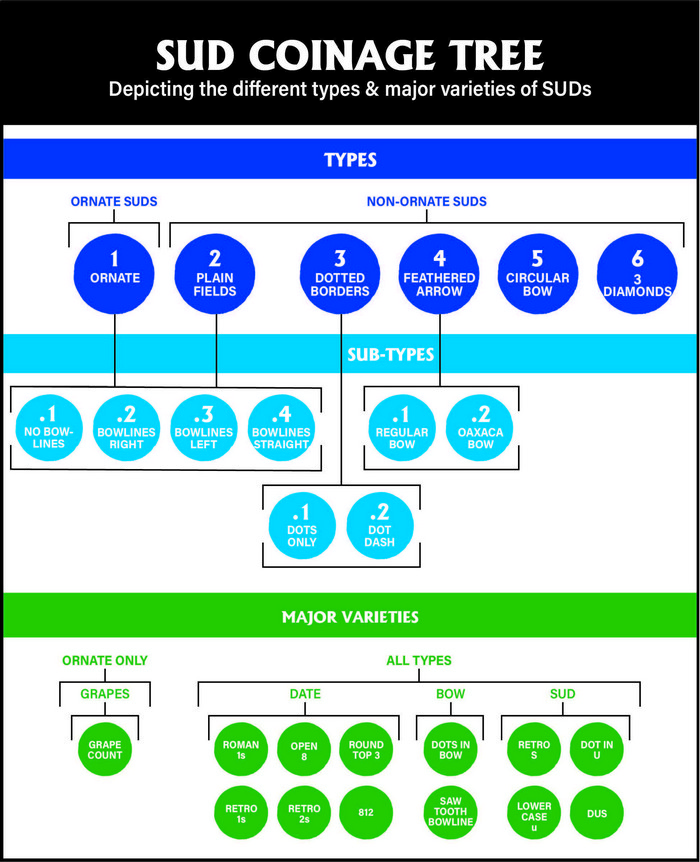
This new SUD classification system is depicted in this coinage tree. Virtually all SUDs can be quickly organized by type, then subtype and finally by variety with this system. The three tiers of this tree can be abbreviated with a type number (1-6), followed by a subtype number (.1-.4), and finally a variety letter (a-i) such as 3.2a.
Major SUD Varieties
Major varieties will be individually listed in my forthcoming book including varieties that can be determined by visual inspection alone, without the need to consult other references such as photographs or drawings. Major varieties include elements such as Arabic or Roman 1s, round top 3s, and retrograde letters or numbers. For ornate style SUDs we also include the number of grapes in the left and right grape clusters. This can be hard to determine on poorly struck pieces. Major varieties are designated with a lower-case letter a-w. Sometimes included are outlandish design elements based on their execution or location on the coin. These are often the work of suspected counterfeiters operating in contemporary times. Varieties such as small letters or large dates are excluded unless their unusual size is obvious. If size cannot be determined by observation alone, and instead requires a reference to determine whether it is large or small, we exclude it. Minor varieties such as missing stops are also excluded. For those collectors wishing to go further, typical stops for an eight reales are “.8.R.” and “SUD” without stops. For two reales typical stops are “.2.R.” and “.SUD.”. Variation on these norms is nearly endless.
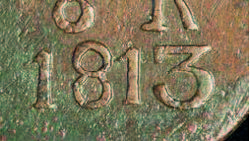
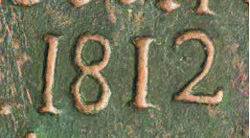
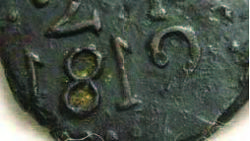
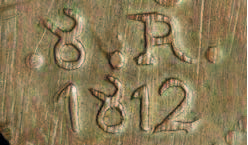
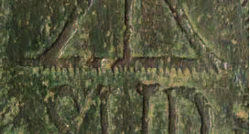
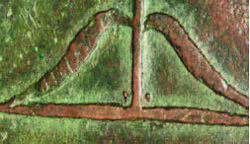
Major SUD Varieties Including Arabic 1s, Roman 1s, Retro 1s, Open 8s, Sawtooth Bowline and Dots in Bow
SUD Collecting Strategies
For the copper SUD enthusiast, there are lots of collecting options at relatively low cost. A good place to start is with an example of each of the six major types in all denominations in which they occur. Next, try to obtain each subtype, or perhaps each subtype and date. For the popular series of copper eight reales, substantial progress on this thirty-coin type/subtype/date set can be achieved in reasonable time: however,completing it will present significant challenges. Some collectors may also want to obtain each major type, both with, and without, a Morelos counterstamp. For collectors desiring a deeper dive, there are a total of ninety-nine major varieties which will be listed for the copper eight reales alone. Finally, the ultimate test is to seek an example of each different die pair (sub-variety) which will reward (or torture) the collector with a lifetime search!
Collecting silver SUDs is much more challenging. A denomination set of the standard, fine style cast silver SUDs is quite achievable, but a full date/denomination set is very difficult! A cast silver collection might then be augmented with a struck silver SUD or two, all of which are rare.
Contemporary Counterfeits
Initially, copper eight reales were confined to ornate style coins (Type 1), which were difficult to counterfeit. With the addition of the simpler, non-ornate styles struck at different locations in 1812-1813, the counterfeiter’s task became much easier and circulating counterfeits flourished! This is evidenced by numerous Morelos’ letters which complain about the incessant problems of counterfeiting (see the introduction to this section for further details). It is also clear that Morelos attempted to produce a quality product in a standardized fashion to minimize counterfeiting. The most cartoonish of die work is almost certainly the result of contemporary counterfeiters but there is a lot of grey area between these, and the SUDs of superior quality engraving. Examples of possible contemporary counterfeits include:
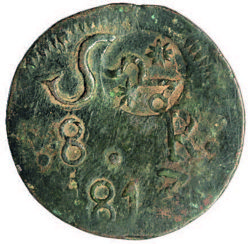
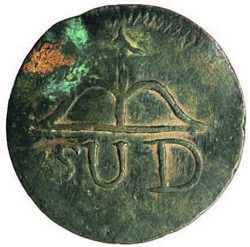
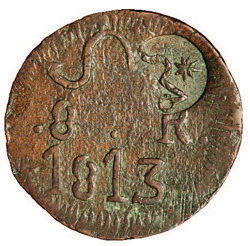
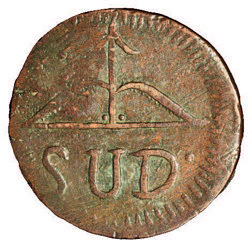
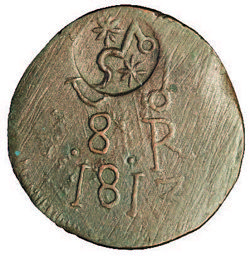
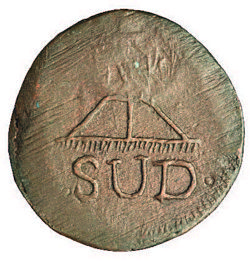
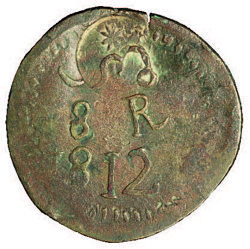
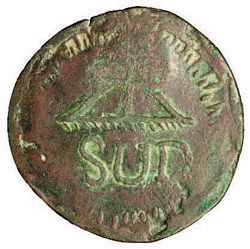
Possible Contemporary Counterfeits (pcc)
These possible contemporary counterfeits do not employ lettering/numbering punches but instead appear to be hand engraved and hence quite crude. Hand engraved dies is not conclusive of counterfeiting, however. Often, different obverse dies are found mated with a single reverse die (reverse dies tend to last longer), an indication of a large production unlikely to be the work of contemporary counterfeiters. We have examples of multiple hand engraved obverse dies which were mated with a common reverse die, indicating that Morelos’ forces resorted to hand engraved dies at times. From Morelos’ letters we know that SUDs were made by Morelos’ forces with his authorization, occasionally by his forces without authorization and by contemporary counterfeiters. When coins show evidence of hand engraved dies and poor workmanship, we designate them as possible contemporary counterfeits (pcc).
Some writers have speculated that all non-ornate style SUDs are contemporary counterfeits based on the language of the proclamation recalling SUDs. The author believes this misreads a proclamation intended to recall both counterfeit SUDs and SUDs issued by Morelos’ forces, but without Morelos’ explicit authorization. The strongest evidence for this reading is the existence of numerous non-ornate style silver SUDs. It is inconceivable that counterfeiters would have made SUD counterfeits in silver when the profit was clearly in copper! As expected, these non-ornate silver SUDs do not have the cartoonish legends typical of contemporary counterfeits. Like non-ornate copper SUDs, non-ornate silver SUDs are frequently found with Morelos counterstamps.
Possible contemporary counterfeits are encountered in all denominations of copper SUDs (as well as other Insurgent copper coinage). It is frequently difficult to separate genuine SUDs from contemporary counterfeits and experts will often have differing opinions. For now, suffice to say that the more amateur the die work and striking, the more likely a copper SUD is a contemporary counterfeit! Contemporary counterfeits are generally of the non-ornate types and comprise at least 10% of plain fields eight reales (Type 2). Contemporary counterfeits are very collectable and trade at values commensurate with genuine SUDs based on their condition and design appeal. This classification system treats contemporary counterfeits as varieties within the six-type classification system. Contemporary counterfeits are often encountered with Morelos counterstamps. As noted previously, Morelos’ September 1813 decree allowed the counterfeit SUDs, already in circulation, to be counterstamping and hence, accepted for circulation and future redemption. In this classification system, possible contemporary counterfeit varieties are designated “pcc”. Modern counterfeits should not be confused with contemporary counterfeits. Modern counterfeits generally do not show genuine signs of aging and typically have a uniform texture. Modern counterfeits, where known or suspected, are excluded from this work.
Morelos Counterstamps
Morelos counterstamps are quite plentiful, especially on non-ornate copper SUD eight reales. Today, fully 50% of these non-ornate copper SUD eight reales are found with Morelos counterstamps. This is clearly a result of the September 1813 Morelos decree recalling copper SUDs for counterstamping.
A Word About Condition
Many copper SUDs available to collectors originate from burial finds. Oxidation and corrosion, where present, are often removed from these coins by mechanical or chemical methods. Artificial patinas are then occasionally applied. Often these coins show evidence of harsh cleaning, have remaining environmental damage and/or brush marks (fine scratches from wire brushes). Copper SUDs without physical or environmental damage are scarce and command a significant premium.
Counterstamped Non-Ornate SUD
Counterfeit SUDs: Copper ½ Real, Silver 1 Real, Cast Silver 4 Reales, 8 Reales & Plated Silver 8 Reales
Modern Counterfeits
Counterfeits of SUD coinage exist. Struck copper minors are occasionally seen and generally have a modern appearance and smooth fields. Struck counterfeit silver SUDs have been created by silver plating copper SUDs. These can be deceptive but can generally be detected by XRF testing, where their apparent silver content will appear very low and variable. Counterfeit cast silver SUDs are plentiful and hence it is important for the collector to familiarize themself with the filed edges typical of genuine insurgent cast coinage, or purchase from a knowledgeable and trustworthy source.
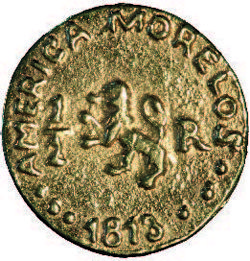
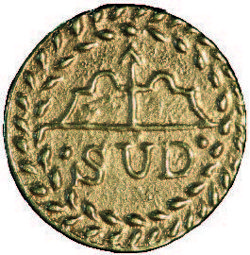
Counterfeit Gold ½ real SUD
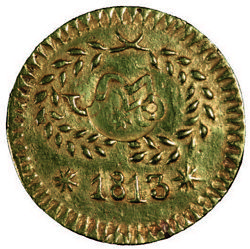
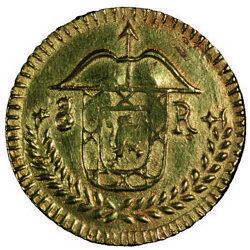
Counterfeit Gold 8 reales SUD
All SUD four reales and all gold SUDs are counterfeit. The gold SUD eight reales pictured above is pedigreed to the 1899 Lyman Low auction and to the John M. Clapp and Louis Eliasberg collections. It is plated in Pradeau and Adolfo Herrera’s book El Duro. Just because a coin is old, does not necessarily mean it is genuine.
Congress of Chilpancingo
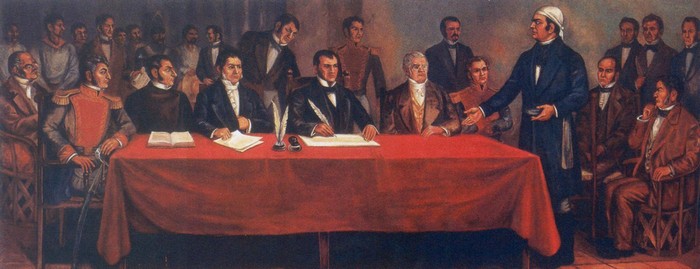
Congress of Chilpancingo
On 13 September 1813, the Supremo Congreso Nacional Americano was convened with President Ignacio López Rayón not yet in attendance. The first act of the reconvened Insurgent Congress was to elect José María Morelos Generalissimo for life, with full executive power. With this election, Morelos replaced the Supreme Junta as the leadership of the Insurgency. A draft constitution “Sentimentos de la Nación” (Sentiments of the Nation) was presented with its first article proclaiming “That America is free and independent of Spain and all other nations, governments, or monarchies, and should be recognized as such”. On 6 November 1813, the Insurgent Congress passed a Declaration of Independence by ratifying article 1 and proclaiming America free.
Disaster at Valladolid
Following the Declaration of Independence in Chilpancingo, Generalissimo Morelos set out to capture the long-desired city of Valladolid and make it the seat of the reconstituted Insurgent government. Morelos’ march was slow and Viceroy Calleja, aware of Morelos’ movements, sent 2,000 reinforcements under Royalist Commander Llano and his second, Agustín de Iturbide, to Valladolid. In a series of battles, Morelos’ forces were routed. According to Bustamante, Iturbide’s men had managed to get close enough to Morelos’ tent that they “cut it to pieces with knives, and
almost got him.” Espinosa Aguirre, Joaquin E., (2022). Que se Organicen Sus Pueblos. Universidad Michoacana de San Nicolás de Hidalgo, Morelia, page 121. In a final engagement at Puruarán on 5 January 1814, a slaughter occurred resulting in Insurgent losses
of 600 dead and 700 captured. The captured included Lieutenant General Matamoros who was executed. Morelos’ first campaign as Generalissimo and Insurgent leader was a complete disaster. Morelos willingly surrendered leadership and retreated to the wilderness of Tecpán, northwest of Acapulco. Following Morelos’ defeat, Congress assumed leadership with José María Liceaga as its President. Congress assigned military responsibilities to Generals Rayón, Cos and Rosains.Timmons, Wilbert H. (1963), Morelos of Mexico: Priest, Soldier, Statesman. Texas Western Press (El Paso: 1970 Reprint), page 129. The best days of the Insurgents were past. Royalist troops under Lieutenant-Colonel Armijo pressed their advantage by marching first on Chilpancingo and then giving chase, keeping the Congress members in constant flight.
Epilog
Morelos’removal came shortly after, when the reinstated Congress of Chilpancingo declared that“the Generalissimo ceased to be so due to ineptitude, not because of death or treason”Olvera García, Jorge; García Castro, René; García Peña, Ana Lidia. (2015), El Caudillo del Sur: forjador de la Nación Mexicana. Toluca, page 184.. By February 1814 Morelos held only the ceremonial title of Generalissimo and a seat on the Congress. On 24 February 1814, Armijo chased the Insurgent Congress from Tlacotepec. Armijo captured a bounty of silver SUDs, Morelos’ uniform and the Insurgent archives, including correspondence with the Guadalupes society! Armijo counterstamped the captured silver SUDs with his monogram.
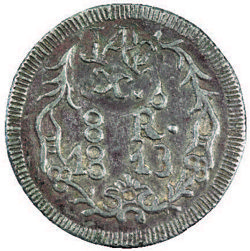
Armijo counterstamp on 1813 silver SUD 8 reales
The Insurgent Congress also left 10,000 copper pesos behind for lack of pack animals. The Royalists thought so little of the copper money that they did not bother to keep it. On 29 March 1814, Morelos’s former stronghold of Oaxaca was retaken and the weakened Insurgent Congress retreated to Michoacán, first to Uruapan, then to various haciendas before ending up in Apatzingán in mid-1814.
Joined by Morelos and Cos, what remained of the Congress sheltered in secluded Apatzingán. After four months the Constitution of Apatzingán was proclaimed on 22 October 1814. In Ario, a nearby town, a Supreme Court was installed, festivals were held,and medals were struck to commemorate the occasionBancroft, Hurbert Howe. (1886), History of Mexico, Vol. IV, 1804-1824. New York, page 604.. Bustamante claimed to have struck the medal in 1822. The only recorded example is in the collection of the National Museum of History at Chapultepec CastleVargas, Ricardo. (2023), Enciclopedia Numismática de Michoacán, Vol.1. American Graphics, Guadalajara, page 35.
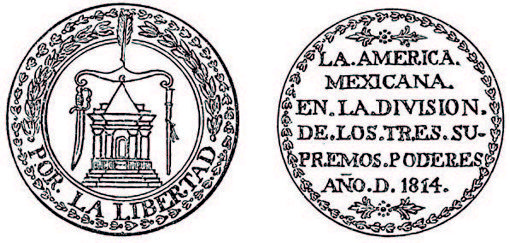
Silver medal commemorating the installation of the Supreme Court in Ario
By 1815, Congress was again on the run, coming to rest at Uruapan in the summer. With Agustín de Iturbide in pursuit, the Congress fled to Tecpán, Mixteca, Huétamo, Cutzamala and Tlalchapa before reaching Tenango on 2 November 1815.
With 600 men, the Royalist Colonel Manuel de la Concha captured Morelos. José María Morelos was tried, defrocked, convicted, and finally executed on 20 December 1815, at San Cristóbal Ecatepec, north of Mexico City. A sad ending to a revolutionary of staggering importance!