{footnote}Alberto Francisco Pradeau, The Mexican Mints of Alamos and Hermosillo, NNM, No 63, American Numismatic Society, New York, 1934{/footnote}
Shortly after Mexico obtained its independence from Spain, when Sonora was still a part of the Province of Nueva Viscaya, a movement was started to have a mint in Alamos. Espinoza de los Monteros, in his project of separation presented 29 February 1823, has embodied the plan of erecting and operating a mint in Alamos. In 1828, Leonardo Santoyo arrived in Alamos with a concession or grant, obtained from the Federal Government, permitting him to coin copper coins of "una cuartilla" denomination - three and one-eighth cents.
The inhabitants in Alamos, however, refused to accept them .They were coined in very small quantities during the years 1828 and 1829. In 1832 we find that Mr. Santoyo had obtained a change in his grant and had gone to Hermosillo, where he coined a different type of “una cuartilla”. Hermosillo was then capital of the State of Sonora. The inscription on the obverse is EST. D. SONORA. UNA CUART.: on the reverse, A. de 1835 L. S. HERMOSILLO., which signifies "Año de 1835 Leonardo Santoyo Hermosillo."
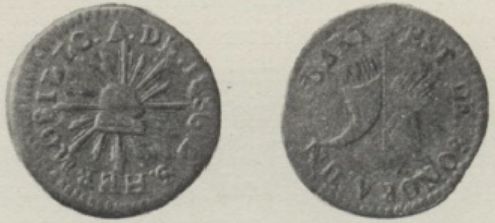
KM-364 ¼r 1836
The chief reason for the establishment of a mint in Alamos was the bonanza existent in the mining districts in and around the city. Owing to the isolation of this mining center which had no railroad until 1907, communication with other cities was possible only by stage-coach, saddle and pack animals. This means of conveyance was anything but safe, and while the convoys, carrying out the silver bars or bringing in the coined gold and silver, were properly escorted by armed guards, these were often outnumbered and massacred by the marauding Yaqui Indians or bandits constantly roving in search of plunder along the routes that led to Alamos.
Whether this mint was established by federal or state decree I have not been able to ascertain, but it is reasonable to assume that due to the French intervention existing from 1862 to 1867, and the inaccessibility of the region, the local authorities had much to do with its foundation. During this period, when the central government was constantly being changed from one locality to another, the states exercised the rights of independent governments, subject to approval of the federal government at such times as it was possible to get in touch with it.
According to official records the first coinage of this mint is given as 1868, but J. W. Bastow, writing in the American Journal of Numismatics, Volume XXXII, No. 1, of July 1897, page 17, gives the date of the first minting operations as 1864. I am wholly in accord with this, as I have in my collection an eight escudos piece dated 1864.
Orozco y Berra in his articles entitled "La Moneda en Mexico " published by the newspaper El Renacimiento in 1869, says in his second article: "Of the mints at Alamos and Hermosillo I have not been able to obtain any information through official channels or in any other manner." (Free translation.) Santiago Ramirez in his Noticia Historica de la Riqueza Minera de Mexico edited by the Government of Mexico in 1884, page 47, gives the beginning of coinage for the Alamos mint as of 1868. And one after another a number of writings on Mexican numismatics might be quoted in which everyone has used the official archives, which, as I have stated, are incorrect. The error was caused by the unsettled condition of the country due to the French intervention and the subsequent monarchy with Maximilian of Austria as Emperor, which lasted until 1867. It is more than probable that the records of the mint, which were supposed to be sent to the treasury department (Secretaria de Hacienda), were either lost in transit or destroyed.
The following statements of tremendous importance were taken from the book entitled Cuentas, gastos , acreedores y otros asuntos del tiempo de lo Intervencion Francesa y del Imperio written by Manuel Payno, and published in 1869 by order of the Constitutional Government of Mexico, pages 369-373. Free translation: "Not a single document is to be found in the national archives, that will throw light on the revenue-yielding industries of the country during the five years of French intervention in Mexico (1862-1867) excepting those of the mint at Mexico City, the records of which were kept quite accurately." The Minister of Finance (Secretario de Hacienda) in a circular letter addressed to all the mints of Mexico, asking for information about the amounts coined in each, during the years of 1857 to 1867, failed to bring in a report for the mint at Alamos, which is not even mentioned."
The very fact that coins of all denominations bearing the dates of 1864, 1865, 1866 and 1867 are to be found is conclusive proof that the Alamos mint was in operation from 1864 until 1895 at which time it was closed. The information concerning the opening date is corroborated by the statement of Mr. Bastow who obtained the information directly from the officers of the mint, while still in operation or shortly after its closing. This mint was turned into a federal assay office. The personnel of the mint was retained.
From Manuel Larraguibel, last mint master, and from Jorge LeBrun, son of the director of the mint during the years 1878 to 1883, and from Lauro B. Quiros, all old residents of Alamos, I learned that the Alamos mint was established with modern machinery propelled by steam power, but that hand presses were available and used for coining silver pieces of small denomination such as half and one real pieces, which from 1874 became five and ten cent pieces.
During most of its life, this mint was leased to private individuals or companies, and although the official records only show the leasing of this mint for the years of 1876 to 1880 inclusive, I have obtained from the above mentioned sources, statements that several companies leased this mint. The most prominent and the one which had it under contract the longest, was the English firm of Symon and Camacho. Several attempts to obtain a copy of this or any other contract have proven futile.
At the time of this writing, 12 February 1933, Manuel Larraguibel, the last mint master of Alamos , a grand old man 83 years of age, whom I had the privilege of knowing in Alamos some thirty years ago, and now a resident of Navojoa, Sonora, Mexico, writes to me and states that the mint in Alamos was established by Robert R. Symon, a British subject, and that in later years Robert R. Symon and Sebastian Camacho, formed a company under the name of Symon y Camacho and leased the mints of Alamos , Hermosillo , Culiacan and Durango .
On 1 March 1933, Manuel Larraguibel writes: "No coin could carry any other initials than those of the assayer" and that "Frequently when the dies for the new year were not available, those for the previous year were used."
In the "Anuario estadistico de la Republica Mexicana" for 1900, No. 8, and issued by Antonio Penafiel, I find the following information having reference to the mint at Hermosillo: "It seems that the opening of the mint at Hermosillo took place during the year 1852, but the first records of the amounts coined in this mint are dated 1861, in which year, this mint as well as that of Alamos, was leased to private individuals by the state government for a period of twenty years. The terms of the lease were that for the first ten years they could coin gold, silver and copper, without paying revenue to the government, having also the right of importing free of customs duty all the necessary materials for the operation of these mints, during a similar period. At the end of twenty years the title of the property was automatically to revert back to the state." (Free translation .)
Robert R. Symon, a British subject, received authority to establish the Hermosillo mint from the local government of Sonora. Later the same privilege was extended to the same individual for the establishment of the Alamos mint. Mr. Symon was ably assisted by Quintin Douglas, an American engineer, in the establishment and manufacture of the mint machinery. Manuel Larraguibel in letter of 30 March 1933, says: "In Alamos we used at the mint a set of large scales, so well constructed that when weighing 30 or 40 kilos (66 to 88 pounds ) it would register half a gram (8 grains ). These balances were made by Mr. Douglas."
Nothing is mentioned about the revenue that the lessors were to pay during the second ten years of operation, but two facts are definitely established; first that the mint at Alamos was founded in 1861, or at least contracted for, and operations must have begun almost immediately, as Manuel Larraguibel, the last mint master, in his letter of 7 February 1933, gives the year of 1862 as the date in which the first minting operations took place in Alamos; and secondly that the state and not the federal government was responsible for the establishment of these mints.
The Alamos mint was closed by order of the federal government on the last day of June of 1895. The machinery and dies were sent to the mint at Culiacan, State of Sinaloa. The building occupied by the mint continued as the federal assay office and the officers of the mint were retained until 1911, and discontinued after that.
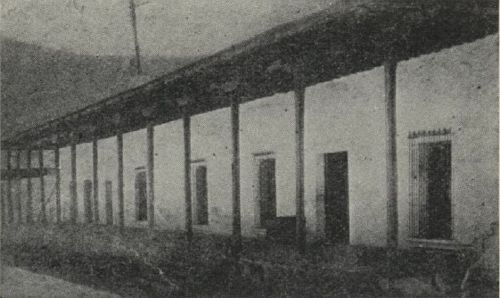
The Alamos mint
The building was located on the corner of "Calle de las Flores" and " Callejon de la Casa de Moneda." This street is only two blocks long. After the government had given up the federal assay office, the building was then purchased by Reynaldo Ramos, who by using more modern methods of assaying was able to obtain from the discarded tailings left in and around the old mint, a sufficient profit to repay him for his labors. There was also a period in which the whole lot occupied by the mint was excavated to a considerable depth in the belief that there might be a buried treasure, frequently found in the old houses of the city of Alamos. In the latter part of the month of December 1927, it rained in Alamos twenty-four inches in seventy-two hours, and this as well as the excavations that had preceded, caused the walls of the old edifice to crumble. So, today, 25 April, 1933, nothing remains. The useable wood and iron work were transported by Mr. Ramos to Navojoa and used in the construction of another building.
The assayers{footnote}list updated{/footnote} were:
| Initials | Name | Begins on | Ends on |
| PG | Pascual Gaxiola | 1862 | 1868 |
| DL or L |
In 1850 he witnessed an outrage by a party of twenty-two Americans who were on their way to California motivated by the gold rush, The party murdered one Mexican and wounded three more, whereupon the townsfolk stoned the house where the Americans were quartered, managing to kill two, wounding several and taking two more prisoner. Larraguibel was praised for his actions, in calming the people and securing the prisoners until the government to dispose of them. However, despite his good performance and the congratulations he received, he resigned from the position in September of the same year. In July 1852, Larraguíbel arrived in Alamos as head of the assay house, a position in which he remained until 1866 when he was appointed assayer of the Casa de Moneda, which had opened its doors in 1862. He held this important position, except for the period of 1872-74, until his death of consumption on 16 June 1879. A note in El Minero Mexicano in 1876{footnote}El Minero Mexicano, Tomo III, Núm. 46, 13 February 1876{/footnote} described as “hombre escrupuloso en sus operaciones y de larguísima práctica (a man scrupulous in his operations and of very long practice)". {footnote}image from a daguerrotype donated to the Alamos Museum by Guadalupe Larraguíbel Retes{/footnote}. |
1866 | 1879 |
| AM | Antonio Moreno | 1872 | 1874 |
| ML or L |
Manuel served on several occasions as a councillor on the Alamos City Council. When the Assay Office closed Manuel decided to move to the nascent town of Navojoa where he died on 16 September 1938 at the advanced age of 88. |
1876 | 1895 |
| JD | 1886 |
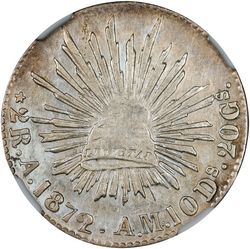
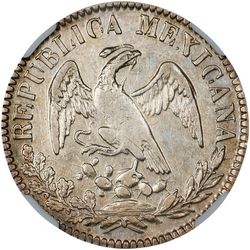
KM-374 2r 1872 A AM (Stack’s-Bowers Kirk Menczer Collection, 24 June 2026, lot 73001)
Diameter 28 mm. 6.760 g, 0.90277 silver
| Date | Asssayer | Recorded Mintage |
Comment |
| 1872 | AM |
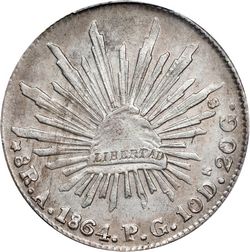
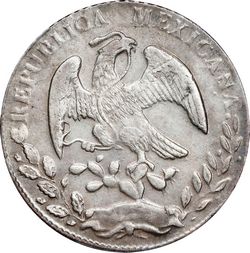
KM-377 8r 1864 A PG (Stack’s-Bowers auction, 17 August 2024, lot 44195)
Diameter 39 mm. 27.070 g, 0.90277 silver
| Date | Asssayer | Recorded Mintage |
Comment |
| 1864 | PG | ||
| 1864/5 | PG | ||
| 1865 | PG | issued while Maximilian's forces controlled the mint (May 1865 - 28 August 1866) | |
| 1866/5 | PG | ||
| 1866 | DL | ||
| 1867 | DL | ||
| 1868 | DL | ||
| 1869/8 | DL | ||
| 1870 | DL | ||
| 1871 | DL | ||
| 1872 | AM | ||
| 1873 | AM | 509,000 | |
| 1874/3 | DL | As mintmark | |
| 1874 | DL | ||
| 1875 7/7 | DL | A mintmark | |
| 1875 | DL | A mintmark (illustrated below) | |
| 1875 | DL | As mintmark (illustrated below) | |
| 1876 | DL | ||
| 1877 | DL | 515,000 | |
| 1878 | DL | 513,000 | |
| 1879 | DL | ||
| 1879 | ML | ||
| 1880 | ML | ||
| 1881 | ML | 966,000 | |
| 1882 | ML | 480,000 | |
| 1883 | ML | 464,000 | |
| 1884 | ML | ||
| 1885 | ML | 280,000 | |
| 1886 | ML | 857.000 | |
| 1886/0 | ML/JD | As - CN mintmarks | |
| 1887 | ML | 650,000 | |
| 1888/7 | ML | 508,000 | |
| 1888 | ML | ||
| 1889 | ML | 427,000 | |
| 1890 | ML | 450,000 | |
| 1891 | ML | 533,000 | |
| 1892/0 | ML | ||
| 1892 | ML | 465,000 | |
| 1893 | ML | 734,000 | |
| 1894 | ML | 725,000 | |
| 1895 | ML | 477,000 |
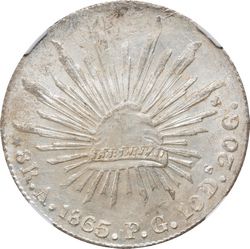
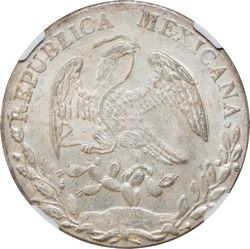
KM-377 8r 1865 A PG (Stack’s-Bowers auction, 9 April 2025, lot 42453)
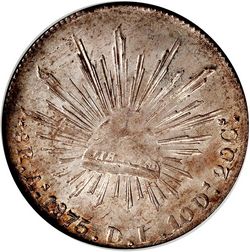
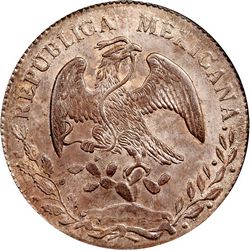
KM-377 8r 1875 As DL (Ponterio Baltimore auction, 4 November 2010, lot 6193)
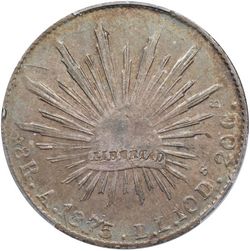
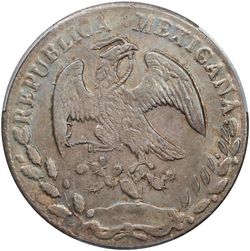
KM-377 8r 1875 A DL (Stack’s-Bowers auction, April 2025, lot 46097)
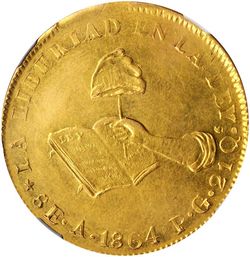
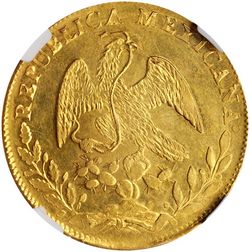
KM-383 8E 1864 A PG (Stack’s-Bowers ANA auction, 20 August 2021, lot 41174)
Diameter 37 mm. 27.070 g. 0.8750 gold
| Date | Asssayer | Recorded Mintage |
Comment |
| 1864 | PG | ||
| 1866 | DL | ||
| 1868/7 | DL | ||
| 1869 | DL | ||
| 1870 | DL | ||
| 1872 | AM |
This is the capital of the northern state of Chihuahua. The Spanish Colonial Government operated a mint from 1810-1822. The Republican mint opened in 1831. There is reference to this mint opening in August 1832, but this is obviously an error since coins of 1831 are known. Chihuahua issued coins of the Republic annually, until it closed on 30 June 1895. In 1840 Chihuahua became the third Mexican mint to produce its dies from hubs. This technique greatly improved the quality of the coins produced as well as the efficiency of the mint. The mint was occupied by the Imperial Forces of Maximilian from 15 August 1865 to 17 June 1866. It is not known whether coinage operations continued during this period.
Production of 8 Reales ceased in 1871 and resumed in 1873 during which time Balance Scale Pesos were issued.
| from | to | |
| 1831 | 11 July 1839 | Probably Government of the State of Chihuahua |
| 11 July 1839 | unknown | Kelly y Cia. (Juan Potts and Juan Jennison) |
| unknown | Potts, Garniz y Munoz (unknown) | |
| unknown | 19 August 1863 | Macmanus y Cia. |
| 20 August 1863 | 20 August 1874 | Enrique Mueller y Socios |
| 21 August 1874 | 17 February 1880 | Government of the Republic of Mexico |
| 18 February 1880 | 30 June 1895 | Félix Francisco Maceyra, Luis Terrazas, Luis Faudoa, Ramón Remigio Luján and Miguel Salas (Principal stock holders of the Banco Mexicano of Chihuahua) |
| Initial | Name | Begins on | Ends on |
| MR | Mariano Cristóbal Ramírez | 1831 | 1834 |
| AM | José Antonio Mucharraz | 1834 | 1838 |
| RC | Rodrigo García | 1839 | 1856 |
| JC |
Joaquín Campa was a lawyer who was born and died in Chihuahua. He became politicised at a very young age and joined the liberal ranks. He took up various posts in the judiciary until he reached the rank of Magistrate of the Supreme Tribunal of Justice in Chihuahua. He fought against the French Intervention of Mexico and in August 1862 was president of the junta patriótica established in Chihuahua{footnote}El Siglo Diez y Nueve, Tomo IV, Núm. 594, 31 August 1862{/footnote}. However, in October 1865 as president of the Tribunal Superior he was one of the former enemies who signed the act of adhesion to the Empire{footnote}La Sociedad, Tomo V, Núm. 871, 11 November 1865{/footnote}. He died in 1871. |
1856 | 1866 |
| BA | Bruno Arriada | 1858 | |
| FP |
Edward Francisco Potts was by 1860 “a distinguished English gentlemen of wealth and influence, a twenty years’ resident of Chihuahua and assayer at the mint”{footnote}letter S. Hart, El Paso, to President James Buchanan, 21 January 1860 in report to Congress on the difficulties on Southwestern Frontier(footnote}. On 19 January 1860 he wrote from Chihuahua to Mr. Hart in El Paso, requesting the assistance of U. S. troops against rebels from Durango{footnote}ibid.{/footnote}. On 29 May 1865 Potts was named by the Maximilian regime as a member of the Junta auxiliar de colonización in Chihuahua {footnote}El Diario del Imperio, Tomo I, Núm. 125, 1 June 1865{/footnote}. These local juntas were made up of five hacendados or businessmen, two Mexican and three foreigners, who were tasked with developing the resources of their Departamento{footnote}El Diario del Imperio, Tomo I, Núm. 90, 20 April 1865{/footnote}. |
1865 | 1866 |
| JC |
José María Gómez del Campo Gómez del Campo went on to be listed as ensayador in San Luis Potosí in 1873. |
1866 | 1868 |
| MM | Manuel Merino | 1868 | 1876 |
| EA | Eduardo Avila | 1877 | |
| JM |
Jacobo Mucharraz Losa, the son of José Antonio Mucharraz, was born in Chihuahua around 1837. For three years during the war of Intervention he distinguished himself by the services to the state of Chihuahua. Then he was an assayer in the Guanajuato mint before, in 1870, being nominated assayer of the Mexico City mint (El Ferro-Carril, Tomo III, Núm. 187, 11 August 1870) Mucharraz was appointed assayer of the Chihuahua mint by the governor José Eligio Muñoz, so this was between 19 February and 13 June 1877. On 4 August 1877 he was suspended from his post by the subsequent governor, General Pedro Hinojosa, supposedly for being wayward and hindering the work of the mint (díscolo del empleado y entorpeciiento en las labores ó trabajos de la casa). Mucharraz took the case to court, questioning Hinojosa’s right to fire him: on 13 August the mint director, E. Avila, reported the Mucharraz’s conduct was scandalous and insubordinate (escandalosa é insubordinada) and local businesses, in a report of 9 August, called Mucharraz intolerable in every business in which he was involved (hombre intolerable de todo negocio en que tiene intervencion). However, the Ministerio Público declared that Mucharraz’s rights had been violated and on 8 September the judge, Juan de Dios Búrgos, ruled that, irrespective of the reasons for the firing, it had been unconstitutional{footnote}El Foro, Tomo II, Año V, Núm. 123, 27 December 1877{/footnote}. So Mucharraz’s initials only appear on an 1877 eight reales. Mucharraz appears as a third official in the Chihuahuan state government in November 1890{footnote}El Estado de Chihuahua, Año XIII, Núm. 153, 22 November 1890{/footnote}. He died in Chihuahua on 20 June 1900. Incidentally, his son, Jacobo Mucharraz Calderon, had been a founder of the Partido Antirreeleccionista in Chihuahua in 1909 and was on the town council in 1912 and 1913, but on 13 December 1913, a few days after Francisco Villa captured the town, was executed on Villa’s orders. |
1877 | |
| GR |
Guadalupe Rocha Guadalupe Rocha was listed as the ensayador in 1873. |
1877 | |
| AV |
Antonio Valero In July 1879 a newspaper reported that through either ignorance or malice Valero was causing immense harm to Chihuahua businessmen and miners. Since his appointment the young Antonio Valero had upset all the owners of silver who had to deal with him. The difference between the assays made by M. Merino and A. Barbachano and those made by Valero could be up to forty milésimos{footnote}La Libertad, Año II, Núm. 170, 24 July 1879{/footnote}. |
1877 | 1880 |
| PM | Unknown | 1880 | |
| MM | Unknown (possibly Manuel Merino) | 1880 | |
| MG | Manuel Gameros | 1880 | 1882 |
| MM | Manuel Merino | 1882 | 1895 |
The assayers on its decimal coinage were:
| Initial | Name | Began on | Left office on |
| M | Manuel Merino | 1868 | 1895 |
| P | 1872 | ||
| G | Manuel Gameros | 1880 |
-
-
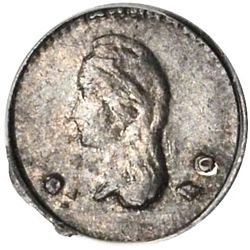
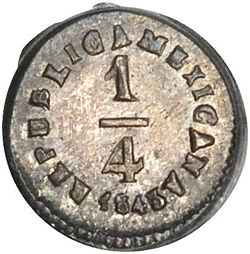
KM-368 ¼r Chihuahua 1843 CaRG (Stack’s Bowers Baltimore Auction, 28 March 2011, lot 8081)
Diameter 12 mm. 0.845 g, 0.90277 silver
| Date | Asssayer | Recorded Mintage |
Comment |
| 1843 | RG |
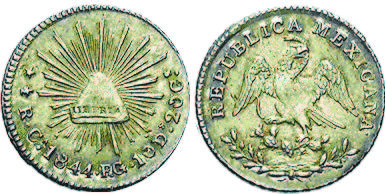 KM-370.1 ½r 1844 Ca RG
Diameter 16 mm. 1.690 g, 0.90277 silver
For a consideration of the rarity of Chihuahua ½ real see here.
| Date | Asssayer | Recorded Mintage |
Comment |
| 1844 | RG | ||
| 1845 | RG |
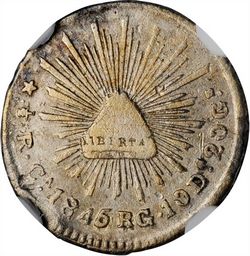
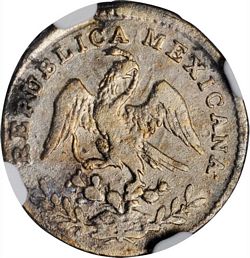
KM-370.1 ½r 1845 Ca RG (Stack’s-Bowers auction, 26 June 2020, lot 73215)
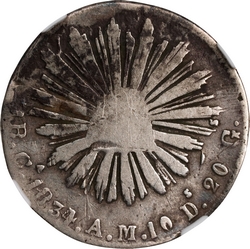
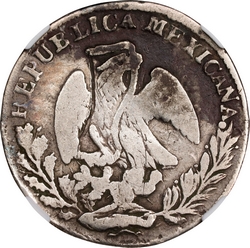
KM-372 1r 1834 Ca AM (Stack’s Bowers Kirk Menczer Collection, 23 June 2026, lot 72266)
Diameter 20 mm. 3.380 g, 0.90277 silver
| Date | Asssayer | Recorded Mintage |
Comment |
| 1834 | MR | possibly unique | |
| 1834 | AM | probably five or less examples known | |
| 1844 | RG | ||
| 1845 | RG | ||
| 1855 | RG |
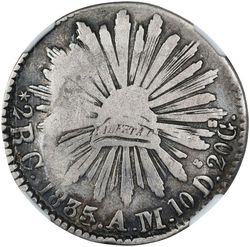
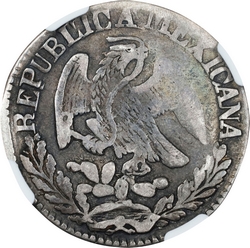
KM-374.2 2r 1835 Ca AM (Stack’s-Bowers Kirk Menczer Collection, 24 June 2026. Lot 73006)
Last of the early style Chihuahua with crude locally made dies.
Diameter 27 mm. 6.670 g, 0.90277 silver
| Date | Asssayer | Recorded Mintage |
Comment |
| 1832 | MR | ||
| 1833 | MR | ||
| 1834 | MR | ||
| 1834 | AM | ||
| 1835 | AM | CA mintmark, unconfirmed | |
| 1835 | AM | C mintmark | |
| 1836 | AM | ||
| 1844 | AM | ||
| 1844 | RG | ||
| 1845 | RG | ||
| 1855 | RG |
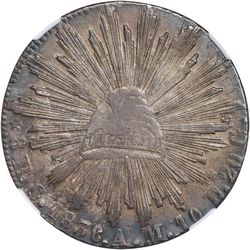
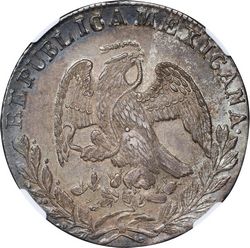
KM-377.2 8r 1836 Ca AM (Stack’s-Bowers auction, 26 August 2025, lot 41390)
Diameter 39 mm. 27.070 g, 0.90277 silver
| Date | Asssayer | Recorded Mintage |
Comment |
| 1831 | MR | ||
| 1832 | MR | ||
| 1833 | MR | ||
| 1834 | AM | ||
| 1834 | MR | ||
| 1835 | AM | ||
| 1836 | AM | ||
| 1837 | AM | ||
| 1838 | AM | ||
| 1839 | RG | ||
| 1840 | RG | one dot after date | |
| 1840 | RG | three dots after date | |
| 1841 | RG | ||
| 1842 | RG | ||
| 1843 | RG | ||
| 1844/1 | RG | ||
| 1845 | RG | ||
| 1846 | RG | ||
| 1847 | RG | ||
| 1848 | RG | ||
| 1849 | RG | ||
| 1850 | RG | ||
| 1850/40 | RG | decade overdate. illustrated below | |
| 1851 | RG | ||
| 1852 | RG | ||
| 1853 | RG | ||
| 1854 | RG | ||
| 1855 | RG | ||
| 1855/45 | RG | ||
| 1856 | RG | ||
| 1856/5 | JC | ||
| 1857 | JC/RG | ||
| 1857 | JC | ||
| 1858 | JC | ||
| 1858 | BA | ||
| 1859 | JC | ||
| 1860 | JC | ||
| 1861 | JC | ||
| 1862 | JC | ||
| 1863 | JC | ||
| 1864 | JC | ||
| 1865 | JC | ssued while Maximilian's forces controlled the mint (15 August 1865 -17 July 1866) | |
| 1865 | FP | ||
| 1866 | JC | ||
| 1866 | FP | ||
| 1867 | JG | ||
| 1868 | JG | ||
| 1868 | MM | ||
| 1869 | MM | ||
| 1869 | MM | MM / inverted MM (illustrated below) | |
| 1870 | MM | ||
| 1871 | MM | MM / inverted MM | |
| 1871/0 | MM | ||
| 1873 | MM | ||
| 1873 | MM | 7 / retrograde 7 | |
| 1874 | MM | ||
| 1875 | MM | ||
| 1876 | MM | ||
| 1877 | EA | 472,000 | |
| 1877 | GR | ||
| 1877 | JM | ||
| 1877 | AV | ||
| 1878 | AV | 439,000 | |
| 1879 | AV | ||
| 1880 | AV | ||
| 1880 | PM | ||
| 1880 | MG | regular initials (illustrated below) | |
| 1880 | MG | tall initials (illustrated below) | |
| 1880 | MM | ||
| 1881 | MG | 1,085,000 | |
| 1882 | MG | 779,000 | |
| 1882 | MM | ||
| 1882 | MM | second M over sideways M | |
| 1883 | MM | 818,000 | sideways M |
| 1883/2 | MM | second M over G | |
| 1883 | MM | ||
| 1884/3 | MM | Very scarce overdate (illustrated below) | |
| 1884 | MM | ||
| 1885 | MM | 1,345,000 | |
| 1885/4 | MM | ||
| 1886 | MM | 2,483,000 | |
| 1887 | MM | 2,625,000 | |
| 1888 | MM | 2,434,000 | |
| 1888/7 | MM | ||
| 1889 | MM | 2,681,000 | |
| 1890 | MM | 2,137.000 | |
| 1891 | MM | 2,268,000 | |
| 1891/0 | MM | ||
| 1892 | MM | 2,527,000 | |
| 1893 | MM | 2,632,000 | |
| 1894 | MM | 2,642,000 | |
| 1895 | MM | 1,112,000 |
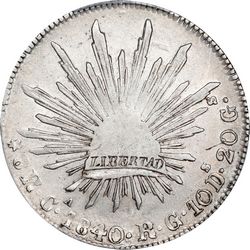
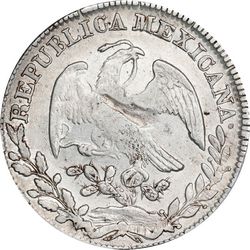
KM-377.2 8r 1840 Ca RG (Stack’s-Bowers auction, 28 February 2024, lot 73125)
Die style of 1840.
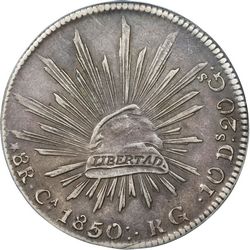
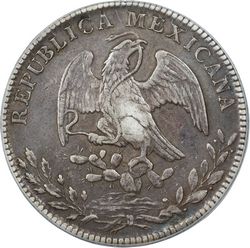
KM-377.2 8r 1850/40 Ca RG (Stack’s-Bowers auction, 25 June 2026, lot 74201)
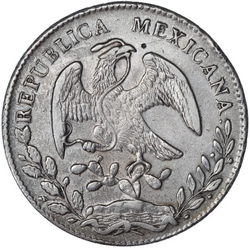
KM-377.2 8r 1869 Ca MM/M (Briggs & Bustos auction, 31 August 2025, lot 265)
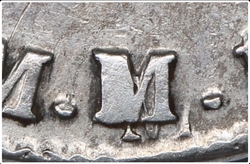 Scarce variety with the second “M” reengraved in the assayer’s mark, which Dunigan & Parker describe as “M over inverted M.”
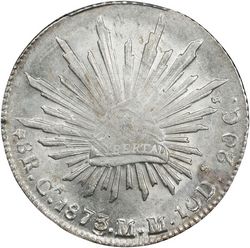
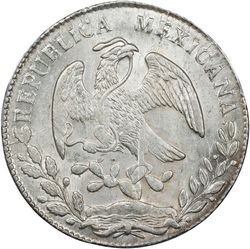
KM-377.2 8r 1873 Ca MM (Stack’s-Bowers auction, 25 June 2026, lot 74203)
Variety with repunched "3".
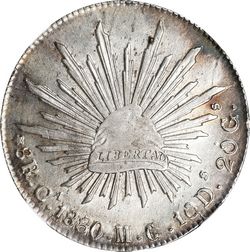
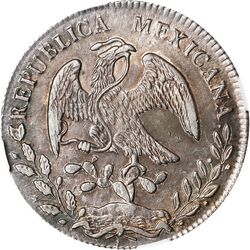
KM-377.2 8r 1880 Ca MG (Stack’s-Bowers auction, 16 May 2023, lot 70344)
Variety with tall assayer's initials.
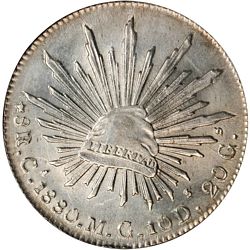
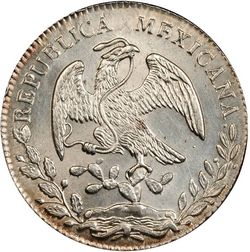
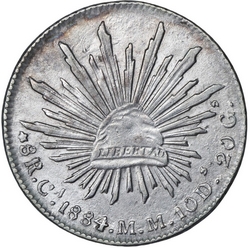
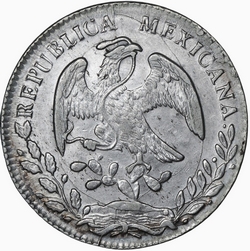
KM-377.2 8r 1880 Ca MG (Stack’s-Bowers Chicago ANA auction, 13 August 2011, lot 20532)
Variety with normal assayer's initials.
KM-377.2 8r 1884/3 Ca MM (Briggs & Bustos auction, 31 August 2025, lot 267)
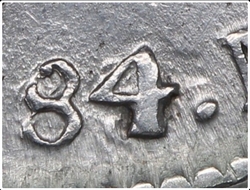
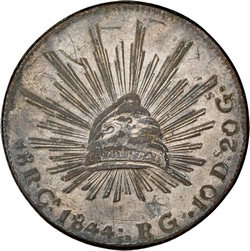
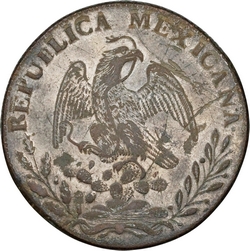
Counterfeit KM-377.2 8r 1844 Ca RG (Stack’s Bowers auction, 5 November 2025, lot 78175)
silver plated copper
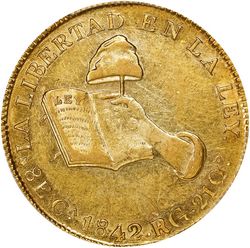
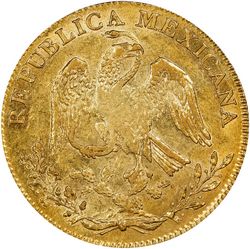
KM-383.1 8E 1842 Ca RG (Stack’s-Bowers NYINC auction, 16 January 2026, lot 41092)
Diameter 37 mm. 27.070 g. 0.8750 gold
| Date | Asssayer | Recorded Mintage |
Comment |
| 1841 | RG | ||
| 1842 | RG | ||
| 1843 | RG | ||
| 1844 | RG | ||
| 1845 | RG | ||
| 1846 | RG | ||
| 1847 | RG | ||
| 1848 | RG | ||
| 1849 | RG | ||
| 1850/40 | RG | ||
| 1851/41 | RG | ||
| 1852/42 | RG | ||
| 1853/43 | RG | ||
| 1854/44 | RG | ||
| 1855/43 | RG | ||
| 1856 | RG | ||
| 1857 | JC/RG | ||
| 1858 | JC | ||
| 1858 | BA.RG | ||
| 1859 | JC/RG | ||
| 1860 | JC/RG | illustrated below | |
| 1861 | JC | ||
| 1862 | JC | ||
| 1863 | JC | ||
| 1864 | JC | ||
| 1865 | JC | ||
| 1866 | JC | ||
| 1866 | FP | ||
| 1867 | JG | ||
| 1868 | JG | concave wings | |
| 1869 | MM | regular wings | |
| 1870 | MM | ||
| 1871/61 | MM | illustrated below |
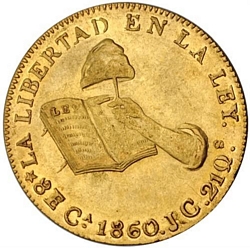
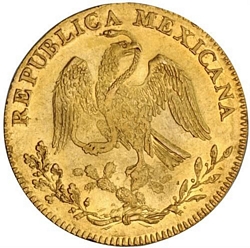
KM-383.1 8E 1860 Ca JC/RG (Louis E. Eliasberg, Sr. Collection , 15 April 2005. Lot 3329)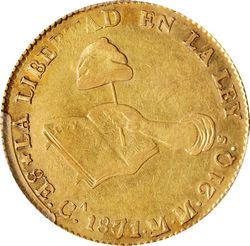
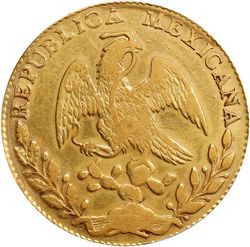
KM-383.1 8E 1871/61 Ca MM (Stack’s-Bowers auction, 24 August 2022, lot 31106)
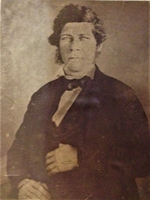 Domingo Larraguibel must have been born in Mexico City around 1809{footnote}In the archive of the Cathedral of Mexico is a baptismal certificate of a Domingo José Rafael Román Larraguíbel Martinez, born in 1811{/footnote} and by 1834 was already based in the city of Chihuahua, where he arrived with the appointment of supernumerary assayer (ensayador supernumerario), moving shortly after to the general office of assay in Jesús María (today Ocampo) where he stayed for 15 years. During his stay in Jesús María he became a deputy to the state legislature for the canton of Rayón.
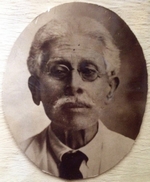 Manuel Nicolás Larraguibel was born in Alamos on 9 September 1850, the son of Domingo Larraguibel and Marcelina Híjar y Hermosillo. His father taught him the trade of assaying metals, so by 1878 Manuel was already together with his father in charge of the mint, and ran it from Dominguez’s death in 1879 until 1895, when the mint closed. The premises were then used for the Federal Assay Office, which was also headed by Manuel Larraguíbel until 1911 when it closed its doors due to the low production of silver in the region and the outbreak of the Mexican Revolution.