Located in a once rich mining area, this city is the capital of the state of Durango.
The mint was opened in 1811 by the Spanish Colonial Govemment. By independence, after more than a decade of war, the country was bankrupt and it was urgent to find mechanisms that would help resolve this situation. The mint of Durango continued its work in 1821 and 1822 during Iturbide’s reign, producing 8 reales that were the same as the previous ones with the bust of Ferdinand VII, and ⅛ and ¼ real copper coins with the legend “DE LA PROVINCIA DE NUEVA VIZCAYA”.
| from | to | |
| Angel Pinilla Pérez (Intendente) | 1811 | 1812 |
| José María Barregas | 1812 | 1813 |
| Manuel de Escárcega | 1813 | 1822 |
| Julián de la Barraza | 1822 | |
| Leonardo Santoyo | 1823 | 1824 |
| Manuel Vicente Escárcega | 1824 | 1828 |
| Manuel Bras de Fer | 1829 | 1834 |
| Initial | Name | Begins on | Ends on |
| RM | Ramón Mascareñas | ||
| MZ | Mariano Zaldívar | ||
| CG | Cosme Garcés had been an assayer in San Luis Potosí before he came to Durango | ||
| RL | Ramón Luelmo | ||
| RM | Ramón Mascareñas |
The state of Durango officially took over the mint on 22 May 1824 and coins were produced annually until it was closed on 30 June 1895. The second location of the mint was at the intersection of calles 5 de Febrero (formerly de las Carretas) and Miguel de Cervantes Saavedra (formerly del Apartado). This site was located in what was the Palacio del Buen Retiro, so called because it served as a resting place for Archbishop Benito de Orta y Blanco, far from what were then the limits of the city. The third location was at calle Negrete N° 900 Pte. This building was acquired for the federal government in 1881, at a cost of $12,000, by Mariano Herrera, Jefe de Hacienda in the city, and José María Peimbert, interventor of the mint. The deed of sale was formalized on 31 December 1881 before the notary public Jesús Cincuenegui.
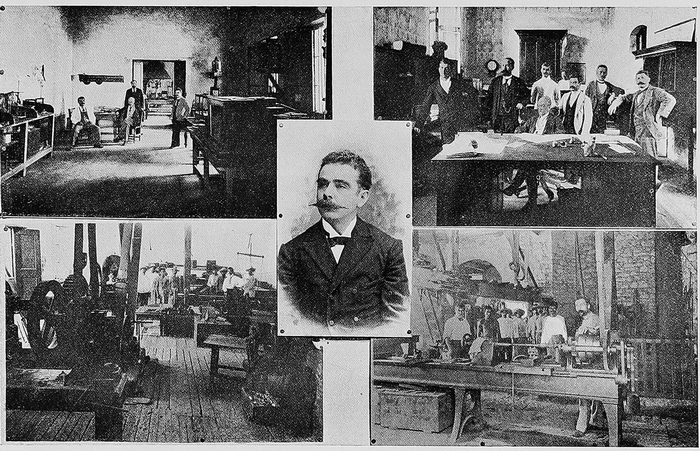
The interior of the mint, with insert of Norberto Domínguez
Durango was one of three mints that produced 8 Reales with the Profile or Hookneck Eagle design. However, there were problems with the quality of production in the beginning.
The early years were difficult for the State of Durango and its mint. There were times when the state did not have a legally organized government. The mint was forced to close from August 1826 until March 1827, causing the governor to complain that the loss of prestige associated with the closing would result in a reduction of the amount of metal brought in for coining. Citing the high cost of operation due to obsolete machinery, the governor recommended a study of the problems. Conditions and economics at the miny improved considerably when a 15 year lease was granted on 24 November 1829 to Manuel Bras-de-Fer and Jose Antonio Pescador.
Under their able management production grew and quality improved dramatically. In 1832 Durango became the second Mexican mint to use hub for the production of dies. When the contract with Bras-de-Fer and Pescador expired on 20 November 1844 the mint was again closed. The State of Durango requested instructions from the Federal Government with regard to the mint. Having had no word from Mexico City, early in 1845 the state legislature accepted a provisional two-year contract{footnote}El Registro Oficial, Periódico del Gobierno del Departamento de Durango, Tomo 4o, Sem. 4o. 27 February 1845{/footnote} that was extendable to seven years with the approval of the Federal Government and the mint was re-opened. Although occupied by the Imperial forces of Maximilian from 4 July 1864 until March 1866, at least some production of Republican 8 Reales continued. Production of 8 Reale was halted in 1870 in favour of the Balance Scale Peso. It resumed in 1873 when that serie was discontinued. From the mid 1860 until the 1880s most of Durango's 8 Reale production was sent to the Orient.
This mint began to produce gold pieces in the year 1832 in values of ½, 1, 2 and 8 escudos. A variety of the 1836 ½ escudo is described here.
The mint also produced copper octavos (from 1824 to 1854) and cuartillas (from 1845 to 1872), with different legends according to the fact that if a Liberal government was established they carried the word "ESTADO" and if they were of the Conservative order they carried the legend "DEPARTAMENTO".
This mint was the fourth most productive in silver minting in the country after those of Mexico City, Guanajuato and Zacatecas.
It closed on 30 June 1895, when the federal government was in a position to settle the debt with the lessees and take possession.
| from | to | |
| 22 May 1824 | November 1829 | Government of the State of Durango |
| 24 November 1829 | 20 November 1844 | Manuel Bras de Fer and José Antonio Pescador |
| 19 February 1845 | 29 November 1847 | Hermann Stahlknecht |
| 29 November 1847 | 30 June 1849 | H. Bernardo Georgy |
| 1 July 1849 | 1857 | Government of the Republic of Mexico |
| 1857 | 16 December 1867 | José Dolores Grimaldo{footnote}Grimaldo was a local businessman, of Italian origin{/footnote}, Francisco Laborda{footnote}Laborda was a prominent merchant, of French origin{/footnote}, Hermanos Delius{footnote}The Delius brothers, Alberto, Agustín, German and Julio, were of German origin and had the commercial house that in 1843 operated under the name of Almacenes de Randell y Delius, then changed to Delius Hermanos and Delius Ortigosa, then to Delius e Hildelbrand to resume in 1864 as Delius Hermanos. German Delius and Maximiliano Damm formed a company with Alberto Delius in Hamburg as the partner in charge of the purchase and shipment of goods from Europe.{/footnote}, Toribio Bracho, representing Francisco Gurza{footnote} Gurza was the owner of mining haciendas, the La Concordia hacienda in the state of Coahuila and various other properties{/footnote}, Antonio Arana{footnote} The Spaniard Arana owned several mines in Durango, had commercial interests in London, Bordeaux and Bilbao and owned the brig "Gabriel" that sailed between Europe and the port of Mazatlan, Sinaloa{/footnote} and Pablo Jáquez{footnote} Pablo Jaquez was a Mexican who was dedicated to agriculture and various other trades.{/footnote}.{footnote}AHGED, Año de 1857, expediente sobre la entrega de la casa de moneda, núm. 199, Juzgado de Distrito, expediente núm. 68{/footnote} |
| 16 December 1867 | 31 December 1879 | Government of the Republic of Mexico |
| 31 December 1879 | 30 June 1895 | Cia. Limitada Central de Casas de Moneda de Mexico |
| from | to | |
| Manuel Bras de Fer | 1834 | 1835 |
| Manuel Ruiz de León | 1836 | 1842 |
| Manuel Bras de Fer | 1842 | |
| Marcelino Castañeda | 1842 | 1845 |
| Hermann Stahlknecht | 1845 | 1846 |
| Carlos Stahlknecht | 1846 | 1847 |
| Bonifacio Gutiérrez | 1848 | |
| H. Bernard Georgy | 1848 | 1849 |
| Dionisio Guerrero Tavizon | 1850 | 1852 |
| Francisco Elorreaga | 1852 | 1855 |
| Fernando Guerrero Tavizon | 1856 | 1863 |
| Luis de la Torre | 1864 | 1866 |
| Carlos León de la Peña | 1866 | 1872 |
| José María Peimbert | 1872 | 1879 |
| Enrique Amezcua | 1880 | 1893 |
| Norberto Domínguez | 1893 | 1895 |
In the investigations that I have been able to carry out within the Historical Archive of the Government of the State of Durango (AHGED) we have located files (some already classified and others in the process of being so), as well as some Periódicos Oficiales, that give us the name of the Durango assayers. Up to now the mention of the assayers’ initials in various books and catalogs, based on the research of Dr. Alberto Pradeau Avilés and published in his work Numismatic History of Mexico has in the main been wrong. Dr. Pradeau relates some events that gave rise to the different administrations of the mint of Durango, as well as others related to the assayers, although he confesses to not knowing the name corresponding to several of the initials that appear on the coins. Likewise, others he deduces from some characters in the political history of the state as if they were the assayers, but without checking the sources of the files or newspapers from which he took that observation.
Therefore, I will here list the names and correct data of the characters, in chronological order, with the intention that the pertinent corrections will be made in the specialized books and catalogs.
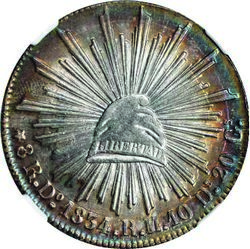
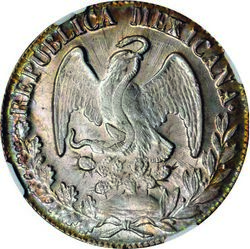
1.-Initials R.M. In 2022, a file was located in the Historical Archive of the State of Durango, in the Finance section, so today we know that they belong to Ramón Mascareñas, an assayer at the time of the War of Independence coins, and not to Ramón Mendoza, as mentioned in the book by Dr. Alberto Pradeau. The data was found in a still unclassified box of files in the section of “Hacienda” from 1811 in the time of the Nueva Vizcaya.
2.- Initials M.Z. Like the first ones these were located in still unclassified files in the Colonial section where the name appears as Mariano Zaldívar with his appointment as the main assayer of the Durango mint.
3.- Initials C.G. This assayer’s name, Cosme Garcés, was very hidden within the Archive’s documents. In the vast majority of documents from 1818 to 1823 his name was not mentioned and on one occasion did we locate a document of the year 1810 giving some reports of assays in the San Luis Potosí office, where his name is mentioned. It was not known if this was the same character but now we can be certain that when he finished his function as an assayer in San Luis Potosí he was hired in Durango for the years from1818. The reference is made in unclassified files for February 1823.
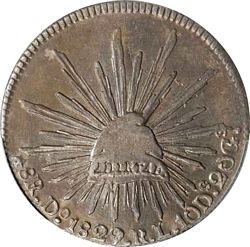
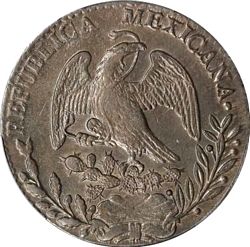
4.- Initials R.L. Nowadays we can be certain that these belong to Ramón Luelmo, as located in 2011, in the files of the Acts of Congress (Actas de Acuerdos y Decretos del Congreso del Estado de Durango) of 13 July 1826, which reported the payment to the assayer. This was outlined in my first book, Reseñas Históricas de Casa de Moneda de Durango 1811-1877, which was published in 2014.
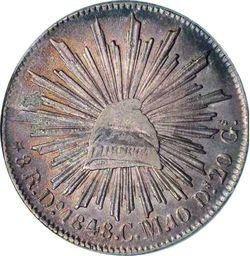
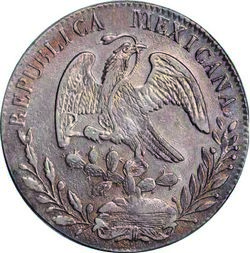
5.- Initials C.M. These belong to Cayetano Mascareñas and not to Clemente Morón, as was thought. This information was located in 2022, in file number 327 in the section “Correspondencias de la Secretaría General de Gobierno”.
Cayetano Mascareñas was the chief assayer in the years of 1848 and 1849. It is understood that it was only in the first months of this year that 8 reales coins were die-cut with his initials “C.M” since the lease contract of the Director Bernard Georgy was terminated and consequently the changes were made of of the assayer at the Durango mint.
However, it was this assayer who was ordered by the director to stamp the initials “B” and “G” on his 8 reales of 1848 and 1849, distributed on the obverses and reverses and representing the initials of Bernard Georgy. These initials have almost been found on most 1848 and few 1849 coins (since, as we have mentioned, Mascareñas was only at the mint for a few months of the latter year, before he retired).
A government inspection was trying to investigate the fraud of the counterfeiting of coins with a low silver content. It is said that director Bernard Georgy forbade entry to the government inspector and gave orders to the guards of the establishment that, if necessary, they should take out their weapons and use them to shoot this state government comptroller, named Dionisio Guerrero Tavizon, if he tried to pass. These are the violent stories of how these foreigners did whatever they wanted to do to have the support of characters within the government who were Conservatives.
After 17 years, Cayetano Mascareñas, returned in 1866 when the assayer Luis de la Torre (“L.T.”) left the mint and in 1867 when the French invaders were no longer in the state. There is a record that there were 431,000 pieces produced in that last year so that Carlos León de la Peña Muñoz (“C.P.”) who was a very accomplished and honest Liberal immediately returned. However, Mascareñas returned for the third time in the years 1873, 74, 75, 76 and 77.
A very interesting fact is that he worked for two years (1874 and 1875) he worked with another assayer named Jose Othón Huitrado (“J.H.”). These pieces are these are considered VERY RARE and RARE pieces
6.- Initials J.M.R. José María Ramírez only appears in a few months in the monthly assay reports in the Periódicos Oficiales, but Cayetano Mascareñas continued to exercise the role of jefe de ensayes until 1852, so, due to the lack of documentation, we are still unsure about this period in the life of the Durango mint.
7.- Initials C.P. These are of Carlos León de la Peña Muñoz, a declared liberal and patriotic supporter of President Benito Juárez against Maximilian, who was forced to leave the position of director of the Durango mint. He held several public offices, as well as that of professor at the Juárez Institute in 1875.
8.- Initials L.T. These belong to Luis de la Torre, as several documents refer to his appointment as director of the Durango mint in the years from 1859 to 1866. However, some receipts for payments for assays bear the name of a totally different person called Francisco Izurieta, though we do not know why.
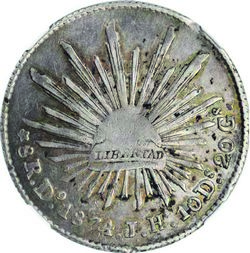
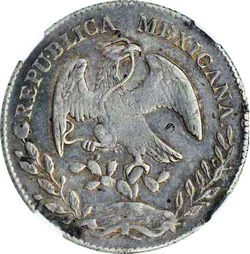
9.- Initials J.H. These belong to José O. Huitrado Aguilar, who was sent from Mexico City to perform the job of assayer. This information was found in the Periódico Oficial of December 1874 (data shared by my companion and numismatic colleague Javier Ruiz Celis).
10.- Initials J.M.P. These were said to belong to someone named José Miguel Palma but this name never appears in the records. However, Ingeniero José María Peimber was an assayer and then director of the mint at this time. Hence his three initials on the 1877 8 reales, the rarest pieces of the Durango mint.
11.- Initials P.E. These belong to Pedro Espejo and appeared in the Periódico Oficial of 19 September 1877 where it was announced that the assayer Carlos León de la Peña had been appointed Director General de Rentas in the state and that the new assayer would soon arrive to take up his position.
12.- Initials T.B. These belong to the assayer named Trinidad Barrera and appear in a file dated 14 November 1878 where there is talk of a trial of the previous assayer for mismanagement of the production of silver coins. This would have been Pedro Espejo who was replaced by Trinidad Barrera.
13.- Initials J.B. These belong to Jacobo Blanco. This name was confirmed in an original report of April 1885, provided to us from a private collection of an acquaintance in the United States, which includes the original signature of the assayer and a red seal of the Intervention of the mint of the government of Durango. Blanco replaced Manuel del Cerro, according to a letter dated 23 February 1885, in which the latter asked for permission to be absent from the office of assayer, to act as Interventor in the month of July. He returned as assayer according to a letter of 9 July of the same year. So the 8 reales with the initials J. B. are extremely scarce, as he performed his functions for just four months.
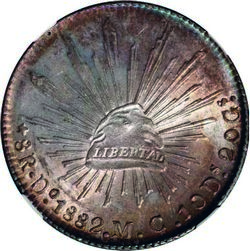
14.- Initials M.C. There is no doubt that these belong to Manuel del Cerro, although Pradeau asserted that these initials could correspond to one of two people: Manuel Canseco or Melchor Calderón. The correct name was found in documents in the section “Correspondencias de la Secretaría General de Gobierno” 1885. In these, addressed to the secretary general of the government, Manuel del Cerro asks for permission to retire for four months from his duties as assayer and Interventor (very special, since he had a double function within the mint).
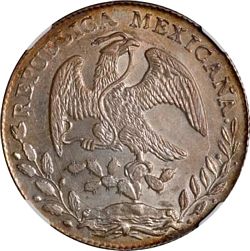
15.- Initials J.P. These are of Ingeniero José Gómez Palacios but were confused with those of another assayer, José María Peimbert (J.M.P.) because of the very similar initials. The original names were found in the Periódico Oficial of September 1890, where it is alluded that this person works as assayer and Interventor of the Durango mint. At the beginning of 1892 he went to Monterrey to establish the federal assay office and in 1895 he was summoned by Leandro Fernández to Mexico City to help him draw up the “Regulation of Mints” which at that time were being organised on a federal basis. In 1896 Gómez Palacios went to Culiacán as director of the city’s mint but only lasted two years until, sick through the climate, he returned to Monterrey. In addition, he held a position on the city council of Durango in the years from 1911 to 1912.
16.- Initials N.D. These are of Ingeniero Norberto Domínguez that appear in the files of “Correspondencias del Gobernador” of 1896. It is mentioned that he was highly recommended as being well prepared in the matter of the assay of metals and for having occupied the position as Interventor and assayer from 1892 to 1895. In addition to being a professor of meteorology at the Juárez Institute since 1892, he also held positions within the city council from 1892 to 1893 and from 1895 to 1897.
As an appendix I include a table giving the amount of silver coinage for each of the assayers of the Durango mint from 1824 to 1895. These figures are approximations based on data collected from archive files (from the Durango Mint section, 1824 to 1888, in the Center for Historical Studies of Mexico, Carlos Slim Foundation) and taking into consideration information from the Krause catalog section on Durango 8 reales (1889 to 1895).
These figures are the total of the silver pieces for ½, 1, 2 and 8 reales in addition to the pieces denominated in the decimal system such as those of 5. 10, 25 and 50 centavos and the balance scales pesos.
The table also includes information on the dates that each assayer held office. However, It should be noted that in some cases two or three assayers worked in the same year, sometimes for periods of a few weeks or months so it is very difficult to know exactly how many pieces are to be assigned to each of them due to the short time in which they were made and for the lack of documentary information.
| Dates | Assayer's name | initials | |
| 1824 to 1829 | Ramón Luelmo | R.L. | 3,590,813 |
| 1830 to 1849 | Ramón Mascareñas | R.M. | 15,483,663 |
| 1848 to 1849 and 1873 to 1877 | Cayetano Mascareñas | C.M. | 5,119,603 |
| 1849 to 1852 | José María Ramírez | J.M.R. | 1,941,994 |
| 1852 to 1864 and 1867 to 1873 | Carlos León de la Peña | C.P. | 11,659,379 |
| 1864 and1865 | Luis de la Torre | L.T. | 1,414,992 |
| 1872 and 1877 | José María Peimbert | J.M.P. | 1,166,976 |
| 1878 | Pedro Espejo | P.E. | 900,919 |
| 1878 to 1880 | Trinidad Barrera | T.B. | 2,668,035 |
| 1880 to 1882 | José Gómez Palacio | J.P. | 4,272,788 |
| 1882 to 1890 | Manuel del Cerro | M.C. | 9,206,211 |
| 1885 | Jacobo Blanco | J.B. | 1,131,644 |
| 1892 to 1895 | Norberto Domínguez | N.D. | 5,512,000 |
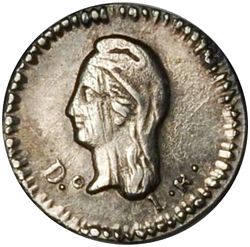
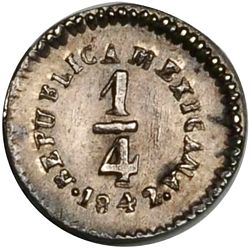
KM-368.2 ¼r Durango 1842 DoLR (Stack’s Bowers Baltimore Auction, 28 March 2011, lot 8083)
Diameter 12 mm. 0.845 g, 0.90277 silver
| Date | Asssayer | Recorded Mintage |
Comment |
| 1842 | LR | ||
| 1843 | LR |
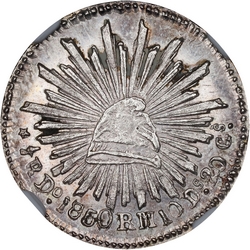
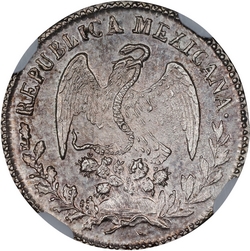
KM-370.3 ½r 1850 Do RM (Stack’s Bowers Kirk Menczer Collection, 23 June 2026, lot 72084)
Diameter 16 mm. 1.690 g, 0.90277 silver
For a consideration of the rarity of Durango ½ real see here.
| Date | Asssayer | Recorded Mintage |
Comment |
| 1832 | RM | ||
| 1833/1 | RM | ||
| 1833 | RM | ||
| 1833 | RL | These dies were created from French hubs which had the assayer as "RL". Normally the "L" was overpunched with an "M" but not in this case (illustrated below) | |
| 1834/1 | RM | illustrated below | |
| 1834 | RM | ||
| 1837/4 | RM | illustrated below | |
| 1837/6/4 | RM | ||
| 1837/6 | RM | ||
| 1841/33 | RM | ||
| 1842/32 | RM | ½ over 8R (illustrated below) | |
| 1842/32 | RM | 8R instead of ½R | |
| 1842 | RM | French dies | |
| 1842 | RM | Mexican dies | |
| 1843/33 | RM | ||
| 1843 | RM | ||
| 1845/32 | RM | ||
| 1845/34 | RM | ||
| 1845/35 | RM | ||
| 1846 | RM | ||
| 1848/5 | RM | ||
| 1848/6 | RM | ||
| 1849 | JMR | ||
| 1850 | RM | ||
| 1850 | JMR | French dies | |
| 1851 | JMR | ||
| 1852 | JMR | ||
| 1852/0 | JMR | ||
| 1852/1 | JMR | illustrated below | |
| 1853 | CP | Medal axis | |
| 1853 | CP | Coin axis | |
| 1854 | CP | ||
| 1855 | CP | ||
| 1856/5 | CP | ||
| 1857 | CP | ||
| 1858/7 | CP | illustrated below | |
| 1859 | CP | ||
| 1860/59 | CP | ||
| 1861 | CP | ||
| 1862 | CP | ||
| 1864 | CP | ||
| 1869 | CP |
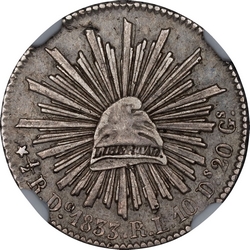
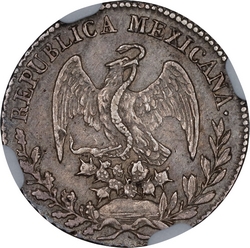
KM-370.3 ½r 1833 Do RL (Stack’s Bowers Kirk Menczer Collection, 23 June 2026, lot 72075)
These dies were created from French hubs which had the assayer as "RL". Normally the "L" was overpunched with an "M". In this case, the die failed to make that correction. Based on the rarity of this coin, the error was probably caught and quickly corrected. Another interesting feature of this coin is that the die axis is Medal rather than Coin as in all subsequent issues beginning with the Do 1833-RM/L.
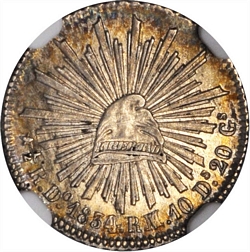
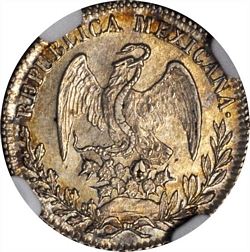
KM-370.3 ½r 1834/1 Do RM (Stack’s Bowers auction, 13 February 2019, lot 71378)
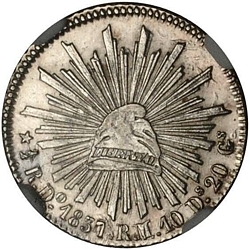
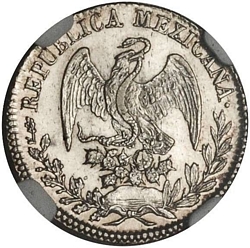
KM-370.3 ½r 1837/4 Do RM (Stack’s Bowers Baltimore auction, 28 March 2011, lot 8123)
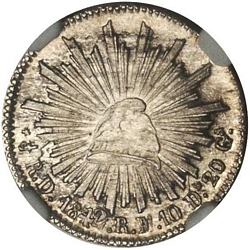
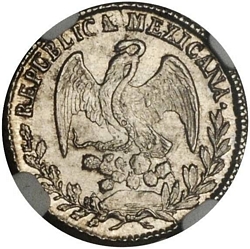
KM-370.3 ½r 1842/32 Do RM (Stack’s Bowers Baltimore auction, 28 March 2011, lot 8124)
1/2 R over 8 R
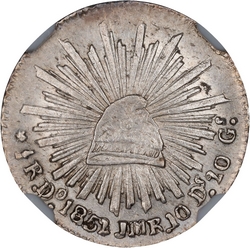
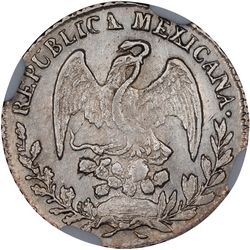
KM-370.3 ½r 1852/1 Do JMR (Stack’s Bowers Kirk Menczer Collection, 23 June 2026, lot 72087)
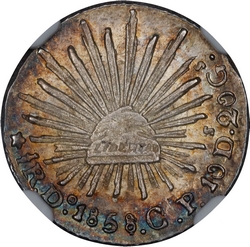
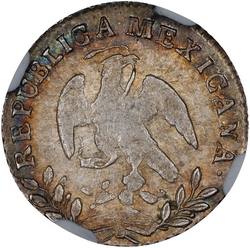
KM-370.3 ½r 1858/7 Do CP (Stack’s Bowers Kirk Menczer Collection, 23 June 2026, lot 72091)
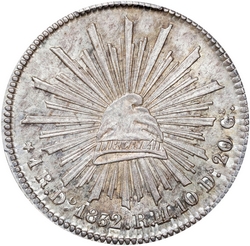
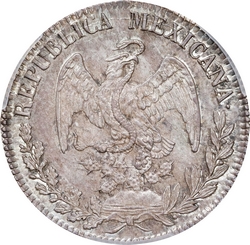
KM-372.2 1r 1832 Do RM/RL (Stack’s Bowers auction, 30 October 2024, lot 73309)
Diameter 20 mm. 3.380 g, 0.90277 silver
| Date | Asssayer | Recorded Mintage |
Comment |
| 1832/1 | RM | ||
| 1832 | RM/RL | ||
| 1832 | RM | ||
| 1834/2 | RM/RL | ||
| 1834/3 | RM/RL | ||
| 1834 | RM | ||
| 1836/4 | RM | coin axis | |
| 1836 | RM | medal axis | |
| 1837 | RM | M/L | |
| 1841 | RM | M/L | |
| 1842 4/3 | RM | ||
| 1843 | RM | M/L | |
| 1844/34 | RM | ||
| 1844 | RM | ||
| 1845 | RM | small date | |
| 1845 | RM | ||
| 1846 | RM | ||
| 1847 | RM | ||
| 1848/31 | RM | ||
| 1848/39 | RM | ||
| 1848/5 | RM | ||
| 1849/8 | CM | ||
| 1850 | JMR | ||
| 1851 | JMR | ||
| 1852 | JMR | rare with 2/1/0 | |
| 1853 | CP | ||
| 1854/1 | CP | ||
| 1854 | CP | ||
| 1855 | CP | ||
| 1856 | CP | ||
| 1857 | CP | ||
| 1858 | CP | ||
| 1858/7 | CP | ||
| 1859 | CP | ||
| 1860/59 | CP | ||
| 1861 | CP | ||
| 1862/1 | CP | illustrated below | |
| 1864 | LT | issued while Maximilian's forces controlled the mint (4 July 1864 - 13 November 1866) |
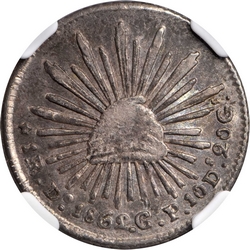
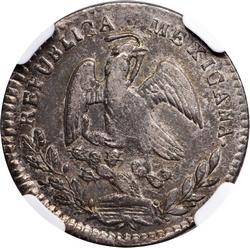
KM-372.2 1r 1862/1 Do CP (Stack’s Bowers auction, 13 February 2019, lot 71314)
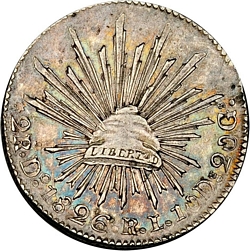
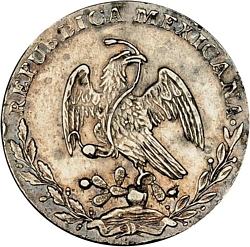
KM-374.4 2r 1826 Do RL (Stack’s Bowers Baltimore auction, 28 March 2011, lot 8251)
Diameter 27 mm. 6.670 g, 0.90277 silver
| Date | Asssayer | Recorded Mintage |
Comment |
| 1826 | RL | ||
| 1832 | RL | Mexican dies | |
| 1832 | RL | French dies | |
| 1832 | RM | post-1832 style | |
| 1834/2 | RM | ||
| 1834/3 | RM | ||
| 1834 | RM | ||
| 1835/4 | RM/RL | ||
| 1841 | RM | ||
| 1842/32 | RM | M/L (illustrated below) | |
| 1842 | RM | ||
| 1843/33 | RM | M/L | |
| 1844 | RM | ||
| 1845/34 | RM | ||
| 1846 | RM | ||
| 1848/36 | RM | ||
| 1848/37 | RM | reported | |
| 1849 | CM | ||
| 1851 | JMR/RL | ||
| 1852 | JMR | ||
| 1854 | CP | P/R | |
| 1855 | CP | ||
| 1858 | CP | ||
| 1859/8 | CP | ||
| 1861 | CP |
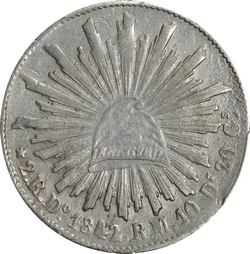
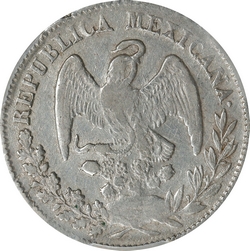
KM 374.4 2r 1842/32 Do RM (Stack’s Bowers auction, 12 September 2023, lot 73352)
An interesting and somewhat visually messy overdate.
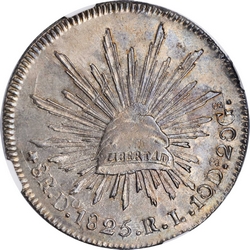
KM-377.4 8r 1825 Do RL (Stack’s Bowers auction, 12 August 2020, lot 20367)
with no period before "Mexicana".
Diameter 39 mm. 27.070 g, 0.90277 silver
| Date | Asssayer | Recorded Mintage |
Comment |
| 1825 | RL | Mexican dies | |
| 1825 | RL | REPUBLICAMEXICANA | |
| 1826/5 | RL | ||
| 1826 | RL | ||
| 1827/6 | RL | ||
| 1827 | RL | ||
| 1828/7 | RL | ||
| 1828 | RL | ||
| 1829 | RL | ||
| 1830 | RM | B on eagle's claw | |
| 1831 | RM | B on eagle's claw | |
| 1832/1 | RM/RL | B on eagle's claw, Mexican dies (illustrated below) | |
| 1832 | RM/RL | REPUB MEX, French dies | |
| 1833/2 | RM/RL | illustrated below | |
| 1833 | RM | ||
| 1834/3/2 | RM/RL | ||
| 1834 | RM | ||
| 1835/4 | RM/RL | ||
| 1835 | RM | Mexican dies | |
| 1836/1 | RM | ||
| 1836/4 | RM | ||
| 1836 | RM | M on snake | |
| 1836 | RM | ||
| 1837/1 | RM | ||
| 1837 | RM | ||
| 1838/1 | RM | ||
| 1838/7 | RM | ||
| 1838 | RM | ||
| 1839/1 | RM | ||
| 1839/7 | RM | ||
| 1839 | RM | ||
| 1840/38 | RM | ||
| 1840/39 | RM | ||
| 1841 | RM | ||
| 1841/31 | RM | ||
| 1842/31 | RM | illustrated below | |
| 1842/31 | RM | B below cactus | |
| 1842/32 | RM | ||
| 1842 | RM | Eagle style of 1832-1841 | |
| 1842 | RM | Pre-1832 eagle resumed | |
| 1842 | RM | ||
| 1843/33 | RM | ||
| 1843 | RM | ||
| 1844 | RM | ||
| 1844/34 | RM | ||
| 1844/35 | RM | illustrated below | |
| 1845/31 | RM | French dies (illustrated below) | |
| 1845/34 | RM | ||
| 1845/35 | RM | illustrated below | |
| 1845 | RM | ||
| 1846/31 | RM | ||
| 1846/34 | RM | ||
| 1846 | RM | ||
| 1847 | RM | ||
| 1848/7 | RM | illustrated below | |
| 1848 | RM | The initials "B" and "G", for Bernardo Georgy, were added to the dies of the 1848 issues. | |
| 1849/39 | CM | ||
| 1849 | CM | The initials "B" and "G", for Bernardo Georgy, were added to the dies of the 1849 issues. | |
| 1849 | JMR/CM | oval 0 in fineness | |
| 1849 | JMR | oval 0 in fineness | |
| 1849 | JMR | round 0 in fineness | |
| 1850 | JMR | ||
| 1851/0 | JMR | ||
| 1851 | JMR | ||
| 1852 | CP/JMR | illustrated below | |
| 1852 | CP | ||
| 1852 | JMR | ||
| 1853 | JMR/CP | ||
| 1853 | CP | ||
| 1854 | CP | ||
| 1855 | CP | ||
| 1856 | CP | ||
| 1857 | CP | ||
| 1858 | CP | ||
| 1858/7 | CP | illustrated below | |
| 1859 | CP | ||
| 1860/59 | CP | ||
| 1860 | CP | ||
| 1861/0 | CP | ||
| 1861 | CP | ||
| 1862/1 | CP | illustrated below | |
| 1862 | CP | ||
| 1863/1 | CP | ||
| 1863/2 | CP | ||
| 1863 | CP | ||
| 1864 | CP | issued while Maximilian's forces controlled the mint (4 July 1864 - 13 November 1866) | |
| 1864 | LT | ||
| 1865 | LT | ||
| 1866/4 | CM/LT | illustrated below | |
| 1867 | CM | ||
| 1867 | CP | ||
| 1867 | CP/CM | ||
| 1867 | CP/LT | ||
| 1868 | CP | ||
| 1869 | CP | ||
| 1870/69 | CP | illustrated below | |
| 1870 | CP | ||
| 1873 | CP | ||
| 1873 | CM | ||
| 1874/3 | CM | ||
| 1874 | CM | ||
| 1874 | JH | ||
| 1875 | CM | ||
| 1875 | JH | ||
| 1876 | CM | ||
| 1877 | CM | 431,000 | |
| 1877 | CP | ||
| 1877 | JMP | ||
| 1878 | PE | 409,000 | |
| 1878 | TB | ||
| 1879 | TB | ||
| 1880/70 | TB | ||
| 1880/70 | TB/JP | ||
| 1880/70 | JP | illustrated below | |
| 1880 | TB | ||
| 1880 | JP | ||
| 1881 | JP | 928,000 | |
| 1882 | JP | 414,000 | |
| 1882 | MC/JP | ||
| 1882 | MC | ||
| 1883/73 | MC | 452,000 | |
| 1883 | MC | ||
| 1884/3 | MC | ||
| 1884 | MC | ||
| 1885 | MC | 547,000 | |
| 1885 | JB | ||
| 1886/5 | MC | 955,000 | |
| 1886/3 | MC | ||
| 1886 | MC | ||
| 1887 | MC | 1,004,000 | |
| 1888 | MC | 996,000 | |
| 1889 | MC | 874,000 | |
| 1890 | MC | 1,119,000 | |
| 1890 | JP | ||
| 1891 | JP | 1,487,000 | |
| 1892 | JP | 1,597,000 | |
| 1892 | ND | ||
| 1893 | ND | 1,617,000 | |
| 1894 | ND | 1,537,000 | |
| 1895/3 | ND | 761,000 | |
| 1895 | ND |
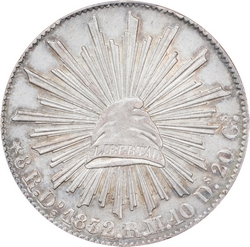
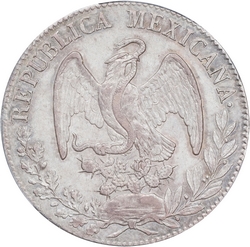
KM-377.4 8r 1832/1 Do RM/RL (Stack’s Bowers auction, 29 October 2024, lot 72564)
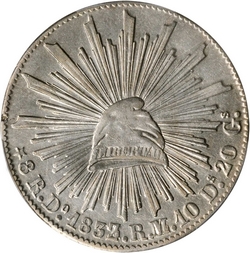
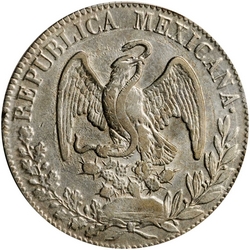
KM-377.4 8r 1833/2 Do RM/RL (Stack’s Bowers ANA Auction, 24 August 2021, lot 45342)
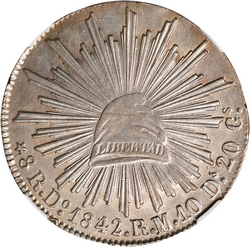
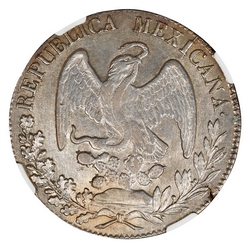
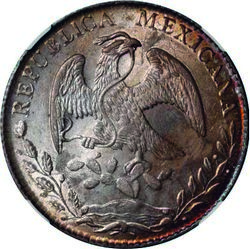
KM-377.4 8r 1842/31 Do RM/L (Stack’s Bowers auction, 16 May 2023. lot 70414)
Variety with European eagle, medal axis.
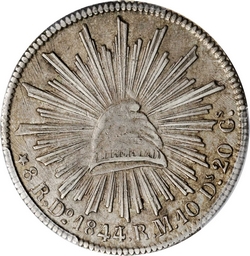
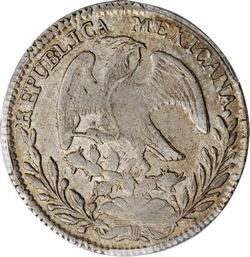
KM-377.4 8r 1844/35 Do RM (Stack’s Bowers auction, 24 August 2021. lot 45343)
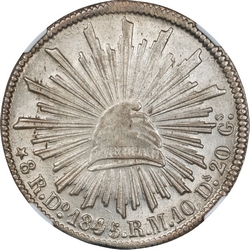
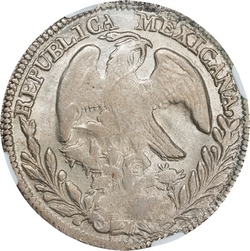
KM-377.4 8r 1845/31 Do RM (Stack’s Bowers auction, 25 June 2026, lot 74231)
Mexican eagle variety.
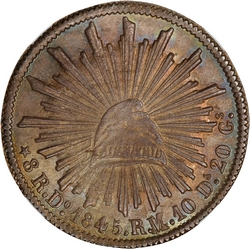
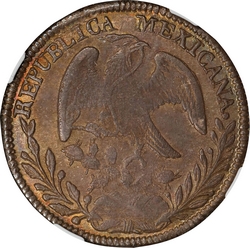
KM-377.4 8r 1845/35 Do RM (Stack’s Bowers auction, 16 May 2023. lot 70721)
Mexican eagle variety.
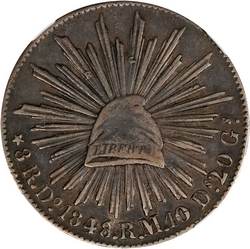
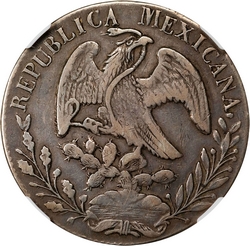
KM-377.4 8r 1848/7 Do RM (Stack’s Bowers auction, 16 May 2023. lot 70421)
Hidden "B" and "G" in rays. The initials "B" and "G", for Bernardo Georgy the lease holder at the Durango Mint, were added to the dies of the 1848 issues. This was done so for ease of identification due to high quality counterfeiting, most likely done from official dies. Since this action was against government regulations Bernardo Georgy lost the mint lease.
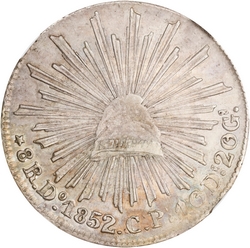
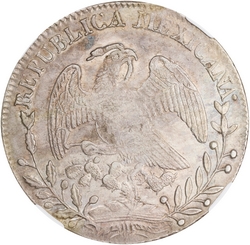
KM-377.4 8r 1852 Do CP/JMR (Stack’s Bowers auction, 26 August 2025. lot 41397)
Displays the faintest hints of the JMR letters, with this date representing the final year in which he served in the role.
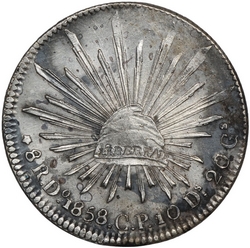
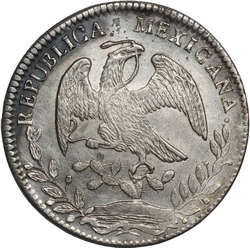
KM-377.4 8r 1858/7 Do CP (Briggs & Bustos auction, 31 August 2025, lot 280)
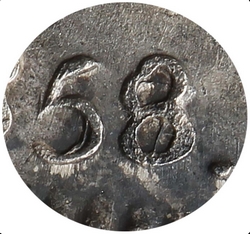 Variety with a clear 8/7 overdate in the final digit.
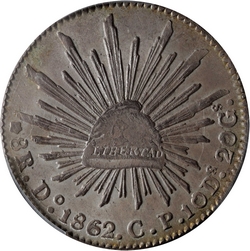
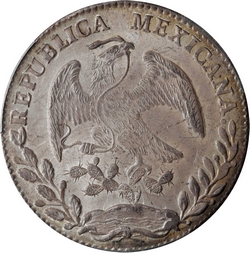
KM-377.4 8r 1862/1 Do CP/JMR (Stack’s Bowers auction, 9 May 2022. lot 56153)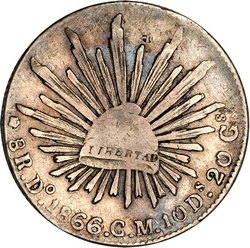
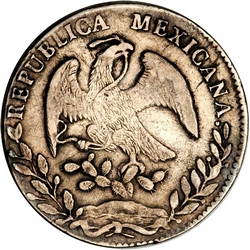
KM-377.4 8r 1866/4 Do CM/LT (Ponterio Baltimore auction, 28 March 2011, lot 8574)
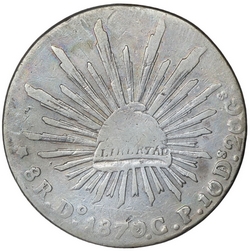
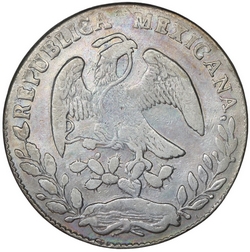
KM-377.4 8r 1870/69 Do CP (Briggs & Bustos auction, 31 August 2025, lot 282)
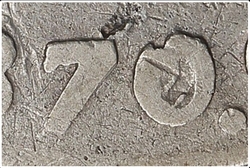 Faint overdate, only perceptible within the final digit.
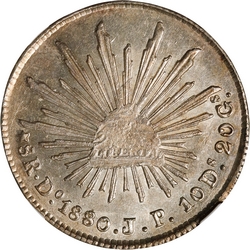
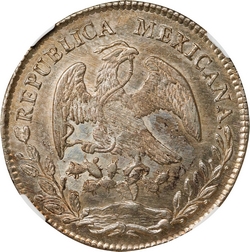
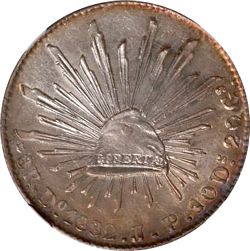
KM-377.4 8r 1880/70 Do JP (Stack’s Bowers auction, 16 May 2023. lot 70454)
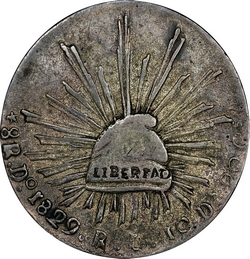
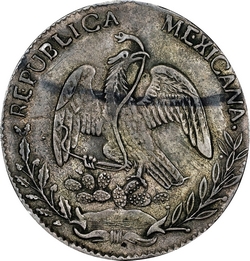
Counterfeit KM-377.4 8r 1829 Do RL (Stack’s Bowers auction, 28 February 2024, lot 73141)
A rather interesting spurious issue that, on account of some fairly extensive wear, appears quite successful at eluding numerous handlers throughout its time in commerce.
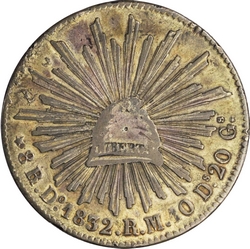
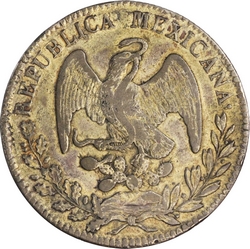
Counterfeit KM-377.4 8r 1832 Do RM (Stack’s Bowers NYINC auction, 21 January 2020, lot 23226)
This spurious example likely circulated a great deal given the moderate, even wear.
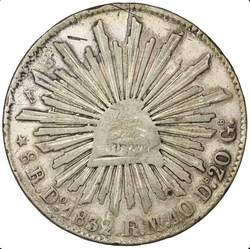
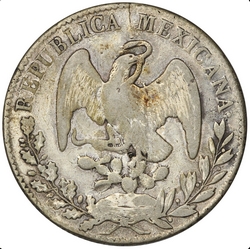
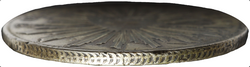
Counterfeit KM-377.4 8r 1832 Do RM (Briggs & Bustos Counterfeit issues II, 10 August 2025, lot 63)
Well-executed contemporary counterfeit, surprisingly similar to the official issue; matches exactly with No. 365 reported by Leonard Riddell{footnote}{/footnote}. Struck in low-fineness silver.
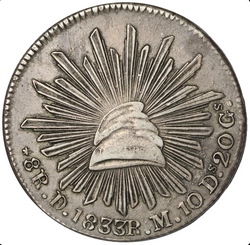
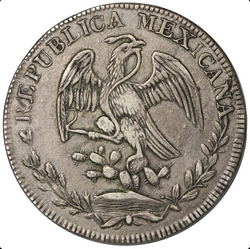
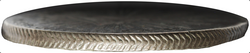
Counterfeit KM-377.4 8r 1833 D RM (Briggs & Bustos Counterfeit issues II, 10 August 2025, lot 64)
Contemporary counterfeit, struck in low-fineness silver. The cap side design resembles more of a “European style,” with the particularity that the mintmark was engraved with only a “D” instead of “Do”. The obverse shows a slender eagle, more similar to the “Mexican eagle” style.
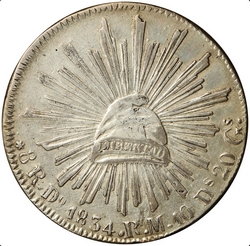
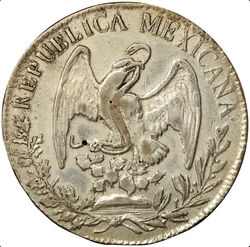
counterfeit KM-377.4 8r 1834 Do RM (Briggs & Bustos Counterfeit issues, 22 February 2025, lot 36)
Struck in silver. Period imitation of the popular European design.
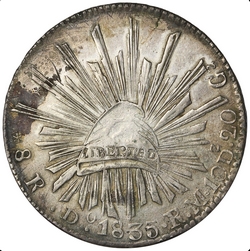
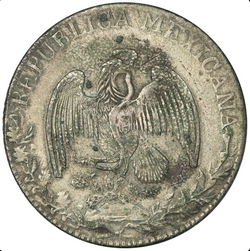
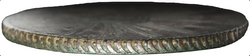
Counterfeit KM-377.4 8r 1835 Do RM (Briggs & Bustos Counterfeit issues II, 10 August 2025, lot 65)
Contemporary counterfeit, struck in low-fineness silver. A design that differs from the “European style” characteristic of the 1832–1842 issues struck at the Durango mint; in contrast, the eagle is slightly smaller and resembles the earlier style also known as the “Mexican eagle.” On the reverse, the cap and rays appear crude, and the legend includes mirrored “s” letters that resemble “z” in “10Ds.20Gs”.
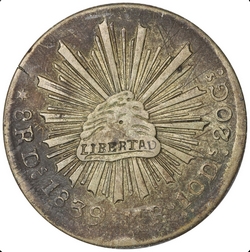
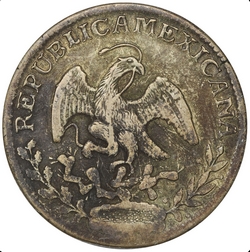

Counterfeit KM-377.4 8r 1839 Ds RM (Briggs & Bustos Counterfeit issues II, 10 August 2025, lot 66)
Contemporary counterfeit, struck on bronze flan Design completely unrelated to the “European style” circulating at the time. The obverse matches the specimen dated 1832, identified by Riddell under No. 415 (evidently made by the same forger), characterized by a stylized and thin eagle, with no spacing in the legend. On the reverse, the cap is surrounded by rays with little variation in size; note the legend with the “Ds” mintmark.