The implementation of the decimal system in Mexico
By Pablo Luna Herrerafrom his website (in Spanish) El DATO
Regarding the circulation of money in the third quarter of the nineteenth century, Carlos Marichal states the following:
"Circulation became very complex because of the considerable variety of monetary instruments with fluctuating exchange rates: old silver coins and reals (and a few gold coins) circulated, new coins (silver and copper) often adulterated, a remarkable volume and variety of foreign currency (as a result of the opening of foreign trade), and an extensive and varied amount of paper money in the form of promissory notes and vouchers issued by governments and armies that had no prospect of being systematically exchanged for cash, at least in the short term..."Carlos Marichal, El nacimiento de la banca en América Latina.: Finanzas y política en el siglo XIX. El Colegio de México, 2021, p. 137.
The first time that a Mexican coin bore the word centavo was in a rare pattern of 1841 from the time when Santa Anna was President of Mexico. This pattern reflects the introduction of the decimal system as one of the possible solutions to the massive economic crisis suffered in those days in Mexico. The cause of this crisis was the lack of stability in the rate of copper coinage, being valued too high by the merchants when given as change, but cheaply accepted back in trade. Santa Anna tried to introduce the decimal system officially in a decree dated 13 December 1853, but the Ayutla Revolution of General Juan Alvarez ended the regime of President Santa Anna and his plans to have a decimal coinage in MexicoValle, Juan N. del. El Viajero en México. Tip. de Castro. México. 1859. p. 338; Tovar, Pantaleón. Historia Parlamentaria del Cuarto Congreso Constitucional. Impr. Cumplido. México. 1868. Vol. II. p. 398; La Casa de Moneda de México a más de 450 años. Porrúa. México. 1989. p. 45.
PradeauAlberto F. Pradeau, Numismatic History of Mexico, Volume III. p. 61 cites an exchange tariff of 22 June 1853 by which an equivalence was given in transactions between octaval and decimal small coins, viz.:
• Tlaco.................1 cent
• Cuartilla............ 2 or 3 cents.
• Medio Real.......5 or 6 cents.
• Real....................11 or 12 cents.
In 1856 President Ignacio Comonfort created the Dirección de Pesas y Medidas (Directorate of Weights and Measures) and on 15 March 1857 he decreed the decimal metric system for use in circulating currencyDiario de Avisos, Año II, Tomo I, 17 April 1857. The decree provided that silver coins of one peso, fifty, twenty-five and ten centavos would be introduced as well as one centavo coins in copper. However, a decree of 8 July 1858[text needed] revoked the system.
Mexico was in the turmoil of one war after another with a struggle of power between liberals and conservatives. These interminable wars prevented the mint from striking any coins of decimal denominations. Juárez ended up becoming President of Mexico after the conservative party had been defeated. A lack of money compelled Juárez to stop all payments to the countries that held Mexico’s foreign debt, which led to the invasion of Mexico by the French. It took the Mexicans most of 1862 trying to stop their arrival in Mexico CityPradeau, Alberto. Historia Numismática de México de 1823 a 1950. Vol. I. pp. 86, 87 and 92; Mayer, Greg. The Republic One Centavo. Nopalitos Publishing. San Antonio. Tx. 2010. pp. 73- 74..
The cent was used in a 1861 copper municipal piece that circulated in the municipality of Campeche, being the first circulating antecedentGrove catalogues two varieties of this coin in his Tokens of Mexico as numbers 1224 and 1225.
On 15 March 1861 Benito Juárez decreed (or reaffirmed) the decimal metric system for the coinage. Eleven coins, five in gold, five in silver and one in copper, were planned. A circular on 27 December 1862El Siglo Diez y Nueve, 19 January 1863 ratified the previous decree.
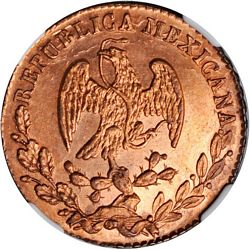
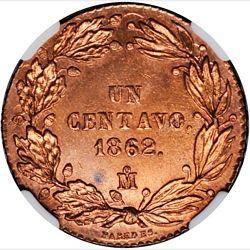
KM-PN86 1862 1c pattern (Stack’s-Bowers Baltimore Auction, 20 November 2012. lot 11320)
On 26 October 1863, Benito Juárez having moved the capital of the government to San Luis Potosí, decreed the minting of 5 and 10 centavo coinsPeriódico Oficial del Gobierno de la República Mexicana, Tomo I, Núm. 26, 4 November 1863. A 1 centavo copper coin was also minted, by the decree of 17 June 1863[text needed], which was issued during Juárez's stay in the same city, probably based on the previous decree of 1861. So the only decimal coins that were minted before the Empire of Maximilian were the one centavo of 1863 in San Luis Potosí and Mexico City, and the 5 and 10 centavos of 1863. San Luis Potosí was Juarez’ provisional seat of government until it was taken by French forces from 23 December 1863 to 25 December 1866, which put an end to the Republican decimal issues there.
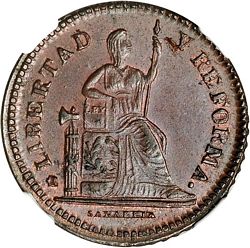
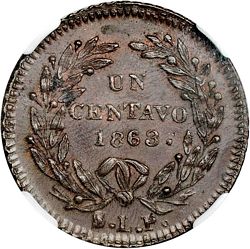
KM-390-1 1863 1c pattern (Stack’s-Bowers Baltimore Auction, 2 April 2011. lot 8807)
It differs from the 1862 pattern design, more closely resembling the pattern of 1841. These copper coins were mostly struck between January and March of 1863, and rare silver coins of five and ten centavos were struck exclusively in April of that year. This was barely four weeks before Juárez’s departure from Mexico City (on 31 May) for San Luis Potosí, when facing the imminent occupation of the capital by the French army.
The 1863 1-cent coin from San Luis Potosí was minted for $10,248.13 pesos (just over a million pieces) the engraver is "Sanabria", while on the same coin from Mexico City of the same dimensions the engraver is Paredes, the edge is fluted.
Once the Republic was restored, President Benito Juárez returned to the capital on 15 July 1867. Four months later he ratified the decree of 15 March 1861, issuing the new decree of 27 November 1867. In this decree Juárez maintained that: (i) the system was necessary to standardize the currency and its divisions for the simplicity of transactions, (ii) the simultaneous use of two systems of currency division was harmful, the origin of disorders and breakdowns, (iii) that the copper coinage minted in the states was not sufficient, since they lacked uniformity and had limited circulation, and (iv) the engraving of the present coinage was imperfect and susceptible to improvement.
Despite the provisions of the 1861 decree, no coin bears the effigy of Hidalgo, in the same way that the $1 and $2.50 gold coins do not show the design of the Scales.
The Chihuahua Mint was notified on 22 April 1868 that it had to mint decimal coins of 5 and 10 centavos in minimum quantities of $500 per month. Therefore, on 29 May 1868, the minting of decimal fractional coins was resumed.
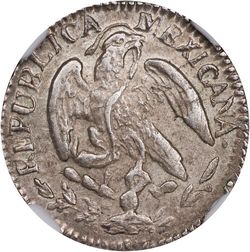
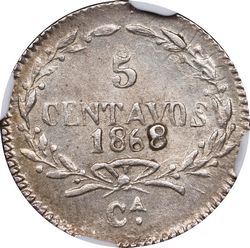
KM-396 5c 1868 Ca (Stacks-Bowers Kirk Menczer Collection of Republican Decimal Minors, 21 October 2025, lot 70177)
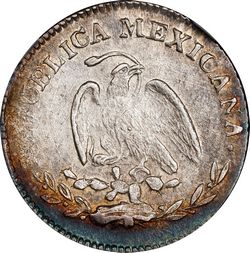
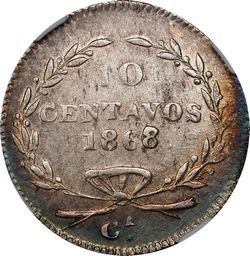
KM-401.1 10c 1868 Ca (Stacks-Bowers Kirk Menczer Collection of Republican Decimal Minors, 21 October 2025, lot 71243)
The coins issued by Chihuahua from 1868 was not guided by the criteria of the 1867 law, as they did not bear the fineness of the silver as well as the initials of the assayer: instead they followed the law of 23 November 1863, and so were similar to the coins previously minted in San Luis Potosí
From June 1868 the mints ceased to be part of the Secretaría de Hacienda (Ministry of Finance) and passed to the Secretaría de Fomento (Development). The logic was that they would cease to be instruments to procure financial resources and become true nodes of mining development, a view promoted by the Secretario de Hacienda, Matías Romero.
On 19 April 1869, the Mexico City Mint began the decimal minting in silver. Article 12 of the 1867 decree mentions the holding of a contest for engravers. The following proofs are probably vestiges of that competition.
Experimental issues (proofs) for the decimal system
One centavo
Three varieties are known in copper, silver-plated copper and silver, the edge may vary.
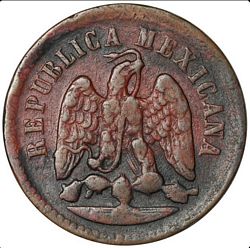
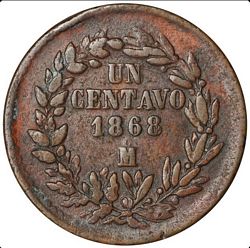
KM-Pn107 1c 1868 Mo proof (Briggs & Bustos, auction IX, 13 September 2024, lot 343)
Briggs & Bustos argues that the proof coins are those with smooth edges and larger diameters, while the regular size fluted edge coins were circulating issues. "We know of the existence of specimens struck on planchets with plain edge and larger diameter, which in fact must be the result of the adjustment in the minting equipment, in other words, authentic Patterns. On the other hand, there are specimens with reeded edge like the one offered here, which we consider to be the first Republican issue of circulation in denomination of Un Centavo, due to their relative abundance, besides the fact that most of them are notably circulated or damaged. Widespread wear, lumpy surface, minor dings, edge tapping, reddish and dark tones in some areas, please compare with the last specimen offered publicly in VG-Tooled quality, auctioned by Stack's Bowers (November 15, 2012), lot No. 11342".
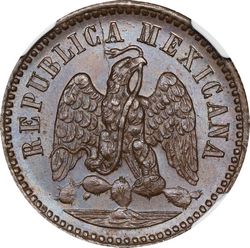
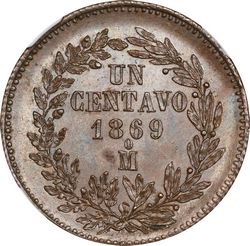
KM-391.6 1c 1869 Mo (Stacks-Bowers Kirk Menczer Collection of Republican Decimal Minors, 21 October 2025, lot 71208)
Not a true pattern, but an interesting off metal strike. At the end of the real system and beginning of the decimal system, complete sets of all denominations were struck in copper probably for presentation. A complete set is in the Smithsonian Numismatic Collection.
Five centavos
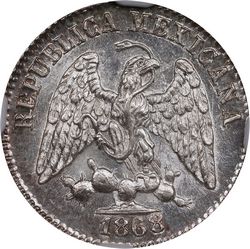
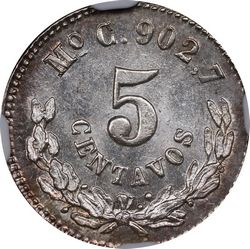
KM-Pn108 5c silver "pattern" 1868 Mo C (Stacks-Bowers Kirk Menczer Collection of Republican Decimal Minors, 21 October 2025, lot 71362)
Long considered a Pattern the cataloguer believes this coin, is a rare first year issue rather than a Pattern. Nothing about the die or planchet preparation rises to the level of a "Pattern".
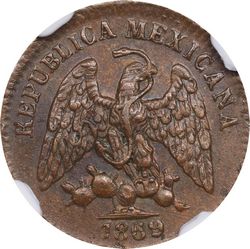
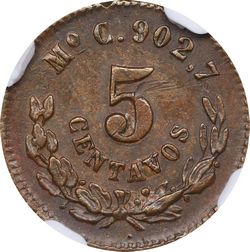
KM-Pn114 5c 1869 MoC copper pattern (Stacks-Bowers Kirk Menczer Collection of Republican Decimal Minors, 21 October 2025, lot 71155)
A variety of the same assayer is known with the year 1869/8, due to the fact that the matrices were dated in 1868 and later retouched with an awl for the following year, when the coin was already in circulation. Recent research suggests the 5 centavos coin is not a proof, due to the abundance in the market of such a specimen.
Ten centavos
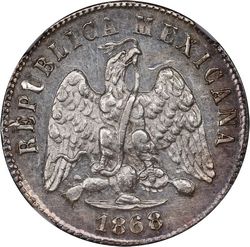
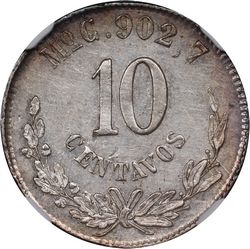
KM-Pn109 10c silver "pattern" 1868 Mo C (Stacks-Bowers Kirk Menczer Collection of Republican Decimal Minors, 21 October 2025, lot 71362)
Long considered a Pattern the cataloguer believes this coin, is a rare first year issue rather than a Pattern.
A variety 1869/8 is also known, which also confirms the existence of matrices from the previous year (1868).
Twenty-five centavos
Known as 1879 Mo in brass and 1871 Mo in copper (Superior Stamp and Coin Company COIN auction, 15-18 June 1972, lots 756 and 758).
Fifty centavos
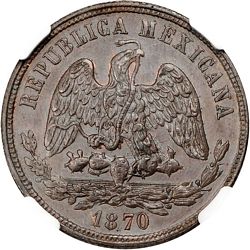
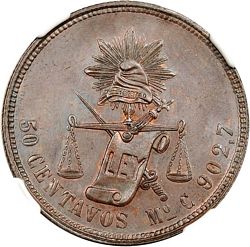
KM-Pn121 50c 1870 MoC copper pattern (Ponterio & Associates 2011 NYINC auction, lot 94)
In November 2010 Stack’s Bowers offered the four test pieces (for1869 silver peso and 1870 5, 10, 20 gold pesos) in copper, all of them being dated to the first year of minting.
One peso
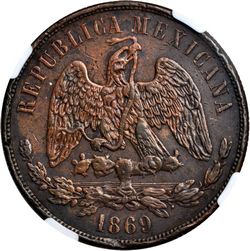
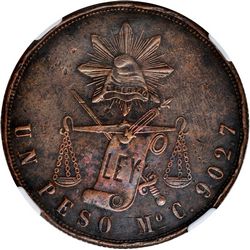
KM-Pn118 $1 1869 MoC copper pattern (Stack’s-Bowers Baltimore auction, November 2012, lot 11288)
Although there is no doubt that the 1869 examples were preparatory tests, later specimens are known, which were perhaps to verify the correct manufacture prior to the final coinage. An example of this is a second $1 copper specimen, also minted Mo but dated 1873 auctioned by Ponterio & Associates on 8 June 1985, lot 413.
In addition to this, there is a third example from 1869 in silver, identical to the one in circulation, but stamped with the proof dies, as it has the inscription "LEY" in large size, like the copper specimens.
Five pesos
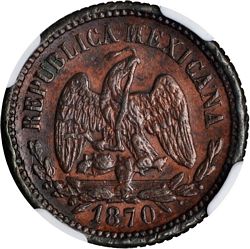
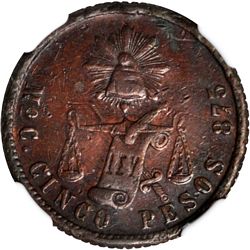
KM-unlisted $5 1870 MoC copper trial strike (Stack’s-Bowers Baltimore auction, 16 November 2012, lot 11023)
A second copy is known dated 1873, mint Mexico, assayer "M", also in copper.
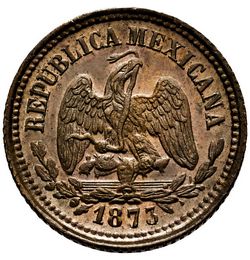
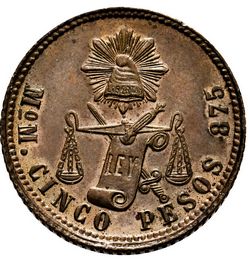
KM-Pn131 $5 1873 M copper pattern (Tauler & Fau Auction 151, 26 November 2024. lot 316)
A special issue with a limited number of pieces, produced exclusively as gifts or presentations for high-ranking individuals. "On April 19, 1869, the Mexico City Mint began decimal minting in silver, extending to gold in 1870. This 5 pesos specimen from 1873 belongs to that experimental minting series, displaying the inscription "LEY" in small lettering; variants with "LEY" in larger lettering are also known. Additionally, other trials exist, including a 5 pesos copper pattern dated 1870 and a 1 peso specimen from 1873, which was auctioned by Ponterio & Associates on June 8, 1985, as part of the Alfredo Porraz Collection in Lot #413."
Ten pesos
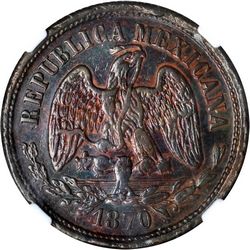
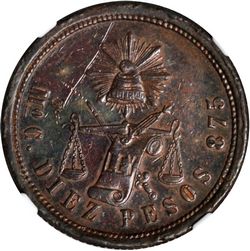
KM-unlisted $10 1870 MoC copper trial strike (Stack’s-Bowers Baltimore auction, 16 November 2012, lot 11020)
For the 10-peso coin, in addition to the aforementioned 1870 copy, there is a second example of 1869 in copper mint Mo from the Pablo Gerber collection (No. 43), a third mint Mo in silver from 1871 (No. 46), and a fourth for the Alamos mint in silver from 1879Pradeau, Alberto Francisco, Sonora and its mints, Alamos and Hermosillo, 1983, Government of the State of Sonora, p. 118.
Twenty pesos
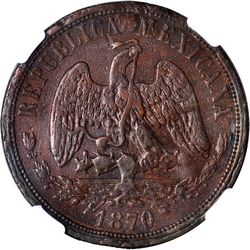
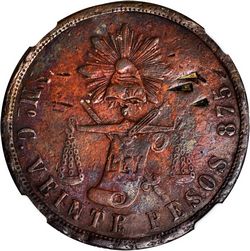
KM-Pn123 $20 1870 MoC copper trial strike (Stack’s-Bowers Baltimore auction, 16 November 2012, lot 11017)
A second example from 1875 in copper, mint Mo, from the Pablo Gerber collection (No. 47) is also known.
These proofs can be distinguished by the different sizes of the letters "LEY".
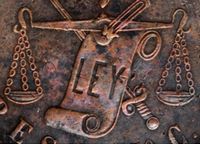
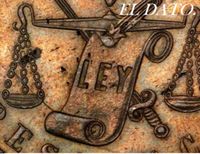
Finally, the existence of a set of proofs from 1888 minted by the San Luis Potosí mint in silver for the gold denominations of 5, 10 and 20 pesos is known, although this mint was characterized by never officially issuing gold coins in any denomination.
Before the entry into force of the decree of 1868, the mints of Mexico City and San Luis Potosí minted new coins of 5 and 10 cents in 1867, 1868 and 1869, which also came to circulate along with the new coins authorized in 1868. Probably the need for small denomination coins and the end of the Empire encouraged its creation, its design is very similar to the reales. As early as 1841, Anastasio Bustamante decreed that two percent of fractional silver coins in all denominations would be minted in mints that were not yet leased. Mints already leased did not have to follow such a measure, but when their contract ended they had to abide by it.
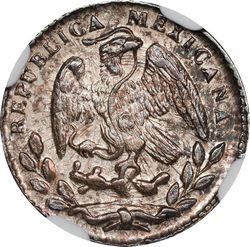
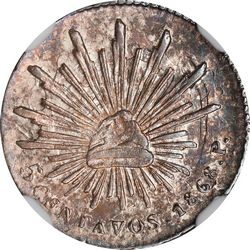
KM-387.1 5c San Luis Potosí 1868 P (Stacks-Bowers Kirk Menczer Collection of Republican Decimal Minors, 21 October 2025, lot 71184)
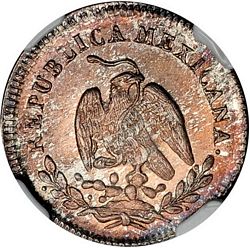
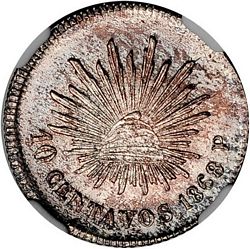
KM-402.1 10c San Luis Potosí 1868 P (Ponterio Baltimore auction, March 2011, lot 8912)
This 10c coin seems to have been unpopular due to its close resemblance to the contemporary silver one real, worth 12½ cents, though most of the survivors are well worn, suggesting extensive circulation.
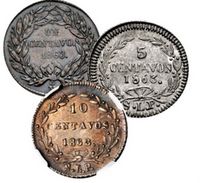
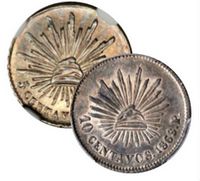
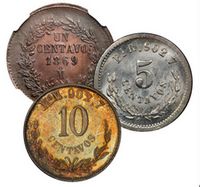
The following table attempts to clarify the situation of having three different families of coins in less than a decade:
 |
 |
 |
|
| Decree of authorisation | San Luis Potosí, 26 October 1863 | Mexico City, 27 November 1867 | |
| Years of miniing | 1863, 1868, 1869 and 1870 | 1867, 1868 and 1869 | 1869 to 1905 |
| Mints | Mexico City, San Luis Potosí and Chihuahua | Mexico City and San Luis Potosí | All |
| Notes | The decree does not mention a 1c coin. The relevant decree is probably 15 March 1861 | Probably a transitional issue | Proofs exist from 1868 |
Manuel Cervantes, regarding the monetary system at that time, comments:
The monetary system at this time (late nineteenth century) was in reality a bimetallism with free coinage of gold and silver, without a legal relationship between the two metals, but the traditional one of one to fifteen, one to sixteen. But since only silver pesos circulated in commerce, the law of 1867 expressly declared that the Mexican monetary unit is the silver peso, going from a bimetallism with no legal relationship between gold and silver coins to a monometallism in which the monetary unit of legal tender was the republican silver peso.{footnote}Manuel Cervantes, La Moneda en México, 1854, Private edition. Mexico City.
At the time, the coexistence of the two systems among the population was confusing, an example of which is that the ½ real and 5 centavos coins had very similar dimensions, which caused their exchange at par, but someone lost out from that transaction when ½ real was more than 5 centavos, being 6.25 centavos. In the same order of ideas, it is worth mentioning these first three 5-centavos coins (illustrated in the table above) are of the same blank, of equal dimensions.
On 30 May 1873 President Sebastián Lerdo de Tejada authorized the suspension of balance pesos and the return of the 8 Reales, due to the failure in eastern markets, being that the Mexican currency was circulating throughout the world. However, the decimal coin of low denomination in gold and silver continued to be manufactured. To summarize the above, it is worth quoting what Dr. Alberto F. Pradeau mentioned on this subject:
The eight-piece reales of the Mexican mint were accepted worldwide, but not the Balance Scales pesos: due to the opposition expressed by the Orientals, it was necessary to discontinue their stamping and resume the minting of the eight-real pieces. The above was authorized by decree of May 29, 1873 and the explanatory circular of June 19 of the same year. This provision did not affect gold or silver coins of lower denomination by weight. Therefore, during the second half of 1873, the eight-real pieces began to be minted, similar to those issued in 1870 and did not cease until June 1895{footnote}.