
Store tokens from Veracruz
Rio Blanco
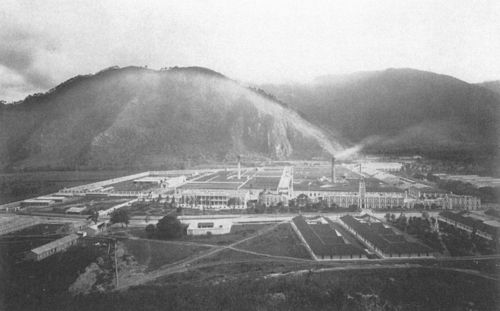
Rio Blanco factory
La Compañía Industrial de Orizaba S.A. was formed in 1889 with capital from Thomas Braniff, and the Barcelonnettes Ollivier y Cía (Ciudad de Londres), J. Tron y Cía (Palacio de Hierro), and Signoret, Honnorat y Cía (Puerto de Veracruz). In the next ten years it acquired and constructed four textile factories in the Orizaba valley: Cerritos, San Lorenzo, Río Blanco and Cocolapan (acquired in 1899). The Rio Blanco factory was built to supply the owners’ department stores in Mexico City and other major cities throughout the country. With more than 40,000 spindles and almost 2,600 workers, it was the largest textile mill in the country and was large even by international standards. Like most textile mills in Mexico, it was originally built on an unpopulated site that was eventually transformed into a company town.
One way in which the Compañía Industrial de Orizaba's partners earned income, from the foundation of their factories until 1912 were the tiendas de raya. These businesses served the entrepreneurs to recover part of the wages of the workers, by forcing them to buy in them the food, clothing and other goods they needed. The tiendas de raya received the vales issued by the textile companies as an advance of the salary at the request of the worker. Vouchers could be redeemed for goods or for money at 90% of their value. The following Saturday the amount advanced to the workers was deducted from their salaries to pay the debt.
Río Blanco’s company store was leased to Victor Garcín, a Barcelonnette who had been in the region for some decades. Eduardo Garcín, his brother, was the Compañía Industrial de Orizaba manager in 1903 and a member of the board in 1905 and 1906. However, Garcín’s store was not merely a company store. He seems to have run the largest store in the area, occupying a whole block, and sold not only directly to workers but also to several stores in the region. Besides Río Blanco’s company store Garcín owned two other stores: “El Centro Comercial” at Nogales,and “El Modelo” at Santa Rosa, and nine pulquerías which also held billiard tables.
In 1907 (footnote}El Universo, Chihuahua, Año V, Núm. 222, 13 January 1907{/footnote}.
After the conflicts of 1907, where the workers burned the tiendas of Victor Garcin, he decided to sell his property to Manuel Diez and left the area.