Worthington{footnote}{/footnote} lists a trade token for the Hacienda de Encinillas
obverse: TIENDA DE RAYA / CHIHUAHUA / MEX. / ENCINILLAS
reverse: BUENO POR / $1.00 / MERCANCIAS
Only a part of the structure of what was the Hacienda de San Simón is preserved (the main house, the house of the administrator and the tower of the sugar mill). This hacienda gave birth to the town of the same name located a little more than 20 kilometres north-east of the city of Zamora, Michoacán, in the municipality of Ixtlán de los Hervores, Tanhuato district.
The origin of the hacienda dates back at least to the 18th century. In 1817 the Royalists placed a fortification there against the Insurgents. The Zamoran writer Francisco Garcia Urbizu, affirms that it belonged to the rich landholder José Francisco Velarde de la Mora, owner, among many properties, of the Hacienda Buenavista in Michoacán(?) and of the Casa de la Morena in La Barca, Jalisco, but does not cite his source. General Francisco Velarde was shot on 14 June 1864 in the city of Zamora, because he had declared himself a monarchist during the brief empire of Maximilian. In 1851, the Hacienda San Simón belonged to Nicolás Dávalos y Tompes. He died in that year and left it in inheritance to his·three sons Arcadio, Francisco and Nicolás Dávalos y Jasso.
These brothers maintained control of the hacienda until 1893 when Arcadio died. The large property that included, in addition to the Hacienda San Simon, El Limon and La Plaza began to break up. The house, along with the aguardiente factory and the fields adjacent to the house went to Nicolás Dávalos y Jasso. On his death the following year, 1897, another division left the house and various fields to the Dávalos Garcia and the Dávalos Márquez de la Mora families, the two families that Nicolas Davalos formed. The hacienda, located on fertile lands with both irrigation and seasonal rains, was dedicated not only to agriculture and cattle but also the cultivation of sugar cane from the time of Nicolás Davalos y Tompes who built the sugar and aguardiente factories.
In 1905 a new deed was prepared showing María de Jesús Márquez de la Mora and her children as owners of the hacienda. They sold it in 1909 to the agriculturalist Tomás Sánchez for 100,000 pesos. The land area was 9,987 hectares.
In 1914, the hacienda was confiscated by the Revolution, since all landowners were considered as enemies. An inventory was made by which we know that it had 107 permanent employees, whose weekly salaries were 50 pesos for the administrator and 10 for the secretary, while the salary for the rest of the employees were from 7 pesos for the granary keeper to one peso and 5 centavos for the gate keeper. The common labourer was paid 50 centavos per day because they could not be certain to work seven days per week. From this comes the 50 centavos tokens as the most common, exclusively for the labourer. An informant of Miguel J. Hernández Madrid told him that the lines on payday reached to the entrance of the hacienda of La Estanzuela, half a kilometre distance from the central patio and “payday did not finish until sunset”.
From 1909 till 1949 the brothers Benjamín, Esteban and José María Sánchez, sons of Tomás Sánchez, worked it as part of the “Sociedad Sánchez”. This was dissolved in 1949 upon the death of José María Sánchez and it passed to the control of their sons. The small part of the hacienda that was left by the Reforma Agraria (in 1948 only 3 78 hectares were protected by a court writ) was administered by Roberto and Felipe Sánchez Villasenor who had no experience in agriculture and upon the death of Felipe in 1975, the six survivors decided to dissolve the society and sell it.
María Elena Sánchez Villaseñor, daughter of the last owner, saved a group of 470 tokens. This included ten different denominations, eight of metal and two of cardboard, as follows:
Obverse: ANTICIPO / 10¢
Reverse:
20.5mm. tin, octagonal
Obverse: ANTICIPO / 15¢
Reverse:
22mm. tin, octagonal
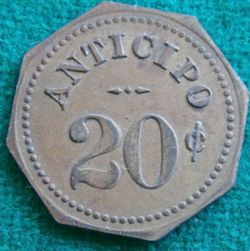
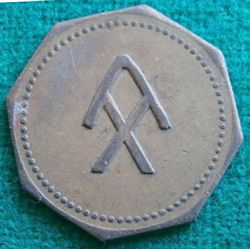
Obverse: ANTICIPO / 20¢
Reverse: brand
24.5mm. tin, octagonal
Obverse: ANTICIPO / 25¢
Reverse:
28.5mm. tin, octagonal
Obverse: ANTICIPO / 10¢
Reverse:
20.5mm. tin, octagonal
Obverse: 25 L/S maiz
Reverse:
24.5mm. tin, circular
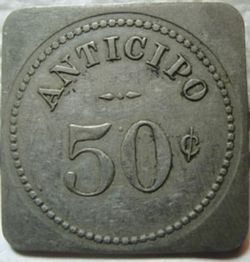
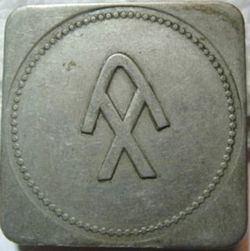
Obverse: ANTICIPO / 50¢
Reverse: brand
28 x 28mm. cupronickel
Obverse: $1 maiz
Reverse:
31 x 31mm. cupronickel
For the cardboard cartones see Haciendas (northern Michoacán).
We do not know the year in which the metallic tokens were made but it must have been after August 1909 when Tomás Sánchez purchased the hacienda (the cardboard tokens date from the Revolution). They were used until 1920 according to the information of Antonia Coronado{footnote}Interviewed by Teresa Lara Campos during May 2003{/footnote}. During 1917 the circulation of these was prohibited and in 1924 it was prohibited to use them for payment of salaries.
(based on Ignacio de Jesús Sáchez Montes, Hacienda Tokens of San Simón, Michoacán)
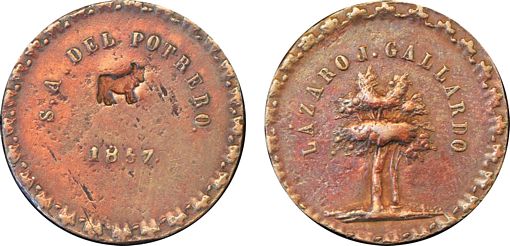
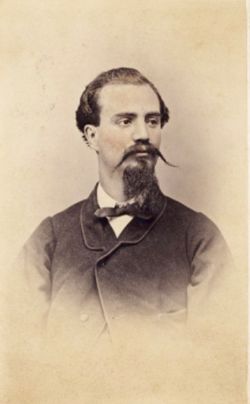 Lazaro Gallardo was a tavern owner and tequila producer in the famous Mexican town of Tequila. A year after this token was produced, Gallardo invented the process that he called 'seleccion suave,' or the smooth selection, whereby newer tequilas were blended with older, smoother, and more refined tequilas, allowing for the highest quality tequila available. He later named his tequila Gran Centenario, a brand which is still produced--using Gallardo's method--even today.
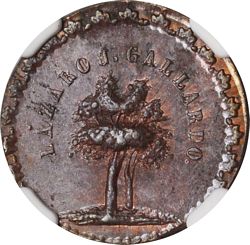
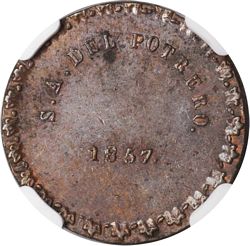
Copper ⅛ real 1857 (Stack’s Bowers Auction, 23 October 2019, lot 72567)
Grove 1431
Obverse: around two trees. LAZARO J. GALLARDO
Reverse: S. A. DEL POTRERO / 1857
20mm. bronze
Grove 1432
Obverse: around two trees. LAZARO J. GALLARDO
Reverse: S. A. DEL POTRERO / 1857, counterstamped with a cow
20mm. bronze
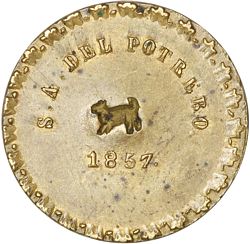
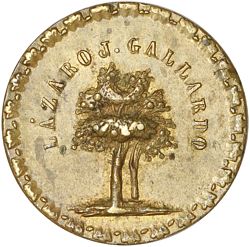
(Briggs & Bustos auction #2, 4 November 2022, lot 232)
Grove 1433
Obverse: around two trees. LAZARO J. GALLARDO
Reverse: S. A. DEL POTRERO / 1857, counterstamped with a dog
20mm. bronze
Grove 1434
Obverse: around two trees. LAZARO J. GALLARDO
Reverse: S. A. DEL POTRERO / 1857, counterstamped with a dog and cactus
20mm. bronze
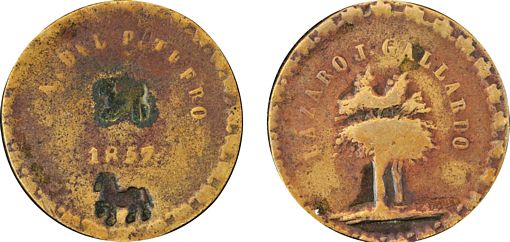 Grove 1435
Obverse: around two trees. LAZARO J. GALLARDO
Reverse: S. A. DEL POTRERO / 1857, counterstamped with a dog and horse
20mm. bronze
Grove 1436
Obverse: around two trees. LAZARO J. GALLARDO
Reverse: S. A. DEL POTRERO / 1857, counterstamped with a tree
20mm. bronze
Grove 1437
Obverse: around two trees. LAZARO J. GALLARDO
Reverse: S. A. DEL POTRERO / 1857, counterstamped with the letters L. J. G.
28mm. brass
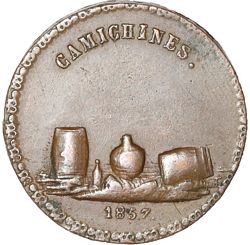
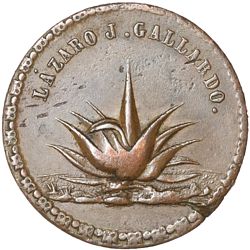
(Briggs & Bustos auction #2, 4 November 2022, lot 233)
Grove 1438
Obverse: above a maguey cactus LAZARO J. GALLARDO
Reverse: several items found in a store, CAMICHINES / 1857
28mm. brass
Grove 1439
Obverse: above a maguey cactus LAZARO J. GALLARDO
Reverse: several items found in a store, CAMICHINES / 1857, counterstamped with a cactus
28mm. brass
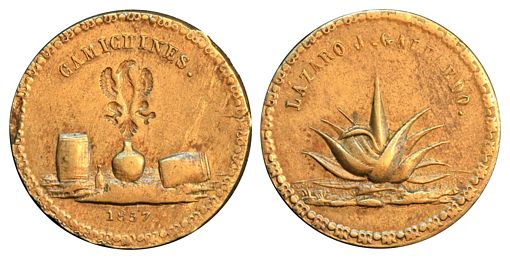 Grove 1440
Obverse: above a maguey cactus LAZARO J. GALLARDO
Reverse: several items found in a store, CAMICHINES / 1857, counterstamped with a spread eagle
28mm. brass
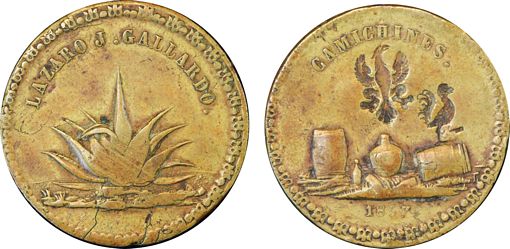 Grove 1441
Obverse: above a maguey cactus LAZARO J. GALLARDO
Reverse: several items found in a store, CAMICHINES / 1857, counterstamped with a spread eagle and rooster
28mm. brass
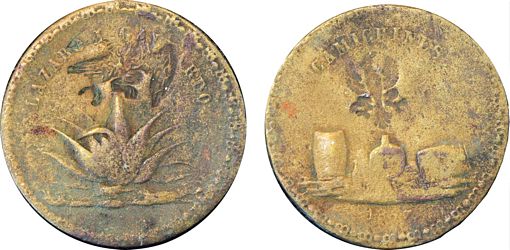 Grove 1442
Obverse: above a maguey cactus LAZARO J. GALLARDO
Reverse: several items found in a store, CAMICHINES / 1857, counterstamped with a spread eagle and eagle
28mm. brass
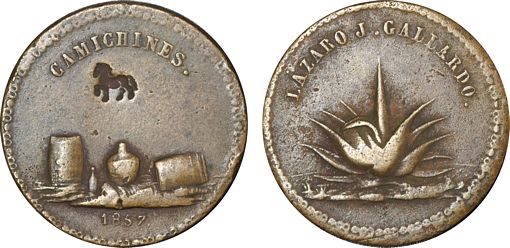 Grove 1443
Obverse: above a maguey cactus LAZARO J. GALLARDO
Reverse: several items found in a store, CAMICHINES / 1857, counterstamped with a horse
28mm. brass
Grove 1444
Obverse: above a maguey cactus LAZARO J. GALLARDO
Reverse: several items found in a store, CAMICHINES / 1857, counterstamped with the letters L. J. G.
28mm. brass
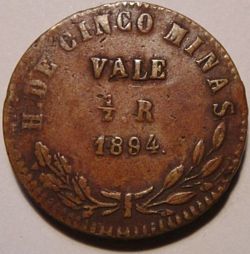
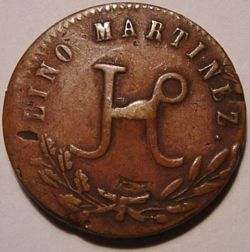
Grove 1474
Obverse: above an wreath of oak and laurel H. DE CINCO MINAS / VALE / ½ R / 1894
Reverse: above a wreath and cattlebrand LINO MARTINEZ
19mm. bronze
Grove 1475
Obverse: above an wreath of oak and laurel H. DE CINCO MINAS / VALE / 1 R / 1894
Reverse: above a wreath and cattlebrand LINO MARTINEZ
23mm. bronze
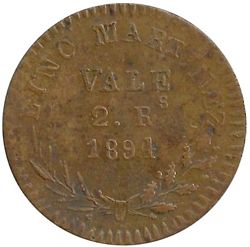
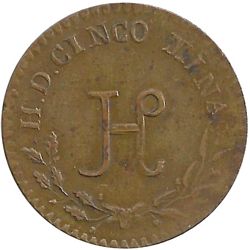
Obverse: above an wreath of oak and laurel H. DE CINCO MINAS / VALE / 2 RS / 1894
Reverse: above a wreath and cattlebrand LINO MARTINEZ
This hacienda, begun under the Spanish Crown, was given to Francisco Melodio Velasco in the sixteenth century. It passed through his heirs until one of them, Francisca Figueroa, who had no heirs, assigned the rights to the Order of the Carmelites, a religious order. Thus it came to be called "Hacienda Del Carmen". Years later, with the reforms of President Juárez, this property, which had over 60 highly productive hectares, generous climate, fertile land, abundant water and a prime location, was expropriated and given to General Florentino Cuervo in 1860.
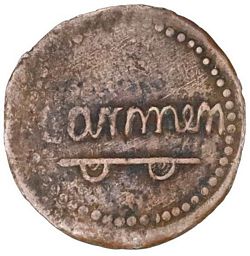
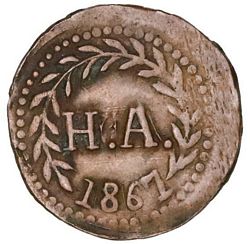
Hacienda del Carmen (Sedwick Treasure Auction 28, November 2020, lot 1120)
obverse:cursive "Carmen" above double yoke
reverse: H.A. inside overarching wreath above date 1867
22 mm. bronze
Grove 1469
Obverse: above a wreath FLORENTINO CUERVO / AM cattlebrand / 1877
Reverse: above a wreath HA DEL CARMEN / ⅛
23mm. bronze
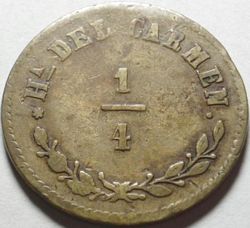
Grove 1470 Hacienda del Carmen ¼r (Briggs & Bustos auction VI, 10 November 2023, lot 287)
Grove 1470
Obverse: above a wreath FLORENTINO CUERVO / AM cattlebrand / 1877
Reverse: above an wreath HA DEL CARMEN / ¼
26mm. bronze
The Hacienda La Providencia, in Zapopan, was the property of the Bernardino Villaseñor family.
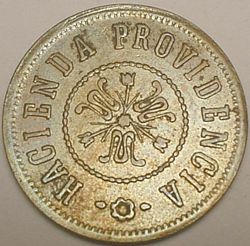
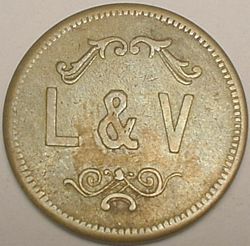
Obverse: HACIENDA PROVIDENCIA
Reverse: L & V
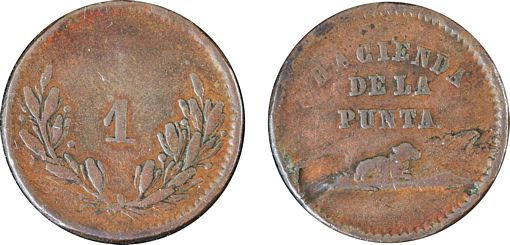
Grove 1543
Obverse: above an animal HACIENDA / DE LA / PUNTA
Reverse: above a wreath 1
21mm. bronze
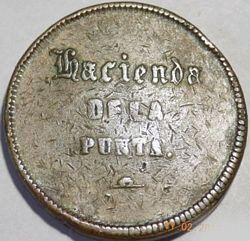
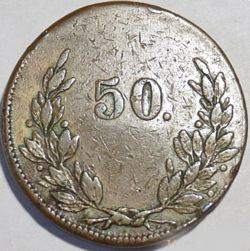
Grove 1544
Obverse: above an animal HACIENDA / DE LA / PUNTA
Reverse: above a wreath 50
30mm. bronze
Grove 1596
Obverse: MENDOZA HNOS / TECALITLAN / JAL. / HDA. DE SANTIAGO
Reverse: 1
35mm. aluminum
Grove 1597
Obverse: MENDOZA HNOS / TECALITLAN / JAL. / HDA. DE SANTIAGO
Reverse: 10 / LITROS / MAIZ
32mm. aluminum
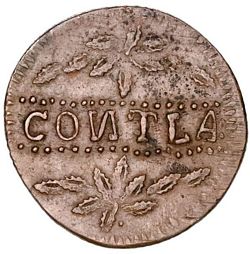
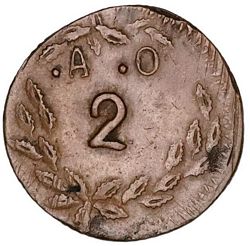
Apolonio Ochoa 2 almudes (Sedwick Treasure Auction 28, November 2020, lot 1123)
obverse with CONTLA (with retrograde N) between rows of dots with clusters of agave(?) leaves above and below
reverse: .A.O / 2 within wreath of same leaves
24.5 mm. bronze
[If correct person] Apolonio Ochoa Duarte was born in Jalisco in 1839 and died on 18 April 1887 in Atotonilco el Alto, Jalisco.
One hacienda de Belen was situated in Pihuamo, but it is a common name, and the tokens are placed here until further information (such as the identity of FC) is revealed.
All the Belen tokens were struck by Scovill Mfg. Co., Waterbury, Connecticut and proof specimens of copper and white metal pieces were found in the estate of one of its former employees. It is believed that the cupronickel specimens were struck for circulation. The other pieces may have been patterns or trials, except the BELIN error which were rejected patterns.
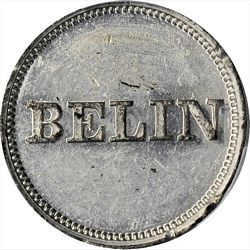
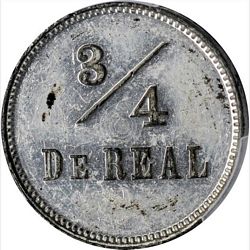
Hacienda Belen ¾r (Stack’s-Bowers auction, 27 February 2020, lot 71342)
Rulau-Mxo88
Obverse: BELIN in centre
Reverse: 3/4 / DE REAL
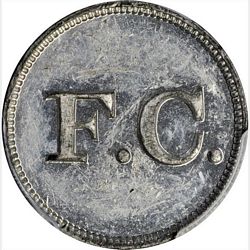
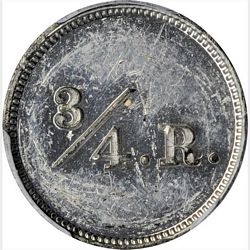
Hacienda Belen ¾r (Stack’s-Bowers auction, 27 February 2020, lot 71343)
Rulau-Mxo103
Obverse: F.C.
Reverse: 3/4. R.
Grove 1842
Obverse: RANCHO / DE / BUCHEL
Reverse: MANUEL GOMEZ / JEREZ, / ZAC.
31mm. bronze
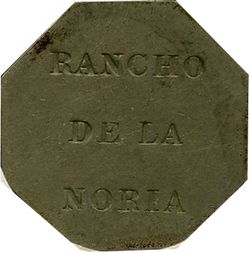
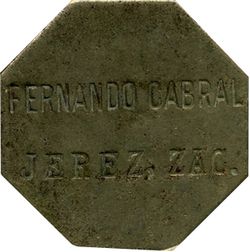
Grove 1848 Rancho de la Noria
Grove 1848
Obverse: RANCHO / DE LA / NORIA
Reverse: FERNANDO CABRAL / JEREZ, ZAC.
32mm. nickel
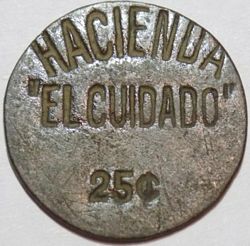
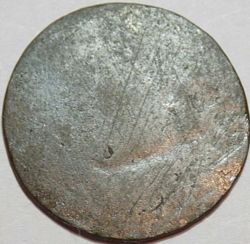
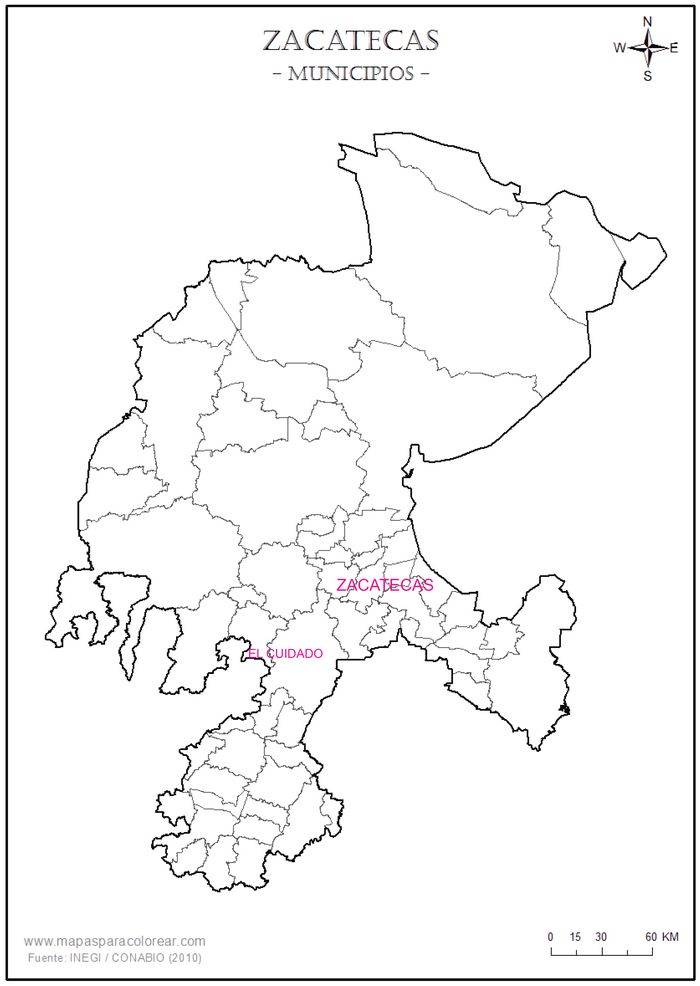
Grove 1478
Obverse: HACIENDA / "EL CUIDADO" . 25¢
Reverse: blank
24 mm. brass
Grove 1479
Obverse: HACIENDA / "EL CUIDADO" . 50¢
Reverse: blank
28 mm. brass
This hacienda was founded by the Treasurer of the Royal Caja de Zacatecas, Pedro Gómez de Contreras in the sixteenth century.
It passed to Manuel Diáz de Inguanzo, who had started as the administrator of Hacienda San José de Maguey and had used his salary to buy this Hacienda del Tesorero and the Hacienda de los Perez. These two properties became the foundation of the Inguanzo family fortune, which increased dramatically during the 19th century. Manuel's son, Eulogio Inguanzo Zesati del Castelu, married Maria del Refugio Amozurrutia de Inguanzo, whose father was the owner of Hacienda La Labor de Santa Gertrudis. By the time Eulogio died in 1893, his estate was valued at 280 thousand pesos, a vast fortune in those days. Included were at least three haciendas, various ranches, and several houses in Jerez.
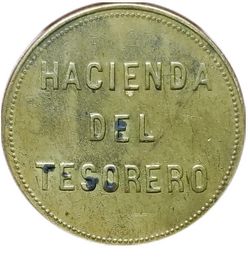
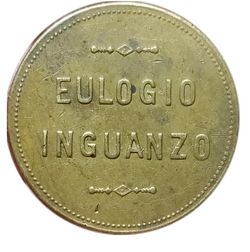
Obverse: HACIENDA / DEL / TESORERO
Reverse: EULOGIO / INGUANZO
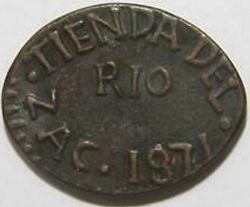
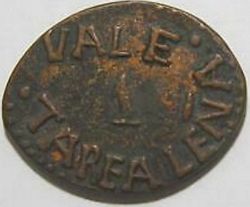
Obverse: TIENDA DEL / RIO / ZAC. 1871
Reverse: VALE / 1 / TAREA LEÑA
33 mm.
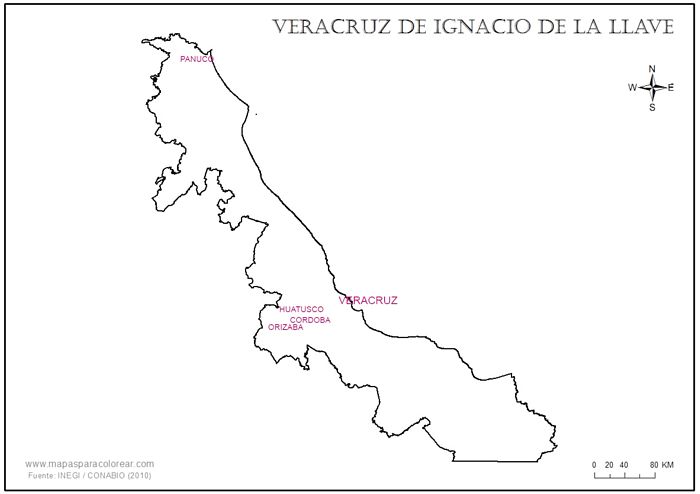
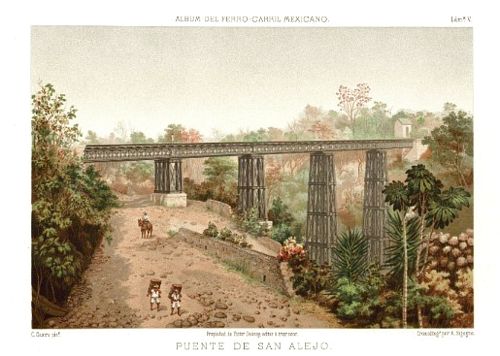
By 1868 the brothers Antonio and Eugenio Durand Laurent, originally from Pontis, Bas-Alpes (now Alpes-de-Haute-Provence), France, had settled in Paso del Macho, Veracruz. They began with a grocery business, in a strategic location on the Mexican Railroad, and began to amass a great fortune obtained by the cultivation of sugarcane and coffee. In the year 1900 they were among the main producers of the Canton of Córdoba{footnote}Southworth, {/footnote}.
As well as owning the Hacienda San Alejo, in the municipality of Paso del Macho, which was used for the cultivation of coffee, Durand Hermanos served as tenants on farmland belonging to the Haciendas of Vista Hermosa, El Ingenio, Rancho la Palma and El Potrero. They also owned haciendas in Chiquihuite and Naranjal, in the municipality of Atoyac. In the Hacienda El Potrero they had small establishments producing panela that was sold in Veracruz, Puebla, Mexico and Monterrey{footnote}AGN, Archivo de Antiguos Bancos de Emisión, la Sucursal de Banco Mercantil de Veracruz en Córdoba, fs.24, 109 of 1911, 7, 8, 21, 24, 28 of 1913 and 235 of 1914{/footnote}.
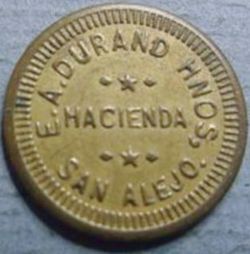
Grove 1556
Obverse: E. A. DURAND HNOS / HACIENDA / SAN ALEJO
Reverse: 5
21 mm. brass
Grove 1556
Obverse: E. A. DURAND HNOS / HACIENDA / SAN ALEJO
Reverse: 50
33 mm. brass
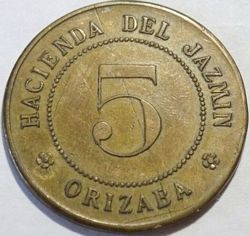
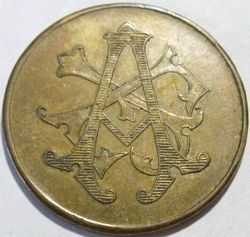
Grove 1500
Obverse: HACIENDA DEL JAZMIN / 5 / ORIZABA
Reverse: monogram AEJ
26 mm. brass
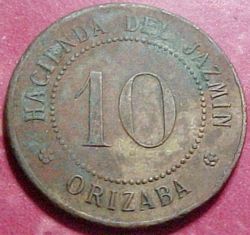
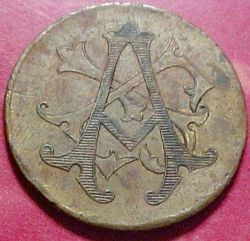
Grove 1501
Obverse: HACIENDA DEL JAZMIN / 10 / ORIZABA
Reverse: monogram AEJ
30 mm. brass
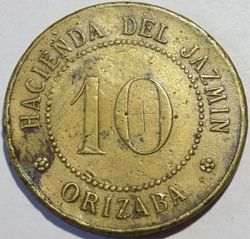
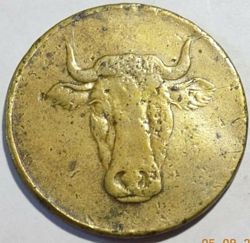
Grove 1502
Obverse: HACIENDA DEL JAZMIN / 10 / ORIZABA
Reverse: a cow's head
30 mm. brass
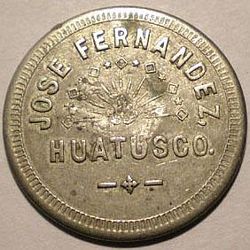
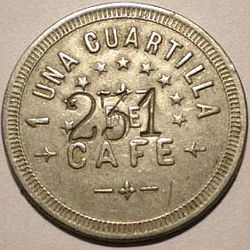
Grove 1343
Obverse: JOSE FERNANDEZ / HUATUSCO
Reverse: UNA CUARTILLA / DE / CAFE
30 mm. nickel
José Fernández introduced the first steam engine to help in the processing of coffee.
Pánuco is a city in the Huasteca Alta region of Veracruz, 50 kilometres west of Tampico.
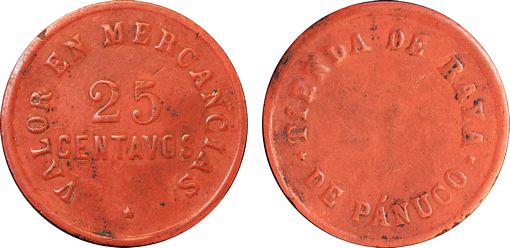
Grove
Obverse: TIENDA DE RAYA / DE PÁNUCO
Reverse: VALOR EN MERCANCIAS / 25 / CENTAVOS
mm. pink coloured plastic
Grove 1952
Obverse: TIENDA DE RAYA / DE PÁNUCO
Reverse: VALOR EN MERCANCIAS / 1 / PESO
40 mm. olive coloured plastic
In 1823 this hacienda was confiscated from the former convent of Belén and passed into the hands of the city council, but in 1842, by order of the Antonio López de Santa Anna government, it was sold and the proceeds spent in the Yucatán campaign. By 1861, the hacienda was owned by Dionisio José de Velasco, a wealthy Spanish merchant, and when he died on 29 November the hacienda was inherited by his sons: Pedro Juan, Francisco de Paula, Justo José Ramón, José Lino and Dionisio José de Velasco y Carballo, who established the company "Velasco Hermanos" which also owned other properties and operated a sugar mill. The company owned the hacienda for a few decades but by the 1910s, the owner was Manuel R. Morales and after his death in 1918, the hacienda was divided into three lots that were awarded to his sons: Marcos, Isaac and Tomás.
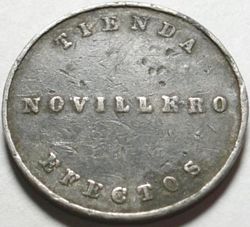
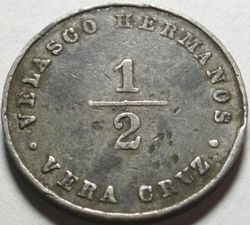
Obverse: TIENDA / NOVILLERO / EFECTOS
Reverse: VELASCO HERMANOS / ½ / VERA CRUZ
The Hacienda de Tuxpango was a sugar cane plantation near Veracruz.
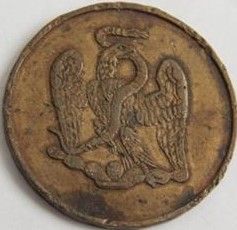
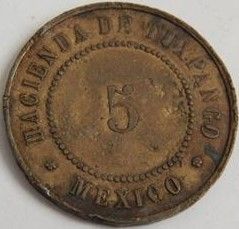
Grove 1636
Obverse: HACIENDA DE TUXPANGO / MEXICO / 5
Reverse: Mexican eagle
25 mm. brass
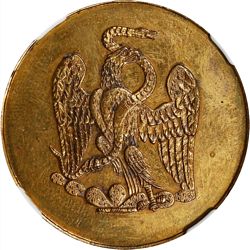
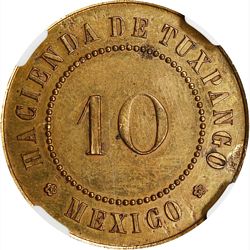
Rulau Ver-25. Grove-1637. (Stack’s Bowers Auction. 16 May 2023, lot 70682)
Grove 1637
Obverse: HACIENDA DE TUXPANGO / MEXICO / 10
Reverse: Mexican eagle
30 mm. brass
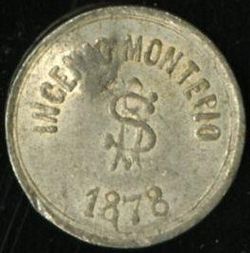
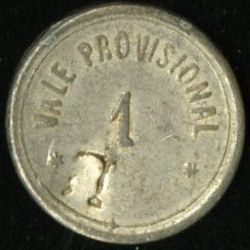
Ingenio Montepio
Obverse: INGENIO MONTEPIO / SR (monogram) / 1878
Reverse: VALE PROVISIONAL / 1 counterstamped broken U
A brief mention in a Mexican government report ca. 1890s notes the "plantation called Montepio in the area of Vera Cruz of Senor Carrere and Sebastiano Rueda". The latter is likely to whom is referred by the monogram.
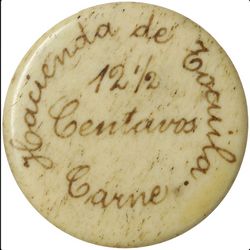
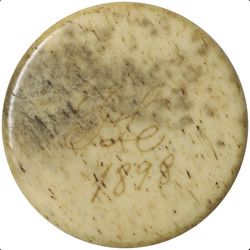
Grove 1492 Hacienda de Tocuila 12½c 1898 (Briggs & Bustos auction VIII, 26 April 2024, lot 389)
This iconic specimen is undoubtedly an atypical piece in Mexican numismatics. Crafted in blanks that were made of polished bone and were good for 12½c worth of meat. Neil S. Utberg{footnote}Neil S. Utberg, Numismatic Sidelines of Mexico, 1965{/footnote} describes for the first time a specimen like this one asserting that the legends were pyrographed with a hot iron. Miguel L. Muñoz{footnote} Miguel L. Muñoz, Tlacos y Pilones - La Moneda del Pueblo de México{/footnote} indicates that the legends were handwritten with huizache ink, which we believe is more possible since the calligraphy on each of the specimens we observed is similar but not identical. On the reverse, monogram FLe that refers to the initials of Federico Lüdert Rul who was the owner of the hacienda; below the date.