Another property of Benito Aznar & Compañía,
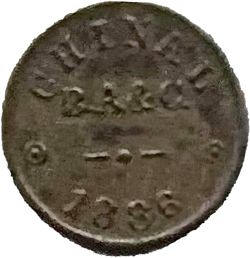
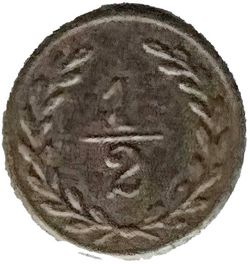
Obverse: CHINAL / B. A. & C. / 1886
Reverse: ½
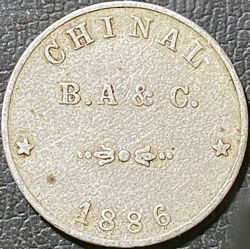
Grove 1252
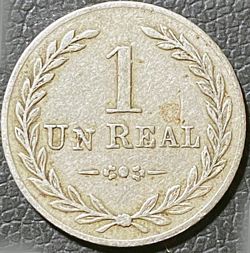
Obverse: CHINAL / B. A. & C. / 1886
Reverse: 1 / UN REAL
20mm. nickel
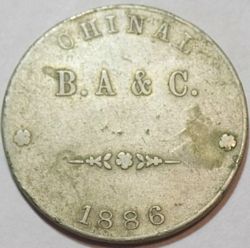
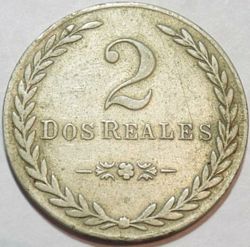
Grove 1253
Obverse: CHINAL / B. A. & C. / 1886
Reverse: 2 / DOS REALES
27mm. nickel
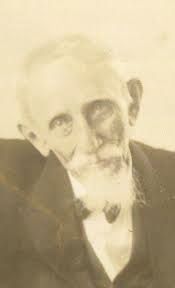
Escalante Bates' father, Eusebio Escalante Castillo, was the main driver of the henequen industry during the 19th century. He believed that the development of the industry needed the right infrastructure , viz. the technological development of the defibration of the henequén; the creation of capital; the demand abroad; the empowerment of the port of Progreso; and the presence of the railway. So from the mid 19th century to the 20th century his family worked from private initiative to ensure that the state met these conditions. Exploiting his relationships with Wall Street bankers, particularly with Thebaud Brothers, Escalante Castillo secured the funding that the henequen ranches required for the production. Its exporting house became the main intermediary in the export of henequén. Over the years, other successful export houses would copy the same scheme that Escalante Castillo had established, becoming important competitors.
In 1884, Eusebio’s father retired from business at the age of 80, and from then on he led the Casa E. Escalante é hijo, then the most important exporting house in the henequen industry.
In 1890, Escalante Bates promoted the foundation of the Banco Mercantil de Yucatán that quickly became one of the most important in the country. Similar to what happened to his export company, the Banco Mercantil de Yucatán received strong competition from the Banco Yucateco, an entity headed by Olegario Molina Solís. In the face of the financial panic of 1907, , both banks were affected to such an extent that they suffered a merger process under the tutelage of the Secretaría de Hacienda, constituting the Banco Peninsular Mexicano.
In 1902, a group of capitalists headed by Escalante Bates{footnote}among the investors were well-known Yucatecan entrepreneurs such as Carlos Peón Machado, José Palomeque Solís and Pedro Peón Contreras{/footnote} bought the Mérida-Valladolid railway. This was merged with two other railway companies to found Ferrocarriles Unidos de Yucatán. Although most of the capital had been provided by the Escalante family, the council's presidency was given to his brother-in-law, former governor Peón Machado, while he held the vice presidency of the council and his son, Nicolas Escalante Peón, was general manager.
In partnership with Manuel Dondé Cámara he founded the Merida Tram Company, and with Joaquín A. Peón, Nicanor Ancona Cámara and others, ran a line of steamships.
In partnership with Raymundo Cámara Luján, Agustín Vales Castillo and other minority capitalists, Escalante Bates founded the Agricultural Company of Cuyo y Anexas, S.A. The company had more than 1,500 employees and controlled a 2,627 square kilometres estate in the northwest of Yucatan
The financial panic of 1907 had very serious consequences for the henequen industry in Yucatan, which suddenly saw the orders of its main trading partners in North America slowed down.
Rumors of the collapse of Eusebio Escalante e Hijo had been circulating in Merida throughout the first months of I907. The Escalante house was the oldest casa exportadora in Yucatan, and although it could no longer lay claim to dominance in henequen sales, its investments in the Yucatecan economy were still considerable. Besides the commercial house in Merida, the firm owned the Agencia Comercial, whose warehouses, docks, lighters, and other means of transport enabled the Escalantes to move fiber from hacienda to steamship. The Agencia, which had been created in the late I880s in a partnership with another prominent casa, Manuel Donde y Cia (which succumbed to bankruptcy in an earlier bust cycle in I895), owned considerable real estate in the port of Progreso. In addition, Escalante e Hijo had invested heavily in the Ferrocarriles Unidos, tramway companies, banks, urban properties and haciendas, a variety of attendant service industries and some chancy agricultural companies in the eastern portion of the peninsula. Like all casas, Escalante e Hijo served as creditor to a great number of hacendados: in some cases, it made cash advances; in others, it provided mortgages to planters. Finally, many wealthy busi- nessmen and individuals in Merida and elsewhere had invested in the Escalante casa, including such notable personages as former governor Carlos Pe6n Machado and the wealthy merchant, Pedro Peon Contreras. The Thebaud Brothers, who had first financed the Escalantes in the 1850s and in large measure contributed to the creation of the henequen industry in Yucatan, had running accounts with the casa that exceeded a million dollars. Clearly many stood to lose through association with this economic powerhouse.{footnote}Gilbert M. Joseph and Allen Wells, “Summer of Discontent: Economic Rivalry among Elite Factions during the Late Porfiriato in Yucatan”. In Journal of Latin American Studies Vol. 18, No. 2 (Nov., 1986), Cambridge University Press{/footnote}.
The Escalante family tried to get the support of the federal government to avoid bankruptcy. However, Olegario Molina's presence in the federal cabinet may have played against him. The fall of the Casa Escalante favored the interests of Molina and his son-in-law and partner, Avelino Montes.
In a desperate but futile effort to avoid bankruptcy, Nicolas Escalante Pe6n went to Mexico City in May and June of 1907 to speak with Ministers Molina and Limantour. What was at stake was more than just the failure of one of the largest henequen firms in the peninsula. Yucatecan banks, especially the Banco Mercantil (the Escalante bank) were also in imminent danger of default. Secretary of Hacienda Limantour agreed to bail out the Yucatecan banks by authorizing the Banco Nacional de Mexico to loan million pesos to the Banco Yucateco and the Banco Mercantil under cetain unspecified conditions. Later in 1908, Limantour would agree to the fusion of the two weakened banks into one stronger institution, the Banco Peninsular Mexicano. While the federal government had intervened prop up the peninsular banking industry during this financial crisis, however, they did not rescue the ailing Escalante casa. Nicolas Escalante Peon and some of his creditors would later suggest that Molina intentionally worked to subvert any type of financial settlement that would save the Escalante house from failure. Although we will probably never know if this is true, the Molinista faction certainly had little interest in propping up Escalante. As a direct result of the Escalante failure in July 1907, Avelino Montes S. en C. would scuttle one of its principal rivals in the henequen trade, obtain control of the Ferrocarriles Unidos de Yucatan and of the peninsular banks, and then use its new clout to purchase a steamship line in I908. Rarely has a business profited so well from another's misfortune. Escalante's demise ensured Molinista dominance over the key facets of the regional economy.{footnote}Gilbert M. Joseph and Allen Wells, “Summer of Discontent: Economic Rivalry among Elite Factions during the Late Porfiriato in Yucatan”. In Journal of Latin American Studies Vol. 18, No. 2 (Nov., 1986), Cambridge University Press{/footnote}.
When news of the Escalante's bankruptcy became public, financial circles in Mérida, Mexico City, Paris and New York shook. There is ample evidence to suggest that the Escalante's bankruptcy led to a similar bankruptcy of Thebaud Brothers. the New York investment bank. The bankruptcy had repercussions as far away as France, where the Crédit Lyonnais, a bank that had invested significant amounts in the peninsular banks closed its doors in September 1907.
Despite the break of their business empire, the Escalante came out relatively unharmed from the debacle.. Although local judges issued an arrest warrant against Eusebio Escalante Bates and Nicolas Escalante Peón in 1909, a high-ranking "government official" warned the two of their imminent arrest two months before the order was issued. These previous warnings gave them enough time to flee to New York [...] the Escalante received an amparo trial from Mexican courts and were finally exonerated of any crime.
After the bankruptcy of his export home, Escalante Bates retired from business. However, their children, the Peón Escalante, quickly got to work to rebuild the family's commercial empire. He died in 1935.
Hotzuc is located in the municipio of Umán.
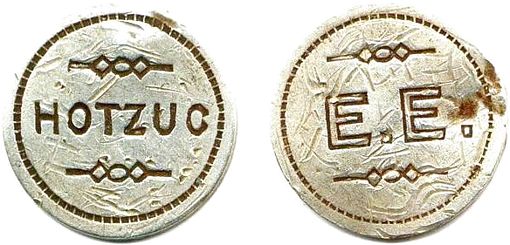
Obverse: HOTZUC
Reverse: E. E.
18.8mm. nickel
Isincab is located in the municipio of Tecoh.
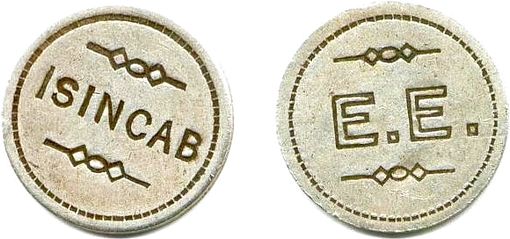
Grove 1685
Obverse: ISINCAB
Reverse: E. E.
18.7mm. nickel
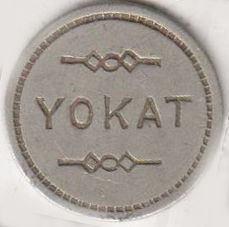
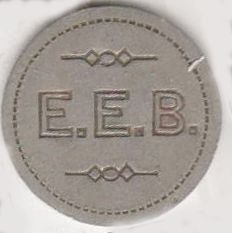
Grove 2018
Obverse: YOKAT
Reverse: E. E. B.
21mm.
The Hacienda Yokat was first founded in the 18th century and for more than 250 years, the hacienda was used in cattle farms, sugar cane production and henequen production. In the 20th century Yokat belonged to the Spanish businessman Avelino Montes, a result, no doubt. of the bankrupcy.
Tecoh is located in the municipio of San José Tzal in the department of Mérida. E Escalante G is Eusebio Escalante Galera.
Grove 1620
Obverse: HACIENDA TECOH / E ESCALANTE G
Reverse: ⅛
19mm. white metal
Grove 1621
Obverse: HACIENDA TECOH / E ESCALANTE G
Reverse: ¼
22mm. white metal
Grove 1622
Obverse: HACIENDA TECOH / E ESCALANTE G
Reverse: ½
25mm. white metal
This hacienda was located inthe municipio of Kanasín.
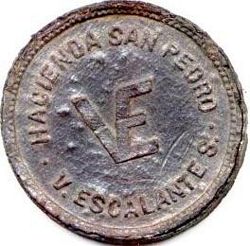
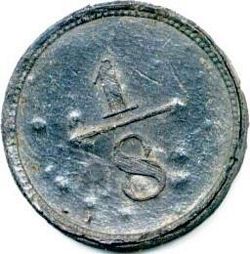
Obverse: HACIENDA SAN PEDRO / moogram VE / V ESCALANTE S.
Reverse: ⅛
22mm. nickel plated
Obverse: HACIENDA SAN PEDRO / moogram VE / V ESCALANTE S.
Reverse: ½
24mm. nickel plated
Calcehtok is located in the municipio of Opichén.
Obverse: CALCEHTOK
Reverse: E. E. B. (Eusebio Escalente Bates)
19mm. nickel
This hacienda is situated in the municipio of Hoctún, 45 kilometres east of Mérida and was devoted to sugar cane. The hacienda’s mill produced approximately 12,000 kilograms of sugar cane and about 10,000 kilograms of honey per year.
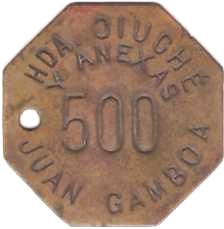
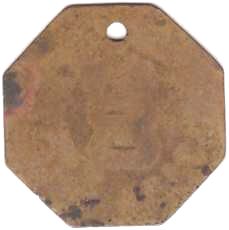
Grove 1479
Obverse: on octagonal planchet HDA. ƆIUCHE / Y ANEXAS / 500 / JUAN GAMBOA
Reverse: blank
38mm. brass
Grove 1480
Obverse: on octagonal planchet HDA. ƆIUCHE / Y ANEXAS / 500 / JUAN GAMBOA
Reverse: blank, counterstamped P
38mm. brass
Grove 1481
Obverse: on octagonal planchet HDA. ƆIUCHE / Y ANEXAS / 500 / JUAN GAMBOA
Reverse: blank, counterstamped SA
38mm. brass
Grove 1482
Obverse: on octagonal planchet HDA. ƆIUCHE / Y ANEXAS / 500 / JUAN GAMBOA
Reverse: blank, counterstamped SA P
38mm. brass
Grove 1483
Obverse: HDA. ƆIUCHE / Y ANEXAS / 1000 / JUAN GAMBOA
Reverse: blank
39mm. brass
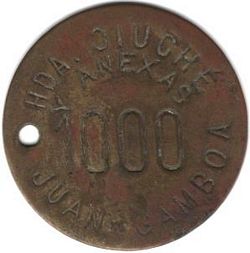
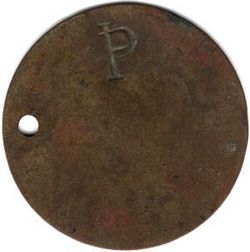
Grove 1484
Obverse: HDA. ƆIUCHE / Y ANEXAS / 1000 / JUAN GAMBOA
Reverse: blank, counterstamped P
39mm. brass
Grove 1485
Obverse: HDA. ƆIUCHE / Y ANEXAS / 1000 / JUAN GAMBOA
Reverse: blank, counterstamped SA
39mm. brass
Grove 1485
Obverse: HDA. ƆIUCHE / Y ANEXAS / 1000 / JUAN GAMBOA
Reverse: blank, counterstamped SA P
39mm. brass
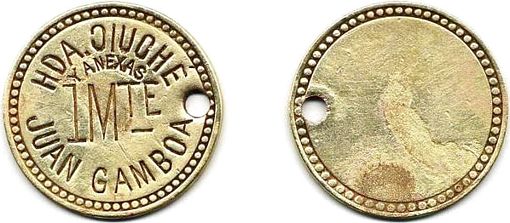 Grove 1486
Obverse: HDA. ƆIUCHE / Y ANEXAS / 1 MTE / JUAN GAMBOA
Reverse: blank
28mm. brass
Kandtrix is located in the municipio of Teabo in the department of Tekax.
Grove 1506
Obverse: HACIENDA / KANDTRIX / DE / MEZQUITA / GAMBOA / HNOS
Reverse: 500 / PENCAS
26mm. aluminum
San José is located in the municipio of Hoctún in the department of Izamal.
Grove 1574
Obverse: HACIENDA SAN JOSE / JOSE CAMARA VALES
Reverse: 1/4
23mm. white metal
Grove 1575
Obverse: HACIENDA SAN JOSE / JOSE CAMARA VALES
Reverse: 1/2
25mm. white metal
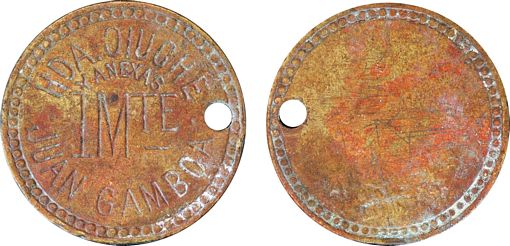 Grove 1576
Obverse: HACIENDA SAN JOSE / JOSE CAMARA VALES
Reverse: 1
28mm. white metal
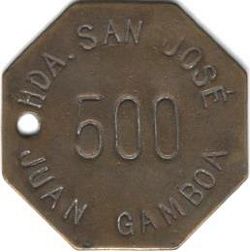
Grove 1577
Obverse: on an octagonal planchet HDA. SAN JOSE / 500 / JUAN GAMBOA
Reverse: blank
28mm. brass
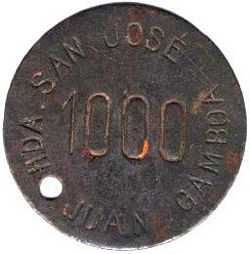
Grove 1578
Obverse: HDA. SAN JOSE / 1000 / JUAN GAMBOA
Reverse: blank
38mm. brass
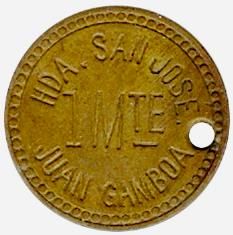
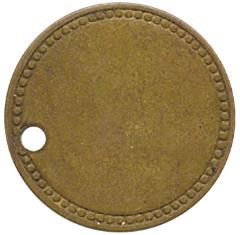
Grove 1579
Obverse: HDA. SAN JOSE / 1 MTE / JUAN GAMBOA
Reverse: blank
28mm. brass
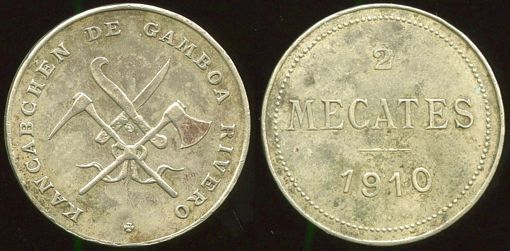
This hacienda{footnote}There are numerous other properties of this name, which means 'the well of the red ground' in Mayan, in the Yucatán including Hacienda Kancabchén in Motul, Hacienda Kankabchén in Seyé, Hacienda Kankabchén in Tixkokob, Hacienda Kancabchén in Tunkás),Hacienda Kancabchén Ucí and Hacienda Kancabchén de Valencia{/footnote} is in the municipio of Baca, about 22 kilometres from Mérida. It was built by Pascual Gamboa Rivero in 1890 to engage in livestock and henequen activity. The property was inherited by his daughter, Josefina Gamboa de Casares, who kept it in her possession until 1985.
Grove 1689
Obverse: around henequen tools KANCABCHEN DE GAMBOA RIVERO
Reverse: 500 / PENCAS / 1910
30mm. nickel
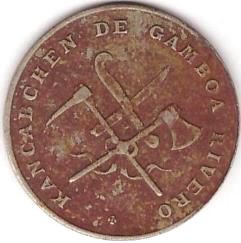
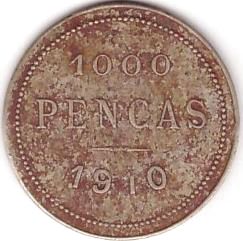
Grove 1690
Obverse: around henequen tools KANCABCHEN DE GAMBOA RIVERO
Reverse: 1000 / PENCAS / 1910
30mm. nickel
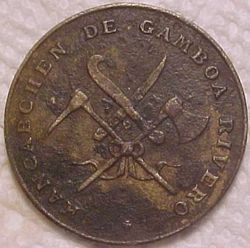
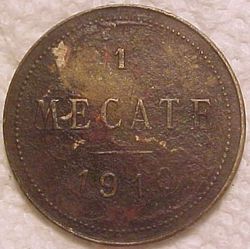
Grove 1691
Obverse: around henequen tools KANCABCHEN DE GAMBOA RIVERO
Reverse: 1 / MECATE / 1910
30mm. nickel
Grove 1692
Obverse: around henequen tools KANCABCHEN DE GAMBOA RIVERO
Reverse: 2/ MECATES / 1910
30mm. nickel
This hacienda is in the municipio of Motul.
Grove 1693
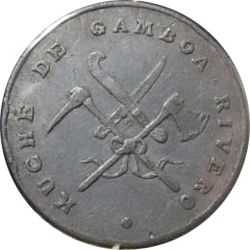
Obverse: around henequen tools KUCHE DE GAMBOA RIVERO
Reverse: 500 / PENCAS / 1910
30mm. nickel
Grove 1694
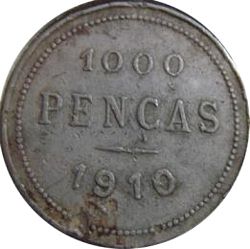
Obverse: around henequen tools KUCHE DE GAMBOA RIVERO
Reverse: 1000 / PENCAS / 1910
30mm. nickel

Grove 1695
Obverse: around henequen tools KUCHE DE GAMBOA RIVERO
Reverse: 1 / MECATE / 1910
30mm. nickel

Grove 1696
Obverse: around henequen tools KUCHE DE GAMBOA RIVERO
Reverse: 2 / MECATES / 1910
30mm. nickel
Obverse: around henequen tools SAKOLA DE GAMBOA RIVERO
Reverse: 500 / PENCAS / 1910
30mm. nickel
Obverse: around henequen tools SAKOLA DE GAMBOA RIVERO
Reverse: 1000 / PENCAS / 1910
30mm. nickel
Obverse: around henequen tools SAKOLA DE GAMBOA RIVERO
Reverse: 1000 / PENCAS / 1910 counterstamped M
30mm. nickel
Obverse: around henequen tools SAKOLA DE GAMBOA RIVERO
Reverse: 1 / MECATE / 1910
30mm. nickel
Obverse: around henequen tools SAKOLA DE GAMBOA RIVERO
Reverse: 2 / MECATE / 1910
30mm. nickel
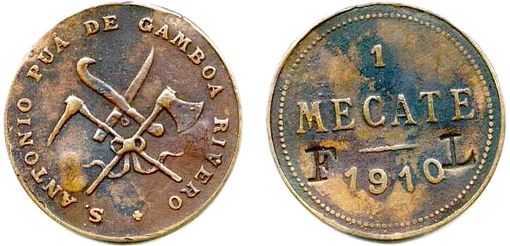
San Antonio Puá is located in the municipio of Cacalchén.
Grove 1873
Obverse: around henequen tools S. ANTONIO PUA DE GAMBOA RIVERO
Reverse: 500 / PENCAS / 1910
30mm. brass
Grove 1874
Obverse: around henequen tools S. ANTONIO PUA DE GAMBOA RIVERO
Reverse: 1000 / PENCAS / 1910
30mm. brass
Grove 1875
Obverse: around henequen tools S. ANTONIO PUA DE GAMBOA RIVERO
Reverse: 1000 / PENCAS / 1910, counterstamped F L
30mm. brass
Grove 1876
Obverse: around henequen tools S. ANTONIO PUA DE GAMBOA RIVERO
Reverse: 1/ MECATE / 1910
30mm. brass
Grove
Obverse: around henequen tools S. ANTONIO PUA DE GAMBOA RIVERO
Reverse: 1 / MECATE / 1910, counterstamped F L
30mm. brass
Obverse: around henequen tools S. ANTONIO PUA DE GAMBOA RIVERO
Reverse: 2 / MECATE / 1910
Obverse: around henequen tools S. ANTONIO PUA DE GAMBOA RIVERO
Reverse: 2 / MECATE / 1910 counterstamped F L
Eulogio Duarte Troncoso was born in 1841. He came from an important family of sugar hacendados, including Anselmo Duarte de la Ruela, who had been dedicated to the production of sugarcane since the beginning of the nineteenth century. With his sons, Anselmo Duarte formed “Duarte Hermanos,” which was a major player in the henequen industry.
Duarte possessed multiple henequen estates and served as vice president of the Cámara Permanente, an organisation established to protect the interests of the henequen barons. In 1893 Duarte bought the Hacienda San Juan Bautista Tabi from Governor Carlos Peón, He invested heavily, with modern machinery and even bringing sixty Cuban sugar experts to improve agricultural and refining techniques, and made Tabi the foremost hacienda in the state. Despite the transformative and modernising effects of capital investment and industrialisation at Tabi and other estates, many preindustrial features hacienda life persisted, including peonage.
Duarte died on 27 February 1904.
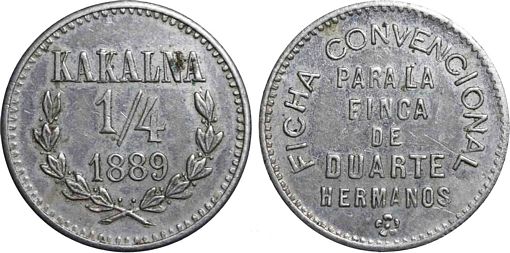 Grove 1365
Obverse: within a laurel wreath KALKALNA / 1/4 / 1889
Reverse: FICHA CONVENCIONAL / PARA LA / FINCA / DE / DUARTE / HERMANOS
17mm. nickel
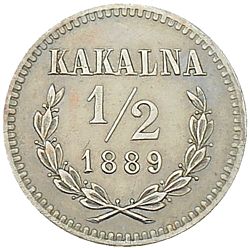
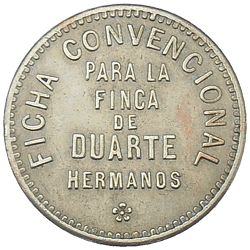
Grove 1366
Obverse: within a laurel wreath KALKALNA / 1/2 / 1889
Reverse: FICHA CONVENCIONAL / PARA LA / FINCA / DE / DUARTE / HERMANOS
21mm. nickel
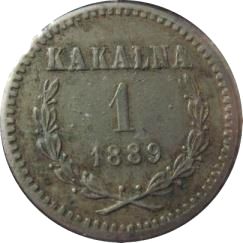 Grove 1367
Obverse: within a laurel wreath KALKALNA / 1 / 1889
Reverse: FICHA CONVENCIONAL / PARA LA / FINCA / DE / DUARTE / HERMANOS
24mm. nickel
Grove 1560
Obverse: HACIENDA SAN ANTONIO XUKU / MARCOS / DUARTE T.
Reverse: FICHA CONVENCIONAL / 1888 / MEDIO REAL
19mm. nickel
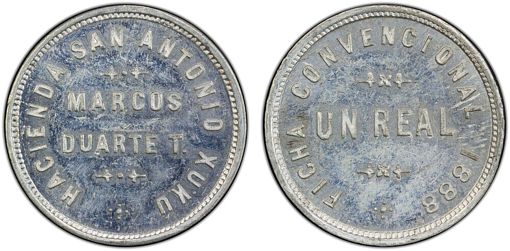
Grove 1561
Obverse: HACIENDA SAN ANTONIO XUKU / MARCOS / DUARTE T.
Reverse: FICHA CONVENCIONAL / 1888 / UN REAL
23mm. nickel
This hacienda is located in the municipio of Sotuta.
Obverse: TABI / 1 MECATE
Reverse: blank
Obverse: TABI / 1 CANOA
Reverse: blank
Obverse: TABI / 1 CADAVORA
Reverse: blank
Obverse: TABI / 1 JORNAL
Reverse: blank
Obverse: 100 / F M
Reverse: blank
Obverse: O. MF / 1000
Reverse: blank
The Cámara family is the oldest Creole family in Yucatan as Juan de la Cámara came to the peninsula with Montejo. The Cámara family also exerted significant influence in the second half of the 19th century and the beginning of the 20th century.
Numerous haciendas, such as Hacienda San Antonio Cámara, Hacienda Chucmichén, Hacienda Santa Ana, Hacienda Xcalak, Hacienda San Diego Azcorra, Hacienda Itzincab Cámara, Hacienda Polyuc and Hacienda Dzuiché, among others, were under the ownership and influence of Cámara family members during the early years of the twentieth century.
Alfonso Cámara y Cámara was a conservative politician who served as vice governor of the state during the administration of Francisco Cantón. In 1902, Canton proposed him as his successor, but Porfirio Díaz, the dictator who ruled Mexico for 30 years, favored the candidacy of his rival, Olegario Molina.
Raymundo Cámara Luján was the owner of numerous farms in Temax, among which the haciendas of San Antonio Cámara and Chumichén stand out. Together, these haciendas had a combined area of 7,812 hectares devoted to henequen farming. Raymundo was also the owner of the Hacienda de Tekik, a henequen hacienda in Timucuy.
In 1887, he partnered with the Villamil Vales family to found the Compañía Particular de Fomento de Fincas, S.A., with the aim of exploiting and producing henequen. They acquired the Hacienda San Diego Tixcacal in Opichén, the Hacienda de Santa Cruz, and the Hacienda de Subintal in Huhí for this purpose,
His agricultural activity was not only limited to the production of henequen, as he was also the owner of several sugar mills dedicated to the production of sugar cane. After Manuel Cicerol, owner of the Hacienda de Catmís in Tzucacab, Cámara Luján became the second most important producer of sugarcane in the Yucatan Peninsula. Among the mills operated by Cámara Luján, the Hacienda de Dziuché in Hoctún stands out, which produced around 12,000 kilograms of sugar and 10,000 kilograms of honey per year.
Similarly, he owned the Hacienda Polyuc, a sugar mill located in Tekax. Between 1906 and 1909, this hacienda was managed by José María Pino Suárez, son-in-law of Cámara Luján.
Along with Felipe Peón, Eusebio Escalante, and Rafael Hernández Escudero, Cámara Luján owned the Hacienda Yokat in Ticul{footnote}Friedrich Katz, Agrarian serfdom in Mexico in the Porfiran era, 2013. Ediciones Era{/footnote}. Yokat was a cattle ranch, as well as a sugar and henequen plantation. The Haciendas of Yokat and Polyuc were sold to Augusto L. Peón after the financial panic of 1907.
Again associated with Escalante, Cámara Luján was co-owner of a 2,627 km² plot of land that included the Hacienda de Santa María in Quintana Roo (Compañía Agrícola del Cuyo y Anexas, S.A.).
Influenced by his son-in-law, José María Pino Suárez, a lawyer and social reformer, Cámara implemented progressive labor practices, providing favorable working conditions for workers in his mills. He introduced reforms such as establishing a minimum wage, an eight-hour workday, and ensuring labour mobility and the ability to negotiate working conditions on all farms. In addition, he prioritized education by establishing rural schools on his properties to teach basic reading and writing to workers and their families. Notably, the Hacienda de Dziuché became a precursor to labor unions, inspiring other landowners in Yucatán to follow suit. Camara's progressive ideals were grounded in his Catholicism and his belief in treating workers with respect, while recognizing the practical benefits of better conditions in terms of productivity and profits. Although his reforms faced criticism from some ranchers who saw them as costly and detrimental to the henequen industry, they ultimately improved the lives of thousands of workers in Yucatan.
At the dawn of the 19th century, Cámara teamed up with his brother-in-law, José María Ponce Solís, to establish the José M. Ponce y Cía trading house, which quickly became one of the leading exporters of henequen. Between 1898 and 1902, his company was responsible for exporting approximately 16% of henequen fibre bales, amounting to about 13 million kilograms annually to the U.S. market. In addition to their role as exporters, the company became a financial institution, granting loans to both henequen producers and entrepreneurs in various sectors. Notably, they played a crucial role in financing the construction of the railway connecting Mérida and Valladolid, later expanding this network to include the route from Conkal to Progreso. This infrastructure was instrumental in efficiently transporting henequen from the northeastern region of Mérida to shipping ports. However, by 1904, the operations of the company led by Ponce Solís y Cámara came to an end. The company's sudden demise can be attributed to a combination of political and economic factors. In the political sphere, the government of General Cantón was replaced by Olegario Molina, marking the transition to the first civilian governor of the Porfiriato. The political collaboration between General Cantón and José María Ponce Solís, who had also served as mayor of Mérida from 1900 to 1902, came to an end. In the same year, International Harvester was born, the result of the merger of sixteen American companies dedicated to the manufacture of agricultural machinery and cordage. This merger created a near-monopoly on henequen fibre, consolidating its control of the market. The fate of the henequen market was sealed with a secret agreement between Olegario Molina, then governor (though formally separated from his company), and International Harvester, which kept fibre prices artificially low in exchange for acquiring increasing volumes of the Yucatecan product.Because of this secret cartel, the United States, being the leading importer of henequen, went from being a price taker to a price maker, causing the price of henequen to fall from about $9.48 per pound to a flat rate of just eight cents per pound. Faced with this new market reality, Ponce and Cámara strategically decided to reduce their share of the henequen market and began to diversify their interests. In 1900, they ventured into a new business direction, opening Cervecería Yucateca, S.A., a brewery.
In 1890, the Mercantile Bank of Yucatán, S.A., the first bank in the region, was founded. In 1890 Cámara was one of founders of the Banco Mercantil de Yucatán and participated in its first board of directors. The bank maintained close ties with the business interests of the Escalante and Cámara families. However, it faced strong competition from Banco Yucateco, which was associated with the Molina family. Amid the Panic of 1907, a severe economic crisis on an international level, both banks were greatly affected and were forced to merge, forming the Banco Peninsular Mexicano.
This finca was located 15 kilometres south of Mérida.
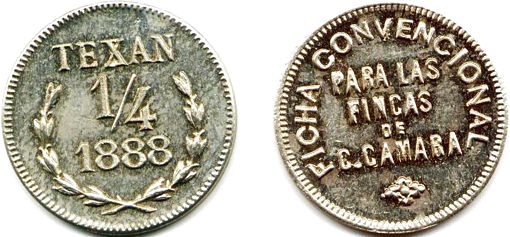 Grove 1412
Obverse: above a laurel leaf, TEXAN / 1/4 / 1888
Reverse: FICHA CONVENCIONAL / PARA LAS . FINCAS / DE / C. CAMARA
17mm. nickel
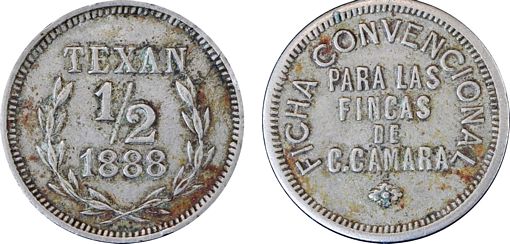
Grove 1413
Obverse: above a laurel leaf, TEXAN / 1/2 / 1888
Reverse: FICHA CONVENCIONAL / PARA LAS . FINCAS / DE / C. CAMARA
21mm. nickel
This finca, was located in the municipio of Tecoh, just 25 kilometres south of Mérida. The hacienda was purchased in around 1860 by Camilo G. Cámara. As early as 1898, Cuban workers were being used on the farm. In 1905, salary reports show 22 of the workers were from the newly arrived Korean indentured servants.
In the 1930s with the land reforms passed under the agrarian acts the size of the hacienda was greatly reduced. In 1934, the family retained 211 hectares. By 1981 only 14 hectares were still part of the hacienda and when the Cámara family sold the property in 1996, the property had 4 hectares of land remaining.
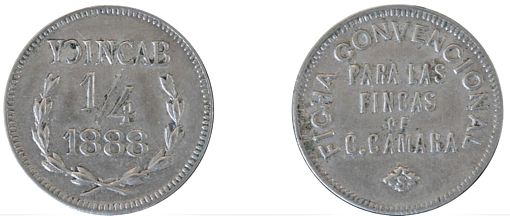
Grove 1420
Obverse: above a laurel leaf, YƆINCAB / 1/4 / 1888
Reverse: FICHA CONVENCIONAL / PARA LAS . FINCAS / DE / C. CAMARA
17mm. nickel
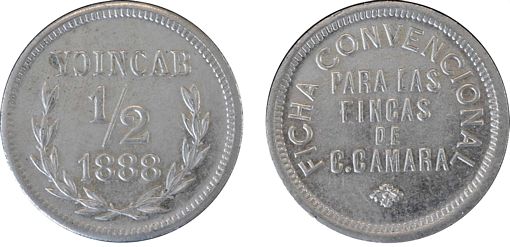
Grove 1421
Obverse: above a laurel leaf, YƆINCAB / 1/2 / 1888
Reverse: FICHA CONVENCIONAL / PARA LAS . FINCAS / DE / C. CAMARA
21mm. nickel
This hacienda is located in the municipio of Mérida.
Obverse: HACIENDA SAN JOSE / JOSE CAMARA VALES
Reverse: ¼
23mm. nickel
Obverse: HACIENDA SAN JOSE / JOSE CAMARA VALES
Reverse: ½
25mm. nickel
Obverse: HACIENDA SAN JOSE / JOSE CAMARA VALES
Reverse: 1
28mm. nickel