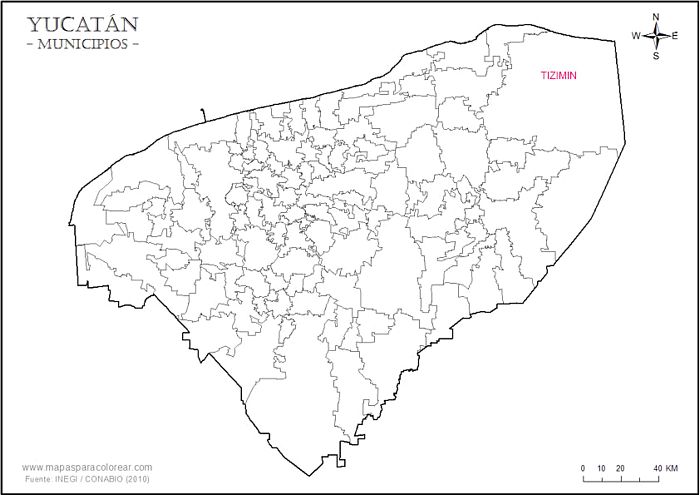
Cuyo de Ancona is located in the municipio of Tizimín, in the upmost righthand corner of Yucatán, on the border with Quintana Roo. The hacienda was owned in 1895 by Ramón Ancona Bolio.
Grove 1322
Obverse: ESPECIAL / CUYO DE ANCONA 1895 / 5
Reverse: same
19mm. nickel
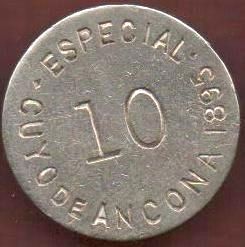
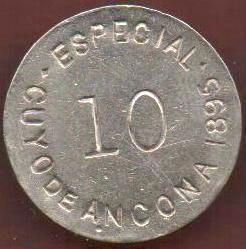
Grove 1323
Obverse: ESPECIAL / CUYO DE ANCONA 1895 / 10
Reverse: same
20mm. nickel
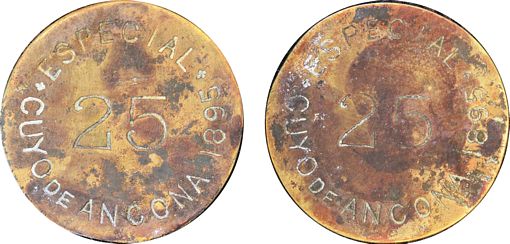
Grove 1324
Obverse: ESPECIAL / CUYO DE ANCONA 1895 / 25
Reverse: same
24mm. nickel
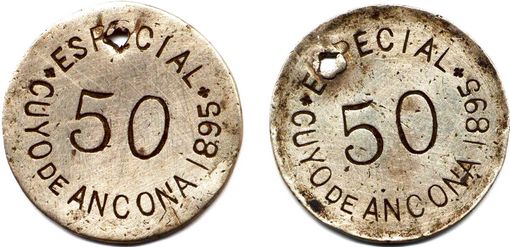 Grove 1325
Obverse: ESPECIAL / CUYO DE ANCONA 1895 / 50
Reverse: same
27mm. nickel
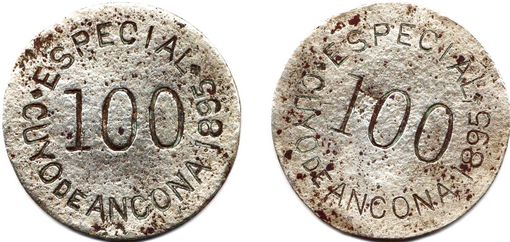 Grove 1326
Obverse: ESPECIAL / CUYO DE ANCONA 1895 / 100
Reverse: same
35mm. nickel
Grove 1327
Obverse: ESPECIAL / CUYO DE ANCONA 1895 / 500
Reverse: same
38mm. nickel
Obverse: ESPECIAL / CUYO DE ANCONA 1895 / 1 (peso)
Reverse: same
lead
[if relevant] Eusebio Escalante Bates, Raymundo Cámara Luján, Agustín Vales and other Yucatecan entrepreneurs founded the Compañía Agrícola del Cuyo y Anexas, S.A., which employed more than 1,500 workers and controlled an extensive 2,627 km² estate located in the northwest of Yucatan.
"rich in dye wood, ideal for the cultivation of sugarcane, vanilla, tobacco, corn or cereals, as well as suitable for harvesting sea salt [...] Among the productive activities of the plantation, we can highlight the exploitation of forest resources (dyewoods, precious woods for cabinetmaking, and hard woods for construction), as well as the extraction of resins (chicle), the production of sea salt, the cultivation of sugarcane, the development of tobacco, cocoa, cotton, banana, and vanilla plantations, … Likewise, for self-consumption by its inhabitants, corn, rice, beans, and all other available natural products were produced on the mentioned estate [...] The dye wood exported by the Company was in demand in the European textile manufacturing markets of Hamburg, Le Havre, and Liverpool. As for chicle, its main destination was New York City, with an average commercialization of 400,000 kg per year{footnote}Edgar Joel Rangel González, "Plantaciones agrícolas-forestales en la costa oriental de Yucatán: explotación forestal, colonización y arrendamiento, 1890–1910" in Segundas Jornadas de Historia Económica de la Asociación Mexicana de Historia Económica, 11 November 2021{/footnote}.
The Compañía Agrícola del Cuyo y Anexas, S.A faced strong competition from the Compañía Colonizadora de la Costa Oriental de Yucatán, S.A., which had the participation of Olegario Molina Solís and several capitalists from Mexico City close to the cientifícos.
Haciendas developed late in Yucatán compared with the rest of Mexico because of geographical, ecological and economical reasons, particularly the poor quality of the soil and lack of water to irrigate farms. Commonly the farms were initially used exclusively for cattle ranching, with a low density of labour, becoming over time maize-growing estates in the north and sugar plantations in the south, before finally becoming henequen estates. One of the regions of Yucatán which had produced maize but evolved into the henequen industry is the area adjoining and near to Mérida, where haciendas were established along the main roads and the highway to Campeche. By the 19th century, the hacienda henequenera developed on a wider scale throughout Yucatán, particularly in the north-central region, where the soil was better suited for the cultivation of henequen.
"Haciendas henequeneras" refers to estates in the Yucatán which were created during the 19th century when the henequen industry began. During the development of this industry, "the traditional land-owning families, owners of latifundia, encomiendas, and estancias, whose prestige came from the colonial period, demonstrated a mysterious ability to adapt to the changing economic order." They were part of "a group of 20 or 30 industrialists, who concentrated land ownership, were able to produce 50% of the henequen, control about 90% of its trade and, of course, direct the regional political destinies; in other words, they formed an oligarchy," also known as the divine caste, whose members forged "untold fortunes, placing them among the richest men in the Americas.{footnote}Elsie Montiel, Yucatán's Green Gold, Universidad Nacional Autónoma de México.{/footnote}"
John Kenneth Turner, pointed out that the families belonging to the Yucatecan oligarchy,
lived in expensive palaces in Mérida and many of them have houses abroad. They travel a lot, generally speak several languages, and they and their families are a very cultivated class of people. The entire Yucatan Peninsula depends on [them]. Naturally, these men control the political machinery of their state, and naturally operate the machinery for their own benefit.{footnote} Turner, John Kenneth Turner, Barbarous Mexico, 1910{/footnote}.
Gilbert Joseph, described the families that made up this oligarchy as a group that:
They confidently made their way through an army of waiters waiting for them with bowed heads to the roulette tables of the Casino di San Remo in Italy, rubbing shoulders with Peruvian magnates in the silver industry, Argentine cattle ranchers and American steel industrialists. French lessons became a trend in the most select circles of local society and, at least once a year, a team of dressmakers and milliners from Paris visited Mérida to take orders from the most distinguished ladies. Yucatecans made sure to polish their newly acquired language skills and show off their fashion splendor abroad, while local social columnists faithfully reported their European triumphs.{footnote}Gilbert Michael Joseph, ed., Revolution from Without: Yucatán, Mexico, and the United States, 1880-1924 ,1988, Duke University Press {/footnote}.
The hacienda henequenera required large staffing for the cultivation of the fields, as well as, the development and maintenance of industrial processes, such as shredding the leaves. Previous to the emergence of the henequen industry, landowners lived in Mérida and treated their landholdings as occasional retreats. With the emergence of henequen and the wealth it produced, the farms were transformed into haciendas which typically had a grand manor house, the machine house, and a chapel. Because a large population was needed to take care of the properties, workers were provided with housing and the amenities of a community. The foreman usually has his own home, and there were storage buildings, the hydraulics or pump house, a school, an infirmary, a store, the stables and a jail.
Servants on the estates lived in a situation that was very similar to that of the bonded serfdom of the peasants of medieval Europe. They were not slaves, as they retained some civil rights, but they were not free, as they were bound to the land, forced to serve against their will, and in the absence of any type of currency at the governmental level were paid in these hacienda tokens, which could only be exchanged for goods on the hacienda or at the "company store" (tienda de raya).
The majority of these tokens do not have a monetary value but refer to certain tasks:
Pencas (leaves}: a hard-working peon could cut and scrape from 1,500 to 2,500 pencas in a day. But 2,000 pencas was only 50 centavos for a full day’s wages.
Hijos (sons) was the name given to the chupones (suckers) which sprout at the base of the henequen plant. These were removed by peons to be transplanted to form new henequen fields.
Mecate chapeo was 400 square metres of land cleared of weeds and cleaned
Acarreo was cartage probably for a load of 1000 pencas.
Although national legislation, such as Porfirio Díaz' laws of 10 May 1886 and 25 March 1905, prohibited the use of such vales, this was ignored with impunioty. However, with the Revolution, the governot Toribio V. de los Santos ablolished peonage, and the payment in tokens, in his decree of 8 February 1915.
Most of the information on these Yucatán issues comes from the works of Rene G. Bagundo Crespo{footnote}Rene G. Bagundo Crespo, Monetaria Particular de la Peninsula de Yucatán and Exonumía de la Península de Yucatán, both {available in the USMexNA online library{/footnote}. I have relied on him for the location of haciendas.
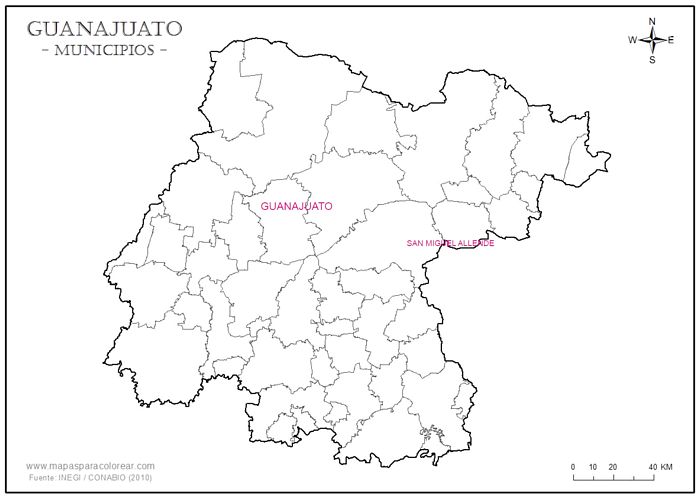
The Sociedad Zamora Hermanos were owners of the Hacienda de San Isidro de las Casas, in San Miguel Allende, Guanajuato. Rutilio Zamora was one of the brothers{footnote}El Popular, 22 March 1906{/footnote}. However, Zamora Hermanos were also a well-known company involved in the construction of railways{footnote}The Mexican Herald, 26 June 1897{/footnote} so we need a complete original token to be able to place them securely.
These are Anillo restrikes. One set had merely a number for the denomination.
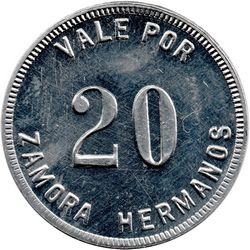
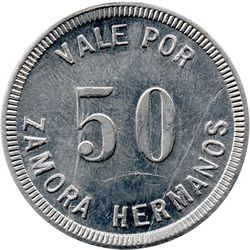
Another set had 'cvs'.
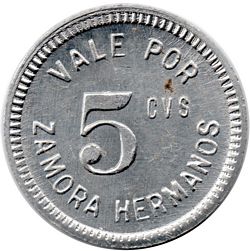
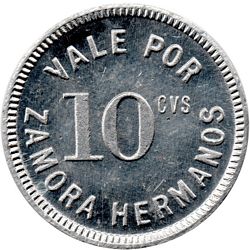
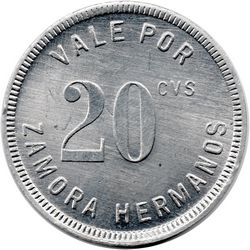
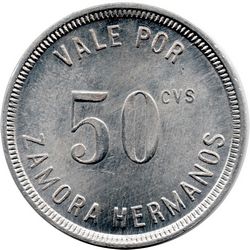
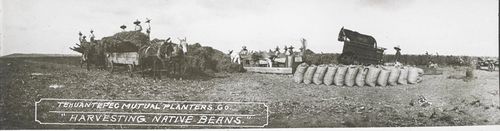
In 1899 El Imparcial{footnote}El Imparcial{/footnote} reported on the formation of a company in Chicago with the object of investing in agriculture in the Tehuantepec isthmus. The Tehuantepec Mutual Planters Company planted bananas, 810 hectares of sugarcane, and 570 hectares of orange trees, the largest orange grove in the country. By 1904, the same company was sending railroad cars loaded with tomatoes directly to the United States.
Its president and general manager was the Chicagoan, Wallace Edward Butler.
Grove 1937
Obverse: TEHUANTEPEC / MUTUAL / PLANTERS / COMPAÑIA
Reverse: SE VALE / 75¢ / EN / MERCENCIAS
25mm. brass
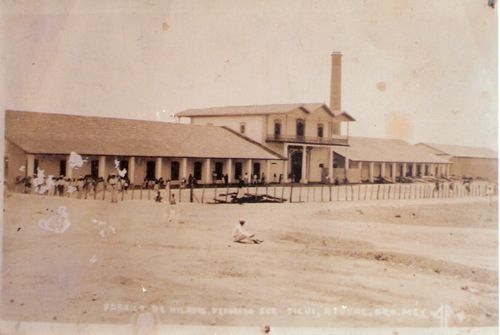
The Progreso del Sur factory at El Ticul
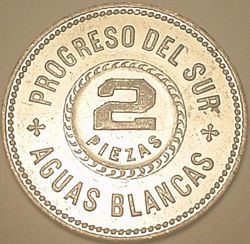
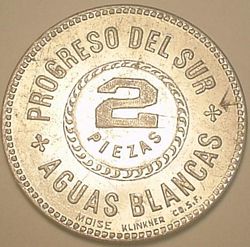
Progreso del Sur" and "Aguas Blancas" were two historic spinning and weaving factories. Progreso del Sur was established by the Fernández family in 1904 in the town of El Ticul, municipality of Atoyac de Álvarez, while Aguas Blancas, also owned by the Fernández family, was located fifty kilometres away in the municipality of Coyuca de Benítez.