Countermarked coins used in Scotland
In the late eighteenth and early nineteeth centuries there was a chronic shortage of British coins. Using Scotland as an example, Adam Smith estimated that the total circulating coins in 1707 was just over one million pounds sterling in value. By 1776, the year of the publication of The Wealth of Nations, his calculations suggested that the gold and silver coin incirculation - in a greatly expanded Scottish economy - might only account for some half a million pounds. The principal reason was that the market price for silver was higher than the Royal Mint was authorised to pay.
Britain needed more silver coin and the answer to this problem lay in the vast number of foreign coins, mostly eight reales, which captured in war or acquired through peaceful commerce, filled the vaults of the Bank of England and were available as a regular commocity on the bullion market. In 1797 Spanish dollars were stamped, by authority of the Bank of England, with the oval punch containing the bust of George III which was used to mark silverware.
A number of private companies, most of them Scottish, also countermarked dollars with their own marks which recycled the foreign coins as British tokens.To avoid the withdrawal and melting of countermarked tokens, their stamped valuation obviously had to be higher than the bullion purchase prices, but not so high as to invite extensive counterfeiting with false punches. Problems for the issuers arose when the dollar market price fluctuated by more than a few pence: a drop would bring on a flood of demands for redemption of the tokens at their marked value, and the subsequent loss to the issuer when he sold the coins back into the bullion market; a significant rise in bullion prices would mean withdrawal by the public, and melting or hoarding of the now more valuable host coins.
In either case, the issuer would not want to reissue redeemed tokens at their original stamped valuation. He would also be loath to sell them back into the bullion market still marked with an inappropriate stamped valuation, since he might have to redeem them a second time, perhaps at another loss. One solution was melting. Another was to deface the valuation by various methods, a grille being the most common. Unfortunately, these cancellations were sometimes done so enthusiastically that the whole countermark became illegible, and several countermarks types are known only by a single, largely undeciphered specimen.
Of the 121 diffferent types of tokens referred to in Harrington Manville's Tokens of the Industrial Revolution Foreign Silver Coins Countermarked for use in Great Britain, c. 1787-1828, 95 are from Scotland, and of the Scottish ones, 58 are from places within a twenty mile radius of Glasgow. Manville gives an historical account of the cities, towns and hamlets which became the places for issuing such countermarked coins, following that with detailed comments on the issuers, and a catalogue of recorded examples.
Three or four issues have a surviving population of 50 or more examples, but at the other extreme more than 70 issues have a surviving population of less than 10 specimens and often only one or two examples. Perhaps another 20 issues are known with a population of 10 to 35 examples. It is clear that the ‘redemption recall’ of these countermarked dollars was very effective for the majority of enterprises and these coins would have been consigned to the melting pot at their current bullion value. In many cases firms ‘cancelled’ their countermarked dollars by applying a grill countermark over the original countermarked value to avoid having to redeem them at a higher price when the value of silver had dropped. Ultimately these pieces would also be melted, but in the first instance they may well have passed back into general circulation at a value agreed by the local population by convention with some link to bullion value.
Some coins are known with further privy marks. It is believed that these were applied as a kind of safeguard or internal control over official issues, to highlight forgeries and copies. For a discussion on these privy marks see Eric C. Hodge, “Secret Marks On Merchant Countermarked Silver Coins” in British Numismatic Journal, vol. 79, 2009.
Adamson & Logan, Glasgow
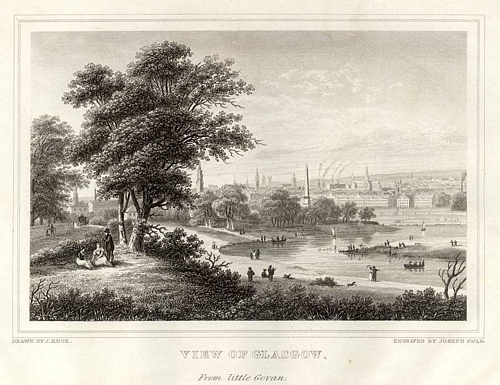
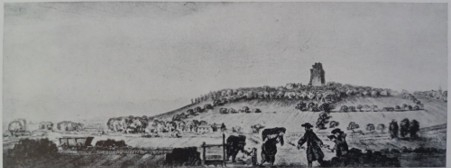
View of Glasgow from Little Govan
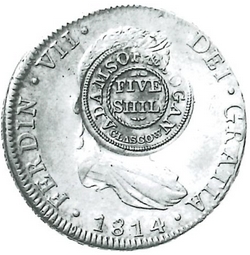
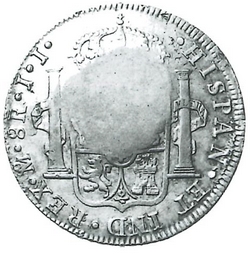
Manville-34 Five / Shil on 6r 1814 Mo JJ
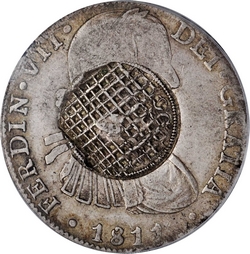
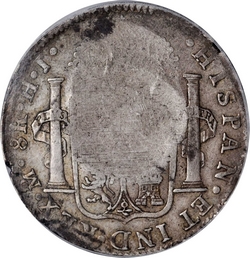
KM-CC37; Manville-34 Five / Shil on 8r 1811 Mo HJ (cancelled) (Stack’s Bowers auction, 16 January 2021, lot 22364)
The firm of Adamson and Logan were a well known early 19th Century manufacturer producing muslin, gingham and pullicate wears (pullicate were checked handkerchiefs of woven coloured yarn). By 1817 the firm was well enough known to be featured in the news report of the August issue of The Scots Magazine.
On the 29th ult. A swindler contrived to carry off a considerable sum from the Glasgow Bank, by using the name of Adamson and Logan, manufacturers; whose proceeds of bills discounted he audaciously called for and received from one of the tellers. The amount was £1,314., but this being a larger sum than the swindler wanted, or was able to utter, he next day returned £900., inclosed in a letter, in which he promised to repay the remainder on his arrival in AmericaScots Magazine, vol. 80, n.s. 1 (1817 ii), 84.
Clearly a successful firm they moved several times to different locations between 1825 and 1847.
The countermark ADAMSON & LOGAN GLASGOW around FIVE SHIL is known on 1796 Mo FM, 1810 Mo HJ, 1812 Mo HJ, 1812 Mo JJ, and 1813 Mo JJ. The countermark on the above coin is deeply applied though the subsequent grill cancelation obliterated most of the design save for a small portion of the outer legend of which the "OG" of "LOGAN" is visible making attribution easy for the trained eye.
Alloa Colliery, Clackmannanshire
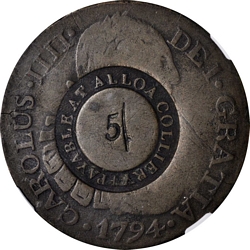
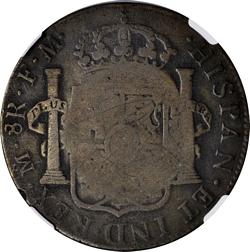
KM-CC1, Manville-5 5/ on counterfeit 8r 1794 Mo FM (Stack’s Bowers auction, 16 January 2021, lot 22363)
Issued by John Francis Erskine and Alexander Bald, proprietor and manager of Alloa colliery.
Nearly all known examples from this proprietor utilized contemporary counterfeit Mexican Dollars, most likely produced in Birmingham, instead of genuine Dollars that were readily available from the silver market. The main purpose that these token coins were issued was so that employers could force their labourers to purchase goods at the company store at exorbitant prices perpetually keeping their employees in debt. Since the Alloa issue is almost entirely made up of False Dollars they would have been virtually worthless anywhere else and would have undoubtedly forced their employees into prolonged servitude.
Until 1775, colliers were serfs in the fullest sense of the word: they were bound to the mine in which they worked, and were sold as part of the working machinery. Even when Parliament acted, the rate of emancipation was slow. Under the 1775 Act colliers under the age of twenty-one were liberated in seven years, those between twenty-one and thirty-five in two years. It was only after another Act had been passed in 1799 that all colliers in Scotland were free, and this was mainly to attract a larger number of workers to the rapidly expanding coal industry.
By 1800 the windlass and horse-gin for raising coal were in use in all the coal-fields except those in the East of Scotland, where the "bearing system", the primitive method of raising coal on the backs of women, was still in use and was continued into the nineteenth century, The "bearers" were, for the most part, the wives and daughters of the colliers, who attended their menfolk in the pit and carried up their coal as it was hewn.
Woman-bearers bringing loads of coal to the surface (from a print dated 1835)
To their lasting credit, the owners and managers in the Clackmannanshire coalfield were enlightened enough to support the Earl of Shaftesbury (then Lord Ashley) in his struggle to secure a better life for the miner and his family. The opposition to the withdrawal of women and girls from the pits came not so much from less progressive colliery owners as from the miners themselves, who regarded the introduction of other forms of carriage and haulage as a blow at their mode of life and an attempt to deprive them of a useful means of increasing their earnings. In 1808, Robert Bald, one of the earliest Scottish mining engineers and the son of Alexander Bald, the Earl of Mar's Colliery manager and superintendent at Alloa, tried to arouse public indignation by describing the conditions of this class of women “whose peculiar situation was but little known to the world” but women continued this kind of work until the passing of the law abolishing female labour underground in 1843John L. Carvel, One Hundred Years In Coal: The History Of The Alloa Coal Company.
John Francis Erskine, the son of John Erskine, the eleventh Earl of Mar, had relied heavily on Alexander Bald to manage colliery affairs, and on the latter’s death in 1823, found himself unable personally to supervise the coal-fields and handed over day-to-day management to trustees, before dying in 1825.
Countermarked Alloa dollars must have been issued after 1797, the date of false Bank of England oval countermark found on two of the coins, and probably well before the mid 1820s.
One counterstamp is known on a genuine 1781 Mo FF, otherwise it is found on counterfeit 1792 Mo FM and counterfeit 1794 Mo FM.
(Robert?) Arthur & Company, Lochwinnoch
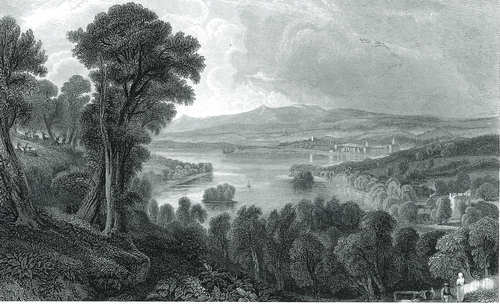
Loch Winnoch with town beyond lake
(from and early 19th century print)
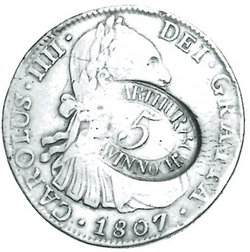
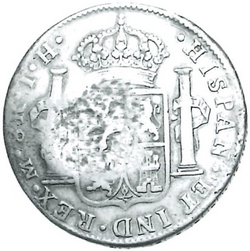
Manville-66 5 on 8r 1807 Mo TH
This is known on 1807 Mo TH
Thomas & Robert Arthur, Glasgow
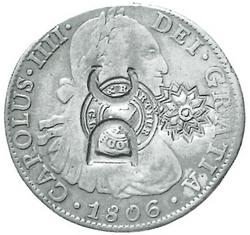
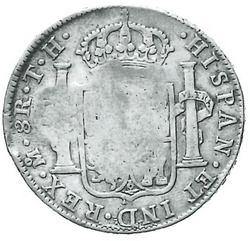
KM-CC38; Manville-35 on 8r 1806 Mo TH overstruck with DC and rosette
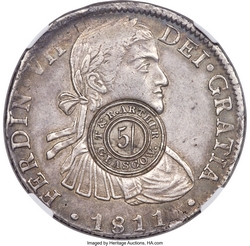
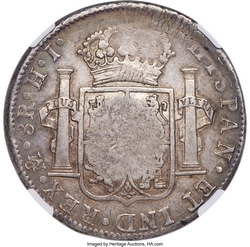
KM-CC38; Manville-35 on 8r 1811 Mo HJ (Heritage Auction 3085, 7 August 2020, lot 31965)
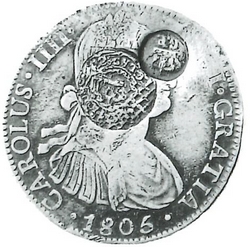
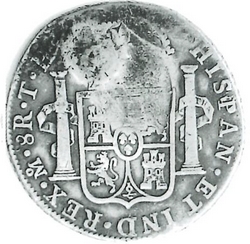
KM-CC38; Manville 35 on 8r 18o5 Mo TH, cancelled with additional Crowned G.P.
In about 1799 Thomas Arthur joined with Robert Arthur (presumably his brother) as manufacturers of muslin. The firm is not listed after 1828.
The countermark T & R. ARTHUR GLASGOW around 5/- is known on 1795 Mo FM, 1804 Mo TH, 1805 Mo Th, 1806 Mo TH, 1810 Mo HJ, 1811 Mo HJ, and 1814 Mo JJ, and, when found, almost universally grill-cancelled. Given the stamped valuation of five shillings, the most likely period of issue is the five-shillings countermarking heyday of mid 1815 to about 1819.
P. Atherton and Company
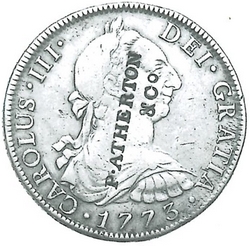
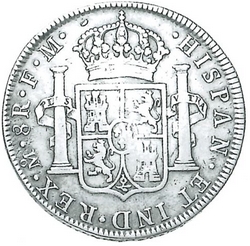
Manville-49 on 8r 1773 Mo FM
The mark of P ATHERTON over & Co in two separate punches vertically across the bust is known on a 1773 Mo FM and a 1786 Mo FM.
Manville tentatively suggest Peter Atherton & Co., a cotton warehouse in Trades Land, an unincorporated part of Glasgow, in 1789.
Ballindalloch Cotton Works
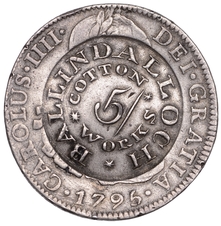
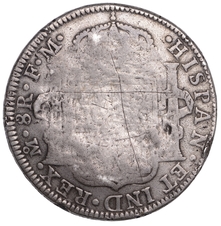
KM-CC7; Manville 6 5/ on 8r 1795 Mo FM (Noonans auction of Eric Hodge Collection, 29 September 2026, lot 6002)
Ballindalloch was acquired in 1800 by James Finlay & Co., Glasgow merchants, who also operated mills at Catrine and Deanston, which, with the addition of Ballindaloch, reportedly gave employment to 25,000 hands. The Finlay Company continued to operate the works until 1844, when it was sold once more.
The five shillings counterstamp is known on 1782 Mo FF, 1792 Mo FM, 1794 Mo FM, 1795 Mo FM, 1796 Mo FM., 1797 Mo FM, and 1977 Mo FM. Judging from the dates of the host coins and the valuation stamped, all of the Ballindalloch silver tokens were probably issued between 1800 and 1810.
W. Bilton, 630 Argyle Street, Glasgow
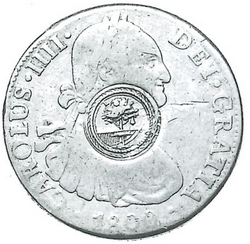
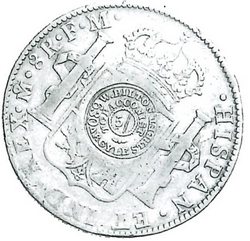
Manville-36 5/ on 8r 1800 Mo FM
A single marked token is known. The host is a 1800 Mo FM and the countermark is W. BILTON 620 ARGYLE STREET, around TOBACCONIST, both around 5/ and on the obverse Glasgow arms within a roped circle. This could date to either 1809-1810 or 1826, the last year Bilton was at that address.
CBCo
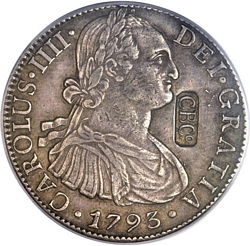
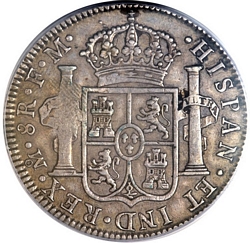
KM-CCA39.2; Manville-50 5 Shilling on 8r 1793 Mo FM (Heritage Auction 3030, 5 January 2014, lot 25056)
The identity of the issuer of this intriguing piece remains unknown. Manville suggests Carrick Brown & Company, the name adopted by the first of the early Glasgow banks, the Ship Bank, in 1789. Carrick, Brown had other interests such as linen printers and muslin manufacturers so a token in their name could have served a dual purpose.
This mark is known on 1793 Mo FM and 1794 Mo FM.
Robert and George Blair, Greenock
Robert and George Blair (presumably brothers, though perhaps father and son) were wine and spirit merchants , located on West Burn Street from at least 1820.
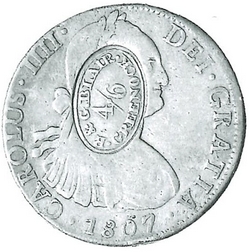
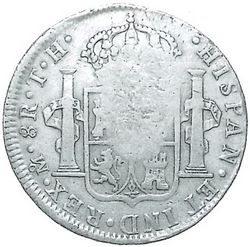
Manville-53 4/6 on 8r 1807 Mo TH
A countermark reading R & G BLAIR GREENOCK in a linear oval around 4/6 is known on four Mexican dollars (1774 Mo, 1806 Mo TH, 1807 Mo TH, and 1818 Mo JJ). This suggests an issue during the early to mid 1820s.
Blantyre Works, Blantyre, Lanarkshire
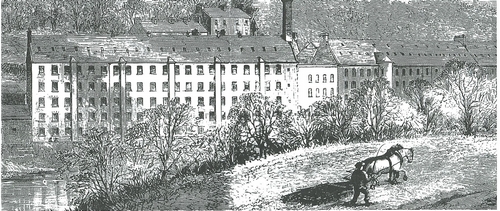
The Blantyre Works (early 19c.)
Illustration provided by Dr. G. G. Brunk, courtesy of Jay Glasby, Sr. Librarian,
Information of Local Studies, Hamilton District Council
The Blantyre Mills were erected by David Dale and James Monteith in 1785: ownership passed to Monteith in 1792 and to Monteith’s brother Henry in 1802. The mill was run as Henry Monteith & Co. from then until at least 1840. Its most illustrious employee was the future explorer David Livingstone who entered the mills at the age of 10 as a piecer and became a spinner when he was 19. It is recorded of him that "he contrived to read in the factory by placing his book on the spinning jenny, so that he could catch sentences as he passed at his work”.
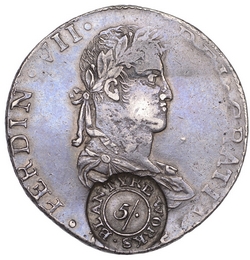
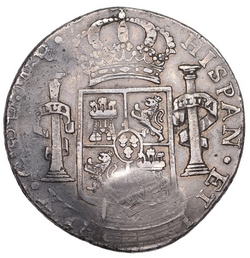
KM-CC11; Manville-11 5/ on 8r 1814 Ga MR (Noonans auction of Eric Hodge Collection, 29 September 2026, lot 6007)
BLANTYRE WORKS in a circle around 5/. is known on 1792 Mo FM, 1804 Mo TH, 1812 Mo JJ, and 1814 Ga MR.
Campbell Hall & Watt
The 1828 directory lists “Campbell, Hall, Watt – Wholesale & retail grocers, 21 Houston Square, referring to Stirling Campbell, James Hall and Robert Watt, but the partnership did not last long. So the most likely date for a joint issue would have been about 1826 to 1828 – towards the very end of the tradesmen’s countermarking period.
A heavily cancelled CAMPBELL HALL & WATT in a denticled circle around JOHNSTONE above 4/6 within a roped circle is known on 1817 Mo JJ.
Catrine Cotton Works, Catrine, Ayrshire
The Catrine Cotton Works was set up by Claud Alexander of Ballochmyle, the landowner, and Glasgow merchant David Dale in 1787. Various mills and works were built over the next few years powered by water from the River Ayr. Workers were housed in a purpose built village, similar to Dale’s development at New Lanark where conditions were unusually good for the period. The mills had gas lighting installed in 1814, four years before gas appeared on the streets of either Glasgow or London.
These coins form a complex series, stamped at various different rates, using several different shapes and each stamp is individually numbered - the only example of this in the entire countermarked issue. The date of the host coins do suggest a general order of issue for the different denominations. All host coins but one are of the Mexico City mint, and were issued between 1782 and 1807. The 4/9 denomination pieces including the overstruck 5/6, were minted before 1801; with two exceptions, the host coins of the other denominations were minted in 1800 and later, This places the 4/9 at the beginning of the Catrine series, probably circa 1800, presumably followed by 5/6 punched over 4/9. When the price of dollars dropped, a 5/3 oval denomination was evidently prepared, and when the price remained low that denomination was changed to 5/. on the punch. During 1813, the dollar price briefly rose above six shillings, and the 6/6 denomination was evidently issued to reflect this occurrence. One specimen of the 5/ round issue is punched over a 6/6, and this would place it as the last type in the Catrine series.
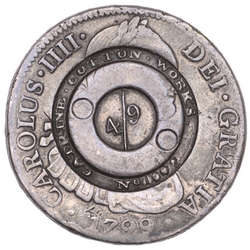
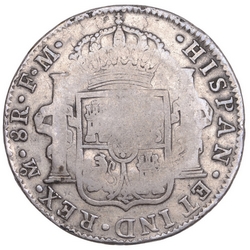
KM-CC17; Manville-18 4/9 on 8r 1799 Mo FM (Noonans auction of Eric Hodge Collection, 29 September 2026, lot 6012)
The Four Shillings and Ninepence – large circle known on 1785 Mo FM, 1791 Mo FM, 1792 Mo FF, 1793 Mo FM, 1796 Mo FM, 1797 Mo FM, 1798 Mo FM, 1799 Mo FM.
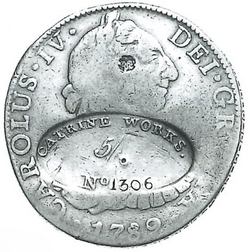
Manville-16 5/. on 8r 1789 Mo
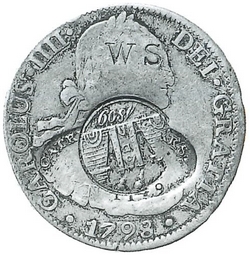
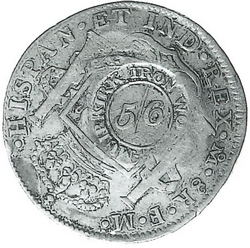
Manville 16 5 on 8r 1798 Mo FM (overstamped with Muirkirk Iron Works)
The Five Shillings – oval (erased 3) known on 1789 Mo FM, 1798 Mo FM, 1800 Mo FM, and 1805 Mo TH.
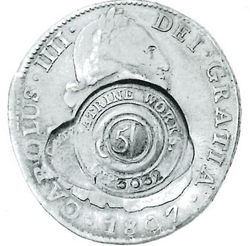
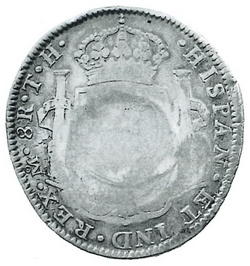
Manville-17 5/ on 8r 1807 Mo TH
The Five Shillings - round known on 1807, Mo TH, 1809 Mo HJ
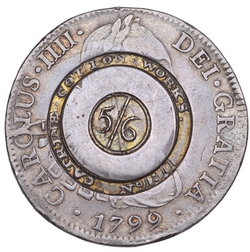
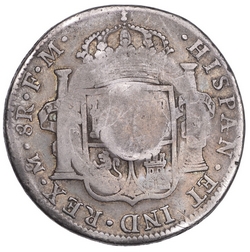
KM-CC14; Manville-14 5/6 (struck over 4/9) on 8r 1799 Mo FM (Noonans auction of Eric Hodge Collection, 29 September 2026, lot 6011)
The Five Shillings and Sixpence – large circle , 5/6 over 4/9 known on 1782 Mo FF, 1794, Mo FM, 1799 Mo FM, 1800 Mo FM.
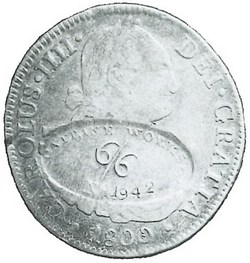
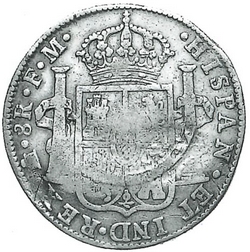
Manville-13 6/6 on 8r 1800 Mo FM
The Six Shillings and Sixpence – oval known on 1800 Mo FM, 1807 Mo TH
For a discussion on the privy marks see Eric C. Hodge, “Secret Marks On Merchant Countermarked Silver Coins” in British Numismatic Journal, vol. 79, 2009.
D. Campbell and Company(?)
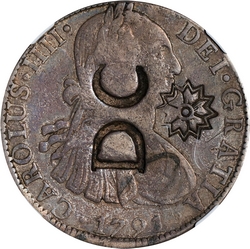
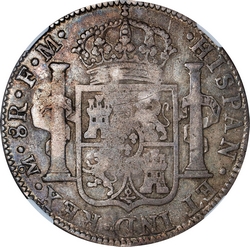
KM-CC40; Manville-51 6 Shillings on 8r 1791 Mo FM (Stack’s Bowers NYINC Auction, 13 January 2024, lot 53303)
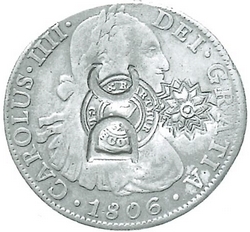
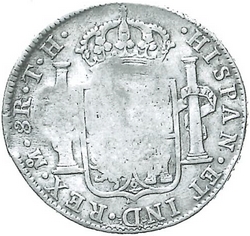
Manville-51 6 Shillings on 8r 1806 Mo TH, struck over T & R Arthur
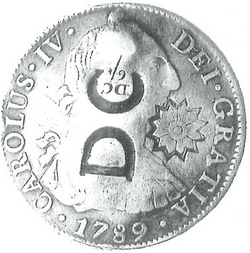
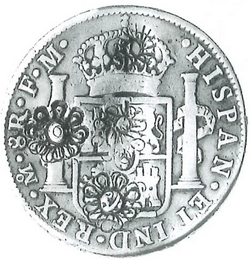
Manville-51 6 Shillings on 8r 1789 Mo FM, four rosettes on reverse, engraved DC 6/- within C
"DC" with six-leaved (twelve-pointed) rosette.
To Stack’s Bowers the most reasonable attribution of DC was posed by Walter AllenWalter Allen, Spink Coin Auctions No. 34, 14 March 1984, who suggested "D. Campbell & Company" as the issuers, manufacturers of inkle (inkle is the thread or yarn used for a type of linen tape or braid). It appears there were two possibly successive issuers for these countermarks, first Dale Campbell who was active from as early as 1789 to about 1806 at various addresses. The second was Dick Campbell who was active from about 1809 to at about 1828 with the same address until at least that time.
This counterstamp is known on 1776 Mo FM, 1789 Mo FM, 1791 Mo FM, 1792 Mo FM, 1798 Mo FM, 1800 Mo FM, 1802 Mo FT or TH, 1803 Mo FT, 1804 Mo TH, 1805 Mo TH, 1806 Mo TH, and 1808 Mo TH.
Concer(?), Paisley
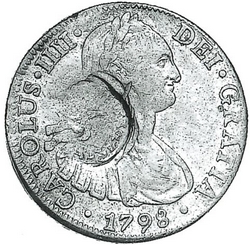
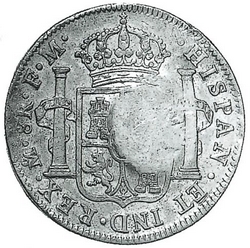
Manville-85 5/ on 8r 1798 Mo FM
The only written record of a countermark supposed reading CORCER PAISLEY around 5/, on a 1798 Mo FM, occurs in Julius Meili’s article on countermarks in Sphink’s 1897 Numismatic Circular and his book published the same yearJulius Meili, Englische Stempel auf Spanischen Thalern und auf anderen Aehnlichen Muenzen, Sphink’s Numismatic Circular 1897, cols 2372-2376.
Robert Crighton, Port Glasgow, Renfrewshire
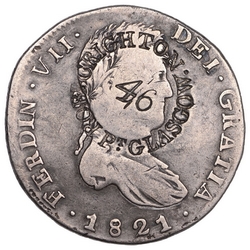
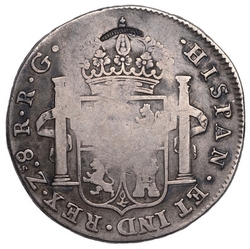
KM-CC89 ; Manville-87 4/6 on 8r 1821 Zs RG (Noonans auction of Eric Hodge Collection, 29 September 2026, lot 6072)
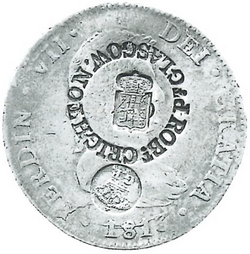
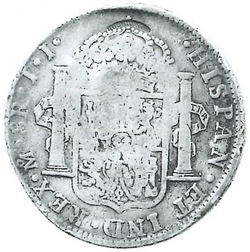
KM-CC89 ; Manville-87 on 8r 1813 Mo JJ, with Crowned Portuguese arms over 4/6. additional Crowned G.P.
Robert Crighton ran a general grocers and wine- and spirit-merchants on King Street and Lyons Lane between c. 1820 and 1835.
This countermark is known on 1803 Mo FT, 1807 Mo TH, 1813 Mo JJ, 1817 Mo JJ and 1821 Zs RG. All have the additional short, curved rope-like mark punched on the upper reverse, presumably as a semi-concealed privy mark.
Culcreuch Mill, Fintry
Fintry is five miles east of Balfron and about 17 or 18 miles due north of Glasgow. In 1795-6 Peter Spiers, a Glasgow merchant, founded the Culcreuch Cotton Mill. After the new cotton mill and new Fintry village were established, there were at least three issues of countermarked dollars, by the cotton mill itself and by two merchants – Robert McNee and John Stewart.
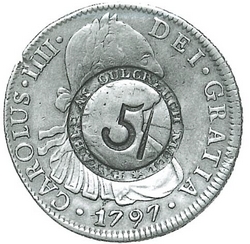
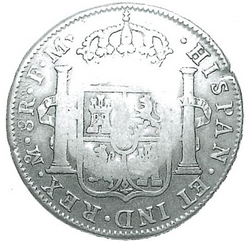
Manville-30a 5/ on 8r 1797 Mo FM
Five Shillings -Culcreuch Mill known on 1796 Mo FM, 1797 Mo FM, 1812 Mo JJ
Five Shillings -Culcreuch Mill smaller 5 known on 1792 Mo FM
Deanston, Perthshire
Deanston is 23 miles northeast of Glasgow. In 1785 John Buchanan of Carston, in partnership with his three brothers, established the Deanston Cotton Mill, also known as the Adelphi Cotton Works. The youngest brother, Archibald, then an apprentice to Sir Richard Arkwright at Cromford, was called to Deanston as resident manager (He later held the same position at the Ballindalloch Cotton Works at Balfron in 1798, and at the Catrine Mills from about 1801). However, the mills were not very productive and were sold in 1794. Finally, in 1807-8 the mill was acquired by Kirkman Findlay, of the firm of James Findlay & Company
The Deanston/Adelphi series of countermarked coins is complex.
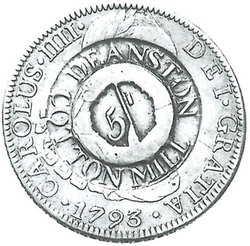
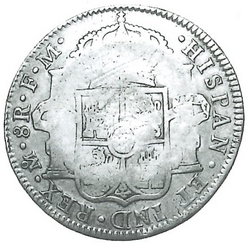
Manville-21 5/ on 8r 1793 Mo FM
Five Shillings DEANSTON COTTON MILL is known on pillar 1771 Mo MF. 1793 Mo FM, and 1795 Mo FM.
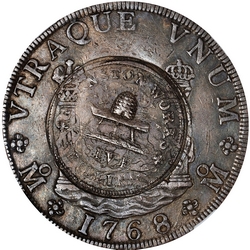
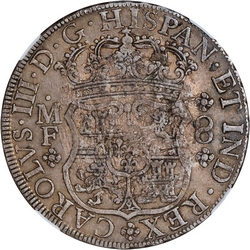
KM- ; Manville-X22 5 Shillings on 8r 1768 Mo MF (Stack’s Bowers NYINC Auction, 13 January 2024, lot 53305)
Five Shillings DEANSTON WORKS with beehive is known on pillar 1768 Mo ME, 1773 Mo FM, and 1799 Mo FM.
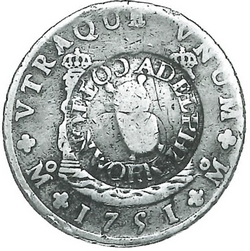
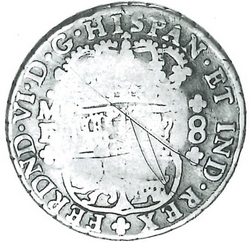
Manville-23 on 8r 1751 Mo MF
ADELPHI COTTON WORK without a denomination is known on pillar 1751 Mo MF This has a beehive on stand, legend around within solid border.
It is interesting to note that according to Manville this issue did not appear on the market until sometime during the 1930s. Supposedly, the die was found in a desk drawer some 100 years after the fact, but shows no signs of age or degradation. In fact, aside from the three known examples on colonial Mexican hosts, most others are on base metal blanks. Though the origins of this issue are unknown, it is still an interesting aspect of the Scottish countermark series.
J. Faulds. & Co., Beith
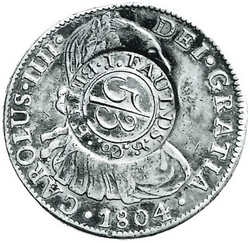
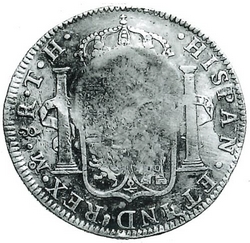
KM-CC10; Manville-10 5/3 on 8r 1804 Mo TH
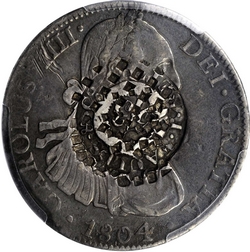
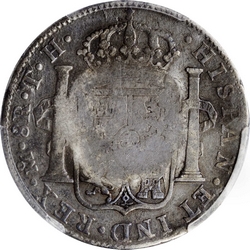
KM-CC10; cf.Manville-10 5/3 on 8r 1804 Mo TH (cancelled) (Stack’s Bowers NYINC auction, 18 January 2020, lot 21089)
According to Manville there were four generations of James Faulds in Beith around the time of the Industrial Revolution and of the four only two are possible candidates for issuing tokens. One was a grocer or other merchant active between 1807-19 and the other a manufacturer who was active between 1816-34.
Manville knew of just one specimen. J FAULDS & Co. BEITH around 5/3, on 1804 Mo TH but Stack's Bowers offered a cancelled coin in 2020.
J. Fleming Jr., Paisley
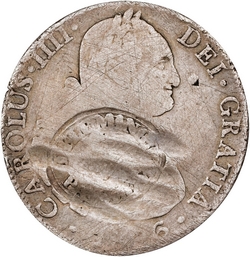
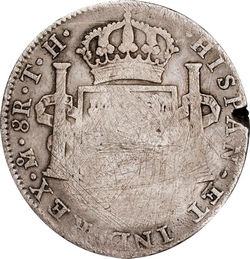
KM-unlisted; Manville-86 5 on 8r 1806 Mo TH (Stack’s Bowers NYINC Auction, 17 January 2026, lot 42200)
Manville listed a heavily cancelled 1809 Mo TH as [J. C. … & Jr?], Paisley. Stack’s Bowers were more certain of the name but unable to locate any solid information pertaining to J Fleming Jr. of Paisley. “Another interesting facet is the denomination of 5 Shillings; there are only a couple of periods where the bullion value for Spanish Dollars was above this rate, so we opted to give a general date range of circa 1802-11 or 1815-19 based off historical bullion charts as compiled by Harry Manville.”
Forster & Corbet, Hutchesontown, Renfrewshire
Forster & Corbet were cloth manufacturers from 1805 until 1821 when the company was dissolved. Hutchesontown is on the south bank of the Clyde, across the river from Glasgow city centre and forms part of the wider Gorbals district.
The 5 shilling denomination suggests a circulation period c. 1815-1819, and certainly no later than 1821.
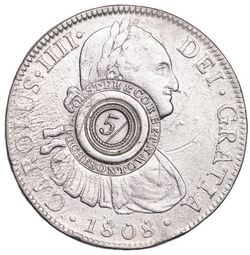
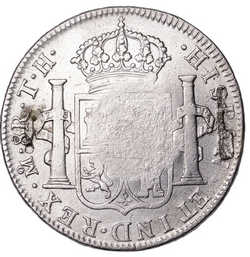
KM-CC64; Manville-37 5/ on 8r 1808 Mo TH (Noonans auction of Eric Hodge Collection, 29 September 2026, lot 6026)
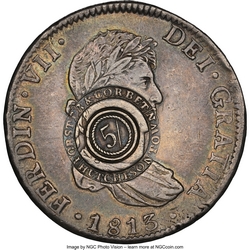
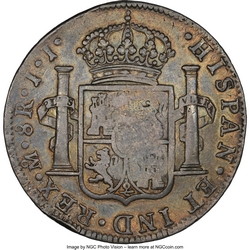
KM-CC64; Manville-37a 5/ on 8r 1813 Mo JJ (Heritage Auction 3107, 5 May 2023, lot 31823)
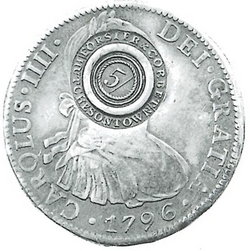
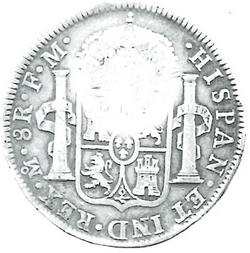
Manville-37b on 8r 1796 Mo FM
Two puncheon dies were used: on the first, the stroke following the 5 of the denomination points to the right of the O and the TC letters in HUTCHESONTOWN touch: on the other, now known from a single specimen, the stroke points to the centre of the O, and the TC letters do not touch. The first is known on 1807 Mo TH, 1809 Mo TH, 1810 Mo HJ, 1811 Mo HJ, 1814 Mo HJ, and 1814 Mo JJ: the second on 1796 Mo FM.
W. G. and Company
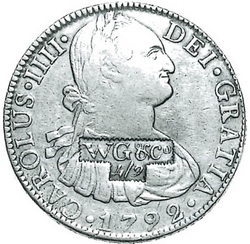
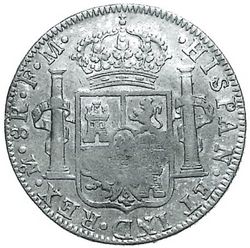
Manville-52 4/9 on 8r 1792 Mo FM
This countermark consists only of WG & Co over 4/9 within a sunken T-shaped frame. The WG initials would fit many Glasgow companies but Manville tentatively suggests William Graham & Company, merchants and cotton goods manufacturers.
It is known on 1789 Mo FM and 1792 Mo FM.
Galston Society
Galston is on the left bank of the river Irvine, some 22 miles from Glasgow.
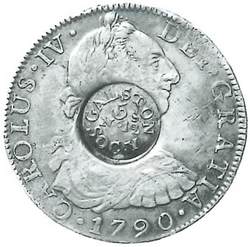
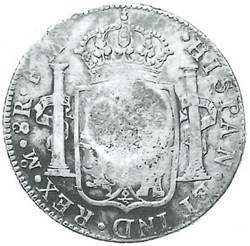
Manville-33 5s on 8r 1790 Mo FM
GALSTON SOC.Y around 5s No 12 is known on 1778 Mo FM, 1781 Mo FM, 1790 Mo FM, 1800 Mo FM, and 1820 Mo JJ. The latest known date on a host coin is 1820, suggesting a possible issue by the Galston New Friendly Society in the early to mid 1820s, when that society is known to have been active.
A. Gibson & Company, Lochwinnoch
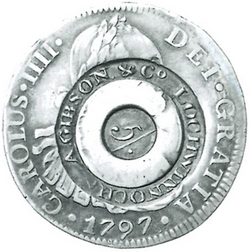
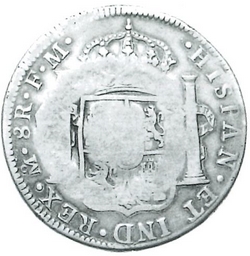
Manville-67 5/. on 8r 1797 Mo FM
Andrew Gibson was the foreman of a silk manufactory in Lochwinnoch by 1781 and from at least 1800 until 1803 he managed Lochwinnoch’s Old Cotton Mill. Beginning in 1804, he is listed as a manufacturer and cotton yarn merchant in Lochwinnoch. He died sometime before April 1817.
A. GIBSON, & Co. LOCHWINNOCH within a circular band around 5/- is known on 1789 Mo FM, 1794 Mo FM, 1795 Mo FM, 1797 Mo FM, 1799 Mo FM and 1800 Mo FM. Given the dates of the host coins and the known dates of Gibson’s career, the tokens were probably issued between 1804 and 1810, when he was manufacturing and selling cotton yarn, perhaps in connection with one of Lochwinnoch’s mills.
Glasgow Bank Company, Glasgow
The Glasgow Bank Company was founded in 1809 by the London banking-house of Ransom, Morland & Co. of Pall Mall. It was situated in Ingram Street and in 1836 was merged with the Ship Bank.
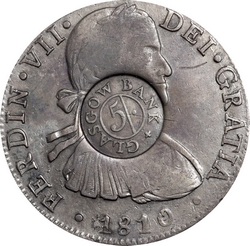
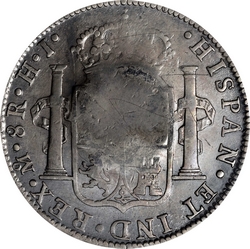
KM-CC44; Manville-X38 5/ on 8r 1810/09 Mo HJ (Stack’s Bowers NYINC , 20 January 2022, lot 8671)
Five Shillings (type 1) known on 1798 Mo FM, 1803 Mo FT, 1805 Mo TH, 1806 Mo TH, 1807 Mo TH, 1808 Mo TH, 1809 Mo TH, 1810 Mo HJ
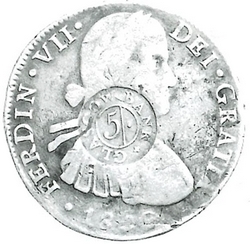
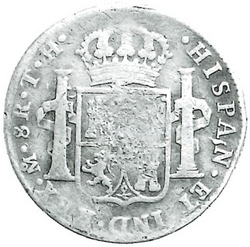
Manville-X38 5/ on 8r 1809 Mo TH
Five Shillings -type 2 (probably a contemporary counterfeit) known on 1809 Mo TH
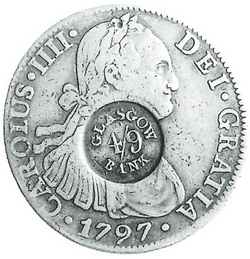
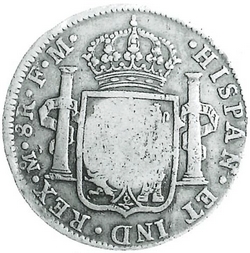
Manville-39 4/9 on 8r 1797 Mo FM
Four Shillings and Ninepence known on 1797 Mo FM, 1800 Mo FM, 1807 Mo TH
According to Manville he was able to document only 17 examples of the genuine countermarks for this issue, but was only able to locate one example of the contemporary counterfeit punch. More recent discussion and research by some of the fields top academic scholars indicate that this particular punch is of more modern manufacture circa 1990 when it first started appearing on the market.
Glas[ ] & Co
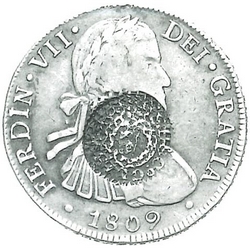
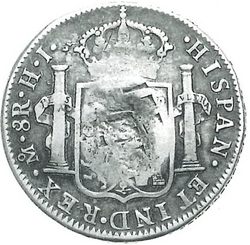
Manville 113 5/. on 8r 1809 Mo HJ (heavily cancelled)
The legend appears to begin with GLAS (likely Glasgow) and may end with E & Co, around 5/.
Greenock Drapers' Society
GREENOCK DRAPER’S SOCIETY within a beaded circle around 4/6 within a triangle and lined field within an inner roped circle, is known on 1802 Mo FT.
Judging by the valuation and the date of the latest host coin, an issue period of about 1808 to 1810, or from the middle of 1815 to about 1819 is likely.
In September 1817 the local newspaper warned:
LOCAL TOKENS - Some of our readers may not be aware, that to issue or to circulate local tokens is illegal, and has been so since the year 1815. In order to put such on their guard we publish the section of the ACT 54th GEO III CAP 4th.Greenock Advertiser, 16 September 1817
but in December 1819 argued:
It has been suggested that, during the present scarcity of silver, it would be highly beneficial again to recur to the practice of STAMPING DOLLARS. This is at present done in PAISLEY, where, in consequence, there are few or no complaints of the scarcity of change. We would also suggest to our country readers that the hoarding up of silver is not quite so safe in these troublesome times, whilst so many bands of desperate ruffians are prowling around the country and breaking into homes for the purpose of plunder.Greenock Advertiser, 31 December 1819
Jamieson & Harvie, Dalry
Dalry is some 25 miles southwest of Glasgow and 16 from Paisley.
The only token reported is on a 1815 Mo JJ, countermarked JAMIESON & HARVIE DALRY around 5. with the initials WTH engraved behind the bust.
This is probably from John Jamieson, a spirit dealer, and William Harvie, a grocer and part-time auctioneer.
John Inglis, Glasgow
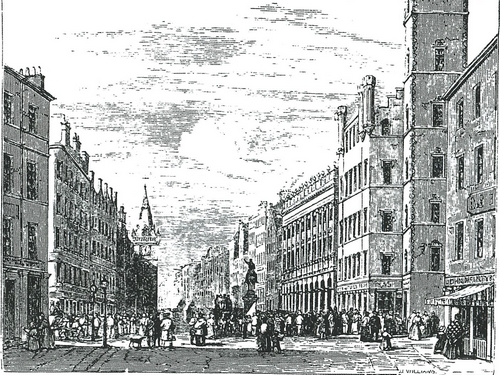
View of the Trongate from the Cross
(from a 19th century print)
John Inglis was a haberdasher, located at the Trongate from 1799 until about 1821.
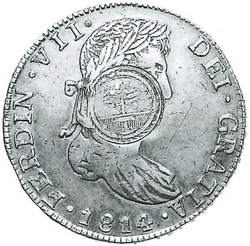
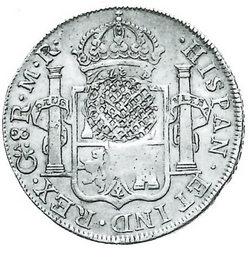
Manville-40 on 8r 1814 Ga MR
A single specimen, on a 1814 Ga MR, reads PAYABLE BY J. INGLIS 32 TRONGATE GLASGOW around 5/ and on the obverse has the Glasgow arms with a roped circle.
Archibald King, Greenock
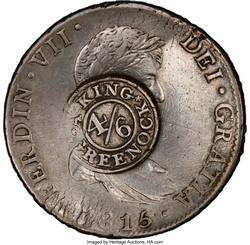
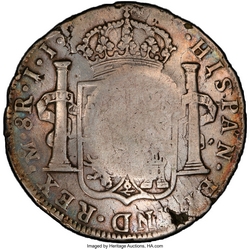
KM-CC56; Manville-55 4/6 on 8r 1815 Mo JJ (Heritage Auction 3083, 27 April 2020, lot 32760)
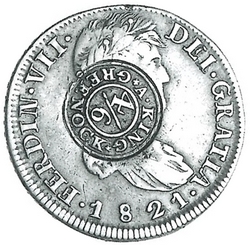
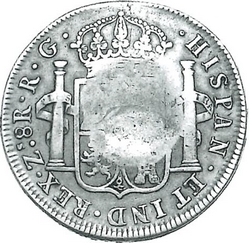
KM-CC56; Manville-55 4/6 on 8r 1821 Zs RG
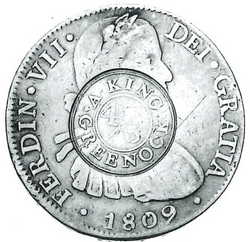
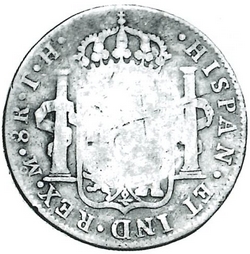
Manville-X55 counterfeit A. King on 8r 1809 Mo TH
The only A. King in the Greenock directories during the 1820s is Archibald King, a tobacconist in Hamilton Street between 1820 and 1831.
This countermark is known on 1804 Mo TH, 1809 Mo TH, 1811 Mo HJ, 1813 Mo JJ, 1817 Zs AG, 1818, Mo JJ, 1821 Zs RG. This suggests an issue during the early to mid 1820s.
Thomas Kirk, Dundee
Manville doubted the authenticity of these pieces, due to the absence of a Thomas Kirk in listings, and the valuation and date of the host coins.
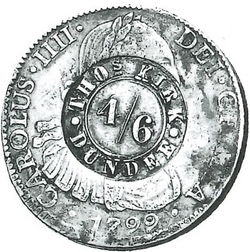
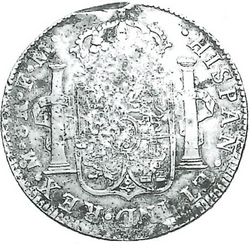
Manville-X29 4/6 on 8r 1799 Mo FM
The Four Shillings and Sixpence countermark is known on 1773 Mo FM, 1799 Mo FM, 1803 Mo FT.
John Lang, Paisley
Several merchants named John Lang are listed as working at Paisley during this period but this is likely to have been issued by a grocer and grain-dealer, based in the High Street. This John Lang died in 1824.
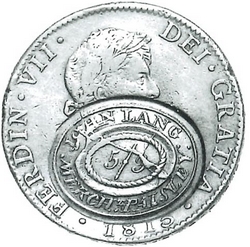
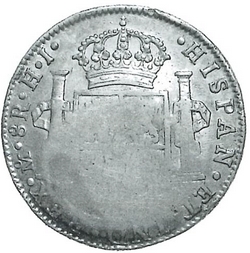
Manville-76 5/3 on 8r 1813 Mo HJ
This countermark, reading JOHN LANG MERCHT PAISLEY in an oval around 5/3 is known on an 1810 or 1811 Mo HJ and 1813 Mo HJ.
W. Langmuir, Paisley
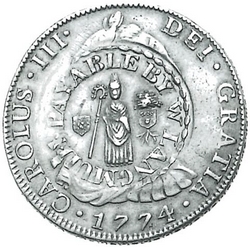
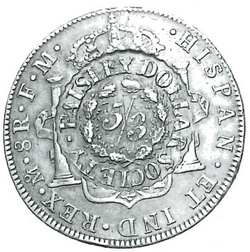
KM-CC83; Manville-77 5/3 on 8r 1774 Mo FM
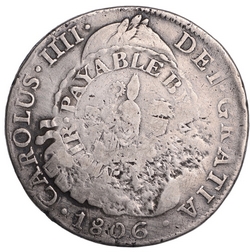
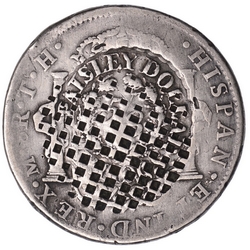
KM-CC83; Manville-77 5/3 on 8r 1806 Mo TH (cancelled) (Noonans auction of Eric Hodge Collection, 29 September 2026, lot 6069)
This was a bifacial countermark with on the obverse the arms of Paisley (a bishop holding his mitre and flanked by two shields), and the legend around "PAYABLE BY W. LANGMUIR.", and on the reverse: 5/3 within a wreath, legend around "PAISLEY DOLLAR SOCIETY".
William Langmuir was described as a miller at Seedhills in 1810; subsequently at Thread Street, Paisley, 1812, as a grain dealer, 1813, as a flour factor, Seedhills, 1816 and as a grain merchant at various addresses from 1820 to 1838. According to Manville the Paisley Dollar Society was not listed in any of the directories or official records that he consulted indicating that this short-lived organization was not around long enough to be recorded.
This countermark is known on on 1774 Mo FM, 1805 Mo TH, 1806 Mo TH, 1807 Mo TH and 1811 Mo HI.
Levern Mill, Barrhead, Renfrewshire
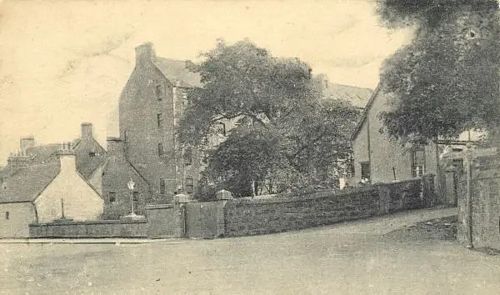
The Levern Mill, Barrhead
In 1780, the second cotton-spinning mill in Scotland was built at Dovecothall, Barrhead, on the banks of the River Levern. Acquired by Stewart Dunlop and Co. in 1794, it was modernised and expanded over the next few years.
Manville wrote that the Levern Mill countermarked tokens in two denominations: five shillings and five shillings and sixpence – the former in two types, one with artfully concealed privy marks on the reverse. The higher denomination has a small, presumably verifying , secondary countermark. The Five Shillings and Sixpence with S-D in a small circle is known on pillar 1794 Mo MF, 1805 Mo TH. 1810 Mo HJ, 1811 Mo HJ: the Five shillings with small letters/wide gap is known on 1797 Mo FM, 1803 Mo FT, and 1804 Mo TH and the Five shillings with large letters/narrow gap reverse privy mark known on Charles III 1789 Mo FM, 1793 Mo FM, and 1801 Mo FM.
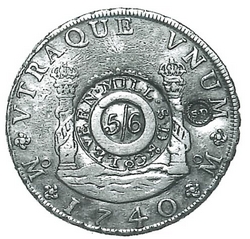
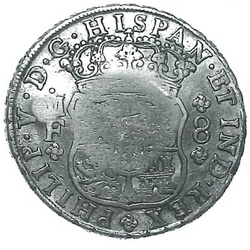
Manville-8 5/6 on 8r 1740 Mo MF
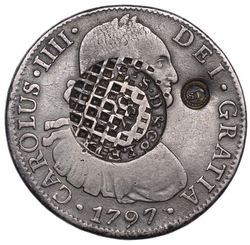
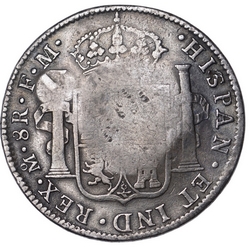
KM-CC73; Manville-8 5/6 on 8r 1797 Mo FM (Noonans auction of Eric Hodge Collection, 29 September 2026, lot 6005)
cancelled with grid pattern, with additional SD countermark at side.
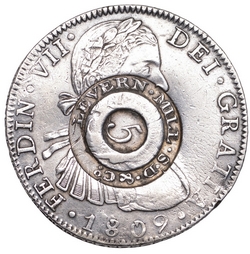
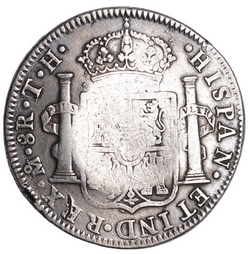
KM-CC74; Manville-9 5/ on 8r 1809 Mo TH (Noonans auction of Eric Hodge Collection, 29 September 2026, lot 6006)
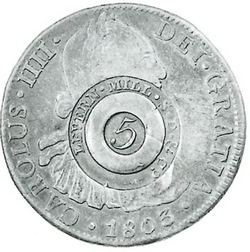
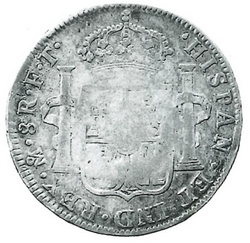
Manville-9a 5 on 8r 1803 Mo TH
However, a 4/9 denomination is also known.
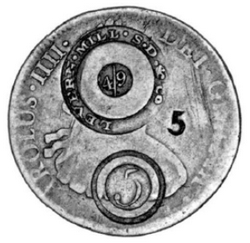
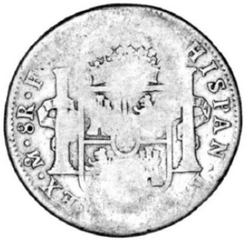
4/9 on 8r ---- Mo FM
For further details on these coins, including differences in countermarks and the order of issue see Eric C. Hodge, “New Value on a Levern Mill Countermarked Dollar” in the British Numismatic Journal, 7 November 2018.
J. Lockhart, Stevenston
Coal mining was the most important industry in Stevenston, near the western coast of Ayrshire.
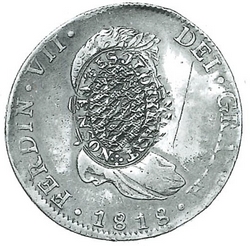
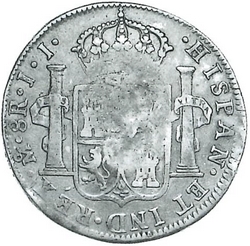
Manville-98 5 Sh on 8r 1818 Mo JJ
The only specimen known of the countermark, J. LOCKHART STEVENSON in an oval band around 5 Sh, is on an 8r 1818 Mo JJ. The token was evidently issued by James Lockhart, a spirit dealer in Stevenston from 1806 to some time before his death in 1835. James’ son, John, was listed as a grocer and innkeeper in 1828, and the token may have been issued jointly between about 1820 and 1825, assuming John and his father co-owned a business during that period.
McFie, Lindsay & Company, Greenock
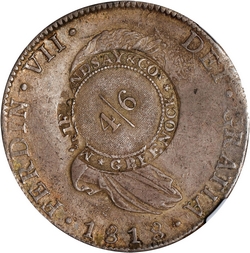
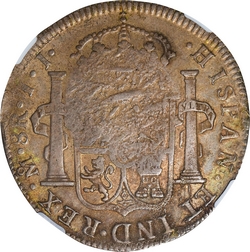
KM-CC58; Manville-57 4/6 on 8r 1818 Mo JJ (Stack’s Bowers NYINC Auction, 13 January 2024, lot 53306)
McFie, Lindsay & Company was active as general grocers from 1815 to 1834. According to Manville, they are noted for having invented and perfected a method of preserving fresh salmon. Based on the known host dates it appears that McFie, Lindsay & Company issued tradesman tokens from around the early 1820s to August 1828 when the company formerly recalled them to be exchanged for current silver.
NOTICE
The subscribers will thank those persons holding the SPANISH DOLLARS issued by them at four shillings and sixpence, to send them in to their place of business as early as convenient to be exchanged, silver being now so plenty that they are no longer required for the convenience of trade.
MACFIE, LINDSAY & Co.
15, William Street,
Greenock, 28th. August, 1828Greenock Advertiser, 29 August 1828.
The countermark is known on 1780 Mo FF, 1791 Mo FM, 1792 Mo FM, 1806 Mo TH, 1808 Mo TH, 1810, Mo HJ, 1811 Mo HJ, 1816, Mo JJ, 1817 Mo JJ, and 1818 Mo JJ.
McGavin & Clarkson, Paisley
McGavin & Clarkson are listed as cotton manufacturers between 1810 and 1814. Because the first directory exclusively for Paisley merchants was published in 1810, the partnership between John McGavin and John Clarkson may well have been formed before that date.
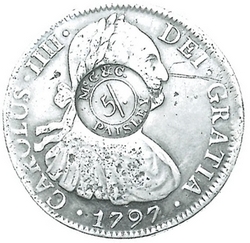
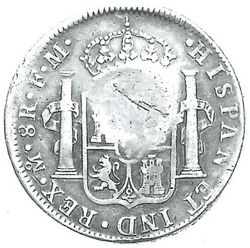
Manville-78 5/. on 8r 1797 Mo FM
This countermark is known on 1783 Mo FF and 1797 Mo FM. Given the tokens’ value of five shillings and the fact that the McGavin & Clarkson firm apparently ceased to exist before 1816, the countermarks were probably issued between 1802 and 1810 when dollars could be obtained in the bullion market for less than five shillings each.
John McKelvie, Glasgow (?)
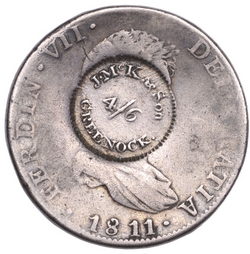
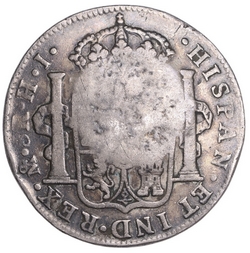
KM-CC57; Manville-58 4/6 on 8r 1811 Mo HJ (Noonans auction of Eric Hodge Collection, 29 September 2026, lot 6049)
While the identity is not certain, these tokens were probably issued by John McKelvie, grocer and spirit dealer of Dalrymple Street and John McKelvie Jr, who was a wholesale grocer and tea dealer in Shaw Street.
This countermark is known on 1804 Mo TH, 1806 Mo TH, 1811 Mo HJ, 1813 Mo PJ, 1814 Mo JJ, 1817 Mo JJ, 1821 Mo JJ, 1821 Ga FS, 1821 Zs RG, 1822 Mo JM, and 1822 Go JM. At least some of the countermarked tokens must have been issued by 1825, when two were found on the body of a man drowned off Greenock, and Manville suggests an issuing period from perhaps early in the 1820s until at least 1827 or 1828.
John & Robert McKerrell, Paisley
This firm made its first appearance in a Paisley directory in 1813 and by 1820 had ceased to exist.
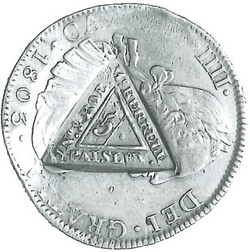
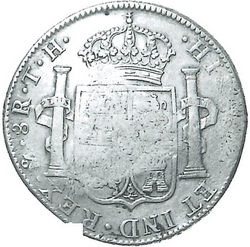
Manville-79 5/. on 8r 1803 Mo TH
JNO & ROBT MCKERRELL PAISLEY in a triangle around 5/. is recorded on a 1803 Mo TH, possibly issued between mid-1815 and perhaps 1819.
Dugald McLachlan, Tobermory, Argyllshire
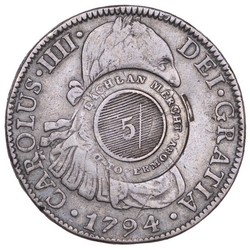
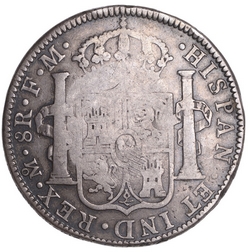
KM-CC102; Manville-99 5/ on 8r 1794 Mo FM (Noonans auction of Eric Hodge Collection, 29 September 2026, lot 6087)
Dugald McLachlan is listed in local directories as a wine and spirit dealer at various addresses in Tobermory in the 1820s.
This counterstamp is known on 1794 Mo FM, 1796. Mo FM, and counterfeit 1810 Mo HJ.
J. McLean, Paisley
There were several merchants or manufacturers named John or James McLean in early nineteenth-century Paisley but the only one on Cotton Street during the relevant period was John McLean, grocer, tea and spirit dealer, who was listed at 6 Cotton Street between 1812 and 1820.
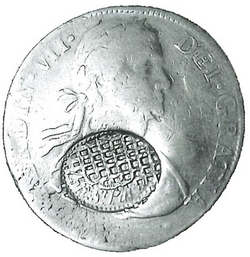
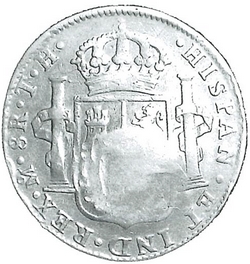
Manville-81 on 8r Mo TH
J. M. MCLEAN Cott: St Paisley around 5/3. is known on a (1808-1810) Mo TH. The date of the host coins, valuation of five shillings and threepence and known dates of the grocer’s address all suggest a short-lived issue between June 1814 and early March 1815 or possibly after June 1815.
McLean & Dobie, Paisley
McLean & Dobie were tobacconists and candlemakers at 100 High Street, Paisley from at least 1820 and perhaps a few years earlier.
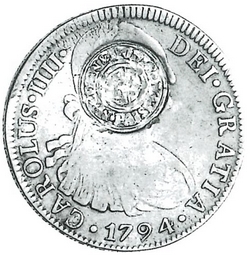
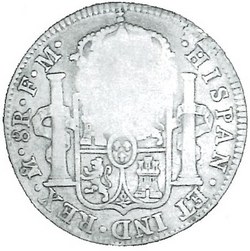
Manville-80 5/ on 8r 1994 Mo FM
The only known specimen, a 1794 Mo FM reading MCLEAN & DOBIE PAISLEY around 5/, was probably issued after mid-1815, when dollars were obtainable on the bullion market for less than five shillings each.
Robert McNee, Fintry
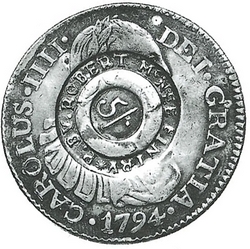
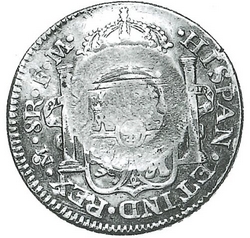
Manville-31 5/ on counterfeit 8r 1994 Mo FM
Five Shillings – Robert McNee known on counterfeit 1794 Mo FM
John Morris, Paisley
This is probably a thread manufacturer.
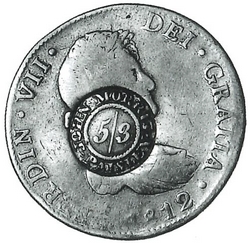
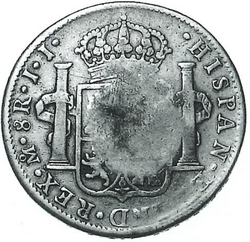
Manville-82 5/3 on 8r 1812 Mo JJ
JOHN MORRIS PAISLEY around 5/3 is known on 1806 Mo, 1808 Mo TH, and 1812 Mo JJ. Again all factors suggest a short-lived issue between June 1814 and early March 1815 or possibly after June 1815.
James and Andrew Muir, Greenock
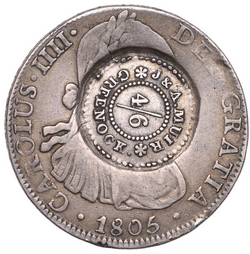
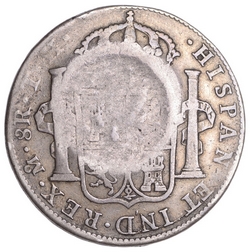
KM-CC59; Manville-59 4/6 on 8r 1805 Mo TH (Noonans auction of Eric Hodge Collection, 29 September 2026, lot 6050)
James and Andrew Muir, haberdashers and straw hat manufacturers, of William Street, Greenock, established their business in 1808, then expanded their commercial interests during the first half of the nineteenth century to become one of the finest known firms in Greenock.
The countermark is known on 1776 Mo FM, 1786 Mo FM, 1799 Mo FM, 1807 Mo TH, 1808 Mo TH, 1810 Mo HJ, 1812 Mo JJ, 1815 Mo JJ, 1816 Mo JJ, 1817 Mo JJ, 1821 Mo JJ, and 1821 Zs RG. The 1821 coins establish an issue date in the early 1820s, probably about 1822.
J. Muir, Paisley, Renfrewshire
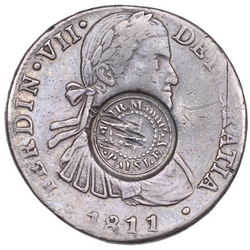
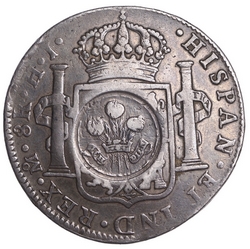
KM-CC87, Manville-83 5/ on 8r 1811 Mo HJ (cancelled with horizontal cuts) (Noonans auction of Eric Hodge Collection, 29 September 2026, lot 6071)
This coin has on the reverse a countermark with the Prince of Wales’ feathers, and ICH DIEN on a scroll.
There are five or six J. Muirs listed as manufacturers in early nineteenth-century Paisley but Manville preferred John Muir, manufacturer of shawls and plaids.
The countermark is known on 1796 Mo FM, 1797 Mo FM, 1798 Mo FM, 1804 Mo TH, 1810 Mo MJ, 1811 Mo HJ, and 1812 Mo HJ suggesting a large issue and, because of the number of tokens cancelled by various methods, an issue cancelled by redemption at different periods.
Muirkirk Iron Works
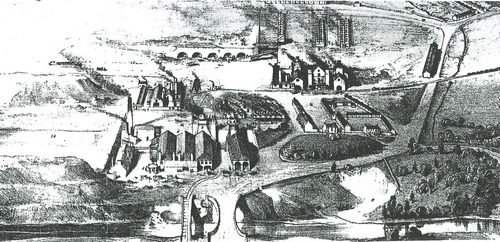
Sketch of Muirkirk Ironworks c. 1840
Muirkirk is thirty miles south of Glasgow. The Muirkirk Iron Works were fully operational by the mid 1790s with three large blast furnace for making pig-iron, a forge for bar-iron, a foundry, and workshop buildings.
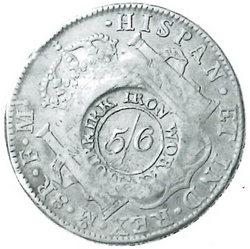
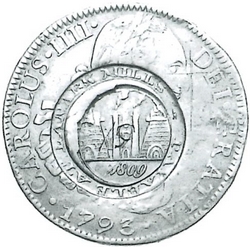
Manville-68 5/6 on 8r 1793 Mo FM (reverse over New Lanark)
The counterstamp has MUIRKIRK IRON WORKS around 5/6 on one side and on the other a forge or foundry with two smoking chimneys between two blast furnaces with 1809 in exegue. It is known on 1793 Mo FM, 1798 Mo FM, 1800 Mo FM, 1801 Mo FT, and 1803 Mo FT. Five of the six specimens are punched over a previous tradesman’s countermark.
New Lanark Mills, Lanarkshire
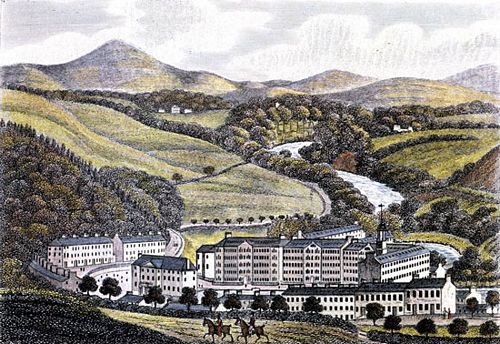
New Lanark Mills (watercolour by John Winning, circa 1818)
The New Lanark cotton mills were founded in 1786 by David Dale in a brief partnership with Richard Arkwright. The mills used the recently developed water-powered cotton spinning machinery invented by Richard Arkwright. Dale sold the mills, lands and village in the early 19th century for £60,000, payable over 20 years, to a partnership that included his son-in-law Robert Owen. Owen, who became mill manager in 1800, was an industrialist who carried on his father-in-law's philanthropic approach to industrial working and who subsequently became an influential social reformer. New Lanark, with its social and welfare programmes, epitomised his Utopian socialism.
In Owen's time some 2,500 people lived at New Lanark, many from the poorhouses of Glasgow and Edinburgh. Although not the grimmest of mills by far, Owen found the conditions unsatisfactory and resolved to improve the workers' lot. He paid particular attention to the needs of the 500 or so children living in the village and working at the mills, and opened the first infants' school in Britain in 1817, although the previous year he had completed the Institute for the Formation of Character.
The mills thrived commercially, but Owen's partners were unhappy at the extra expense incurred by his welfare programmes. Unwilling to allow the mills to revert to the old ways of operating, Owen bought out his partners. In 1813 the Board forced an auction, hoping to obtain the town and mills at a low price but Owen and a new board (including the philanthropist William Allen and the economist Jeremy Bentham) that was sympathetic to his reforming ideas won out.
New Lanark became celebrated throughout Europe, with many statesmen, reformers and royalty visiting the mills. They were astonished to find a clean, healthy industrial environment with a content, vibrant workforce and a prosperous, viable business venture all rolled into one. Owen's philosophy was contrary to contemporary thinking, but he was able to demonstrate that it was not necessary for an industrial enterprise to treat its workers badly to be profitable. Owen was able to show visitors the village's excellent housing and amenities, and the accounts showing the profitability of the mills.
In 1825, control of New Lanark passed to the Walker family when Owen left Britain to start settlement of New Harmony in the US.
The sequence of issues appears to have been 4/6 with star stop, 4/6 with lozenge stop, 4/9, and finally 5/.
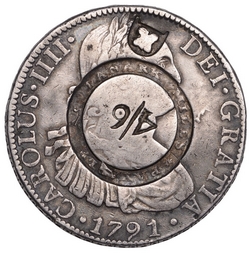
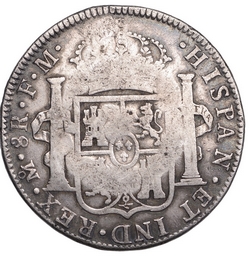
KM-CC68; Manville-72 4/6 on 8r 1791 Mo FM (Noonans auction of Eric Hodge Collection, 29 September 2026, lot 6065)
Four Shillings and Sixpence – star stop, shield and quatrefoil known on 1788 Mo FM, 1791 Mo FM, 1792 Mo FM
Four Shillings and Sixpence – lozenge stop, shield and quatrefoil known on 1793 Mo FM,
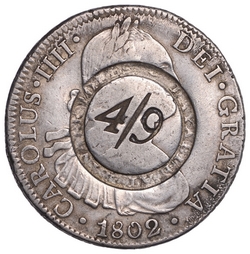
KM-CC67; Manville-71 4/9 on 8r 1802 Mo FT (Noonans auction of Eric Hodge Collection, 29 September 2026, lot 6064)
Four Shillings and Ninepence – lozenge stop on 1787 Mo FM. 1792 Mo FM, 1793 Mo FM, 1794 Mo FM, 1796 Mo FM, 1797 Mo FM, 1798 Mo FM, 1800 Mo FM, 1801 Mo FM, 1802 Mo FT, 1803 Mo FT
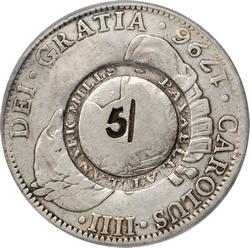
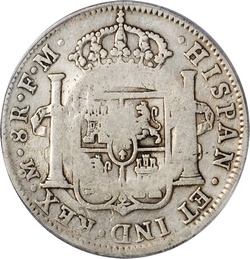
KM-CC66; Manville-69 5/- on 8r 1796 Mo FM (Stack’s Bowers auction, 6 August 2020, lot 21574)
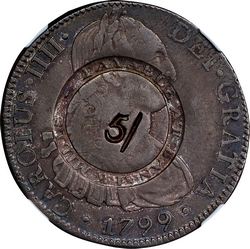
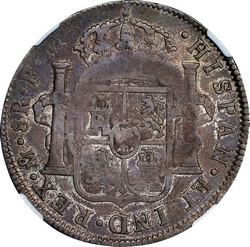
KM-CC66; Manville-69 5/- on 8r 1799 Mo FM
Five Shillings – lozenge stop on 1777 Mo FM or FF, 1783 Mo FF, 1788 Mo FM, 1791 Mo FM, 1792 Mo FM, 1793 Mo FM, 1794 Mo FM, 1795 Mo FM, 1796 Mo FM, 1797 Mo FM, 1798 Mo FM, 1799 Mo FM, 1880 Mo FM, 1801 Mo FT, 1802 Mo FT, 1803 Mo FT, 1804 Mo TH, 1805 Mo TH, 1806 Mo TH, 1807 Mo TH, 1808 Mo TH, 1809 Mo TH, 1813 Mo HJ or JJ, 1818 Mo JJ, 1819 Mo JJ,
According to Manville the Five Shillings denomination was issued in two periods. The first was issued prior to 1811 while the second period was between 1815-20. Manville also states that due to degradation the ring punch must have been employed for an extended period. The Stack's Bower piece illustrated exhibits signs of die deterioration in the form of cracks and chipping which indicates later use and was why it was attributed to the later period of issue.
Five Shillings – lozenge stop LANAK (false counterfeit) on 1818 Mo JJ
Robert Peacock & Sons, Paisley
Robert Peacock first appears in Paisley directories of 1810 to 1813 as Robert Peacock or Robert Peacock & Sons, manufacturers, Abbey Street. The last entry was in 1820 and about that time the firm apparently went out of business.
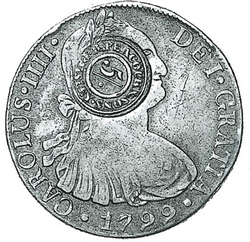
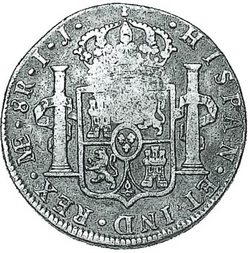
Manville-84 5/- on 8r 1977 Mo JJ
The countermark R. PEACOCK & SONS PAISLEY around 5/- is known on 1801 Mo FT and 1810 Mo HJ. The directory listings, dates of the host coins and the five-shillings denomination indicate an issue from mid-1815 to about 1819, when the value of Spanish dollars on the bullion market was somewhat less than five shillings.
Henry Reid, Carlton
The Henry Reid who issued these tokens is probably the same individual who issued copper farthing tokens bearing the legend Henry Reid Barrowfield Road Calton / Teas, Spirits Wines & Groceries. These farthing tokens, one of which is dated 1815, also show a pair of scales, an appropriate symbol for a grocer.
HENRY REID CARLTON around 5/ known on 1806 Mo TH and 1810 Mo HJ
John Rodger junior, Greenock
In an 1820 directory John Rodger junior is listed at William Street, Greenock, under linen and woollen drapers.
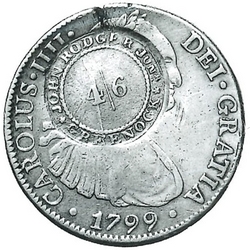
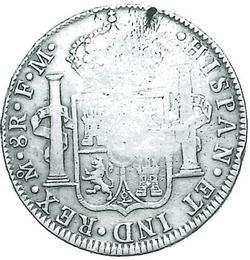
Manville-60 4/6 on 8r 1999 Mo FM
JOHN RODGER JUNR GREENOCK around 4/6 is known on 1792 Mo FM, 1799 Mo FM, 1810 Mo HJ, 1812 Mo JJ, 1816 Mo JJ, 1818 Mo JJ. So probably an issue in the early to mid 1820s.
Rothsay Cotton Works, Isle of Bute
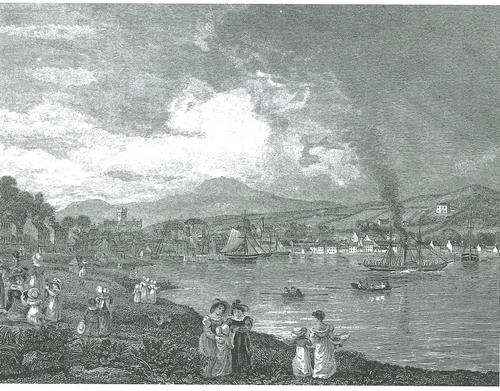
Rothsay in the 1830s
In 1778 an English engineer, James Kenyon of Sheffield, located in Scotland to evade Richard Arkwright’s patent rights for the water frame. To add insult to injury, Kenyon hired away some of Arkwright’s workmen to come north with him and help prepare the buildings, water supply, and ,above all, machinery necessary for a large cotton spinning factory to be erected above the town of Rothesay. When the new mill opened in 1779, it was two storeys high and provided accommodation for 1,000 spindles.
In 1785 the mill was acquired by David Dale, proprietor of the Lanark Mills, who greatly enlarged it before placing it on the market five years later. By 1815 the mills were in the hands of the Glaswegians William Kelly and Robert Thom. Kelly had been David Dale’s manager at New Lanark, and carried Lanark-style labour relations to Rothesay, building workers’ houses, and paying in tokens.
Rothsay Mills countermarked tokens are among the most varied and complex. They include the only cut dollars from Britain, multiple varieties and punches for the same denomination, one denomination punched over another, additional punch marks and a hidden privy mark.
During Joseph Bonaparte usurpation(1808-1813), coins for countermarking were evidently imported directly from the New World (or were captured from Spanish ships) and included crudely designed and struck dollars from provincial Mexican mints, such as Chihuahua, Nueva Vizcaya (Durango) and Zacatecas. Thus the Chiuhuahua coin illustrated below has additional countermarks T and pomegranate between crowned pillars on obverse (A temporary mint was established at Chihuahua mint by a decree of 8 October 1810 and between 1810 and 1813, 8 reales were cast using Mexico City coins as patterns and obliterating/changing the mint mark and assayer initials. Struck coins were issued between 1813 and 1822. Two countermarks were placed on the obverse, on the left a T designating receipt by the Royal Treasurer and on the right crowned pillars of Hercules with pomegranate beneath the comptroller’s symbol of the Royal Hacienda.)
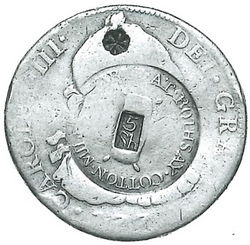
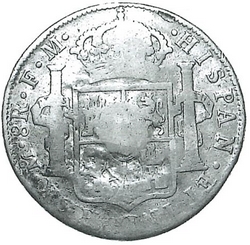
Manville-91a 5 Sh on 8r 177[7/] Mo FM
Five Shillings in rectangle with star – stops in legend on 177[7?] Mo FM
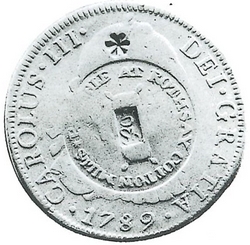
Manville-91b 5s on 8r 1789 Mo FM
Five Shillings in rectangle with star – no stops in legend on 1789 Mo FM
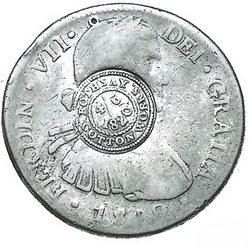
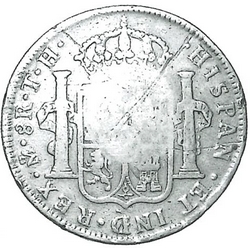
KM-CC100; Manville-92 4/6 on 8r 1809 Mo TH
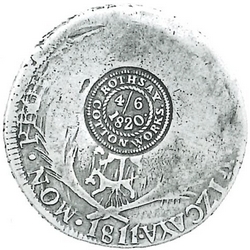
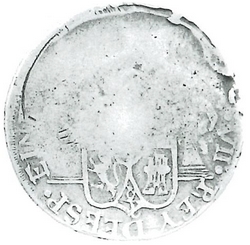
KM-CC100; Manville-92 4/6 on 8r 1811 Nueva Vizcaya
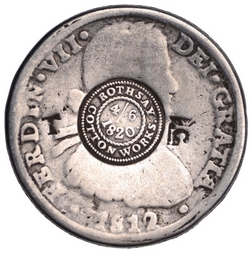
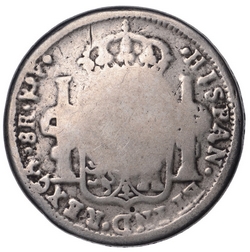
KM-CC100; Manville-92 4/6 on 8r 1812 Ca RP (Noonans auction of Eric Hodge Collection, 29 September 2026, lot 6075)
Four Shillings and Sixpence, privy punch mark (a small dot below or just to the right of the lowest portion of the shield) on reverse on 1796 Mo FM, 1806 Mo TH, 1809 Mo TH, 1811 Nueva Vizcaya, 1812 Mo HJ or JJ, 1812 Zs, 1813 Mo JJ, 1813 Ca RP, 1813 Zs FP, 1814 Ca RP, 1814 Zs AH, 1816 Mo JJ, 1818 Mo JJ, 1818-1823 Ga FS, 1819 Mo JJ, 1820 Mo JJ, 1821 Mo JJ
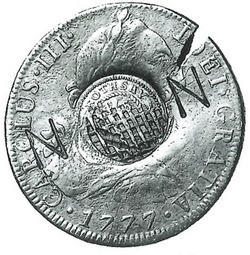
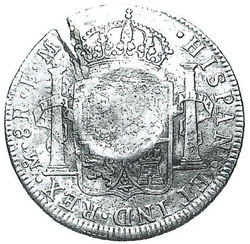
Manville-X92 on 8r 1777 Mo FM (cancelled, punched with two large Ns)
Four Shillings and Sixpence, without privy punch mark on reverse – probable forged puncheon on counterfeit 1777 Mo FM, 1778 Mo FF, 1808 Mo TH, counterfeit 1810 Mo HJ
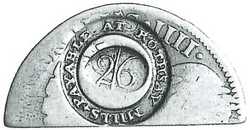
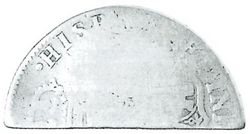
Manville-93 2/6
Two Shillings and Sixpence in oval (on cut half-dollars) on 1792 Mo FM, 1793 Mo FM, 1794 Mo FM
Two Shilling and Sixpence in rectangle, over 2/4 star, cross in legend (on cut half dollars) on pillar Mo, 1786 Mo FM, 1788 Mo FM, 1790 Mo FM
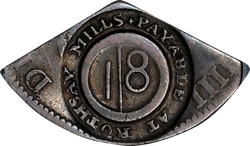
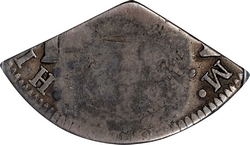
KM-CC94; Manville-96 1/8 on one third of undated 8r (Stack’s Bowers NYINC Auction, 13 January 2024, lot 53299)
One Shilling and Eightpence on cut third dollars on 177- Mo, 1790 Mo FM, 1792 Mo FM,
According to Eric C. HodgeEric C. Hodge, "New Discovery in Scotland" in Coin News, April 2017 there were two different periods of token issuance from this proprietor. The first period circa 1790-1800 covers Manville 90 (5 Shillings [round]), 91 (5 Shillings [rectangle]), 93 (2 Shilling 6 Pence [round]), 94 (2 Shilling 6 Pence [rectangle]), 95 (2 Shillings 4 Pence [rectangle]) and 96 (1 Shilling 8 Pence [round]), while the second period covers Manville 92 (4 Shilling 6 Pence [round]) of much more narrow window of manufacture circa 1820-21. He also goes on to states that the denomination of Manville 92 seems to correspond to other issues in Scotland during the period of 1815-20 and later.
For further information on these the cut coins see Eric. C. Hodge, “Analysis of Cut 8 Reales Countermarked by Rothsay Mills” in British Numismatic Journal, 2019 .
Saltcoats
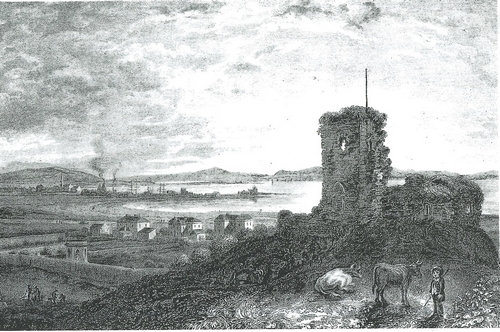
Saltcoats
(from an early 19th century print)
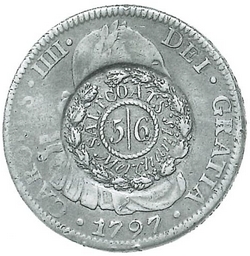
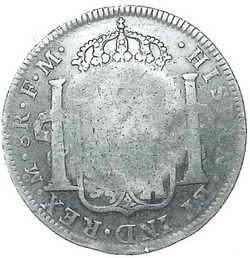
KM-CC101; Manville-97 5/6 on 8r 1797 Mo FM
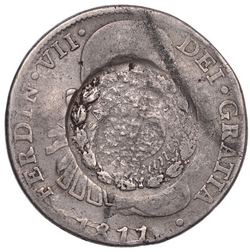
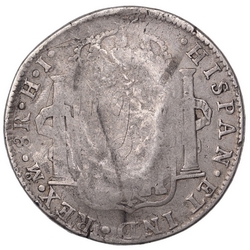
KM-CC101; Manville-97 5/6 on 8r 1811 Mo HJ (Noonans auction of Eric Hodge Collection, 29 September 2026, lot 6086)
Saltcoats is a town in north Ayrshire. The issue of a general ‘Merchants’ token suggests the existence of a local trade or merchants’ association although there are no contemporary references to this.
The SALTCOATS. Merchants around 5/6 is known on 1794 Mo FM, 1797 Mo FM, and 1811 Mo HJ.
I. and W. Scott, Greenock
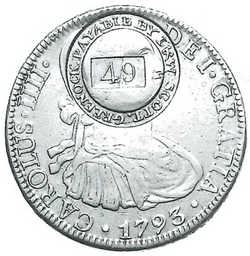
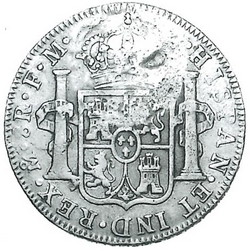
Manville-61 4/9 on 8r 1793 Mo FM
PAYABLE BY I & W SCOTT. GREENOCK in a sunken circular band around 4/9 within a sunked rectangle is known on 1787 Mo FM, 1793 Mo FM, and 1794 Mo FM.
Judging by the dates on the host coins an early issue sometime between the mid-1790s and shortly before 1810, when dollars were obtainable in the bullion market for less than five shillings each , appears likely.
Spanish dollars without countermarks were circulating in Greenock as early as 1803, when a notice appeared in the Greenock Advertiser for 4 November
A CAUTION TO THE PUBLIC
Counterfeit Dollars, in great numbers, are now in circulation; they generally are taken at 4s 6d. their value is at most 1½d. being copper, and coated over with silver leaf, and very well to look on. An ordinary judge cannot distinguish them from silver onesGreenock Advertiser, 4 November 1803.
and in the following month the newspaper printed a letter to the editor, calling for local merchants to issue counterstamped coinsGreenock Advertiser, 23 December 1803.
Alexander Steven & Sons, Port Glasgow, Renfrewshire
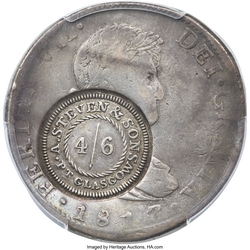
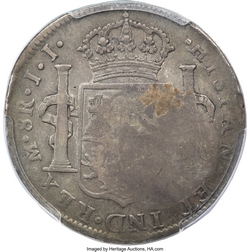
KM-CC91, Manville-89 4/6 on 8r 1817 Mo JJ (Heritage Auction 3126, 6 November 2025, lot 31120)
A directory for 1820 lists Alex. Steven & Son, Church Street, Port Glasgow under “Merchants”. However, Alexander Steven senior was dead by August 1820, when his sons, James and Alexander, and three sisters inherited his properties. The two sons, both listed as merchants, continued in their father’s business until as late as July 1836.
This countermark, for 4/6, is known on 1803 Mo FT, 1806 Mo TH, 1808 Mo TH, 1810 Mo HJ, 1817 Mo JJ and 1819 Mo JJ.
J. Stewart, Fintry, Stirlingshire
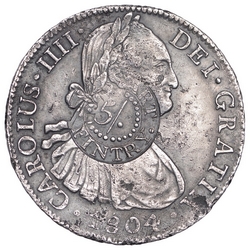
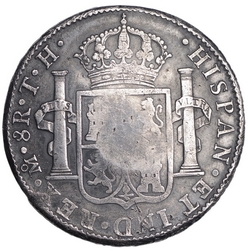
KM-CC35; Manville-32 5/ on 8r 1804 Mo TH (Noonans auction of Eric Hodge Collection, 29 September 2026, lot 6023)
Thistle Bank, Glasgow
The Thistle Bank, founded by Sir Walter Maxwell Bt, and James Ritchie & Co in November 1761, was capitalised at £7,000. Located at first in Bridgegate and then in Virginia Street, it was absorbed by the Glasgow Union Bank in 1836.
Countermarked dollars are known with THISTLE BANK around 4/9. 5/:, and 6/ within small linear circles. There are two different punches for the four-shillings-and-ninepence denomination – one, evidently the earlier, without an additional reverse thistle mark. There are slight indications on at least one specimen that the denomination on this punch may have been altered from one reading 4/6. The second issue of the four-shillings-and ninepence, and the five-shillings and six-shillings denominations, all have a thistle punched on the reverse -sideways with the stem to the right on the four-shillings and ninepence, upright on the two larger denominations. The four-shillings-and-ninepence with thistle type was extensively counterfeited, and many specimens exist in now-unsilvered brass. A warning notice appeared in the Glasgow Herald and Advertiser on 20 April 1804.
CAUTION RESPECTING COUNTERFEIT MONEY; Shillings, Seven Shillings and Spanish Dollars.
The greatest forgery of all is on the Spanish Dollars. The counterfeits may be known by their being of a shiny white colour resembling the amalgam or silvering on the back of a looking glass, very different from the white of real silver, the King of Spain’s head is also not struck deep as in the true one, and often by a close inspection the copper will be seen through at the edge.
Numbers of these have a forged stamp of 4s 9d, ‘THISTLE BANK’ upon them, that stamp should never be taken as proof that the dollar is good, as it is easy to forge it upon the worst dollars. It should be known, that every shopkeeper to whom bad money is offered has the right to clip it in two or otherwise deface it before returning it to the offeror; and if more pieces than one are presented the person should immediately be detained and word sent to the Council Chambers or Police Offices.
COUNCIL CHAMBERS
Glasgow 16th. JUNE 1804Glasgow Herald and Advertiser, 20 April 1804.
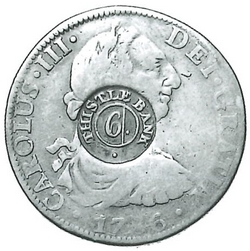
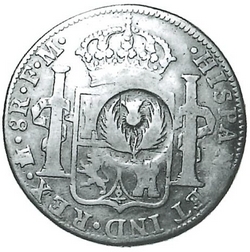
Manville-43 6/ on 8r 1786 Mo FM
Six Shillings reverse upright thistle known on 1786/5(?) Mo FM
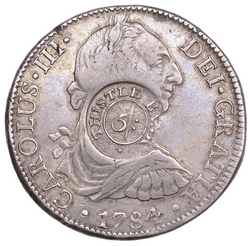
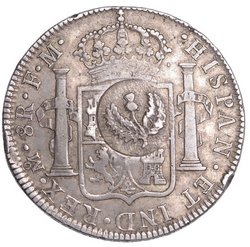
KM-CC48; Manville 44 5/ on 8r 1784 Mo FM (Noonans auction of Eric Hodge Collection, 29 September 2026, lot 6028)
Five Shillings with reverse upright thistle known on 1781 Mo FF, 1784 Mo FM, 1796 Mo FM, 1798 Mo FM, 1803 Mo TH, and 1807 Mo TH.
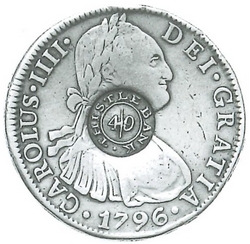
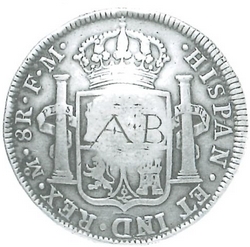
Manville-45 4/9 on 8r 1796 Mo FM
Four Shillings and Ninepence no reverse thistle known on 1780 Mo FF, 1783 Mo FF, 1791 Mo FM, 1792 Mo FM, 1793 Mo FM, 1794 Mo FM. 1795 Mo FM, 1796 Mo FM, and 1799 Mo FM.
Four Shillings and Ninepence no reverse thistle brass counterfeit known on counterfeit 1794 Mo FM
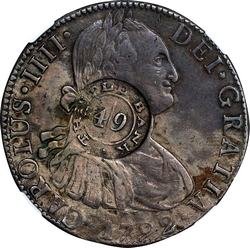
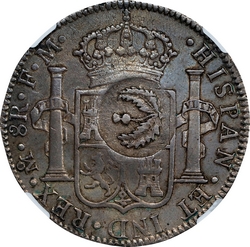
KM-CC49; Manville-46 4/9 on 8r 1792 Mo FM
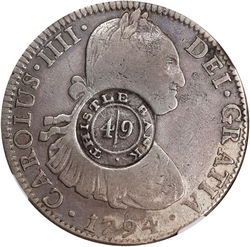
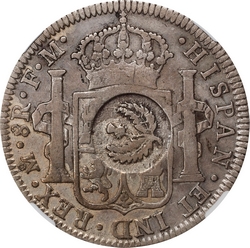
KM-CC49; Manville-46 4/9 on 8r 1794 Mo FM (Stack’s Bowers auction, 25 August 2025, lot 40621)
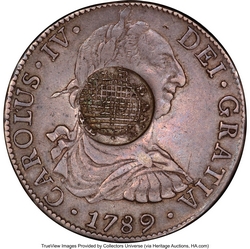
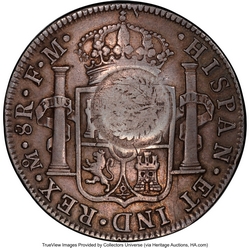
KM-CC49, Manville-46 4/9 on 8r 1789 Mo FM (cancelled) (Heritage Auction 3032, 21 January 2020, lot 34759)
Four Shillings and Ninepence reverse sideways thistle known on 1780 Mo FF, 1782 Mo FM, 1782 Mo MJ, 1784 Mo FM, 1785 Mo FM, 1787 Mo FM, 1789 Mo FM, 1790 Mo FM, 1791 Mo FM, 1792 Mo FM, 1793 Mo FM, 1794 Mo FM, 1795 Mo FM, 1796 Mo FM, 1797 Mo FM, 1798 Mo FM, 1799 Mo FM, 1801 Mo FM,
Four Shillings and Ninepence reverse sideways thistle brass counterfeit on counterfeit 1794 Mo FM
The Bank’s archives document payments for engraving the punches and for stamping dollars in several denominations. For this and a detailed analysis of these coins, see Eric C. Hodge, “Further Merchant Countermark Records of the Thistle Bank: A Reassessment of the Issues” in British Numismatic Journal, vol. 84, 2014
William Thomson, Bell Street, Glasgow
William Thomson was “a flesher in the flesh market, Bell-street”, i.e. a butcher, in 1810 and included in the directories up to 1828. As late as 1847 he is still listed as having his business at 1 Bell-street market, and his house at 67 Bell Street.
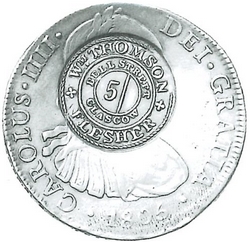
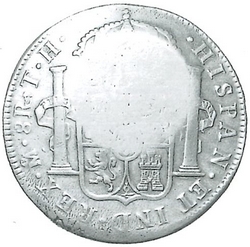
Manville-48 5/ on 8r 1805 Mo TH
A single known token, on a 1805 Mo TH, is marked WM. THOMSON FLESHER around BELL STREET GLASGOW, both around 5/. The likely period of issue was the usual 1815 to about 1819 for a five-shillings denomination.
James Watt & Company, Greenock
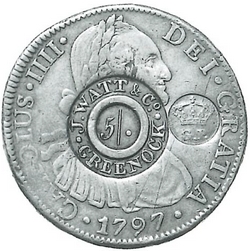
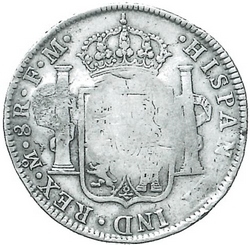
Manville-62 5/. on 8r 1797 Mo FM
In his youth James Watt was a cooper employed in a Paisley brewery. He married his employer’s daughter and eventually bought an old established brewery in Crawfurd’s-dyke (or Cartsdyke). The earliest listing noted is for James Watt and Company, Cartsdyke, in 1816, under ‘malt’.
A notice in the Greenock Advertiser gives the final redemption date for the Watt countermarks:
NOTICE
Those who hold DOLLARS marked with the stamp of JAMES WATT & CO. are requested to present them for payment within fourteen days from this date, as, after that period, MESSRS. WATT & CO. will not hold themselves responsible.
CARTSDYKE 6th. Sept. 1816.
NOTICE
A forged imitation of the stamp used in stamping DOLLARS by Messrs. JAMES WATT & CO. having got into circulation, those who hold the dollars marked by that firm are requested to present them for payment within fourteen days from this date, as, after that period, Messrs. WATT & CO. will not hold themselves responsible.
The public is cautioned against accepting the dollars with the forged stamp, which is clumsily executed, the mark 5s. being larger than in the real stamp, and the surface of the dollar being much defaced by the impression.
CARTSDYKE 9th. Sept. 1816.Greenock Advertiser, 10 September 1816{/foonote}
The following notice appeared a fortnight later:
FORGED DOLLARS AND TEN GUINEAS REWARD
The public are hereby cautioned against taking in payment, or giving currency to DOLLARS, assuming to be stamped by JAMES WATT & CO., Greenock. The Dollars really marked by that firm are now withdrawn from circulation, but they have been succeeded by a spurious imitation of which a considerable number have been industriously disseminated. The public will, therefore be alone to blame, if, after this and previous notices, they take any such Dollars at the rate stamped upon them.
And, further to put a stop to this illegal practice, Messrs. JAMES WATT & CO. herby offer a REWARD OF TEN GUINEAS to any person who will give such information as may bring to conviction the forgeries of the above-mentioned stamp,
Greenock, 18th Sept. 1816.Greenock Advertiser, 27 September 1816
A single specimen of the countermark J. WATT & Co GREENOCK around 5/ is known on 1797 Mo FM. The stamped denomination of five shillings, coupled with the redemption notices of September 1816 places this token to the brief period between mid 1815 and mid 1816 when the market price of dollars was about four shillings and sixpence.
John Wilson, Hurlet, Renfrewshire
The Wilson company (known under various permutations, John Wilson & Company, & Son or & Sons) had been established by 1813 and it continued in the chemical business, producing coal, alum. limestone and copperas, until at least the middle of the nineteenth century. The companies had various office addresses in Glasgow between c. 1800 and 1850.
The company produces two varieties of countermarked tokens to pay it employees.
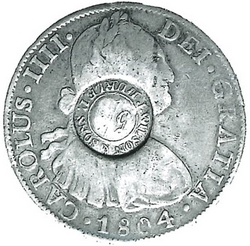
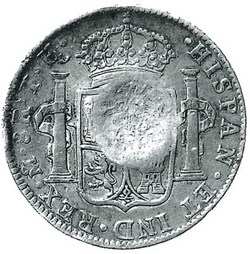
Manville-63 5s on 8r 1804 Mo TH
Two specimens, one cancelled, of a countermark reading I. WILSON & SONS. HURLET. around 5/ are known on 1804 Mo TH and 1806 Mo TH.
Another group of tokens countermarked J. &. J. W. HURLET. around 5/. are also attributed to this company. Two different punches were used:
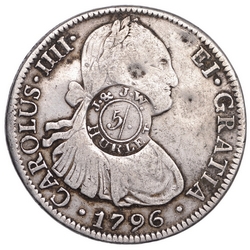
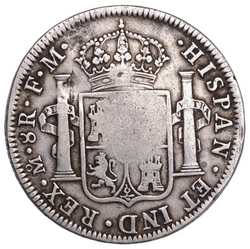
KM-CC63; Manville-64a 5/ on 8r 1796 Mo FM (Noonans auction of Eric Hodge Collection, 29 September 2026, lot 6054)
Type 1 – with a stop between J and W and a triangle of three dots –known on 1795 Mo FM, 1796 Mo FM, 1797 Mo FM, 1799 Mo FM,
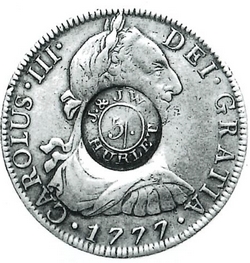
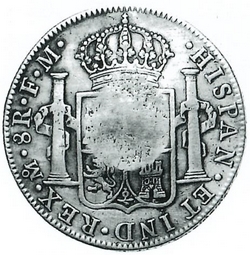
Manville-64b 5/ on 8r 1777 Mo FM
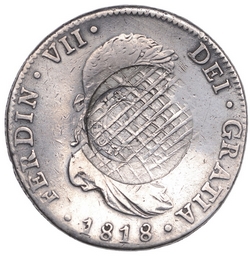
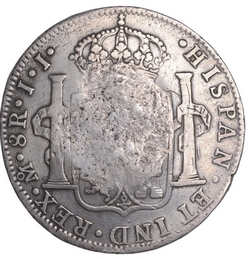
KM-CC63; Manville-64a(?) 5/ on 8r 1818 Mo JJ (cancelled by an open grill pattern)
(Noonans auction of Eric Hodge Collection, 29 September 2026, lot 6056)
Type 2 -with no stop between J and W and no triangle of dots –known on 1777 Mo FM, 1792 Mo FM, 1797 Mo FM, 1802 Mo FT, 1818 Mo JJ
Judging by the denomination and dates of the host coins, type 1 might have been issued during 1816-1819 and type 2 from 1820 to shortly thereafter.
For more information see H. E. Manville, ‘An unpublished Scottish tradesman’s countermark’ in British Numismatic Journal, vol. 62, 1992.
[ ] & Co
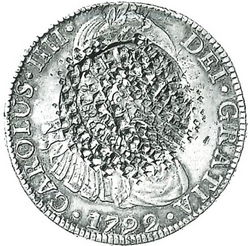
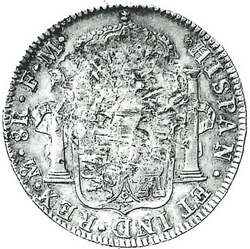
Manville 112 5/3 on 8r 1792 Mo TH (heavily cancelled)
This might read something like …IND & Co. , ending in … OCH, around 5/3.