Countermarked coins used in Ireland
Castlecomer Colliery
(Lifted from The Old Currency Exchange)
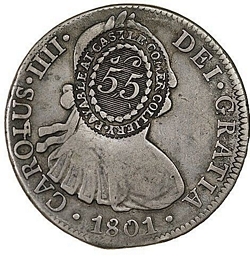
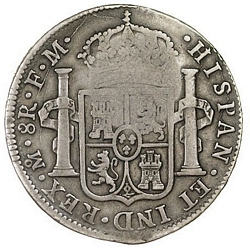
Manville 118 Castle Comer on 8r 1801 Mo FM
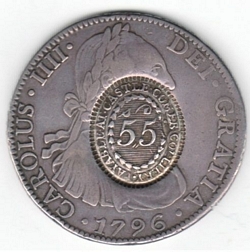
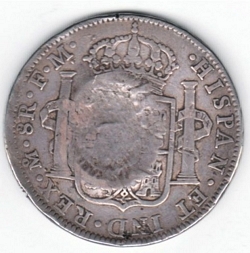
Manville 118 Castle Comer on 8r 1796 Mo FM
Introduction
The Spanish dollar or ‘piece of eight’ reales counterstruck ‘5 shillings & 5 pence’ for use in trading by the Castle Comer Colliery, in Co Kilkenny, is the only silver crown-sized piece issued in Ireland by a private commercial entity. They were produced on behalf of Anne, Duchess of Ormonde, the wife of the seventeenth Earl of Ormonde, John Butler. Her real name was Susan Frances Elizabeth, daughter and heiress of the Earl Wandesford. She married John Butler in February 1769 and survived her husband, her son, and her daughter-in-law, before she herself died in Dublin in April 1830. She was known as Anne and she was the Dowager Countess described by Mr. J. G. Robertson of Kilkenny to his friend, Dr Aquilla Smith in his article of 1855.
It was said, at the time, that she …
“not wishing to lose by the depreciated value of Spanish dollars of which she had at that time a large number, caused all she had to be stamped with the legend ‘Castle Comer Colliery, 5 shillings and five pence’. Coals to that amount being given for them at the pits, Kilkenny traders used to take them in exchange for their commodities knowing that they could give them afterwards to colliers in payment for coals.”
These tokens belong to an era of a shortage of specie (silver and gold) – a time when the Royal Mint was unable to acquire sufficiently large amounts of bulk silver to mint sufficient coinage for the British economy – an economy that was struggling to implement the recently passed Act of Union. Trade and commerce were being strangled by the inability to transact business.
One solution was for private merchants to issue their own ‘countermarked’ foreign coins, though Castlecomer Colliery was the only Irish entity to do so. They are known to exist for the following (donor coin) dates – 1774, 1789, 1791, 1796, 1798, 1799, 1801, 1804 and 1808. It is thought Countess Ormonde (or her agents) had exchanged a large number of Spanish dollars. This might suggest that her tokens were ‘countermarked’ some time after 1808 – but how far after 1808? And, if she was issuing these tokens over a number of years, how far before 1808?
The business case or economic necessity for such tokens would have existed after 1804 and Michael Dolley, independently, suggested that the tokens probably date from 1804 onwards on the basis that Aquilla Smith’s original manuscript (then in the National Museum of Ireland) stated that “This token was used for paying the miners of the colliery during the late war probably about the year 1804.” Smith, Aquilla, ‘Catalogue of Silver Tokens issued in Ireland’, in Proceedings and Transactions of the Kilkenny and South-eastern Archaeological Society, 4 July 1855.
On 24 July 1812, the Royal Assent was given to “An Act to prevent the issuing and circulating of Pieces of Gold and Silver or other metal, usually called Tokens, except such as are issued by the Banks of England and Ireland” (52 Geo. Il l c. 127). A further Act prohibiting the manufacture of private tokens occur in 1813, and their circulation finally became illegal on 20 December 1814.
This would suggest that the Castlecomer tokens were ‘counter-struck’ between 1808 and 1812. However, since various banks, mills and collieries issued such tokens at different dates between c. 1787 and 1823 an issue date beyond 1814 is still possible.
The value of five shillings and five pence is interesting because an English shilling was then valued at 13 pence, or 1 shilling and 1 penny Irish: therefore, 5 shillings and 5 pence Irish is equal to 5 English shillings, or a crown. The Castlecomer token being crown-sized, and of good silver content, might have been valued at 5 English shillings.
Is there a link between Castlecomer Colliery and those in the North of Britain during this period of specie scarcity, at a time when payment of industrial workers and colliers presented such logistical monetary problems to their employers? It may not be coincidental that the tokens for five shillings issued at the Percy Main colliery are very close in style to those of Castlecomer, and it has been suggested that “the same hand way well have been responsible for the two punches”
WhetmoreWhetmore, S. A. H., "The Castlecomer Colliery Token", in The British Numismatic Journal vol. XXXI, 1963, p. 152-158 For a response to Whetstone, further discussion and a list of coins see W. A. Seaby, “Castlecomer Tokens: An Inquiry” in British Numismatic Journal, vol. 34, 1965 , on the other hand, has suggested that Job Hart Price-Clarke (father of the girl who married the eighteenth Earl of Ormonde and apparently both a trustee and agent of the earl, 1806-10), coming from Sutton-cum-Duckmanton in Derbyshire, must have known Richard Arkwright, who was lord of the manor there, and who issued counter-marked Spanish dollars at the Cromford cotton yarn mill in the late 18th and early 19th centuries. If it was Hart Price-Clarke who advised Lady Ormonde on the similar use of her foreign silver, presumably it could have been as early as 1804 when arrangements were being settled for the marriage between his daughter and the earl which took place on 17 March 1805.
Why were they issued?
The Countess was known for her altruistic gestures:
Mason in his Statistical Survey published in 1802 wrote “Castlecomer has 211 houses: many of them good and slated: part of this town was burnt during the late rebellion and has been rebuilt in a handsome manner; the principal part of the town is one very broad street well built. A barrack for infantry has been begun above the town, estimated at about £4,000 and a new market house is about to be erected by Lady Ormonde.”
A few years before 1814 a new road was constructed from the Castle Comer collieries to Carlow, the cost of which was raised by public subscription to which Lady Ormonde contributed £1,000
A contemporary writer remarked “I am happy in having this opportunity of expressing my admiration of the liberal manner in which this lady at all times supports every project which may tend to the benefit of the country. To make her neighbours and tenants comfortable and happy and to improve the surrounding country by every means in her power, appear the noble and patriotic boundary of Lady Ormonde’s wishes and exertions.”
It has been suggested that she may have issued these tokens “to right the exploitation of her own miners by the local tradesfolk, than to benefit herself, that the Countess brought her stock of dollars into public service and demanded that they pass for their true value in Irish currency.” By all accounts, these references to Lady Ormonde give the impression of a competent lady genuinely interested in using her position and means to restore and develop the district in which she lived. Her tokens, being of good weight and quality would have been a scarce commodity at that time – small wonder so few seem to have survived.
Grimshaw, Whitehouse, Co. Antrim
In 1786 Nicolas Grimshaw erected cotton-spinning factories at Whitehouse. He also built housing to accommodate some of the factory hands, and a village slowly grew up around the mills. By 1805, the proprietor of the Whitehouse cotton mills was James Grimshaw (presumably Nicholas’ son).
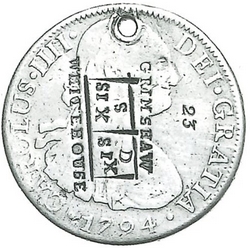
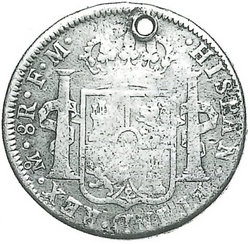
Manville-107 6/6 on 8r Mo 1794 FM
A single, and singular, token is marked by individual punches: 23 above GRIMSHAW above a double compartment with S over SIX and D over SIX above WHITEHOUSE, on a Mexico City dollar dated 1794. Early in the nineteenth century, six shillings and sixpence Irish was the equivalent of six shillings sterling.