In November 1876 a newspaper reported that small denomination coins were still so scarce in the capital that small transactions were becoming almost impossible, and there were innumerable complaints and great damage done to commerce and to the public, particularly the poorer class. In an infinite number of establishments, various means have been resorted to to supply the lack of small change: iIn some businesses tokens, pieces of paper, soap or other objects were given instead of coin; and in others chits {contraseñas) which only served as a means of exchange in the houses that had issued them{footnote}El Monitor Republicano, Año XXVI, Núm. 272, 11 November 1876{/footnote}.
On 27 May 1874 the presidente municipal of Guadalajara reported to the District Judge that the businessmen José María Montero, Refugio Alvarez Tostado and Miguel Alvarez del Castillo, had issued copper tokens for use in their individual stores{footnote}Another store-keeper, Prudencio Avilés, was also mentioned but not charged{/footnote}. The tokens in the subsequent case included
(1) a circular copper coin worth a medio tlaco, with the name “Miguel Alvarez y Compañia) and the date 1873 on one side and a beehive (colmena) and other signs on the reverse:
(2) a circular copper coin with the initials ‘R. A.’ on the face and an illegible number or letter on the reverse:
(3) a semi-circular coin marked ‘R. A’. (for Refugio Alvarez)
(4) a semi-circular coin marked ‘P. D. N.’ This stood for “Paso de Norte”, the name of Montero’s store.
Alvarez del Castillo had made either 1,400 or 1,500 pieces of ¼ real (medio tlaco), which circulated in Guadalajara, other cities in the state and even outside it: Alvarez Tostado did not know how many coins he had issued, though he thought it was only a few.
All were originally sent to prison on remand, but the judge then decided to absolve Alvarez del Castillo and Alvarez Tostado of the crime of issuing copper coins, and Montero of altering the legitimate copper coinage, contrary to public policy. However, he ruled that they should not issue any further coinage and should recall whatever was in circulation and hand it over to the Director of the local mint. The case then went to a Tribunal which decided in August to overturn the lower court and sentenced Alvarez de Castillo to nine months in prison and a $400 fine, and Refugio Alvarez to six months and a fine of $100, while absolving Montero.
Finally, the case was referred to Mexico’s Supreme Court for it to decide
(1) whether the metal tokens that individuals put into circulation (las fichas ó planchuelas metálicas que, marcadas con su sello, expide y pone en circulación un particular) should be considered money;
(2) whether their issue breached Article 72, fracción XXIII of the Constitution;
(3) whether their issue was a case of counterfeiting; and
(4) whether their issue constituted fraud.
Luckily for the accused (and merchants in general), the Supreme Court decided that the Tribunal was wrong. The small “coins” (planchuelas) were not counterfeit money, or even money, but simply credit notes that people could accept if they wanted to (unos simples signos convencionales de crédito, aceptables únicamente para los que quieran admitirlos, y que ninguna está obligado á recibir). So the three had not usurped the functions of Congress or the Ejecutive, and so had not issued counterfeit money{footnote}El Foro, Tomo IV. Núm. 54, 24 March 1875: Tomo IV. Núm. 55, 25 March 1875; Tomo IV. Núm. 56, 30 March 1875; Tomo IV. Núm. 59, 2 April 1875{/footnote}
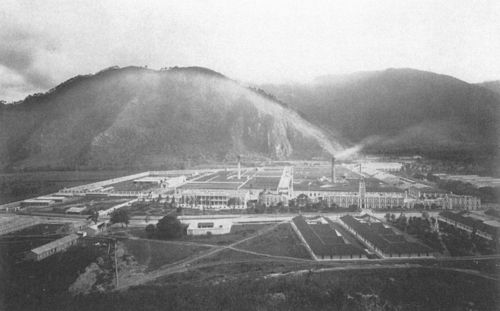
Rio Blanco factory
La Compañía Industrial de Orizaba S.A. was formed in 1889 with capital from Thomas Braniff, and the Barcelonnettes Ollivier y Cía (Ciudad de Londres), J. Tron y Cía (Palacio de Hierro), and Signoret, Honnorat y Cía (Puerto de Veracruz). In the next ten years it acquired and constructed four textile factories in the Orizaba valley: Cerritos, San Lorenzo, Río Blanco and Cocolapan (acquired in 1899). The Rio Blanco factory was built to supply the owners’ department stores in Mexico City and other major cities throughout the country. With more than 40,000 spindles and almost 2,600 workers, it was the largest textile mill in the country and was large even by international standards. Like most textile mills in Mexico, it was originally built on an unpopulated site that was eventually transformed into a company town.
One way in which the Compañía Industrial de Orizaba's partners earned income, from the foundation of their factories until 1912 were the tiendas de raya. These businesses served the entrepreneurs to recover part of the wages of the workers, by forcing them to buy in them the food, clothing and other goods they needed. The tiendas de raya received the vales issued by the textile companies as an advance of the salary at the request of the worker. Vouchers could be redeemed for goods or for money at 90% of their value. The following Saturday the amount advanced to the workers was deducted from their salaries to pay the debt.
Río Blanco’s company store was leased to Victor Garcín, a Barcelonnette who had been in the region for some decades. Eduardo Garcín, his brother, was the Compañía Industrial de Orizaba manager in 1903 and a member of the board in 1905 and 1906. However, Garcín’s store was not merely a company store. He seems to have run the largest store in the area, occupying a whole block, and sold not only directly to workers but also to several stores in the region. Besides Río Blanco’s company store Garcín owned two other stores: “El Centro Comercial” at Nogales,and “El Modelo” at Santa Rosa, and nine pulquerías which also held billiard tables.
In 1907 (footnote}El Universo, Chihuahua, Año V, Núm. 222, 13 January 1907{/footnote}.
After the conflicts of 1907, where the workers burned the tiendas of Victor Garcin, he decided to sell his property to Manuel Diez and left the area.