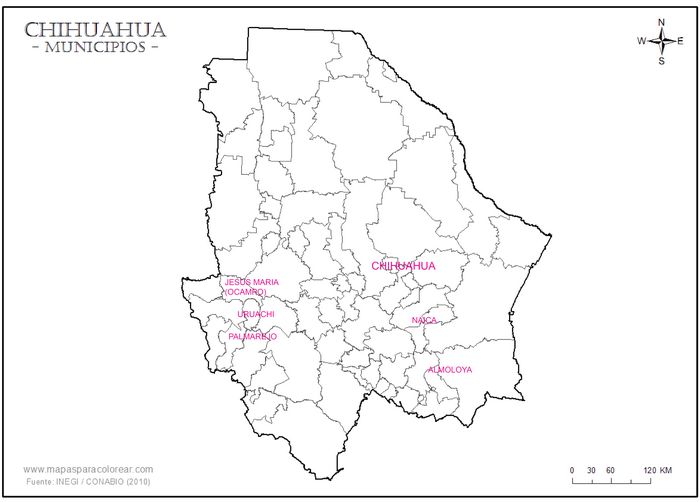
 Santa Clara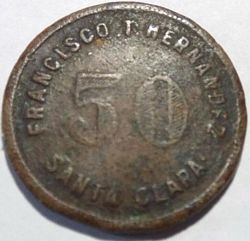
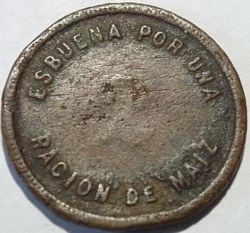
Grove 1898
Obverse: FRANCISCO T. HERNANDEZ / 50 / SANTA CLARA
Reverse: ES BUENA POR UNA / 2 / RACION DE MAIZ
25mm. bronze
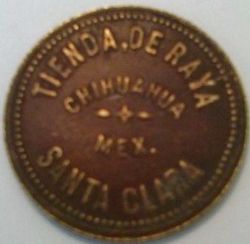
Obverse: TIENDA DE RAYA / CHIHUAHUA / MEX. / SANTA CLARA
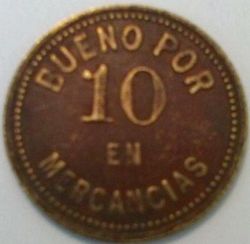
Reverse: BUENO POR / 10 / EN / MERCANCIAS
24mm. brass
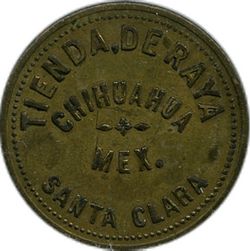
Obverse: TIENDA DE RAYA / CHIHUAHUA / MEX. / SANTA CLARA
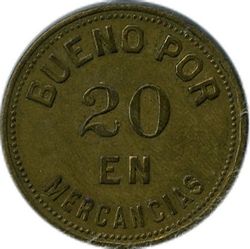
Reverse: BUENO POR / 20 / EN / MERCANCIAS
28mm. brass
In 1883 Matras Alsua and some relatives, and B. Phelps of New York, took over the gold-silver mines of Santa Juliana near the source of the river Mayo. These mines had been worked in colonial times but had been abandoned about 1810. They were pumped dry by some others and the Alsuas in the 1870s.
The Santa Juliana Mining Company is listed in New York City Directories in 1894 and 1896. The 1897 Mine, Quarry And Metallurgical Record Of The United States, Canada And Mexico notes that the Santa Juliana Mine has 1,250 feet of shaft and tunnel, with product being Gold & Silver, 12,000 tons, 300 days, and 400 employees. Its stamp mill had a 40 ton daily capacity, powered by electricity, steam, and water.
On these tokens the reverse pictures indicated the denomination to basically illiterate workers. It is assumed that the diameter is an indication of increasing value.
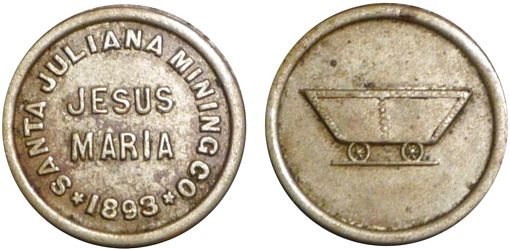
Grove 1746
Obverse: SANTA JULIANA MINING CO. / JESUS MARIA / 1893
Reverse: an ore car
16 mm. nickel
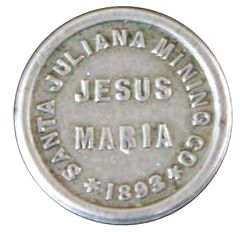
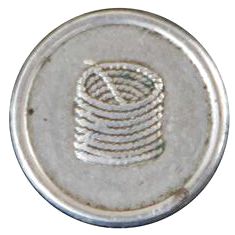
Grove 174
Obverse: SANTA JULIANA MINING CO. / JESUS MARIA / 1893
Reverse: a coil of rope
mm. nickel
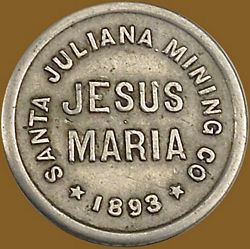
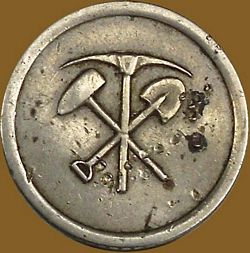
Grove 1747
Obverse: SANTA JULIANA MINING CO. / JESUS MARIA / 1893
Reverse: a pick, shovel and sledge hammer
19 mm. nickel
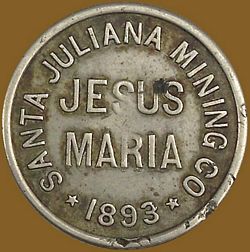
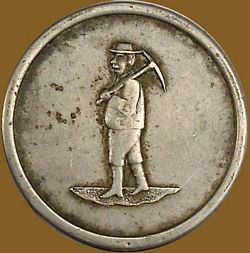
Grove 1748
Obverse: SANTA JULIANA MINING CO. / JESUS MARIA / 1893
Reverse: a miner with a pick
22 mm. nickel
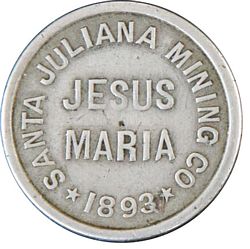
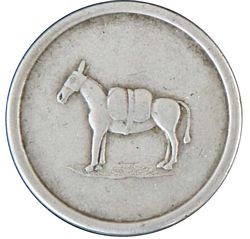
Grove 1749
Obverse: SANTA JULIANA MINING CO. / JESUS MARIA / 1893
Reverse: a pack mule
25 mm. nickel
In 1894 a Mexico City newspaper reported that before the law prohibiting payments in scrip (fichas, cacharpas, vales al portador y otros objetos) came into effect, the practice was rife but now people were paid in legal tender. However, in Ocampo it appeared that the law was less efective, given the great circulation of aluminium tokens (monedas ó contraseñas de aluminio) issued by the Compañía Minera de Santa Juliana, redeemable only in the tienda de raya for highly-priced goods. Any worker who needed banknotes to pay his taxes etc. had to sell the tokens at a 25% discount to other businesses as the tienda did not exchange them at any price{footnote}Voz de México, Mexico, 4 August 1894{/footnote}.
Grove 1935
Obverse: JESUS MARIA / STELL
Reverse: BUENO POR / 1 / COPA
19mm. brass.
Guillermo (William) M Stell, a doctor and surgeon{footnote}Periódico Oficial, Chihuahua, 21 January 1909{/footnote} became interested, along with Luis Siqueiros, in the Matelura mine in Jesús María in 1891{footnote}Jesus Maria, Chihuahua.
Dr. W. M. Stell. Of Jesus Maria, is in the city, attracted by the convention. He is interested in the Matelura. This property is being worked actively and the product is being milled at the John Watterson plant.
The product of the Matelura amounts monthly to about $4,000, but steps are being taken to increase the output of the property materially. Don Luis Siqueiros is associated with Mr. Stell in this promising property.
The Santa Juliana mine and mill are in an active state and are shipping bullion monthly to Chihuahua. (The Two Republics, vol 33, No. 148, 19 December 1891){/footnote}. By June 1892 Stell and Siqueiros were working the mine and contemplating establishing their own plant{footnote}Daily Anglo-American, 20 June 1892{/footnote}, for which they drew water from the nearby river. By 1910 Stell owned the Lupe de Oro gold and silver mine{footnote}Diario Oficial, 26 April 1910{/footnote}.
Gaytan{footnote}Carlos, Gaytan, Paper Currency of Mexico{/footnote} provides a history of the Rascon brothers of Uruachic, Chihuahua. In his article he writes that the Rascon family, José Maria and Leogardo, arrived in the area in 1750. "Leogardo was first to strike a Bonanza when he discovered a gold mine he named “La Bola”. Probing about for more, the brothers made another important strike, “El Omelichi,” just two miles west of “La Bola."
The brothers died in 1818 and 1820 and the mines were flooded after heavy rainfall and ceased production. The remaining family turned to farming and it was not till 1858 when two other Rascon brothers, Epigmenio and Ignacio Rascon, only sons of Leogardo, pumped out the water from “La Bola” mine and restarted operations. The company bought other mines in the area such as Las Animas, San José, Santa Rosa, El Alacran, San Lazaro and many more, and built a very modern hacienda de beneficio with batteries brought from England to crush the ore. In time Rascon brothers were running one of the most successful operations in the state. An indication of their wealth was that their house had the first porcelain toilets and baths, sent all the way from London.
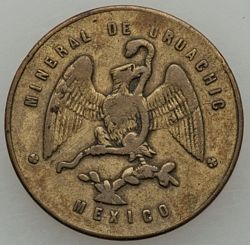
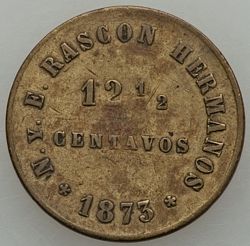
Grove 1751
Obverse: around Mexican eagle MINERAL DE URUACHIC / MEXICO
Reverse: N. y E. RASCON HERMANOS / 12½ / CENTAVOS / 1873
25mm. brass
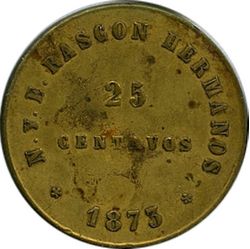
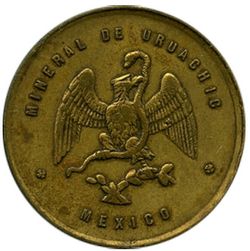
Grove 1752
Obverse: around Mexican eagle MINERAL DE URUACHIC / MEXICO
Reverse: N. y E. RASCON HERMANOS / 25 / CENTAVOS / 1873
28mm. brass
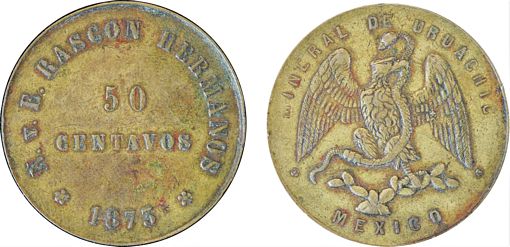
Grove 1753
Obverse: around Mexican eagle MINERAL DE URUACHIC / MEXICO
Reverse: N. y E. RASCON HERMANOS / 50 / CENTAVOS / 1873
31mm. brass
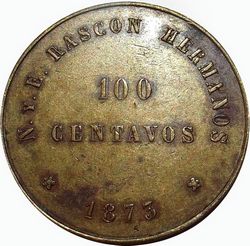
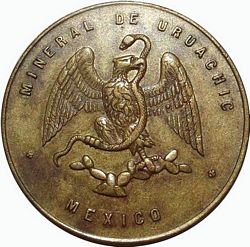
Grove 1754
Obverse: around Mexican eagle MINERAL DE URUACHIC / MEXICO
Reverse: N. y E. RASCON HERMANOS / 100 / CENTAVOS / 1873
mm. brass
In 1873 bronze tokens of 12½, 25, 50 and 100 centavos, produced at the Alamos Mint, were issued by Minera de Uruachic. In addition, paper notes were put into distribution produced locally or printed by The American Bank Note Company in New York. Both were redeemable at the company store, which was run by their relatives, Ezequiel and Daniel Rascon.
The tokens were marked on the back by the letters N and E RASCON HERMANOS. One of the more interesting aspects to the tokens is what has been called a five leaf counter stamp or countermark stamping out the “N” on the 12½ centavos and other values. The tokens have been sold with that description in several auctions.
However, the late Ken Tabachnick, a prolific coin collector and dealer, told me the story that a falling out between the brothers resulted in the stamping out of the letter “N”.
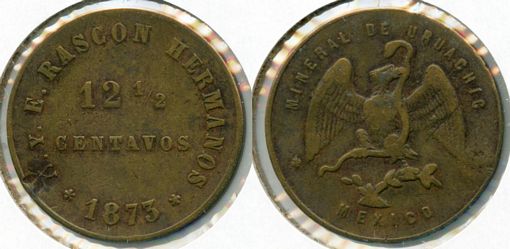 12½ centavos with "N" stamped out
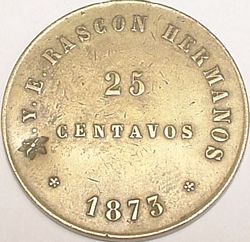
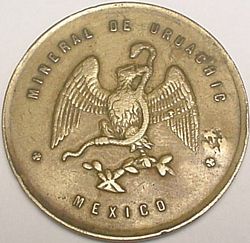
25 centavos with "N" stamped out
Was this a dealer story to sell the coin? In inspecting my 50 and 100 centavos coin I find the “E” stamped out.
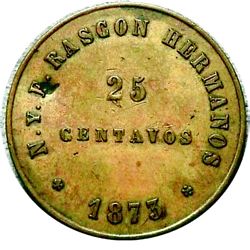 25 centavos with "E" stampted out
Was this the other brother retaliating and punching out his brother? On the other hand, the stamped out letter may have been used to denote that a token had been spent, or was perhaps out of date.
Gaytan goes on to say: “In its hey-day, Uruachic had a population of nearly 15,000; today there are less than 400 living there. The Municipality of Uruachic is bounded on the north by Ocampo, on the south by Chinipas and Guazapares and on the west by the State of Sonora”.
(from Elmer Powell, The Rascon Brothers and the Compañía Minera)
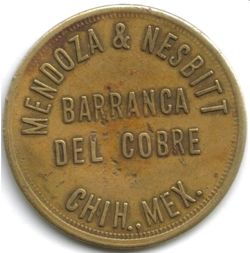
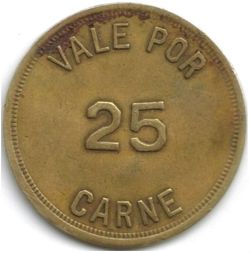
Grove 1725
Obverse: MENDOZA & NESBITT / BARRANCA / DEL COBRE / CHIH, MEX.
Reverse: VALE POR / 25 / CARNE
33 mm. brass
Grove 1726
Obverse: MENDOZA & NESBITT / URIQUE / CHIH, MEX.
Reverse: VALE POR / 25 / CARNE
33 mm. brass
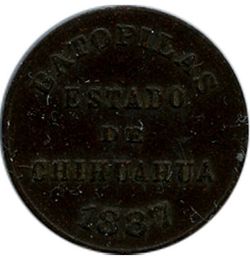
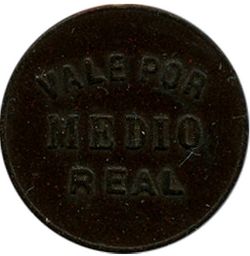
Batopilas ½r
Obverse: BATOPILAS / ESTADO / DE / CHIHUAHUA / 1887
Reverse: VALE POR / MEDIO / REAL
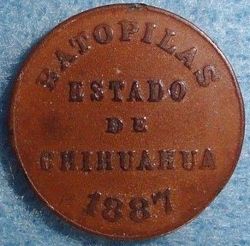
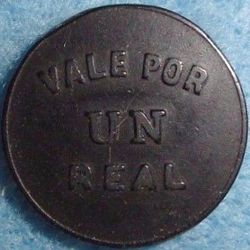
Grove 1156
Obverse: BATOPILAS / ESTADO / DE / CHIHUAHUA / 1887
Reverse: VALE POR / UN / REAL
23 mm. brown vulcanite
For a history of the mining town of Batopilas and possible issuers of this token, see this companion piece on paper currency.
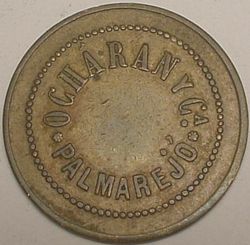
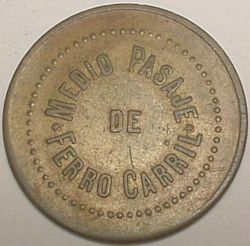
Grove
Obverse: OCHARAN Y CA / PALMAREJO
Reverse: MEDIO PASAJE / DE / FERO CARRIL
23 mm. brass
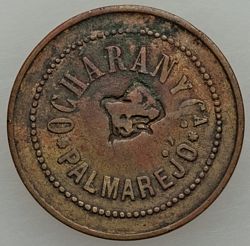
Grove 1799
Obverse: OCHARAN Y CA / PALMAREJO counterstamped with a bull's head
Reverse: MEDIO PASAJE / DE / FERO CARRIL
23 mm. brass
Grove 1800
Obverse: OCHARAN Y CA / PALMAREJO counterstamped with the letter J
Reverse: MEDIO PASAJE / DE / FERO CARRIL
23 mm. brass
Mineral deposits were discovered at the site of the Palmarejo mine in 1818 by Valentine Ruiz, who immediately took on a partner Tomas Pelayo, and registered the mine as Nuestra Señor Cármen. Tomas Pelayo passed away in 1823 and that same year Rafael Ayon bought into the firm for $8,000, but in 1827 sold part of his holdings to Vicente Palacios of Chihuahua and Antonio Lamadrid of Alamos, Sonora. Finding themselves low in funds, the partners obtained a loan in 1837 from Miguel Urrea of Alamos. By 1841 Palacios and Lamadrid had died. Ayón, unable to continue working the mine, sold his interest to Miguel Urrea, who also was successful in purchasing the other partners' interests from heirs to their estates.
By 1853, after an investment of $1,000,000 pesos the Palmarejo (by then a walled compound to ward off the Apache raids) the Justina and the San Miguel mines (the latter two miles from Chinipas near El Zapote) were operating, together with some 35 small crushing milIs. After Miguel Urrea' death in 1875 the mines continued to flourish under the ownership of the widow, Justina Almada de Urrea and her brother and brother-in-law. A bonanza existed from 1878-1880. During that time it is claimed that the mines yielded ore to the wealth of one million pesos.
A British mining engineer, Edward Applegarth, after examining the mining funds (claims, workings, reserves, reduction plants and all facilities and properties) at El Zapote and Palmarejo, returned to England to report. As a result, the Palmarejo Mining Co, Ltd. was formed in London and the Urrea properties were purchased by them in 1886 for $800,000 pesos. Plans were immediately initiated by the new owners for a narrow gauge railroad from Palmarejo to El Zapote for the purpose of transporting ore and supplies.
On 25 June 1898 a new firm, Palmarejo & Mexican Gold Fields Ltd. was incorporated in London as a reorganization of the Palmarejo Mining Co. Ltd. The reorganization also included the purchase of the property of Goldfields of Mexico Ltd at a cost of $548,800 pesos. The newly organized company concentrated on building a stone aqueduct 14 miles long from the Chinipas River to Palmarejo and cornpleting the railroad from El Zapote to Palmarejo. A year or two later the Mexican Mineral Railway Co. Ltd. did complete the railroad. Rather than assume the unfamiliar task of operating a railroad themselves, the Palmarejo & Mexican Gold Fields Co. leased it to Oscar Ocharan, a resident of Alamos. The Company had big plans for the mine and poured over $5,000,600 into development before the first dividend was issued to stockholders.
Unfortunately the improvements and even the little toy railroad soon outlived their usefuJness. In 1910 plans were made to tear down the mill at El Zapote and erect a new 300-stamp mill and build an aerial tramway from Palmarejo to the mill to replace the railroad. By the end of 1911 a hydroelectric plant was completed and the new mill and aerial tramway were en route to the mill to be assembled but the revolution caused everything to be suspended. Oscar Ocharan was exiled in 1912 to the United States. During the period of the revolution, the railroad, the mine and much of the company's property was lost, not because of any military action but because of abandonment and deterioration. As a result, the company entered a claim with the Anglo-Mexican Special Claims Commission for $2,600,000 and in August 1931 a decision was made to award the company for Ioss and damages the sum of $412,000 gold pesos to be paid in eleven annual installments. In 1933 The company finally went into production again. The mine is still being worked.
During the time when the railroad was in operation, little brass tokens were issued, bearing on the reverse side, the words MEDIO PASAJE DE FERRO CARRIL. There are several interpretations of this wording and possible use but the most likely is that the MEDIO PASAJE refers not to half-fare, but rather to half passage. A full trip would be to the mine and back. A medio pasaje would be one way between the two terminals. Tokens such as these are usually used for human passengers and yet it is difficult to see the need for such tokens on an isolated mining railroad. There remains the possibility that they may have been used to pay the transport of a load of ore or freight one way between mine and mill.
This token is also found with the steer head counterstamp of the Quintera Mining Company. A hoard of Palmarejo tokens may have been procured by the Quintera Company, counter stamped and put to use on Quintera ranches.
(based on Elwin C. Leslie, The Palmarejo Railroad Token)
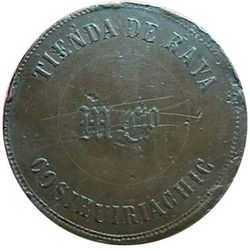
Grove 1946
Obverse: TIENDA DE RAYA / M. Co / COSIHUIRIACHIC
Reverse: 1880 / ¼ / DE REAL EN EFECTOS
23mm. bronze
Grove 1947
Obverse: TIENDA DE RAYA / M. Co / COSIHUIRIACHIC
Reverse: 1880 / ½ / DE REAL EN EFECTOS
30mm. bronze
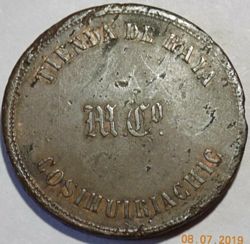
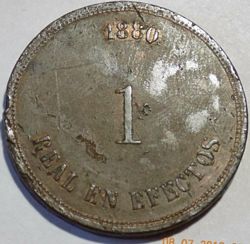
Grove 1948
Obverse: TIENDA DE RAYA / M. Co / COSIHUIRIACHIC
Reverse: 1880 / 1 / REAL EN EFECTOS
35mm. bronze
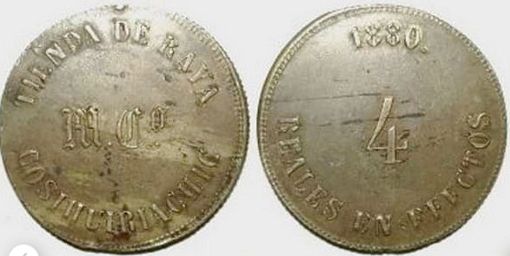
Obverse: TIENDA DE RAYA / M. Co / COSIHUIRIACHIC
Reverse: 1880 / 4 / REALES EN EFECTOS
These were issued by the Santa Rosa Cosihuiriachic Mining Co.
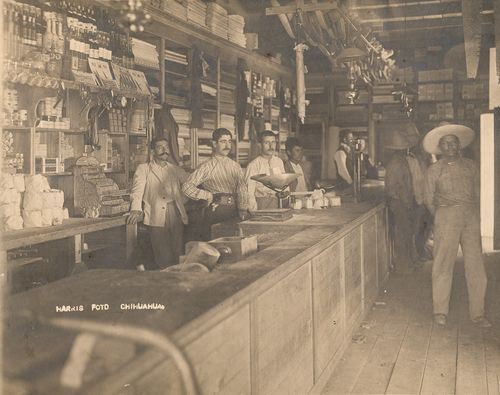
Naica is a mining community about 22 miles south of Delicias in south-east Chihuahua. In 1910 it had two thousand inhabitants, mostly employees of the Compañías Explotadora de Naica, Compañia Minera de Lepanto, Compañia Minera de Naica and the Mighty Mountain Mining Company.
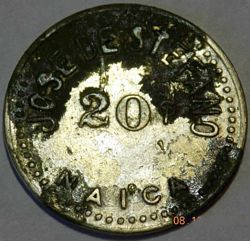
The Italian Jose de Stephano listed himself as a miner and merchant in the 1910 Album del Centenario. As a miner, he was president of the Compañía Minera de Lepanto (and Chihuahua representative for the Compañía Minera Fundidora y Afinadora de Monterey){footnote}The Mexican Herald, 22 January 1908{/footnote} and as a merchant, owner of the wholesale and retail store "Tienda Lepanto", which employed six staff{footnote}Anuario Estadístico del Estado de Chihuahua, 1909{/footnote}, no doubt the same as the "Tienda La bella Napoli".
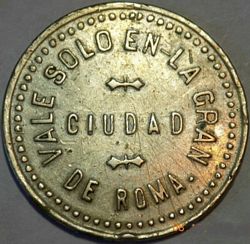
This 10c token is for another of his stores, "La Gran Ciudad de Roma".
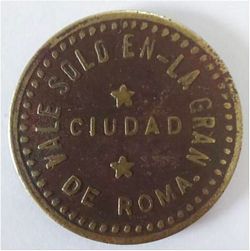
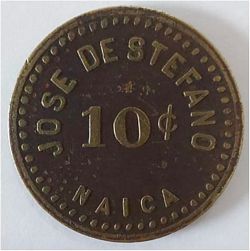
Obverse: VALE SOLO EN - LA GRAN / CIUDAD / DE ROMA.
Reverse: JOSE DE STEFANO / 10¢ / NAICA
24mm. bronze
Grove 1453
Obverse: VALE SOLO EN - LA GRAN / CIUDAD / DE ROMA.
Reverse: JOSE DE STEFANO / 20¢ / NAICA
27mm. nickel
Stefano also seems to have issued paper notes. In 1909 the Secretaría de Hacienda fined de Stefano five hundred pesos for using various ‘papeles ó tarjetas’ with a fixed value in his store{footnote}El Diario, 29 July 1909{/footnote}. Another newspaper described his system as ‘unos formularios, tarjetas ó libretas’{footnote}El Diario del Hogar, 28 July 1909{/footnote}.
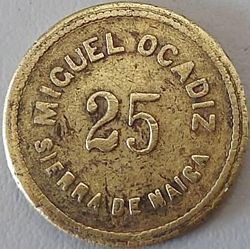
Obverse: MIGUEL OCADIZ / 25 / SIERRA DE NAICA
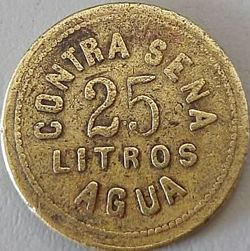
Reverse: CONTRASENA / 25 / LITROS / AGUA
Obverse: MIGUEL OCADIZ / 50 / SIERRA DE NAICA
Reverse: CONTRASENA / 50 / LITROS / AGUA
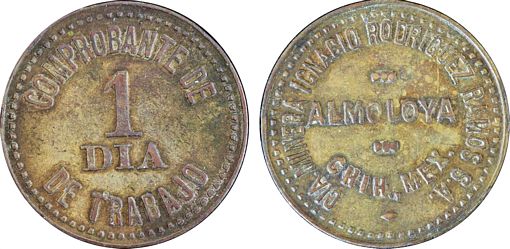
Grove 1729
Obverse: CIA. MINERA IGNACIO RODRIGUEZ RAMOS S.A. / ALMOLOYA / CHIH, MEX
Reverse: COMPROBANTE DE / 1 / DIA / DE TRABAJO
30 mm.
In 1903 it was reported that the Cocheño mine was paying its workers in fichas of 1, 2 and 4 reales to be used in the tienda de raya{footnote}MONEDA ILEGAL. – Se ha tenido noticia de que la Compañía beneficiadora de metales, dueña de la hacienda de Cocheño, en el Distrito de Rayón, Chihuahua, con objeto de obligar á sus trabajadores á que no hagan consumo mas que en la tienda de la hacienda, ha acuñado y puesto en circulación unas fihas de aluminio á las que se ha asignado el valor de uno, dos y cuatro reales, haciendo las rayas con esas fichas. Es de suponer que ese delito, penado por la ley y que encierra además un criminal abuso contra los infelices trabajadores, será castigado con todo el rigor que merece. (El Tiempo, Año XX, Núm. 5872, 8 May 1903){/footnote}.
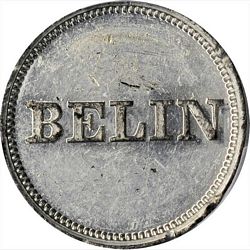
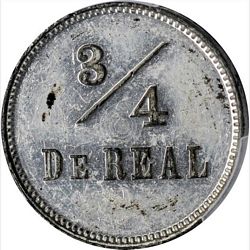
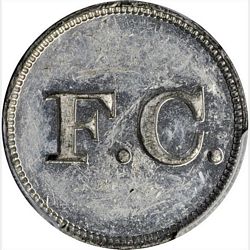
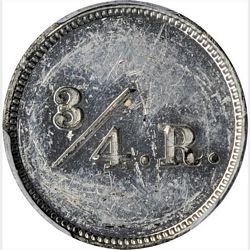
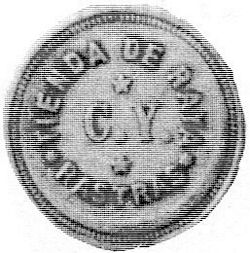
These were issued by the tienda de raya of Las Rastras. 'C. Y.' could be a reference to Clemente M. Ibarra.
All were produced by L. H. Moises of San Francisco.
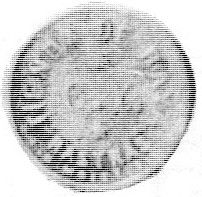
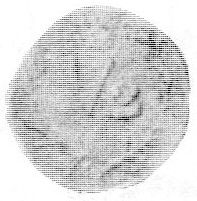
Rastras ½r
obverse: TIENDA DE RAYA / C. Y. / RASTRAS
reverse: ½
16mm brass
Rastras 1r
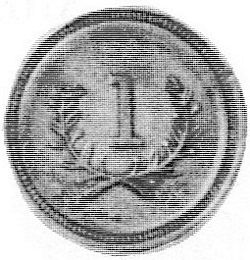
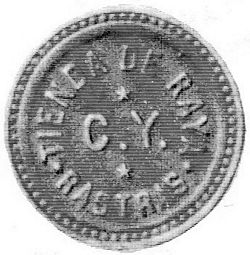
obverse: TIENDA DE RAYA / C. Y. / RASTRAS
reverse: 1
22mm brass
Rastras 2r
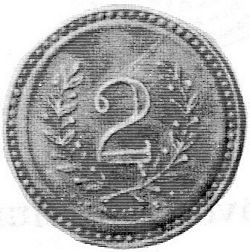
Grove 1955
obverse: TIENDA DE RAYA / C. Y. / RASTRAS within a dotted border
reverse: 2 within a wreath
29mm brass
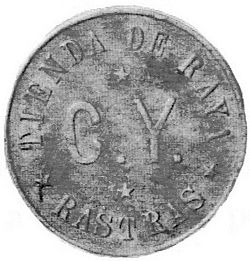
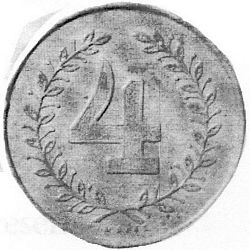
Rastras 4r
Grove 1956
obverse: TIENDA DE RAYA / C. Y. / RASTRAS
reverse: 4 within a wreath
34mm brass
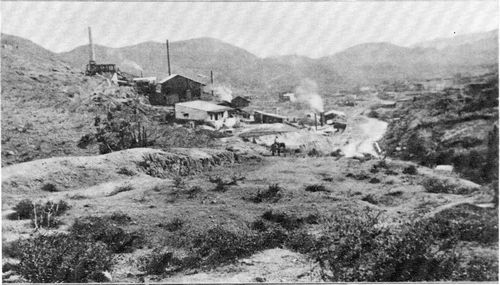
The Quintera Mine
This mine was situated at La Aduana, just west of Alamos. It was discovered in colonial days by a peon named Ouintero. A claim was filed by a local politician, Manuel Ambrosio Espinosa de los Monteros, who retained title until 1850, at which time it was transferred to Ignacio Almada who sold it in 1881 to McFarland & Morgan of New York for $210,000. They in turn sold it to the Franco-Egyptian Bank of Paris in 1894 who retained control at least until 1909 when work on a large scale was suspended.
In 1898 Brigido Caro, editor of El Sonorense, a newspaper published in Alamos, revealed that the mining company was monopolising the public water supply at La Aduana, denuding the hills of wood and timber and illegally paying its workers with scrip (cacharpas). Caro’s articles aroused people to demand that the abuses be corrected and with the aid of the state governor the mining company was forced to reform and pay a large indemnity to the city{footnote}Rachel French, Alamos Sonora’s Silver City, in The Smoke Signal, Spring 1962, Tucson{/footnote}.
The company issued metal tokens, manufactured by L. H. Moise of San Francisco. These are usually found with a counterstamp of a bull's head . Only one example each of the 5c and $1 are reported without the counterstamp. The Medio Pasaje token of Ocharan y Ca. exists with the Quintera counterstamp. It must be assumed that these were put to a later use on the ranches or stores of this mining company.
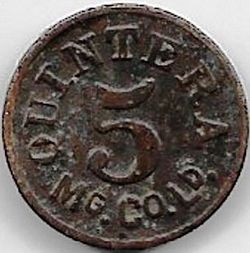
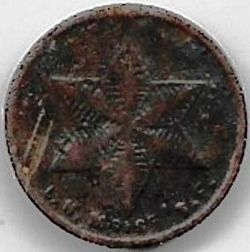
Grove 1732
Obverse: QUINTERA / MG. Co. LD / 5
Reverse: six-pointed star
15mm brass
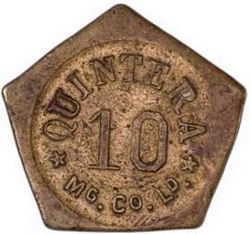
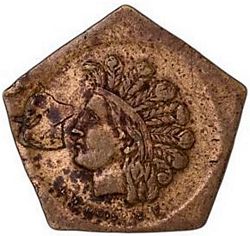
Grove 1733
Obverse: QUINTERA / MG. Co. LD / 10
Reverse: Indian head
22mm brass
Counterstamped with a bull’s head.
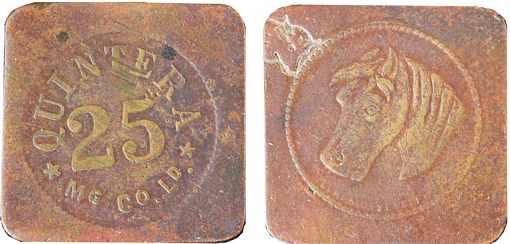
Grove 1734
Obverse: QUINTERA / MG. Co. LD / 25
Reverse: horse’s head
23mm brass
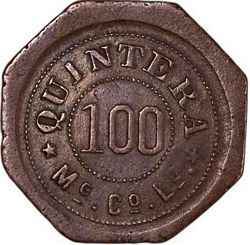
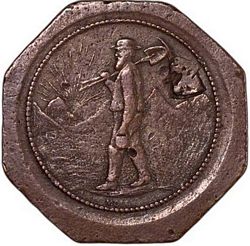
Grove 1734
Obverse: QUINTERA / MG. Co. LD / 100
Reverse: miner
30mm brass
Counterstamped with a bull’s head
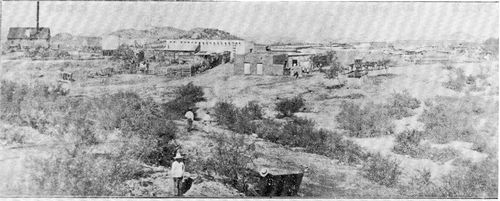
Panorama of the Mineral "El Tiro"
These mines, discovered about 1779, were located 48 kilometres south of Altar. The owner was Agustín. L. Serna.
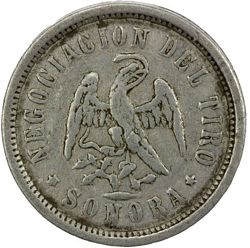
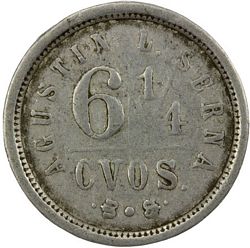
Grove 1778
Obverse: around Mexican eagle NEGOCIACION DEL TIRO / SONORA
Reverse: AGUSTIN L. SERNA / 6¼ / CVOS
20mm aluminium
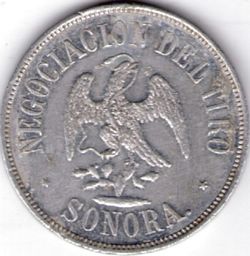
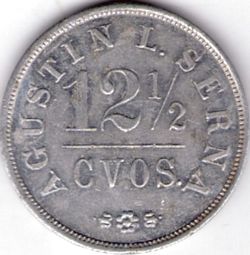
Grove 1779
Obverse: around Mexican eagle NEGOCIACION DEL TIRO / SONORA
Reverse: AGUSTIN L. SERNA / 12½ / CVOS
28mm aluminium
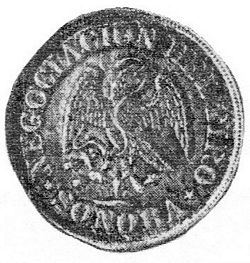
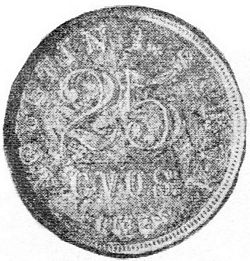
Grove 1780
Obverse: around Mexican eagle NEGOCIACION DEL TIRO / SONORA
Reverse: AGUSTIN L. SERNA / 25 / CVOS
28mm aluminium
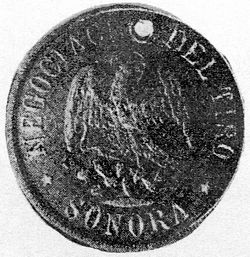
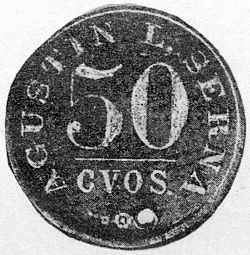
Grove 1781
Obverse: around Mexican eagle NEGOCIACION DEL TIRO / SONORA
Reverse: AGUSTIN L. SERNA / 50 / CVOS
35mm aluminium
José García Díaz, is listed as late as 1920, as a farmer and merchant.
Grove 1446
Obverse: J. GARCIA DIAZ / CANANEA / SONORA
Reverse: BUENO POR / 10¢ - MERCANCIA
25mm brass
Grove 1447
Obverse: J. GARCIA DIAZ / CANANEA / SONORA
Reverse: BUENO POR / 25¢ - MERCANCIA
29mm brass
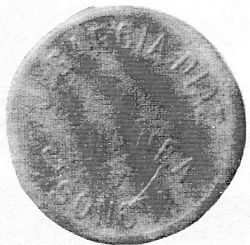
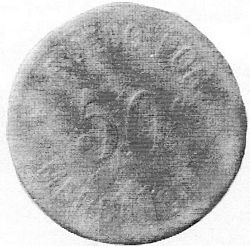
Obverse: J. GARCIA DIAZ / CANANEA / SONORA
Reverse: BUENO POR / 50¢ - MERCANCIA
31mm brass
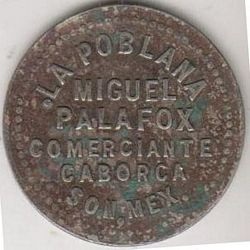
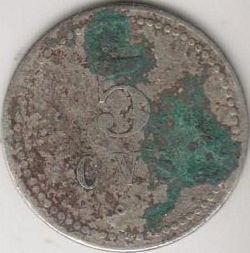
Obverse: LA POBLANA / MIGUEL / PALAFOX / COMERCIANTE / CABORCA / SON. MEX.
Reverse: 3 / CVS
Grove 1826
Obverse: LA POBLANA / MIGUEL / PALAFOX / COMERCIANTE / CABORCA / SON. MEX.
Reverse: 5 / CVS
26mm
Grove 1827
Obverse: LA POBLANA / MIGUEL / PALAFOX / COMERCIANTE / CABORCA / SON. MEX.
Reverse: 10 / CVS
27mm nickel
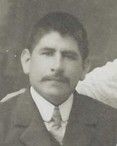 [if correct person] Miguel Palafox Garcia was born on 15 September 1885, in Puebla (hence the name of his store 'La Poblana'). He married Cruz Salcido Sesma on 3 March 1907, in Caborca and lived in Caborca in 1930. He died on 8 October 1949, at the age of 64.
On 17 June 1912 Miguel, as a comerciante, together with Juan José Carmelo, a miner, both from Caborca, applied for permission to work a local mine{footnote}El Estado de Sonora, Tomo III, Núm. 7, 23 July 1912{/footnote}.
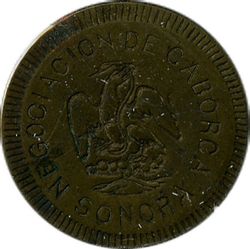
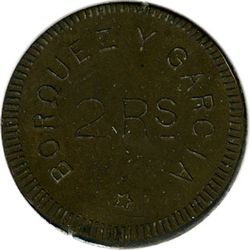
These brass tokens were issued about 1880, by the owners, Modesto Borquez and Benigno V. Garcia, dealers in grain, flour, and operators of the "Mina Grande", which produced gold and silver. Since these tokens call for redemption in Caborca, it is assumed that they were redeemed in a store in that locale. The 1 real exists also with a brand type counterstamp, attributed to a nearby ranch owned by López Santiago.
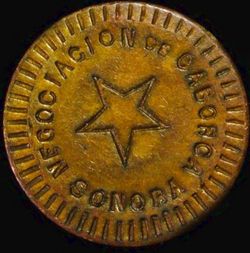
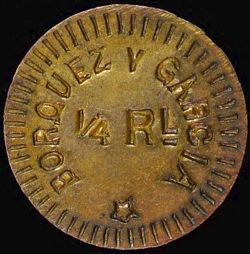
Grove 1766
Obverse: around a five-pointed star NEGOCIACION DE CABORCA / SONORA
Reverse: BORQUEZ Y GARCIA / ¼ RL
13mm brass
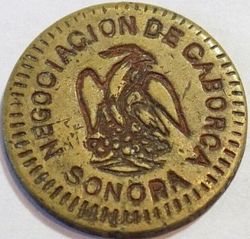
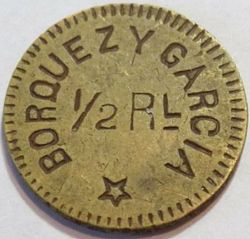
Grove 1767
Obverse: around a Mexican eagle NEGOCIACION DE CABORCA / SONORA
Reverse: BORQUEZ Y GARCIA / ½ RL
19mm brass
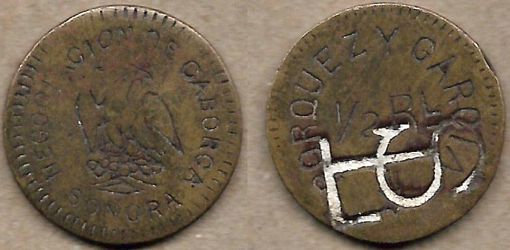
Obverse: around a Mexican eagle NEGOCIACION DE CABORCA / SONORA
Reverse: BORQUEZ Y GARCIA / ½ RL counterstamped SL
19mm brass
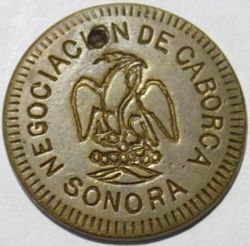
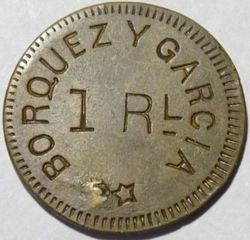
Obverse: around a Mexican eagle NEGOCIACION DE CABORCA / SONORA
Reverse: BORQUEZ Y GARCIA / 1 RL
25mm brass
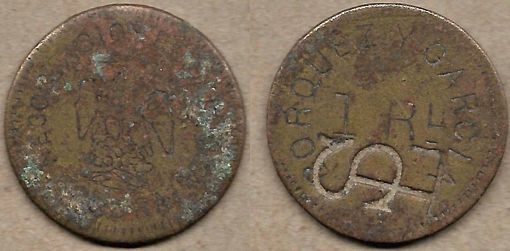
Grove 1768
Obverse: around a Mexican eagle NEGOCIACION DE CABORCA / SONORA
Reverse: BORQUEZ Y GARCIA / 1 RL counterstamped SL (López Santiago)
25mm brass
Grove 1769
Obverse: around a Mexican eagle NEGOCIACION DE CABORCA / SONORA
Reverse: BORQUEZ Y GARCIA / 2 RS
30mm brass
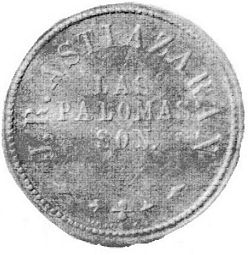
25c
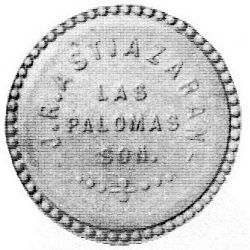
Obverse: J. R. ASTIAZARAN / LAS / PALOMAS / SON.
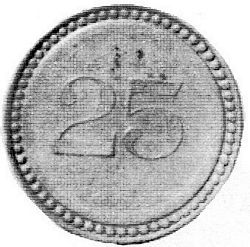
Reverse: 25
28mm brass
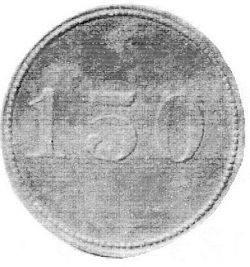
$1.50
Obverse: J. R. ASTIAZARAN / LAS / PALOMAS / SON.
Reverse: 1.50
35mm brass
These were produced by L. N. Moises of San Francisco.
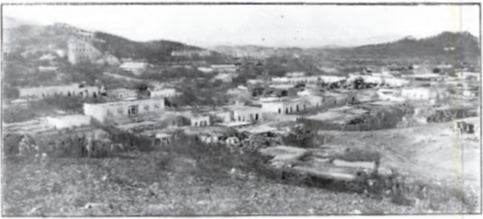
Panorama of Minas Prietas
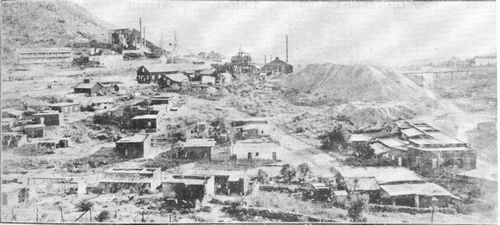
Panorama of La Colorada mine
Minas Prietas (now La Colorada) is situated 45 kilometres south east of Hermosillo. Gold was first discovered by Jesuit missionaries in the district in 1740, and mining began shortly thereafter. Mining continued until about 1745 but was terminated as a result of Yaqui Indian attacks. Spanish miners resumed work on the mines in 1790 and continued until they reached the water table at a depth between 30 and 60 metres. In 1860, an English company installed pumps and built a 48 stamp mill. In 1865, Mr Ricardo Johnson, with the financial backing of the wealthy Ortiz merchants of Hermosillo, obtained the El Creston, Minas Prietas and La Colorada Mines, and in the same year, Mr Pedro Monteverde located the Amarillas Mine and Mr. Juan Vasquez located the Gran Central.
For several years Johnson worked the site, but his presence did not lead to any formal settlement in the area. Like many Sonoran elites of the time{footnote}Other Sonoran notables, including Ramón Corral, Ignacio Bonillas, Pedro Negro, and Pedro Pinelli, also joined the early rush to claim mines at Minas Prietas ("History of Amarillas" The Oasis, 30 December 1899). Corral did not mind using public office to enrich himself and his close associates. In 1896 this group sold their interest to the Gran Central and made a handsome profit. The company retained the services of the governor as their consul and paid him $250 a month until 1906. (Biblioteca CRN-INAH, Libro de contabilidad “Crestón Colorado Co.”, Sep-Nov 1905){/footnote}, Johnson and his benefactors did not have any long-term interest in actually exploiting the mine but rather hoped to profit by selling it to foreign investors. In 1877 Johnson sold his holdings to a group of bankers from Cleveland, Ohio, who organized the Creston-Colorado Company. Johnson then built a 10 stamp mill on the Minas Prietas property. The property was subsequently sold to the Pan American Company of New York in 1888, who installed one of the first operating cyanidation plants. In 1895, the London Exploration Company purchased the Gran Central, Amarillas and La Verde Mines and constructed a 150 ton cyanide mill to treat ore and previously mined amalgamated tailings. The Mines Company of America acquired the Creston, Minas Prietas and La Colorada mines in 1902 and built a 400 ton cyanide mill. In 1913 they purchased the Gran Central, Amarillas and La Verde mines and built a 300 ton cyanide plant at Amarillas.
Besides these large-scale operations, the areas around the mines also included over one hundred separate mining claims operated by Mexicans and foreigners. Firms like the Pan American Mining Company operated smaller diggings in nearby hills{footnote}"Pan American Mining Company," The Oasis, 31 August 1895{/footnote}, while others bought and reprocessed tailings from the Crestón Colorada. This arrangement allowed smaller, less capitalised enterprises to profit.
At the Creston Colorada workers received a combination of wages and coupons (boletas) which they redeemed for products at the two company-operated tiendas de raya, the Prietas Store and the Gran Central Stores. Despite charging inflated prices for most basic items, the availability of credit continued to attract many workers. To circumvent the tienda de raya, many labourers began falsifying the boletas{footnote}AMLC, Presidencía, caja 1, Justicia, 1898-1904, March, 1897. Antonio Madrid arrested for false boletas{/footnote}: a lucrative black market in counterfeit boletas plagued the Gran Central Store{footnote}The Oasis, November 13, 1897{/footnote} and it abandoned the system after 1897 and paid its workers in cash.
In May 1900 a newspaper reported that the tienda de raya in Minas Prietas bought in the chits (fichas) with which workers were paid at a 25% discount{footnote}El Amigo de la Verdad, Puebla, Séptima época, Año XXIX, Tomo II, Núm. 99, 5 May 1900{/footnote} whilst another newspaper stated that they had replaced the fichas with boletos{footnote} “The Mexican government has notified the company store at La Colorada that the issue of "fichas," or tokens exchangeable for goods, is an act of government the same as coining money, and prohibited the practice. As a result the workmen who go to the store with their pay "boletos" take the goods directly, without using the "fichas," the rule being to punch from the "boleto" not less than one dollar in value and supplying goods to that amount. Under the old system the "fichas" were given when the “boleto” was presented, and the workman took the goods when he wanted them, exchanging the "fichas" therefor.” (The Oasis, Nogales, 9 June 1900){/footnote}.
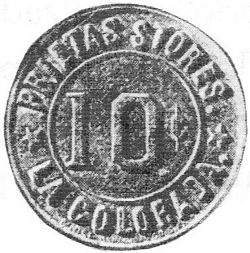
Grove 1923
Obverse: PRIETAS STORES / 10¢ - LA COLORADA
Reverse: same as obverse
30 mm brown plastic
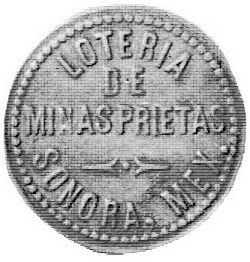
Obverse: LOTERIA / DE / MINAS PRIETAS / SONORA, MEX.
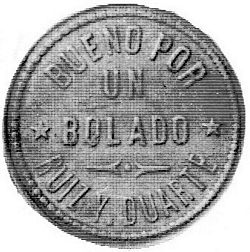
Reverse: BUENO POR / UN / BOLADO . RUIZ Y DUARTE
29mm brass
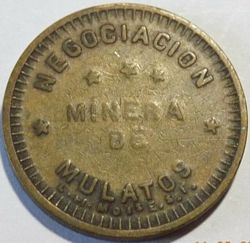
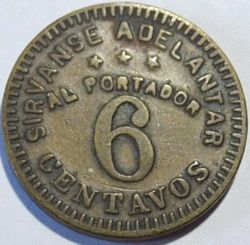
Grove 1775
Obverse: NEGOCIACION / MINERA DE / MULATOS
Reverse: SIRVANSE ADELANTAR / AL PORTADOR / 6 / CENTAVOS
24mm brass
Made by A. H. Moise, San Francisco
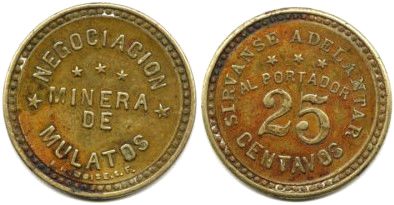
Grove 1776
Obverse: NEGOCIACION MINERA MULATOS 25¢
36mm Brown bakelite
Made by A. H. Moise, San Francisco
Grove 1777
Obverse: NEGOCIACION MINERA / DE MULATOS
Reverse: 1 - REAL
29mm white metal
This mine was located in Mulatos, county of Sahuaripa, north of La Trinidad. This was a gold producing property, employing 100 men. It used tokens made by Patrick & Co, San Francisco.
Grove 1736
Obverse: REY DEL ORO MINING CO. / MULATOS
Reverse: VALOR EN MERCS / SOLAMENTE / 5
22mm aluminum
Grove 1737
Obverse: REY DEL ORO MINING CO. / MULATOS
Reverse: VALOR EN MERCS / SOLAMENTE / 50
30mm aluminum
Grove 1950
Obverse: above a wreath TIENDA / DE / NACOSARI
Reverse: DIEZ CENTAVOS / VALOR EN / EFECTOS
18mm lead

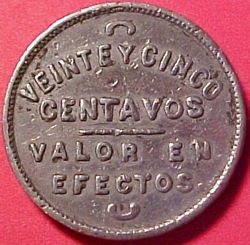
Obverse: above a wreath TIENDA / DE / NACOSARI
Reverse: VEINTE Y CINCO / CENTAVOS / VALOR EN / EFECTOS.
Obverse: above a wreath TIENDA / DE / NACOSARI
Reverse: CINCUENTA / CENTAVOS / VALOR EN / EFECTOS.
35mm. lead
Grove 1951
Obverse: above a wreath TIENDA / DE / NACOSARI
Reverse: UN PESO / VALOR EN / EFECTOS
39mm lead
Las Amarillas was a mine approximately five miles east of Puerto Penasco.
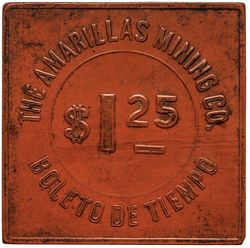
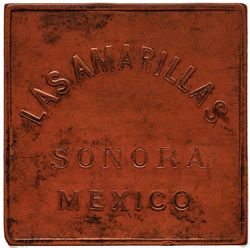
Obverse: THE AMARILLAS MINING Co. / $125 / BOLETO DE TIEMPO
Reverse: LAS AMARILLAS / SONORA / MEXICO
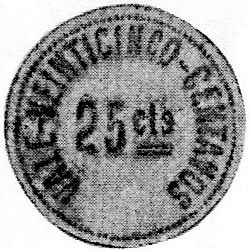
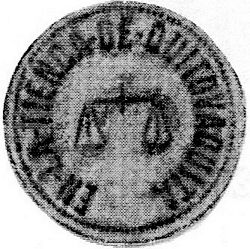
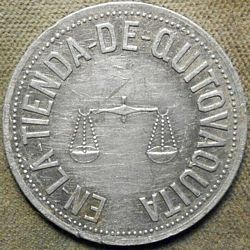
Grove 1953
Obverse: VALE VEINTICINCO CENTAVOS / 25 cts
Reverse: around a scale EN LA TIENDA DE QUITOVAQUITA
29mm aluminum
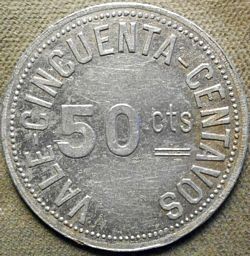
Obverse: VALE / CINCUENTA CENTAVOS / 50 cts
Reverse: around a scale EN LA TIENDA DE QUITOVAQUITA
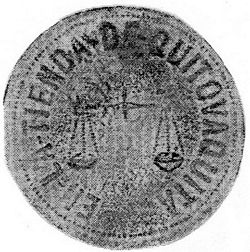
Grove 1954
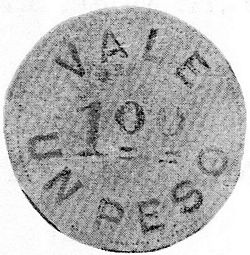
Obverse: VALE / 100 / UN PESO
Reverse: around a scale EN LA TIENDA DE QUITOVAQUITA
32mm aluminum
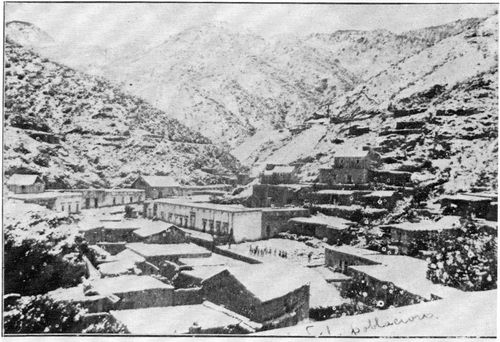
La Trinidad under a blamket of snow
The La Trinidad mines at Sahuaripa, 165 kilometres east of Hermosillo, had been owned and operated by the Matias Alzua family for many years, but in 1884 were sold to James Thomas Browne of England. Browne sold the property on to La Trinidad Limited of London for a handsome profit{footnote}AGHES, tomo [ ], caja 547: La Constitución, 5 October 1883{/footnote}. La Trinidad Limited, incorporated in 1884, issued 100,000 shares of stock at five pounds each.
The new owners of the La Trinidad mines immediately encountered several problems which hampered their operations and also suffered from poor working relations with the miners and the local townspeople, especially the merchants. Discontent erupted into a strike in February 1888. The labourers demanded more pay, claiming that one peso a day for work outside of the mines and one and a half pesos for work inside was too low. On the grounds that the miners were receiving the highest pay in any mining area, the company authorities refused to meet the demands, and attempted to break the strike by bringing in Yaqui miners plus other workers from outside the district. Although the strikers refrained from any violent actions, they cursed the strikebreakers who arrived on 15 February and hindered the operations of the company{footnote}AGHES, tomo 185, caja 606 letter District Prefect Loreto Trujillo to Governor Ramon Corral, 17 February 1888{/footnote}. Because the mine could operate at only partial capacity, the General Manager, Edmund Harvey, requested help from the presidente municipal, Antonio Encinas{footnote} distinguish between Antonio Encinas and senior alderman (Primer Regidor) Manuel Pablos Encinas, who encouraged the workers{/footnote}. Encinas relayed the message to the prefect of the district, Loreto Trujillo, who rode all night from Sahuaripa to arrive at La Trinidad on 16 February. Trujillo immediately posted a guard of twentyfive men to protect the mining properties and personally informed the general manager that his operations would not be harmed. After conferring with Harvey and Encinas, Trujillo arrested three of the leaders of the strike{footnote}AGHES, tomo 185, caja 606 letter Trujillo to Corral, 17 February 1888: letter Trujillo to Corral, 25 February 1888{/footnote}, and the following month they were sentenced to two months imprisonment for crimes against industry and commerce{footnote}Ramón Corral, Memoria de la Administración Pública del Estado, Hermosillo, 1891{/footnote}.
Before returning to Sahuaripa, Trujillo left orders for Encinas to notify him if any further disturbance occurred. Moreover, he had Encinas post a decree stating that any citizen who lacked an income should present himself for work under penalty of vagrancy. Included in the decree also was a declaration that any person or persons who attempted to employ the use of violence, physical or moral, for the purpose of increasing or lowering the wages of workers, or to impede the free exercise of industry, would be immediately apprehended{footnote}AGHES, tomo 185, caja 606 Manifesto 19 February 1888{/footnote}. Trujillo returned to Sahuaripa where he drafted a detailed report of the incident for the secretary of state. Governor Corral ordered Trujillo to continue to protect the mining operations and the official state newspaper, La Constitución, printed one short statement condemning the strike, and agreed with Edmund Harvey that La Trinidad Ltd. paid the highest wages in any mining district{footnote}La Constitución, 24 February 1888{/footnote}.
However, discontent continued and threatened to erupt into a violent clash between the workers and company officials. In addition to the complaint of low wages, the miners claimed that the company's established policy of payment in script, which could then be redeemed at local stores for goods, cheated them of their earnings. The company did not intentionally cheat the miners, but, unfortunately for the labourers, the English firm did not enjoy good relations with the local merchants, and only about half of them would accept the script. Those merchants who did accept the company's script discounted it as much as one-third of its value. Instead of seeking redress from the merchants, the miners blamed the company and demanded that they be paid silver each week{footnote}AGHES, tomo 185, caja 606 letter Trujillo to Corral, 22 February 1889{/footnote}. After the strike Harvey promised that he would reform the method of pay for the miners, but he delayed doing so for several months while tension mounted steadily among the workers. Finally, in a desperate attempt to alleviate the pressure which hampered the operations of the company, Harvey agreed to pay the workers each week, and he also established a company store where the labourers could purchase goods at cost price. Harvey's actions satisfied only one of the grievances and the majority of workers still demanded an increase in pay and now the local merchants became even more hostile because they resented the competition from the company store. The discontent affected the operations of the mines and production decreased considerably{footnote}ibid.{/footnote}.
Instead of requesting help from either the district or the state level or even from the British ambassador in Mexico City, Harvey bombarded the London office with complaints. Steward Pixley, the Chairman of Board of La Trinidad Limited, requested help from the English Minister of Foreign Affairs, Lord Salisbury. Salisbury's office contacted the English Ambassador to Mexico, Sir Spenser St. John, who informed the Mexican Minister of Foreign Affairs, Ignacio Mariscal, who in turn called upon the Secretario de Fomento, Manuel Fernández, who notified President Díaz about the problem confronting La Trinidad Limited. Díaz ordered that he wanted the labour disturbances to end{footnote}AGHES, tomo 185, caja 606, Manuel Fernández, Secretario de Fomento, to Corral, 12 January 1889{/footnote}. At the same time that Corral replied that he was aware of only one strike against the company and that one had been settled to the satisfaction of the company, he also ordered Trujillo to check into the matter{footnote} AGHES, tomo 185, caja 606{/footnote}. Trujillo, in turn, sent an inquiry to the local presidente municipal. About the time that Encinas replied with his report on conditions at La Trinidad, Harvey made his first report of the situation to the district prefect. Encinas informed Trujillo about the changes which the company had made in October and November concerning the pay of the workers and the company store which had been established for the miners and assured the prefect that the local authorities had and would protect the mining operation. According to Encinas, "the workers are much happier and only a small percent remain discontented but these are among the most ignorant and insignificant element{footnote}AGHES, tomo 185, caja 606 Encinas to Trujillo, 13 February 1889{/footnote}”. Contrary to the picture of tranquility which Encinas described, Harvey complained of a lack of guarantees by the presidente municipal and alleged that his company was the target of discontent within the community. Moreover, he complained that some of the leaders of the 1888 strike had returned to the area and were agitating those who worked in the mines{footnote}AGHES, tomo 185, caja 606 Trujillo to Corral, 22 February 1889{/footnote}.
On the basis of Encinas’ letter, Trujillo dismissed the complaints by Harvey and in his report to Corral, the district prefect wrote that Harvey and his attorney "yell strike at what has occurred since time immemorial in this mining area: that is, workers arrive for a week or more of work and when they have earned enough for their needs they return home for a number of days. Mr. Harvey calls this a strike{footnote}ibid.{/footnote}”. Trujillo accompanied his letter with that of Encinas which reported that no major difficulty existed at La Trinidad. Corral seemed satisfied with the general report. He agreed with the district prefect that Harvey's complaints were too vague and too general to stand up in court. "It is important," Corral wrote, "that Mr. Harvey knows that if Manuel Pablos Encinas or another person is promoting disturbances that concrete evidence must be obtained in order to prosecute. These acts must be proved before the law{footnote}AGHES, tomo 185, caja 606 Corral to Trujillo, 1 March 1889{/footnote}”
The comments by Trujillo indicated one of the major sources of irritation between the company officials and the miners. Used to a more dependable work force, Harvey and his staff could not, or would not, understand the Mexican attitude toward work. Most of the mining operations were in the mountainous regions away from settled communities. Frequently the miner would leave his family behind, but only until he had earned enough to sustain himself at which time he would return home to visit for several days. The Yaqui as well as the Mexican miners followed this custom, and consequently, the mining superintendent of the mines had difficulty in operating at full production capacity{footnote}AGHES, tomo 185, caja 606 Trujillo to Corral, 22 February 1889{/footnote}. Thus contrary to the report of Encinas, a clash between the miners and the company officials was imminent.
On 24 February 1889, just two days after Trujillo notified Corral that all was well at La Trinidad, a group of miners attacked several of the officials of the mining company. According to the company superintendent, Richard R. Hawkins, about eight o'clock at night while the mine superintendent, Mr. J. Fredenrick, sat on the front porch of his home talking with four or five other employees, a gang of half drunken natives appeared and began to insult the men in the grossest manner, calling them "gringos cabrones." When Fredenrick requested that they leave, the miners bombarded the house with rocks and drove the group inside. The superintendent and his friends barricaded the doors and "patiently awaiting succor stood the little band of pale determined men firmly grasping their revolvers determined to sell their lives dearly — They could have shot down scores and their self restraint is simply marvelous when you consider the ordeal through which they were passing"{footnote}AGHES, tomo 185, caja 606, Hawkins to Consul Alexander Willard, 25 February 1889{/footnote}. The noise attracted Hawkins and, with the cooperation of the local authorities, he organized a force to suppress the outbreak.
After this violent outburst, Harvey contacted Corral requesting that he induct the troublemakers into the military{footnote}AGHES, tomo 185, caja 606 Harvey to Corral, 26 February 1889{/footnote}. Corral replied that he could not grant this request but did apologize for the attack, stating that "it causes me much pain to see your business attacked and you can be assured that I shall see with the greatest interest that peace and guarantees are enjoyed by your company. I ordered Prefect Trujillo to see to it that those who attacked Fredenrick and his friends are punished with all the vigour of our laws{footnote}AGHES, tomo 185, caja 606 Corral to Trujillo, 7 March 1889{/footnote}". At the same time Corral sent a stinging rebuke to Trujillo instructing him to protect the mining company as he previously had been ordered. "I now repeat those orders to you and that those guilty be punished with all the vigour of the law”. Corral added that the prefect was to make sure the local judge understood the situation, and received the proper instructions concerning the sentence {footnote}ibid.{/footnote}.
Harvey wrote again to Corral explaining that the miners who continued to work for him could not enter town without being harassed by rock throwers, and that Encinas had done nothing to prevent the attacks. He further complained about the erratic work habits of the miners which caused the company. to run at half capacity{footnote}AGHES, tomo 185, caja 606 Harvey to Corral, 16 March 1889{/footnote}. Even if Corral had demonstrated his willingness to protect the mine’s property, he realized the futility in trying to alter work habits which had developed over many decades. So he replied that he knew of no law which obliged a man to work for a determined number of days a week. In regard to Encinas, Corral suggested that the general manager use his influence in the municipal elections scheduled in August{footnote}AGHES, tomo 185, caja 606 Corral to Harvey,26 March 1889{/footnote}.
The company's total lack of knowledge of local customs became even more apparent when Harvey returned to England in late April 1889 {footnote}One of Harvey's letters to the home office in London clearly demonstrated his inability to make judgments. According to the Englishman, "the present Governor has no love for foreigners (Gringos as we are called.). If a Mexican wants anything even if it is out of the common, he gets it at once but we get nothing . . . (FO, F. 0. 50, vol. 472, Edmund Harvey to Stewart Pixley,1 October 1888, quoted in Stewart Pixley to Sir T. V. Lister,26 February 1889). However, in reality Corral worked to attract foreign companies to Sonora and always cautioned the local authorities "to give all kinds of guarantees to the mining companies." (AGHES, tomo [ ], caja 651 Corral to the mayor of Minas Prietas, 12 December 1892: tomo 185, caja 606, Corral to Trujillo, 7 March 1889). The company’s attitude is also demonstrated by the superintendent, Richard R, Hawkins, who could write “The La Trinidad Limitada have always treated their native employees in an exceptionally kind and liberal manner. Not only do we pay higher wages than elsewhere in Mexico but we have opened a general store where all of our workmen can purchase supplies of every description at the cost price to us, an excess of liberality unparalleled in Mexican mining history. Our treatment of the men has been really patriarchal, and this outbreak is consequently inexcusable (AGHES, tomo 185, caja 606, letter to US consul, Guaymas 25 February 1889 my italics){/footnote}. The general manager reported that the problems which confronted the mining company in Sonora stemmed from the local authorities not carrying out the orders of the district prefect. Pixley, the chairman of the board, forwarded Harvey's comment to Lord Salisbury and requested that the minister of foreign affairs use his influence with the Mexican government to obtain a favourable appointment to the position of muicipal president at La Trinidad{footnote}FO, F. 0. 50, vol. 472 Stewart Pixley to Foreign Office, 29 April 1889{/footnote}. Ambassador St. John, who answered Pixley, informed the chairman that municipal positions were arranged at the state level and not the national level and the ambassador suggested that the company give pecuniary assistance to the local authorities to prevent further difficulties. "Mexican officials are so poorly paid, that they will always aid a foreign company that has no objection to making their position more endurable{footnote}FO, F.0. 50, vol. 468 Spencer St. John to Sir T. H. Sanderson, 4 May 1889{/footnote}".
In spite of Corral's efforts to alleviate the problems of La Trinidad Limited, the mining operations folded in 1893 and the property reverted to the Alsua family{footnote}SD papers, J. Alexander Forbes to secretary of state. May I, 1893, "Consular Despatches, Guaymas," roll 9{/footnote}.
(this section is based on "Sonora in the Age of Ramon Corral, 1875-1990", by Delmar Leon Been, a dissertation submitted to the University of Arizona, 1972)
Grove 1982
Obverse: LA TRINIDAD / LIMITED / 1 / SONORA. MEXICO
Reverse: same as obverse
19mm aluminum
Grove 1983
Obverse: LA TRINIDAD / LIMITED / 2 / SONORA. MEXICO
Reverse: same as obverse
25mm aluminum
Grove 1984
Obverse: LA TRINIDAD / LIMITED / 4 / SONORA. MEXICO
Reverse: same as obverse
30mm white metal

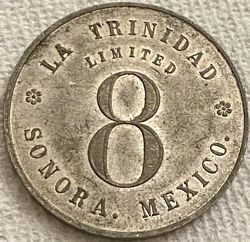
Grove 1985
Obverse: LA TRINIDAD / LIMITED / 8 / SONORA. MEXICO
Reverse: same as obverse
39mm white metal
Verrey{footnote}Claudio Verrey Casillas, Fichas de Sonora,{/footnote} records a 8 reales coin but with the lettering incuse.
All specimens have been seen counterstamped with the monogram 'TMC' for the Trinidad Mining Company.
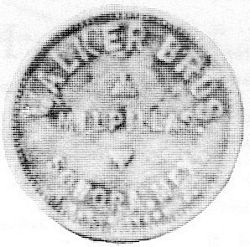
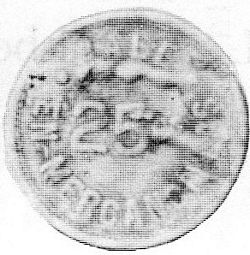
Walker Bros 25c
obverse: WALKER BROS. / MILPILLAS / SONORA, MEX.
reverse: VALE / 25 / EN MERCANCIAS
24mm aluminium
obverse: WALKER BROS. / MILPILLAS / SONORA, MEX.
reverse: VALE / 50 / EN MERCANCIAS
32mm aluminium
These were produced by the L. A. Rubber Stamp Co.
Verrey{footnote}Cladio Verrey Casillas, Fichas de Sonora{/footnote} places this as a ranch in Bavispe.
This U. S. company was established in 1908 to exploit the Promontario group of mines in San Antonio de la Huerta, Ures.
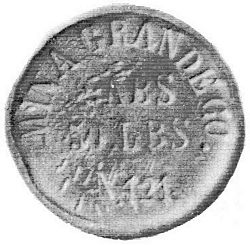
Mina Grande 50 libras
50 libras de carga
obverse: MINA GRANDE CO. / [ ]S / 50 LBS / N 121
reverse:
30mm. brass
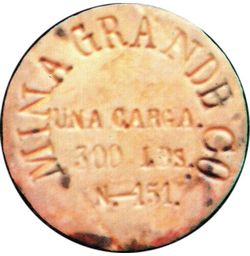
Minas Grande 300 libras
500 libras de carga
obverse: MINA GRANDE CO. / UNA CARGA / 200 LBS / N-151
reverse:
44mm. brass
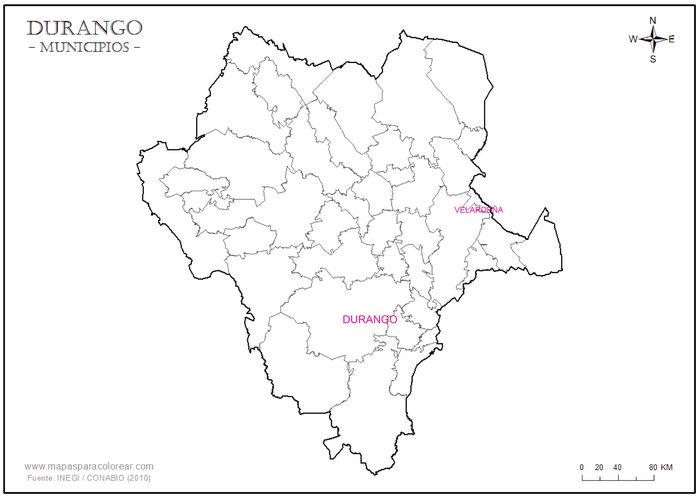
Grove 1738
Obverse: CIA MINERA SAN ANDRES DE LA SIERRA / 1
Reverse: VALE EN EFECTOS EN LA TIENDA DE RAYA / 1
18mm. white metal
Grove 1739
Obverse: CIA MINERA SAN ANDRES DE LA SIERRA / 2
Reverse: VALE EN EFECTOS EN LA TIENDA DE RAYA / 2
24 mm. white metal
In 1890 the company employed 1,282 men with a weekly payroll of between $5,000 and $6,000{footnote}Memoria de la Secretaría de Fomento, [ ]{/footnote}. In October 1899 it was reported that people in San Andrés de la Sierra were complaining that this company made their payroll every six weeks with the object of forcing workers to take out credit with the tienda de raya. A Mexico City newspaper hoped that this terrible injustice would be remedied{footnote}El Popular, Mexico, 13 October 1899{/footnote}.
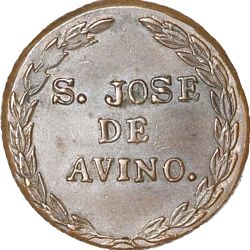
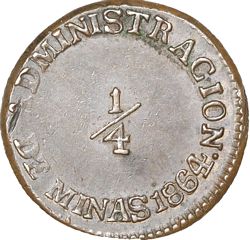
Grove 1740 San José de Avino ¼ 1864 (Briggs & Bustos auction, 11 April 2023, lot 208)
Grove 1740
Obverse: S. JOSE / DE / AVINO
Reverse: ADMINISTRACION / ¼ / DE MINAS 1864.
20 mm. bronze
The 'E' in José was first punched with an 'F' and then the lower serif was hand engraved.
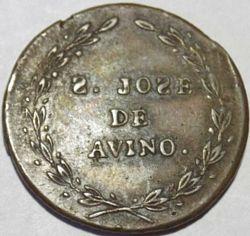
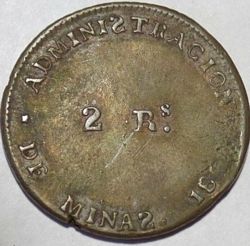
Grove 1741
Obverse: S. JOSE / DE / AVINO. (S reversed)
Reverse: ADMINISTRACION / 2 RS / DE MINAS 1864 (both S reversed)
28 mm. bronze
Grove 1742
Obverse: S. JOSE / DE / AVINO. (S reversed)
Reverse: ADMINISTRACION / 2 RS / DE MINAS 1864 (both S reversed) counterstamped AO
28 mm. bronze
Grove 1743
Obverse: S. JOSE / DE / AVINO.
Reverse: ADMINISTRACION / 1 PESO / DE MINAS 1864
38 mm. bronze
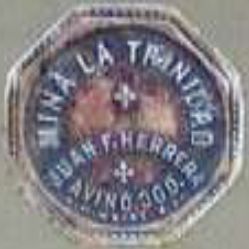
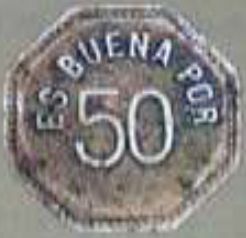
Grove 1750
Observe: MINA LA TRINIDAD / JUAN F. HERRERA / AVINO, DGO.
Reverse: ES BUENO POR / 50
27mm.
made by L. H. Moise, S. F.
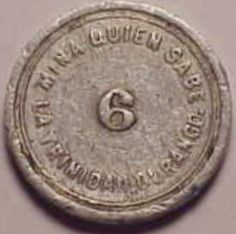
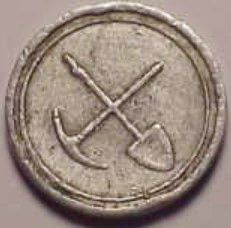
Observe: MINA QUIEN SABE / 6 / LA TRINIDAD DURANGO.
Reverse: pick and shovel
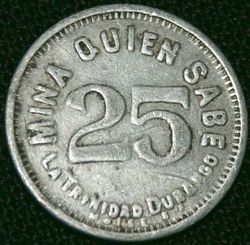
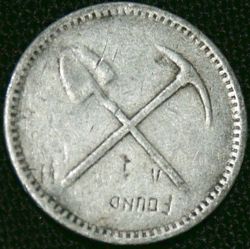
Observe: MINA QUIEN SABE / 25 / LA TRINIDAD DURANGO
Reverse: pick and shovel
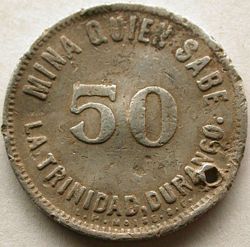
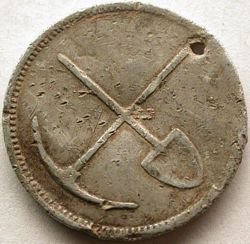
Observe: MINA QUIEN SABE / 50 / LA TRINIDAD DURANGO.
Reverse: pick and shovel
These were made by L. H. Moise of San Francisco.
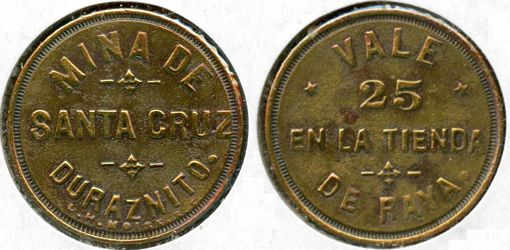
This was operated by the Santa Cruz Mining Company of San Antonio, Texas.
Grove 1744
Obverse: MINAS DE / SANTA CRUZ / DURAZNITO,
Reverse: VALE / 5 / EN LA TIENDA / DE RAYA
22 mm. bronze
Grove
Obverse: MINAS DE / SANTA CRUZ / DURAZNITO,
Reverse: VALE / 25 / EN LA TIENDA / DE RAYA
Grove 1745
Obverse: MINAS DE / SANTA CRUZ / DURAZNITO,
Reverse: VALE / 100 / EN LA TIENDA / DE RAYA
22mm. bronze
These were produced by L. H. Moise, S. F.
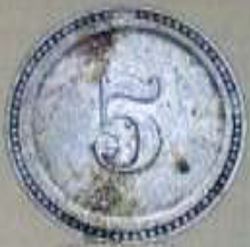
Grove 1992
Obverse: FAVELA HERMANOS / LA UNION / MAPIMI DGO MEXICO
Reverse: 5
25mm. nickel
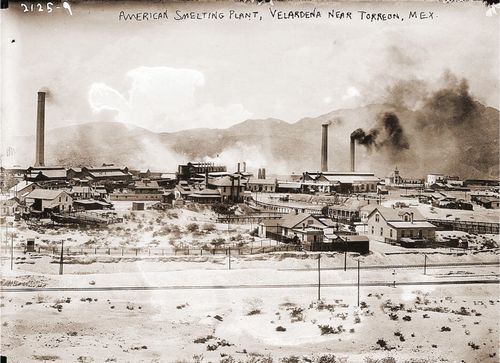
Velardeña is a mining centre situated in Cuencamé, Durango, established by a concession of the Porfirista government on 15 May 1893 to the Velardeña Mining and Smelting Company. In 1905 the company was acquired by a mining syndicate (later known as American Smelting and Refining Co. (ASARCO)) and this, represented by Rafael Prado, was granted a new concession on 17 October 1905.
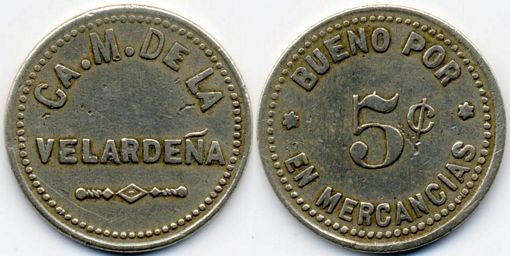
Grove 1997
Obverse: CA. M. DE LA / VELARDEÑA
Reverse: BUENO POR / 5¢ / EN MERCANCIAS
20mm. nickel
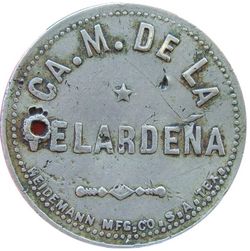
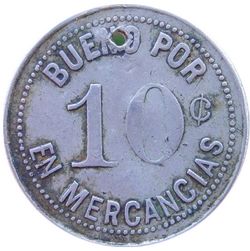
Grove 1998
Obverse: CA. M. DE LA / VELARDEÑA
Reverse: BUENO POR / 10¢ / EN MERCANCIAS
25mm. nickel
Grove 1999
Obverse: CA. M. DE LA / VELARDEÑA, counterstamped M
Reverse: BUENO POR / 10¢ / EN MERCANCIAS
25mm. nickel
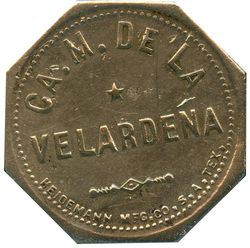
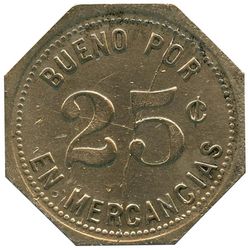
Grove 2000
Obverse: CA. M. DE LA / VELARDEÑA
Reverse: BUENO POR / 25¢ / EN MERCANCIAS
25mm. nickel. octagonal
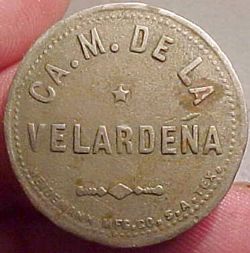
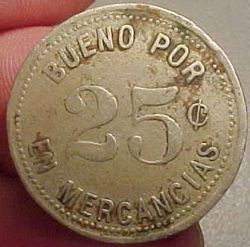
Obverse: CA. M. DE LA / VELARDEÑA
Reverse: BUENO POR / 25¢ / EN MERCANCIAS
round
These were maid by the Heidemann Manufacturing Company of San Antonio, Texas.
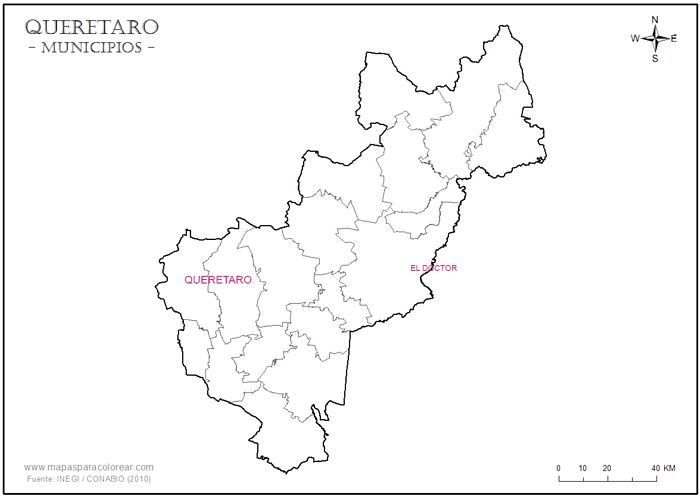
The mining town of San Antonio El Doctor is located 47 kilometres north of Cadereyta de Montes. Rich silver deposits were discovered by Spanish Conquistadors around the year 1557 and in 1728 the San Juan Nepomuceno mine entered into production. From that date till the War of Independence in 1810, El Doctor became one of the principal producers of silver in the country.
This mining company issued a series of tokens to be used in the tienda de raya.
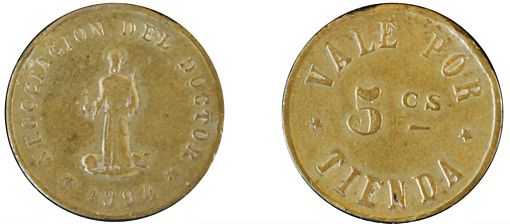
Grove 1770
Obverse: NEGOCIACION DEL DOCTOR / 1894
Reverse: VALE POR / 5cs / TIENDA
20 mm. brass
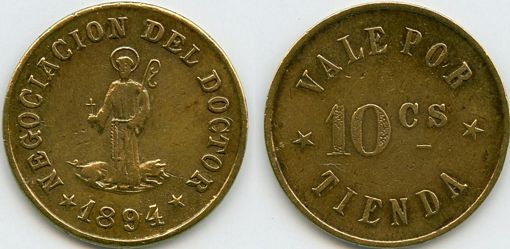
Grove 1771
Obverse: NEGOCIACION DEL DOCTOR / 1894
Reverse: VALE POR / 10cs / TIENDA
21 mm. brass
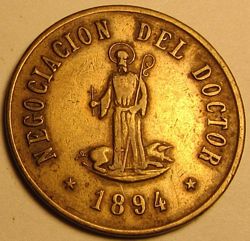
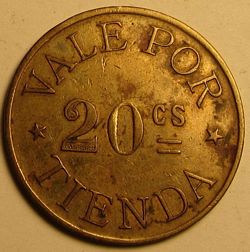
Grove 1772
Obverse: NEGOCIACION DEL DOCTOR / 1894
Reverse: VALE POR / 20cs / TIENDA
30 mm. brass
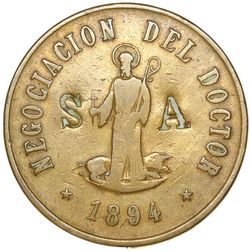
Grove 1773
Obverse: NEGOCIACION DEL DOCTOR / 1894, counterstamped S A
Reverse: VALE POR / 20cs / TIENDA
30 mm. brass
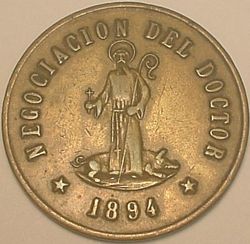
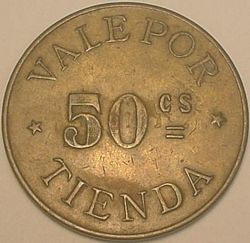
Grove 1774
Obverse: NEGOCIACION DEL DOCTOR / 1894
Reverse: VALE POR / 50cs / TIENDA
35 mm. brass
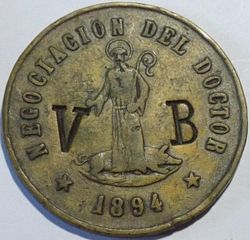
Obverse: NEGOCIACION DEL DOCTOR / 1894 counterstamped V B
Reverse: VALE POR / 50cs / TIENDA
35 mm. brass
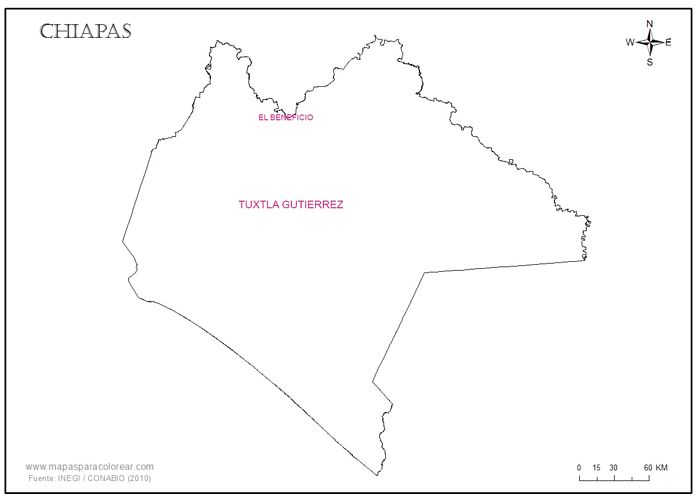
The Chiapas Mining Company was registered in London on 26 April 1889 with a capital of £250,000. It operated the La Providencia and Santa Fe mines, situated in El Beneficio, a community located in the foothills of the northern highlands of Chiapas, from 1889 to 1905.
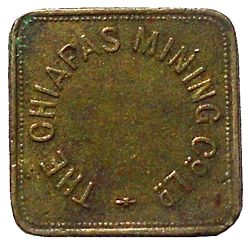
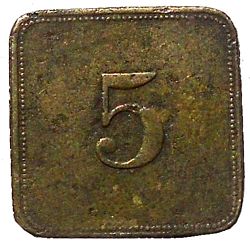
Obverse: THE CHIAPAS MINING CO LD
Reverse: 5
brass
Grove 1731
Obverse: THE CHIAPAS MINING CO LD
Reverse: 50
28mm.