These coins were only known by their description in the work of Manuel Romero de Terreros, Monedas de Necesidad de Michoacán{footnote}{/footnote}. The first one was listed by Romero de Terreros with the number 127 (MRDT 127) in his 1940 work and later referred as ZA. 14 in the annex to Bolrtín 7 of the Sociedad Numismática de México in 1955. No reference to these coins has been made by other authors, including the most important ones on the subject: Mauricio Fernandez, Russel Rulau, Miguel L. Muñoz, Frank W. Grove, Francisco A. Pradeau and Claudio Verrey.
In both Romero de Terreros catalogs the coins appear without images. I knew that the Banco de México had acquired the numismatic collection of Manuel Romero de Terreros, and assuming that the coins described in his books now belonged to the collection of the institution, I made an exhaustive search in it without any luck: the MRDT 127 coin is not part of the collection of the Banco de México.
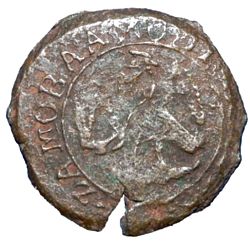
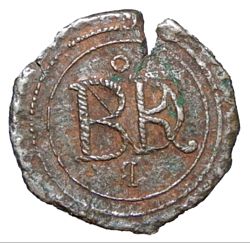
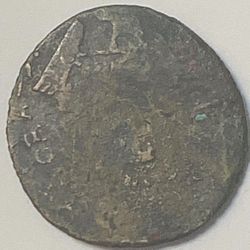
⅛ ZAMORA AÑO D 18(??) MRDT#127
Fortunately, in January 2015, one of these coins came to my hands and now I would like to share it with the numismatic community.
OBVERSE: The inscription: ZAMORA AÑO D 18 ?? (“D” is shaped as a monogram together with the letter “E”) surrounding a circle within which is located the Mexican national shield.
REVERSE: Inside two concentric circles a monogram with the letters “BNFRD” above a small circle which is generally assumed to be the letter “O”. Below the monogram we can see a capital letter “R” backwards.
Romero de Terreros says the date is 1850. However, the evidence that is going to be presented on the next coin suggests that it rather be 1830, as does the existence of very similar designs during that decade. Other pieces of the same municipality as the MRDT 120 and 121, also listed by Mauricio Fernandez Garza{footnote} Mauricio Fernandez Garza, Moneda Municipal y su Contecto Histórico, 2014{/footnote} are dated 1833. Regarding the monogram on the back, although it is very clear, I cannot conclude on a word or a last name that could be formed with the letters BNFRD. That is why I believe that it is probably an acronym.
The second coin also not shown so far, and not found in the Banco de México collection, was also cataloged by Romero de Terreros. This piece, unlike the former one, does not have the name of the town (Zamora) but Romero de Terreros included it in the book under the section ‘Zamora’ with the following number: MRDT 118 in 1940 and ZA.6 in the 1955 print.
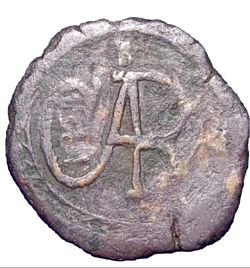
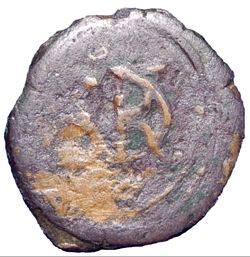
⅛ Zamora 1837 MRDT #118
OBVERSE: Within two concentric circles with ornaments a monogram with the letters “CARD”. Inside the letter “C” reading up from bottom to top the date 1837. Above the monogram is placed a small number “8”.
REVERSE: Within two concentric circles is a monogram with the letters “BNFRD”: above it has a small circle which is generally considered to be the letter “O” (The same reverse as MRDT 127).
Although the second piece is in a very low state of conservation, it is possible to make out that the reverse is exactly the same in both coins.
Romero de Terreros said that he could read on the MRDT 118 coin the letters “FRNADE”. Those letters share “NFRD” with the MRDT 127: that is the reason why I believe that probably the coin that Romero de Terreros had could have deteriorated and so he could not conclude that the reverse was the same on both pieces. He also said that the date is 1839, but the design of the number “7” can be easily confused with a number “1” or a “9”. That does not mean that the 1839 coin does not exist: both dates are possible.
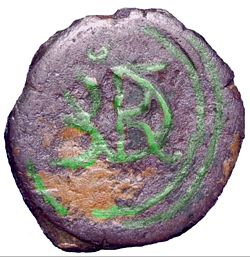
Comparison of monograms in both pieces
In the most damaged coin I have highlighted in green elements to facilitate comparison. I consider this evidence helps us to conclude that the second coin also belongs to Zamora even though the name of the city does not appear on the coin. The reason why Romero de Terreros concluded its origin is unknown to us: however, he was right to say that the second also belonged to Zamora.
The “oldest coin of Sonora” was revealed to the world in 1959 by Dr. Alberto Francisco Pradeau in The Numismatist (Vol. 72, No. 4); it was the only specimen known of this rare cuartilla for almost two decades, included in multiple catalogs ever since, and ultimately in the Banco de México’s National Numismatic Collection (Moneda Nacional No. 14944). In August 1977, a second coin came to light in an article written by Carlos Lucero Aja in the magazine Siluetas n°17 of the newspaper El Imparcial of Hermosillo{footnote} also, in the bulletin Numisnotas of 1989 produced by the Numismatic Society of Sonora, A.C.{/footnote}. By comparing these two specimens, Mr. Lucero deciphered for the first time the entire legend: QUARTO D. R. AYUNT. Ð. P. — short for “QUARTO DE REAL AYUNTAMIENTO DEL PITIC” (¼ Real Town Hall of Pitic{footnote}Pitic was the earlier name of Hermosillo. The name was changed by decree of 5 September 1828, to honour General José María González de Hermosillo, a soldier of the War of Independence.{/footnote}).
As of today, eight examples of this rare coin are known, all poorly struck, some corroded and none showing a complete legend; despite these limitations, their key identifiable features have been clearly ascertained. Centered inside of an inner ring, the general design of the obverse shows a relatively large crowned date 1821. (with an ending dot), situated over a range of three hills tilted to the left. Some examples show portions of a second ring enclosing the legend that runs all around in capital letters. Perhaps the design always included this outer ring but it was not always achieved due to flan inconsistencies and improper hammering technique.
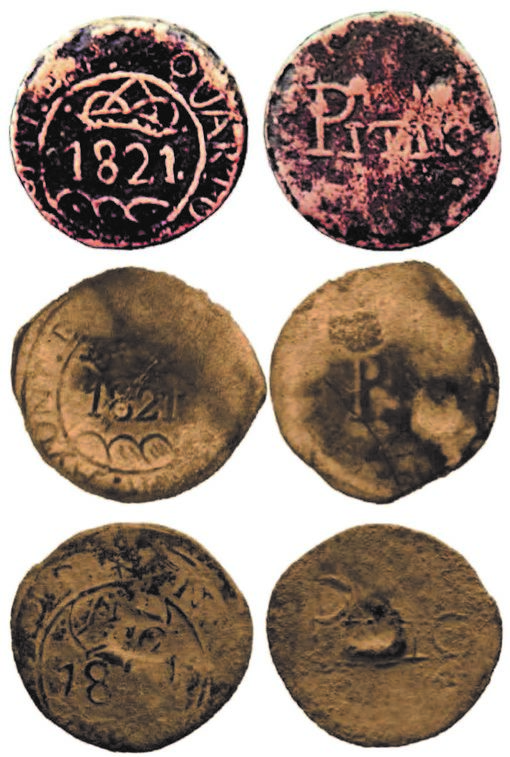
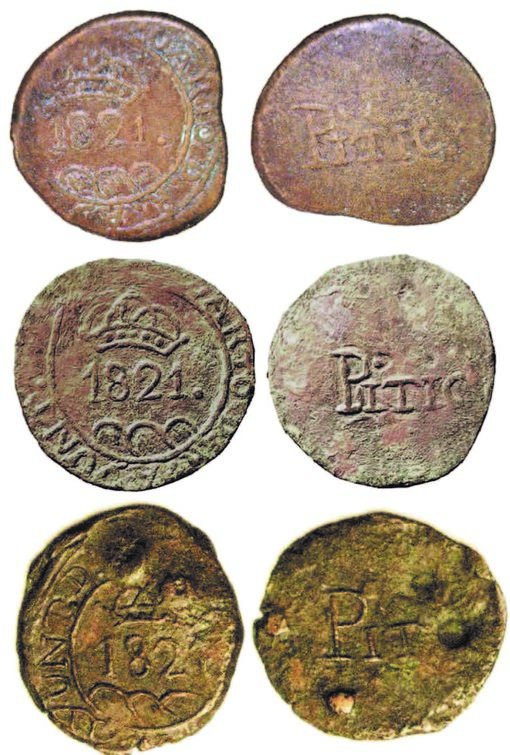
Best-known examples of the Sonora Jola 1821
Despite there being only eight specimens, different dies can be discriminated. There are significant variations in the size and alignment of numbers — clearly illustrated by the “21” being above one or two hills — and in the orientation of the legend relative to the central elements — one example clearly shows the letters “NT” (of “AYUNT.”) instead of “QUART” at the right side. Some small elements seem fused — as with the dots on the crown — suggesting die wear. The reverse shows only the word “PiTic.” with capitals only for “P” and “T”, in various sizes. In some examples, the dot at the end seems missing. Measurements from four examples indicated a range of 20 to 22mm in diameter, 1.3 to 1.75mm in thickness, 3.25 to 4.55gr in weight and plain edge.
The term “Jola” was commonly used in the 19th century throughout the northern provinces of New Spain (later, Mexico) to refer to all kind of small copper change in circulation. Dave Busse and Thomas Reid in Numismatic Terms of the República Mexicana described it as: a term for privately issued tradesman’s tokens. The Diccionario de Mexicanismos (Mexicanisms Dictionary) of 1895{footnote}Feliz Ramos I. Duarte and Ricardo Gomez. Diccionario de Mexicanismos, 1st ed. 1895; 2nd ed. 1898, Mexico.{/footnote} says: Jola (chih.), af. money, coin. “Is a man of many jolas,” as for “Is a rich man” ...;... Jo (Sin.), sm. Cuartillo (coin valued at three cents of a peso); its second edition of 1898 reads: Jola (Dur.), sf. Peso, coin. In Chihuahua, people use jola for tlacos and cuartillos{footnote}“jo” is short for “Jola”, “chih.” for “Chihuahua”, “Sin.” for Sinaloa” and “Dur.” for “Durango”{/footnote}. The word Jola (Joles or Jolas, plural) is an apheresis of the Latin word “Pecuniola” (small money), survivor of the Castilian Latin used by Jesuit missionaries of the northern provinces of New Spain, where the Latin “i” of “Iola” became a written consonant “J”{footnote}Horacio Sobarzo. Vocabulario Sonorense, Instituto Sonorense de Cultura, Sonora, 1991.{/footnote}. While at least ten states, uncountable municipal governments and an endless number of trades (professions, stores, haciendas, bridges, plazas) struck copper coins locally throughout Mexico with diverse names and values — tlacos, señales, cacharpas, clacos, pilones, avitos, prietos, brujes, güitones, chavos, tanteos, tareas, chicas, fichas, butuchis{footnote}Alberto Francisco Pradeau. Historia Numismática de México de 1823 a 1950, Tomo II. 1st. ed. Mexico, 1960.{/footnote} — some northerner towns in the 19th century seems to have favored the appellative “Jola”.
The term “Jola” is found in Northwestern American and Mexican newspapers. The Sacramento Daily Union of 12 January 1861 reads:
The Currency of Sonora.-- A correspondent of the Bulletin, writing from Hermosillo, Sonora, November 28th, says: Pesqueira is still here, and employed in arranging the momentous affairs of the “jolas,” which has occupied the undivided attention of the mercantile community for the last week. ...;... The alleged condition of the contract with the Mint, which will begin coining to-morrow, is the issue of $60,000 in jolas, at one dollar per pound.
The Sonora newspaper La Estrella de Occidente of 22 March 1867 reads:
The Jolas, Commerce and the poor. Hermosillo, March 20th 1867. The scarcity of Jolas is insufferable and even more with the low value commerce takes them ...;... Commerce is without a doubt the major tyrant oppressing the poor, and the copper coinage is a very good venue to dissimulate this tyranny. The big merchants speculate so much with the jolas, it makes me wish the government could remove them for good.
Early travelers of Mexico such as Josiah Gregg in his “Commerce of the Prairies (1831-1839)”{footnote} Reuben Gold Thwaites. Early Western Travels 1748-1846, vol. II, Arthur H. Clark Company, Ohio, 1905.{/footnote} wrote:
The Mexican money table is as follows: 12 granos make I real; 8 reales, I peso, or dollar. These are the divisions used in computation, but instead of granos, the copper coins of Chihuahua and many other places, are the claco or jola (1/8 real) and the cuartilla (1/4 real).
In his classic article of 1999, James Ehrardt writes about another copper coin called Jola: The Texas Jola. Here a Spanish document describes how these Jolas were petitioned to the local authorities of the presidio of San Fernando de Bexar — capital of the colonial province of Texas in 1818:
This shall be the equivalent of the 2nd stamp of the Señor don Fernando the 7th, year of 1818. Senor Governor: don Jose Antonio de la Garza, Postmaster of this city, appears before your lordship and states that the extreme scarcity of small change which we are experiencing in this land results in a notable harm to the public. Inasmuch as I wish to provide for this lack in so far as my means will permit, I have decided to make up to the quantity of five hundred pesos of small change in copper coins called jolas, which shall circulate only through the town with values of one half of a real each. These shall be engraved with the first letters of my name and surname and the year of this date. For this purpose I shall give the necessary bonds on the terms your Lordship should order. I entreat your Lordship to be pleased to grant me the necessary permission, if there should be no just cause to hinder it, so that this may be carried out, and this money may circulate as soon as possible.
San Fernando de Bexar, November thirtieth of one thousand eight hundred and eighteen. Jose Antonio de Ia Garza.
Six Texas Jolas dating 1817 are known and about 100 dating 1818{footnote}Mauricio Fernandez Garza. Las Monedas Municipales y su contexto historico, 2nd. ed. Mexico, 2014.{/footnote}. Despite their exclusive local appreciation, these Jolas circulated throughout the regions of the newly independent Mexican Republic. The first 1817 Texas Jola was discovered in the state of Guerrero in the 1960s. Other Texas Jolas have been found in Goliad (Texas).
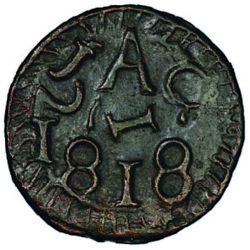
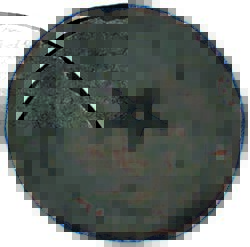
Texas Jola 1818 (1/2 real, José Antonio de la Garza initials [KMTn1])
[Heritage Auction #1298]
The “Statistical Memorial of the State of Occidente” published in 1828{footnote}Pradeau. ibid.{/footnote} mentions another colonial Jola: In all the province of Sinaloa circulates, for the small traffic, the copper coinage made in Durango with the name of jolas or tlacos. These Jolas made at Durango are the copper Octavos we know today (1/8 real KM60) carrying dates from 1812 to 1818. José Antonio Juárez Muñoz, in his book Reseñas Históricas de la Casa de Moneda de Durango. 1811-1877 (Historical reviews of the Durango Mint), transcribes a fraction of a Spanish document regarding these Jolas:
In fulfillment of the order of your superiority of the 23rd of the current month requesting information about the matter of the Tlacos, here I provide with this letter a document showing the cost and gains that resulted from the 525 pesos that you ordered coined at the Mint under my charge; coins that were brought to the Caja Real, as I was able to verify on 26 February of this year, and got credited by the receipt of the ministers of the Royal Treasury. God save your superiority many years. Durango, 27 March 1813. Director. Manuel de Escárzega.
Juárez Muñoz extends on the matter based on another document found at the State Archives indicating that the government ordered the striking of 2,000 pesos more in copper Tlacos, coinage that was ultimately relocated to the Public Treasury of the city on 8 October 1813{footnote}José Antonio Juárez Muñoz. Reseñas Históricas de la Casa de Moneda de Durango. 1811 - 1877, Conaculta, 2014.{/footnote}. If we consider the die-making process and striking time, the production of the 33,600 Jolas mentioned in February of 1813 might have started in 1812 (likely carrying that date). In contrast, the other 128,000 octavos finished before October of 1813 would correspond to Jolas carrying the date 1813.
Juárez Muñoz also transcribes a note — apparently from the same 1813 archive — indicating the shipment of provisional Durango coins to the mining center of Cosalá in the nearby state of Sinaloa: Provisional Mint, file regarding the packaging expenses for 10,000 pesos in coins, sent from this Caja Real to the one located at Cosalá. Durango Jolas — as called in Sinaloa — show a crowned monogram of King Fernando VII on the reverse and were produced under the Royalist governments of Don Bernando Bonavía (1813) and Don Alejo García Conde (1813 to 1817){footnote} Luis Navarro García. Los Intendentes de las provincias internas de Nueva España, Temas Americanistas, 2007{/footnote}.
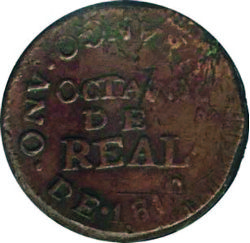
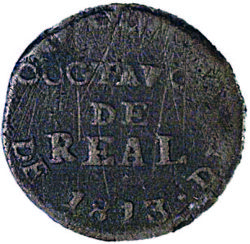
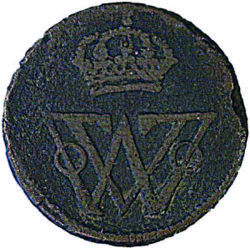
Durango Jolas years 1812 and 1813 ([KM60], 1/8 real)
Spanish documents authorizing the coinage of the Crowned Jola of Pitic 1821, remain to be found. At this point, we only know about their destruction in 1828 by the newly created state of Occidente. On 15 September 1828, the Occidente Legislature replaced the old name of the “Town of Pitic” with the new “City of Hermosillo”, in honor of the independence hero José María González Hermosillo{footnote}Gilberto J. López Alanís. Diccionario de la Independencia en las Provincias de Sonora y Sinaloa (1800-1831). Sinaloa, 2010.{/footnote}; by 18 December 1828, Occidente issued a decree ordering the removal of old copper coinage{footnote}Pradeau. ibid.{/footnote}:
Supreme Government of the State of Occidente.- being currently minting copper Octavos ordered by the sovereign decree #49 of Congress issued on 23 February, in consequence to enable its legal circulation in the state of my command I have agreed on ordering the following precautions:
1a.- Starting ten days after the publication of this decree in each town of the State, all copper Octavos of Durango circulating here will be collected by the first local authorities affiliated to the Town councils.
2a.- Equal collection will be performed for those coins that have circulated with the title of Jolas in the city of Hermosillo, as well as any other coin of that kind introduced by other states. ...;
...
4a.- The quantities of collected coins will be exchanged with Octavos sent from this capital by the General Treasury to all administrations for its circulation.
5a.- Those copper Jolas and Octavos that have circulated until today in many towns of the State, considered false by the first local authorities in agreement with a special envoy to be named for this recognition, will not be exchanged and will be destroyed in the presence of all interested parties. ...
;...
God and Liberty. Concepcion of the Alamos (then the capital of Occidente), 19 December 1828. Jose Maria Gaxiola, Governor. Jose Francisco Velasco, Secretary.
Importantly, this decree called “Jolas” only those circulating at Hermosillo (Pitic), making a clear distinction from the “Octavos of Durango” and “any other coin of that kind introduced by other states”.
Despite lacking information, the only choice for a locally circulating jola at Hermosillo before 1828, is the Pitic Cuartilla of 1821 that we know today.
The current scarcity of Pitic Jolas suggests that most of them were gathered and melted down to make the new Octavos of Occidente in 1829. Evidently, this new republican government was keen on the prompt removal of all the offensive Royal coinage. Since Occidente Octavos [KM335] are smaller (17-18mm) and lighter (2-3gr) than Pitic Jolas, it is unlikely they were used as blanks for re-striking, as Chihuahua mint seems to have done with some Occidente Octavos in 1833 [DB510] {footnote}Don Bailey. State and Federal copper and brass coinage of Mexico, 1824-1872. 2008.{/footnote}. From surviving specimens of the Sonora Jola we know that some of them circulated beyond 1828, and were demonetized by piercing or devaluated to 1/16 of a Real, as it happened to “Santoyo Cuartillas” [1832-1836, KM-364] after 23 July 1837{footnote}Pradeau. Ibid.{/footnote}.
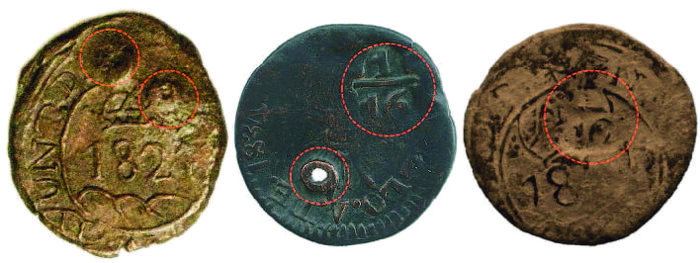
Demonetizing punches and 1/16 real devaluations on Pitic and Santoyo Cuartillas
Jose Francisco Velasco — the secretary that wrote the previous 1828 decree — chose his words carefully when addressing the inhabitants of Sonora; he distinguished “Hermosillo Jolas” from Durango octavos and other coins of the kind. According to Almada’s biographic dictionary{footnote}Francisco R. Almada. Diccionario de Historia, Geografia y Biografia Sonorenses. Instituto Sonorense de Cultura. Sonora, 1990.{/footnote}, Velasco was president of the municipal council of Pitic in 1821. Indeed, government acts of Pitic confirm Velasco was Constitutional Major in 1821: ...At the Presidio of Pitic on 17 March 1821, before me, Don José Francisco Velasco, Sub-Delegate of this Presidio and Constitutional Major of first vote, appeared Don Juan Guati, passerby merchant from Durango... ; ...At the Town of San Pedro of the Conquest of Pitic, on 24 April 1821, before me Don Francisco Velasco, Sub- Delegate and Constitutional Major of first vote{footnote}Fernando A. Galaz. Dejaron huella en el Hermosillo de ayer y hoy. Crónicas de Hermosillo de 1700 a 1967. , 2nd ed. Hermosillo, 1996.{/footnote}. Did Velasco witness or sanction the creation of these Jolas in 1821? We do not yet know but it seems he was especially aware of these Jolas and certainly not happy with them. In his Noticias Estadisticas del Estado de Sonora (Statistical News of the State of Sonora) of 1850, Velasco complained: The hardship offered by the Joles, that is the copper coinage, to commerce is by all means ruinous and without parallel.
Was the Sonora Jola issue by a Spanish Royalist authority or by an Independent pro-Bourbon First Mexican Empire? To answer we must consider that: 1) Velasco was municipal head of Pitic in 1821 and distinguished these Jolas in his decree of 1828; 2) Pitic publicly swore allegiance to the independence on 13 September 1821{footnote}Nicolás Vidales Soto and Rina Cuellar Zazueta, La Independencia en las Provincias Internas de Occidente (Sonora y Sinaloa), Sinaloa, 2009{/footnote}; 3) the Imperial Gazette of 17 November 1821 decreed the election of provincial representatives to the Imperial Constituent Congress and the renewal of all municipal authorities by 24 November — accredited by the retiring authorities the same day; and 4) the new municipal authorities of Pitic had until 28 January 1822 to elect the provincial representatives to the Imperial congress. Everything indicates that this “crowned Cuartilla” of 1821 was issued under a still Spanish Royalist “War for Independence-period” municipal government. Of note, the Internal Occident Provinces of Sonora and Sinaloa elected Juan Miguel Riesgo (or Riezgo), Salvador Porrás, Manuel José Zuloaga and José Francisco Velasco{footnote}José Luis Soberanes Fernández. The first Mexican Constituent congress, UNAM, 2012{/footnote}.
As in the cases of Texas and Durango, Sonora Jolas should have been a response to the local scarcity of fractional money — likely hastened by distance and road insecurity. It is not farfetched to imagine that any arrival of out-of-state Jolas would had inflicted not just a challenge to pride and economy but a reminder to local authorities of their right to strike copper money. The Village of Pitic was promoted to Town status on 29 August 1783{footnote}Flavio Molina Molina. Historia de Hermosillo Antiguo, 1st ed. Hermosillo, 1983{/footnote}, and with that, the Monarchical Spanish Constitution — reinstated in June of 1820 — gave authority to its municipal government to procure its own funding{footnote}Almada, op. cit.{/footnote}. By 15 September 1820, Pitic was showing new constitutional authorities: At this National Presidio of Pitic, before me Don Manuel Rodríguez, Constitutional Major of first vote... ; ...At the Presidio of Pitic Town of San Pedro of the Conquest, before me Ignacio Monroy, Constitutional Major of 2nd vote, this 26 of December of 1820{footnote}F. A. Galáz, ibid.{/footnote}. Sonora Jolas should have been made at a local blacksmith’s workshop in Pitic, in the same way as hundreds of other towns and haciendas did throughout Mexico in the 19th century. The 35mm crude silver medals of Pitic — made to commemorate Iturbide’s ascension to the imperial throne of Mexico in 1822 — attest for the artisan capacity of this primitive mint of Pitic in 1821. Comparing two examples publicly known{footnote}Frank W. Grove. Medals of Mexico. vol II. 1972; Geo. W. Vogt. The Standard Catalog of Mexican Coins, Paper Money and Medals, 1978.{/footnote}, the deciphered complete legend of the reverse reads at center: JURADO EN 6 DE OCTUbr. (Swore on 6 October); all around: MONVMENTO DE FELICIDAD DEL PITIC (Monument to the happiness of Pitic). The obverse at center has a crowned eagle standing over a nopal cactus and all around: AGVST. I. EMPERADOR D. MEXIC. 1822 (date reads upside down).
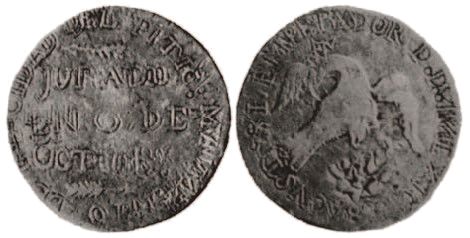
Grove 41a
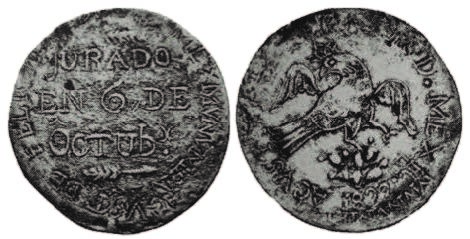
Vogt R-41
Interestingly, Jose Francisco Velasco — as part of the Imperial Constituent Congress — was one of the congressmen that urged Iturbide to seize the crown and later joined his National instituting Council{footnote}Francisco R. Almada, ibid.{/footnote}. He was at Pitic — acting as a lawyer and witness{footnote}F. A. Galáz, ibid.{/footnote} — at the time of Pitic’s ceremony swearing loyalty to Iturbide on 6 October 1822. Of note, there is a remarkable resemblance in the simplicity of designs and traces between the Crowns of:


Royalist Pitic Jola 1821 Imperial Pitic Jola 1822
It has been argued that Pitic Jolas could have been ordered from the mint of Durango. This hypothesis has been supported by the fact that Leonardo Santoyo — who later opened the mints of Occidente (at Alamos in 1828) and Hermosillo (around 1831) — was commissioned by Pedro Celestino Negrete to restore the mint of Durango before 19 October 1821{footnote}Pradeau, ibid.{/footnote}, and was the fifth director of the mint acting from 1823 to 1824, just after Julián de la Barraza (1822) and Manuel de Escárzega (1813-1822){footnote}Juárez Muñoz, ibid.{/footnote}. Santoyo himself may have taken charge of destroying the royalist Jolas of Pitic and Durango to make his new republican 1828-29 Occidente Octavos in Alamos. If the manufacture of Santoyo Cuartillas is known to have required simple manual tools, as shown by the fact that they were heavily falsified in caves nearby Hermosillo — why could Pitic Jolas not be made at Pitic in a similar way?
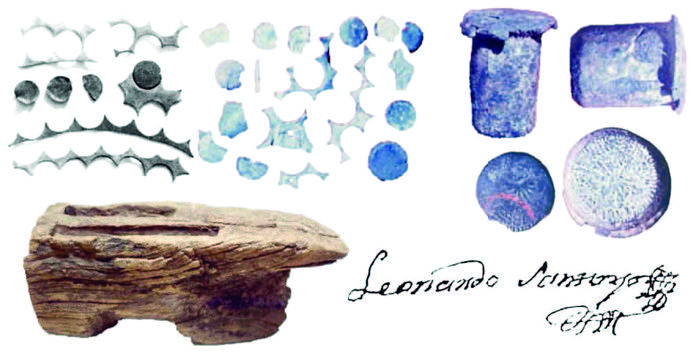
Metal scraps and tools to strike Santoyo Cuartillas found at Arbolillo's cave near Pitic (C.L.A.)
The municipal government of Pitic would have been better off by striking its coin locally instead of choosing economic dependence on another state, risking illegal overproduction and counterfeiting. While Juarez’s research on Durango mint archives did not produce evidence for Pitic, he did find documents relating to the creation of private Tlacos for José María Rivera in 1812, the Jolas of 1812-1818 and the New Viscaya coins of 1821-1823. Durango’s House of Representatives decided to order Imperial copper coins on 2 October 1821{footnote}Juárez Muñoz, ibid.{/footnote}. These coins made at the Durango mint — with Santoyo’s help — carried an Imperial Crown over the arms of the province of New Viscaya.
Here is a last thought: Since Sonora and Sinaloa constituted a single colonial province in 1821, with its capital in Arizpe, and were not separated until 19 July 1823{footnote}Flavio Molina Molina, ibid.{/footnote}, should this Jola be also considered part of the numismatic history of Sinaloa?
Starting in the latter part of the 18th century and continuing through to the 1880s, municipalities, or people doing businesses with them, issued municipal tokens (or coins). Some of the coins bearing the name of a municipality also have the name or initials of an individual who may or may not have been authorized to strike coins for circulation.
Many are uniface - that is, struck on one side only. The majority of coins were die struck, using two dies. A few were made by using incuse punches. In several instances, worn state coppers were countermarked with initials to circulate in specific localities.
Although they did make small transactions easier, profit motive was probably the main reason for coinage of copper coins. Copper was much cheaper in intrinsic value than silver. Labor was cheap and simple dies could not have been very expensive.
The only book dealing exclusively with the subject of municipal coins of Mexico is Mauricio Fernandez Garza ‘s Las Monedas Municipales Mexicanas, which lists and illustrates approximately 300 different pieces. Manuel Romero de Terreros’ Las Monedas de Necesidad del Estado de Michoacán{footnote}Manuel Romero de Terreros, Las Monedas de Necesidad del Estado de Michoacán, Anales del Instituto de Investigaciones Estéticas; Vol. II, Núm. 5, 1940, available in the USMexNA online library{/footnote}.give a careful description of 156 entries of municipal and hacienda pieces of the state of Michoacán.
As neither the federal or the state government produced fractional coins municipalities, haciendas and even private citizens were “allowed” to produce their own, though as these were repeatedly permitted and then prohibited, coins would be struck, then melted, and then struck again.
The latest study of municipal coinage is Ricardo Vargas Verduzco’ Enciclopédia Numismática de Michoacán: Vol 1. Moneda Municipal, illustrated with full colour images of the best example of each coin available, mainly from three main collections{footnote}There have been four previous studies of these coins, Manuel Romero de Terreros’ Las Monedas de Necesidad del Estado de Michoacán in 1940, Mauricio Fernández Garza’s Las Monedas Municipales Mexicanas in 1979, Grove’s Coins of Mexico in 1989, and a re-issued Fernández in 2014, but whereas Romero de Terreros had 156 coins (including haciendas and particulares) with only 10% illustrated, this new catalogue,has 240 coins, all municipal and mostly illustrated in full colour. The cataloguing is based on the first three letters of the town, numbering in chronological order with letters for counterstamps and revalidation, eg. ZAM-7a{/footnote}.
Vargas identifies two different issues.
Vargas identifies two different issues.
Vargas identifies two different issues.
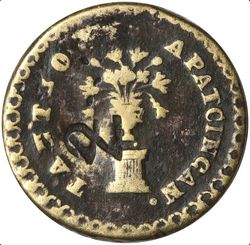
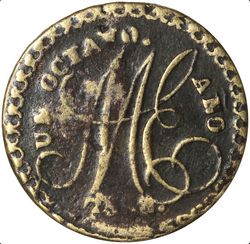
Grove 71 1850 Apatzingán ⅛r 1850
Grove 71
Obverse: around a platform with a large vase of flowers TANTEO DE APATZINGAN counterstamped 2
Reverse: around a large monogram ME UN OCTAVO. AÑO 1850
20mm brass
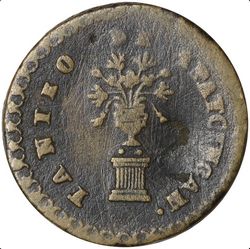
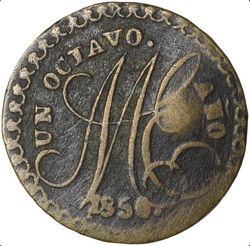
Grove 71 1850 Apatzingán ⅛r 1850 (Briggs & Bustos auction VIII, 26 April 2024, lot 333)
Complete legends, slightly buckled as a result of the counterstamp "2" to the right of the vase.
Vargas identifies 20 different issues.
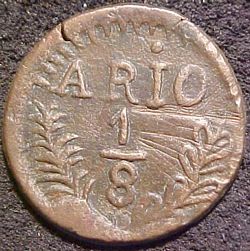
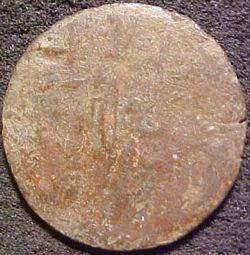
Grove 87
Obverse:
Reverse:
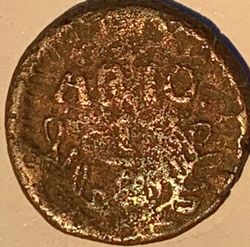
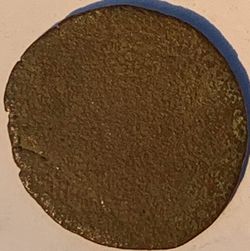
Grove 88
Obverse:
Reverse:
Vargas identifies four different issues.
Vargas identifies six different issues.
Vargas identifies three different issues.
Vargas identifies two different issues.
Vargas identifies six different issues.
Vargas identifies two different issues.
Vargas identifies eight different issues.
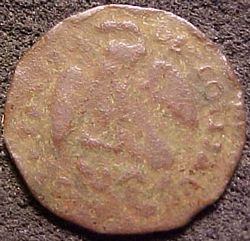
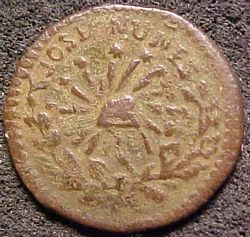
Grove 289 Cotija
Obverse: around the Mexican eagle TANTEO DE COTIJA UN 1/8 1856
Reverse: within a wreath of laurel and oak a radient liberty cap. JOSE NUNES
21 mm. bronze
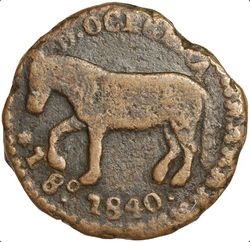
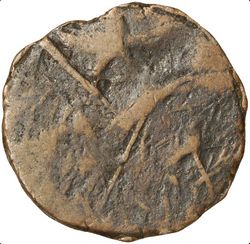
Oceguera ⅛r 1849 (Briggs & Bustos auction IX, 13 September 2024, lot 274)
Vargas identifies a single issue.
Vargas identifies three different issues.
Vargas identifies three different issues.
Vargas identifies nine different issues.
Vargas identifies a single issue.
Vargas identifies five different issues.
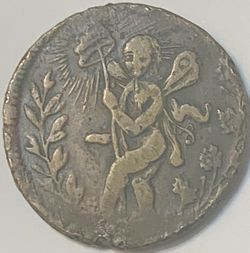
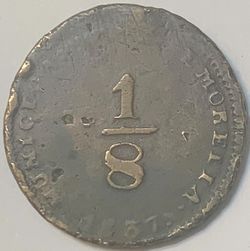
Grove 598
Obverse:
Reverse:
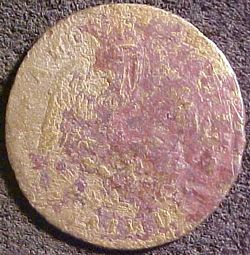
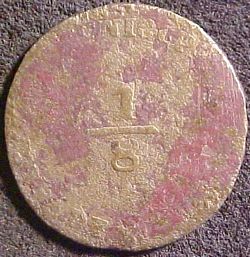
Grove 599
Obverse:
Reverse:
Vargas identifies seven different issues.
Vargas identifies three different issues.
Vargas identifies a single issue.
Vargas identifies six different issues.
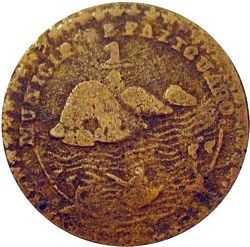
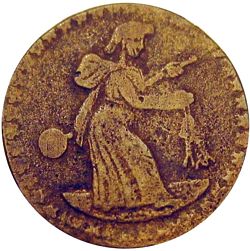
Vargas tentatively identifies ta single issue.
Vargas identifies three different issues.
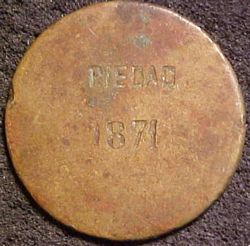
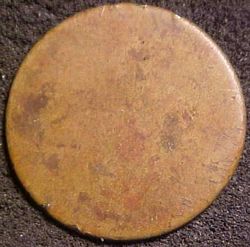
Grove 1823 Piedad
Obverse: PIEDAD 1871
Reverse: blank
26mm. brass
Grove also records a token with on the reverse, around the value '1' in a circle LA AURORA / L. C. & C. (Grove 1824) and another with two counterstamps on the reverse, one JOV (Grove 1825).
Vargas identifies three different issues.
Vargas identifies seven different issues.
Vargas identifies a single issue.
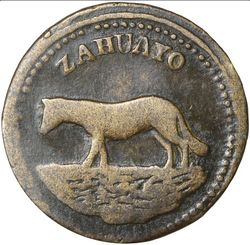
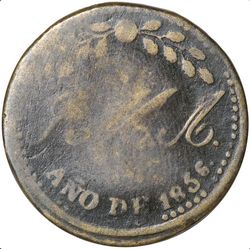
Grove 1088 Sahuayo ⅛r 1856 (Briggs & Bustos auction VIII, 26 April 2024, lot 339)
Brass struck, 21.2 millimetres diameter. Obverse at center, on a plain a coyote in profile looking to the left, on this the legend "ZAHUAYO". On reverse the initials J.M.A. (José María Arregui) in quite stylized cursive letters, below them "AÑO DE 1856".
Vargas identifies thirteen different issues.
Vargas identifies six different issues.
Vargas identifies two different issues.
Vargas identifies seven different issues.
Vargas identifies two different issues.
Vargas identifies fifteen different issue.
Vargas identifies a single issue.
Vargas identifies eight different issues.
Vargas identifies two different issues.
Vargas identifies a single issue.
Vargas identifies 20 different issues.
Vargas identifies a single issue.
Vargas identifies a single issue.
Vargas identifies sixty different issues, including these.
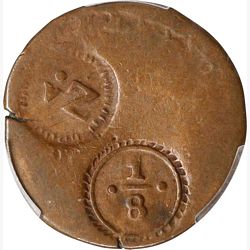
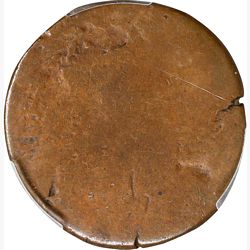
KM-L81. Zamora. 1/8 Real Token, ND (1852-58).(Stack’s-Bowers Auction 28 February 2023, lot 71625)
"ZA" countermark and "1/8" countermark on a host that is virtually worn completely bare.
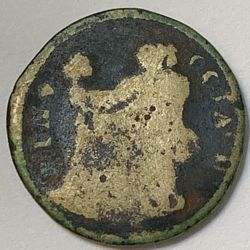
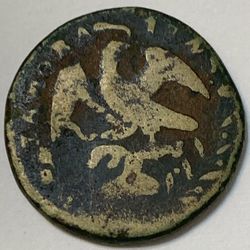
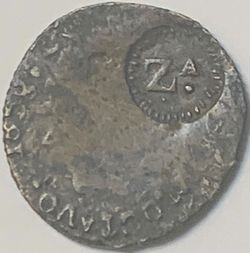
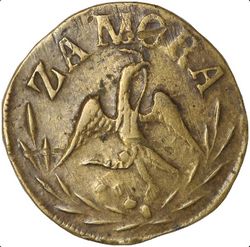
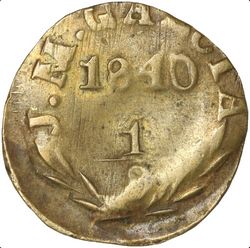
Grove 1091 Zamora ⅛r 1840 (Briggs & Bustos auction VIII, 26 April 2024, lot 344)
Obverse: slender eagle perched on an almost round cactus, all on two branches with 10 leaves to the left and 8 to the right
reverse with date slightly above the center and below the value 1/8, sponsor's name J.M. Garcia on top
Vargas identifies two different issues.
The history of coinage in Mexico has a common factor - the lack of low denomination currency. During Spanish rule the smallest working denomination was 1/2 Real, (equivalent to 6¼ centavos) and its mintage was minuscule compared to large values, such as 8 Reales.
Moreover, even this denomination was too onerous and of too great a value. Although in the period mentioned above they occasionally minted 1/4 Real and 1/8 Real coin they were badly received and unpopular. It would be until the nineteenth century that states, with the multiplicity of mints in the Republic, produced 1/4, 1/8 and even 1/16 Real coins (decrees of the time permitted 1/32 Real coins but these were never minted). You might think that this money (mainly of copper and brass) was the solution, but quite the opposite: it turned out to be a calamity, because of the large amount of counterfeit, abundant and even clandestine currency, coined outside the limits of the law, for a population not yet accustomed to fiduciary systems based on silver coinage.
The arrival of the decimal system and its implementation in the second half of the nineteenth century partially solved the lack of small currency, with copper 1 centavo and silver 5 and 10 centavos coins. However, the use of Mexican currency throughout the national territory was not achieved until well into the twentieth century with the creation of the Bank of Mexico in 1925. There were parts of the country where the Mexican coinage was unknown, so they used various methods for everyday commerce.
It should also be added that the absence of means of payment results in the use of unofficial currencies, which is caused by multiple factors such as (i) the disappearance of currency in circulation, (ii) an inadequate or insufficient supply, (iii) the loss of value, and (iv) poor distribution, related to political instability, poor roads, and/or geographical isolation {footnote}Díaz Negrete, Juan Cristóbal, "Cuando falta el dinero: La Moneda de Necesidad en México", in La Moneda Independencia y Revolución, 2009, Banco de México.{/footnote}).
The hardest-hit areas were the south of the country, especially Chiapas, although barter or swap was an age-old tradition. It is well known that in some situations, tokens (fichas, tarjetas, planchuelas) or other generally metallic objects of a local/ particular nature were used, such as hacienda or municipal tokens. However, from the last quarter of the nineteenth century to the first of the twentieth century the daily currency of Chiapas was the “cachuco”.
However, we can find backgrounds to this situation since the middle of the nineteenth century. Pradeau {footnote}Pradeau, Alberto Francisco, Historia Numismática de México Tomo I. 1957, Sociedad Numismática de México, México D.F.{/footnote} relates:
On October 22, 1869, and then on December 27 of the same year, a bill was submitted to the National Congress proposing that the currency (moneda recortada) cease to circulate in the State of Chiapas, and for it to be amortized by federal offices within two years. Mr. J. Cristóbal Salas, author of that project, noted that most of the currency came from Guatemala and showed a collection of pieces that he had brought for this purpose to the Session Hall of the Chamber of Deputies.
This is reaffirmed by Díaz Negrete{footnote}Díaz Negrete, op. cit.{/footnote}, recounting that since the nineteenth century Chiapas was characterized by the use of tokens from coffee plantations.
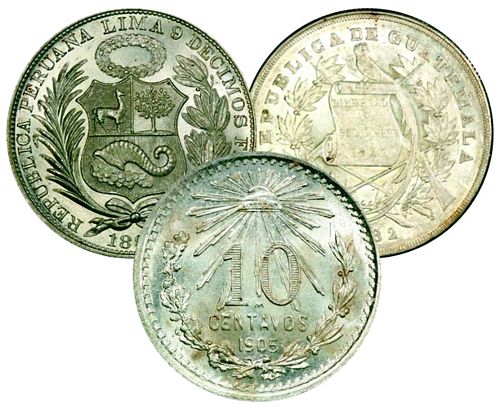 The “cachuca” coinage (from “cacho”, fraction or piece) was one made up of a diversity of issues such as Chilean pesos, Peruvian soles, Colombian pesos, and fractional currency of Guatemala, although the aforementioned coins were already demonetized (for the most part) in their country of origin and only circulated exclusively as a “legal” medium in Chiapas. The cachuco had a value of approximately 80-85 Mexican centavos. The Memoria de la Secretaría de Hacienda 1908-1909 mentions that most of the pieces were from Guatemala.
Several reasons supported this anomaly: (i) the scarcity of circulating currency in the state, (ii) the remoteness from the Mexican mint, (iii) the lack of means of communication, (iv) a premium of up to 35% over its face value was charged when obtaining Mexican currency, and (v) the correlative tradition and rooting in trade with the Guatemalan people.
Both nations had problems in common that allowed the use of the “cachuco”, Mexico had a fragile financial system, which had not manifested itself or reached the Chiapaneco territory despite the formation of the Banco de Chiapas in 1901, while Guatemala had problems with its paper currency, which was not properly backed in cash.
The cachuca currency was introduced to Chiapas by businesses through the payment of imports. It was initially received as merchandise (with pieces valued for their weight in silver), although later it was legitimized and even legalized. The Memoria de la Secretaría de Hacienda 1908-1909 gives the following background:
We refer to the circulation in the Departments of the State of Chiapas bordering the neighboring Republic of Guatemala of the currency called “cachuca”, which comprises all kinds of small silver coins, minted by the Central and South American Republics. Whether because of the frequent commercial relations that the peoples of that Mexican border maintain with those of Guatemala, where it is said that a lot of coin is minted in the other Central and South American Republics; lack of communications and traffic with the rest of the Mexican Republic and even with the other departments of Chiapas; or for both reasons together and perhaps also because of the local circumstances that are unknown to the Comisión [de Cambios y Moneda], the fact is that the currency in circulation throughout that border territory has become the “cachuca” currency, to the extent that in times not long ago the peso and other Mexican currencies were almost unknown to a good part of the proletarian population. In virtue of this and through necessity, local authorities came to sanction provisions under which the “cachuca” currency was commonly admitted to local public offices of certain Departments, at a certain discount in relation to the national currency; and for this reason, as it could not help but strengthen the custom of using “cachuca” currency, it gave room for particular speculations, almost always advantageous to those who undertake them, making them interested, for the same reason, in the continuation of this abnormal state of things, which have not been enough to make stop the repeated orders and provisions issued for some time to this area by the federal power and aimed at the offices that depend on it not to admit in any case , or for any value, the aforementioned foreign currency.
Having considered the above, the Comisión de Cambios y Moneda took several actions to overcome the problem, such as the purchase of the “cachuco” (starting November 1907) as silver for its subsequent melting and the shipment of fractional currency to the area. That same year it is pointed out that $736,257.74 of foreign currency was purchased at its metallic value: with Chiapas having a population in 1910 of 438,843 inhabitants, this draws attention to the abundance of this coin. It appears that the solution of such a situation would soon no longer be so resolved as the fluctuation in the price of silver in 1907 and 1908 stopped the acquisition of the “cachuca” currency.
In the Memoria de la Secretaría de Hacienda 1908-1909(footnote}Secretaría de Hacienda y Crédito Público, Memoria de la Secretaría de Hacienda, Ejercicios fiscales: 1908-1909 y 1909 – 1910, Tipografía de la Oficina Impresora de Estampillas, Palacio Nacional. México D.F.{/footnote under the heading “Joint results of operations from 1 May 1905 to 30 June 1909”, the Comisión reports withdrawing “in Central and South American pesos circulating in the State of Chiapas” $333,571,00, and “in Central and South American fractional currency that also circulated in Chiapas” $533,452.05. That is, in just over four years it withdrew from circulation $863,023.05 (value in Mexican pesos).
In the Memoria de la Secretaría de Hacienda 1909-1910 “Mexican and Cachuca silver currency received from the Directorate” gives a monthly analysis from July 1908 to June 1909 of the foreign currency destined for smelting in the Mexican Mint, the most notable month being October 1908 with 99,055 coins for its face value, being in kilograms 2,122,400, the lowest month, June 1909 with 9,000 in face value and 193,127 kilos. The total between the period referred to is 482,440 in nominal value of the coins or 10,364,099 kilograms.
Having said that, the Government continued to report the illegality of trade in this type of coinage to the local authority. Even, it was asserted that the foreign money was used as legal tender to pay national taxes. In the same Memoria it reports:
It is obviously desirable to end the circulation of the “cachuca” currency in the State of Chiapas, and since the importation of silver coin from Central and South American wedges is not strictly prohibited, in order to melt it and turn it into bars, at the introducer’s cost, it is clearly indicated that the federal and local authorities of that State (the latter, above all), should be reminded of the prohibition on receiving taxes and other cash benefits other than in national currency, and especially individuals, under article 26 of the monetary law, to use in payment any object other than legal currency, under the penalty of a fine of the second class. At the same time, the Comisión will take measures to increase stocks of fractional currency there and simply buy “cachuca” as silver, so as not to harm its good faith holders, and by these concurrent means it is believed that this anomaly to our unique monetary circulation in the Republic will soon be extinguished. ‘
Although the problem existed throughout the Chiapaneco territory there were areas where both Mexican (in smaller quantity) and cachuca currency coexisted and in other areas only the second. All the west of the state starting from San Cristóbal de las Casas. adjoining Guatemala, was “cachuco” territory, while in the east Mexican currency achieved greater penetration.
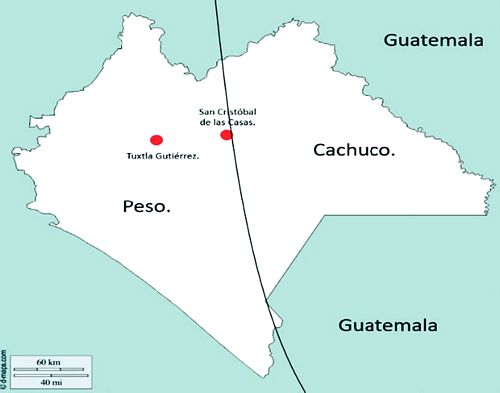
It should be added that Guatemalan exports to Chiapas were made in Guatemalan currency, and no exchange was made so the merchants of Chiapas worked with this foreign currency on a daily basis. When the value of the peso rose as a result of the 1905 Monetary Reform, the difference between the peso and the cachuco increased, intensifying the exploitation of workers, who had to work harder to get the same amount of salary.
Concerned about the situation in these early years of the twentieth century, the Comisión de Cambios y Moneda sent large remittances of metal currency to the bank branches in Tuxtla Gutiérrez and Tapachula in addition to collecting and melting the silver cachucos to get them out of circulation.
In the face of currency problems, President Venustiano Carranza, on 14 May 1918, repealed article 22 of the Monetary Law of 1905 which prohibited the circulation of foreign currency. This gave legal status to foreign currency for a limited time , including the “cachuca”.
However, when Carranza created the Comisión Monetaria on 3 April 1916, among its objectives was to ensure internal circulation and serve as a conduit for the Federal Government to launch and withdraw currency issues. By 1925 it had 17 branches and 333 correspondents. Its structure was inherited by the Bank of Mexico years later. Another relevant factor for the penetration of southeastern Mexico came during the government of Plutarco Elías Calles, who provided a strong stimulus to the construction of infrastructure to expand national and international communication with roads, railways, airports, telephony and telegraphy.
When the Bank of Mexico was established in 1925 it had 24 branches located in different points of the national territory though only five of these original branches by the 1930s. The main functions of these branches were, in general terms, to distribute and collect cash, serve as a clearing house and make payments on behalf of the Government. By the third decade of the twentieth century the use of the “cachuca” coin was minimal.