
Chilpancingo is the state capital.
Tamborrel{footnote}{/footnote} mentions that in December 1914 and January 1915 some revolutionary leaders, such as Heliodoro Castillo, Encarnación Díaz and Jesús Salgado, agreed to mint money due to the shortage of money in the city. A silversmith made silver 10 and 20 centavo coins, but in the absence of dies he copied Mexico City coins and only added the legend "MEZICO ESTADO G.R.O." on the 10 centavos coin and "MEXICO ESTADO DE G.R.O." on the 20 centavos coin and a sun with a human face on top of both coins.
[image needed]
KM-663 Chilpancingo 10c
[image needed]
KM-664 Chilpancingo 20c
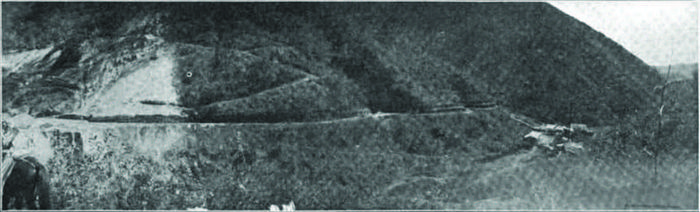
The Suriana Mining and Smelting Co., Guerrero, Mexico, showing mine (mid and upper left), and smelting plant (right), from the horse trail in, with horse in left corner, 1910{footnote}The Engineering and Mining Journal, 1 October 1910, Hill Publishing Co., NY, NY, pp.663-664, photo of mine and plant, p.663,{/footnote}
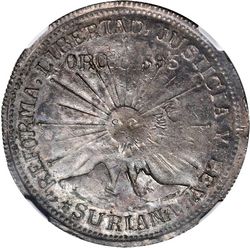
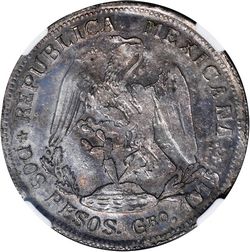
KM-665 Suriana $2 (Stack’s-Bowers Baltimore Auction, 16 November 2012, lot 11447)
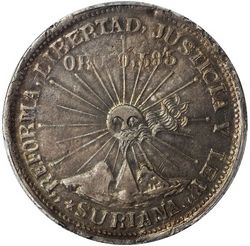
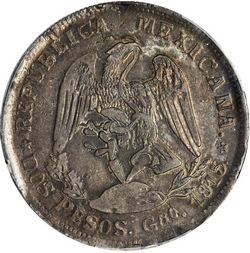
KM-665 Suriana $2 (Briggs & Bustos sale IX, 13 September 2024, lot 51:
ex. Ponterio & Associates sale 127, 20 September 2003, lot. 626)
According to several authors, it was General Adrián Castrejón, who ordered the production of “$2 coins in a camp near Campo Morado, modifying the popular reverse design with the radiant sun over two mountains and a volcano, substituting the locality of *Co Mo* (Campo Morado) for the legend *SURIANA. 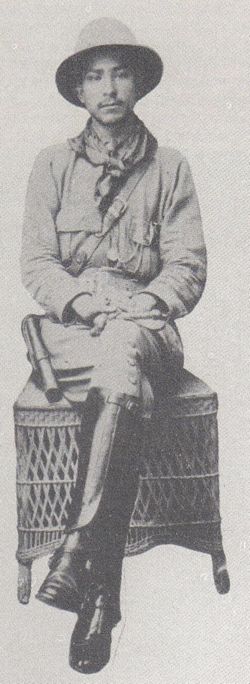 Castrejón was born in Apaxtla, , Guerrero, on 6 June 1893. On 2 July 1911,he joined the troops of Lieutenant Salvador González and later, under the orders of General Jesús H. Salgado, operated in the states of Guerrero and Morelos. In 1913 he organized his own guerrilla to operate against Victoriano Huerta and in favor of Emiliano Zapta; took Juchitlán, Guerrero, and was promoted to Lieutenant Colonel. He took part in operations in Guerrero, Michoacán, the Estado de México and Morelos. In 1918 he joined the forces of General Fortino Ayaquica Rangel, operating in the state of Puebla. On 10 April 1919 he accompanied Emiliano Zapata on his visit Jesús Guajardo at the Hacienda de Chinameca, where he was wounded without being able to save Zapata's life. After Zapata’s murder Castrejón remained loyal to the Suriano movement. He died in Mexico City on 15 March 1954.
A more detailed description, it is worth mentioning that the SURIANA were struck with an obverse die GB-177, something very similar happening with the reverse as it follows the same pattern of GB-177 in which the “locality” is framed in the lower part between stars, although in the case of Suriana it only has one at the beginning. Another particular detail of this issur is the culmination in point nine of the sun's rays, which is unique to this issue. About the type: It is mind-boggling that despite how extremely scarce it is today, at its time of production it was perhaps very trivial, the design pursued and managed to be, if not the most aesthetic, one of the most pleasing and emblematic of all the designs of revolution. In an exhaustive search by Briggs & Bustos, they located no more than 15 pieces.

The mint at Taxco was the first used by Emiliano Zapata and the one from which he issued most of his coinage. Zapata had not only the silver resources around Taxco but also talented artisans who were able to create coinage dies.


KM-667 Taxco 2c (Stack’s-Bowers NYNIC Auction, 15 January 2019, lot 43716)


KM-668 Taxco 5c (Stack’s-Bowers NYNIC Auction, 15 January 2019, lot 43717)


KM-669 Taxco 10c (Stack’s-Bowers Auction, 12 September 2013, lot 73436)


KM-671 Taxco 50c (Stack’s-Bowers Auction, 12 September 2013, lot 73435)


KM-674 Taxco $1 (Stack’s-Bowers Baltimore Auction, 16 November 2012, lot 11428)
The Guthrie-Bothamley catalog number for an authentic 50c coin is GB-228 and the Carlos Amaya catalog number is A-GO-194. I would classify this coin as scarce which makes it a good target coin for counterfeiters. Based on my observation, it seems like more fakes have been seen in the market in recent times compared to genuine struck coins of this variety. Hence, this is a coin which you will want to better understand the attributes between a counterfeit and a genuine specimen since I consider the counterfeit to be a dangerous coin as it is well made and the creator tried to closely match most of the coin attributes to those on an original struck coin. This in turn could fool not only the unsuspecting or ill-informed collector, but also the experienced collector.


Genuine Example
9.81 g, 27.80 mm


Counterfeit Example #1 (Flat Strike)
8.62 g, 28.01 mm


Counterfeit Example #2 (Well Struck)
9.91 g, 27.99 mm
Overall, the lettering, eagle and cactus engraving on the counterfeit coin is comparable to a genuine coin. One must look more closely at the design details to distinguish between an original struck coin and a counterfeit.


Genuine Counterfeit #1 Counterfeit #2
The mouth on the head of the snake on the genuine is blunter and more rounded around the point at the top of the mouth, while the counterfeit is much more pointed. Also, the feather crest or crown on top of the head of the eagle is rounded at the point on the genuine coin, while the counterfeit is more pointed.


Genuine Counterfeit #1 Counterfeit #2
There are several other indicators to review on the obverse involving the right foot and three talons of the eagle as well as the right cactus nopal. The claw and the talons of the eagle on the original coin are long and uniform in shape and size compared to the counterfeit which are noticeably smaller and oval shaped. The genuine coin also shows the talons connected to one another, while on the counterfeit they are all disjointed. Also, the genuine strike has a pointed claw at the end of each talon, while the counterfeit does not have a distinctive claw on any of the talons as evident on a well struck specimen like counterfeit #2. This feature is not as legible on a soft struck specimen like counterfeit #1. Also, the far-right cactus nopal on the genuine coin is connected to the adjoining cactus nopal while the counterfeit has a very slight gap and is clearly disconnected from the nopal which the eagle’s claw is grasping.
The reverse has various easy identifiers to distinguish a genuine from a counterfeit to include several letters in the legend, the berry counts on a portion of the wreath, the protruding stem on the bow, and finally the date within the sun.


Genuine Counterfeit #1 Counterfeit #2
The “TA” of TAXCO has several attributes which are quite different between the genuine and counterfeit such as the vertical line of the “T” which is unevenly shaped and comes down to a point on a genuine coin while the entire letter of the “T” on a counterfeit is evenly proportioned. Also, the top of the “A” on the counterfeit has a small die mark; however, this is missing on the genuine coin.


Genuine Counterfeit #1 Counterfeit #2
The left wreath has a berry placement of 2-2-3 on the genuine coin: however, the counterfeit has a placement of 2-3-3. Bottom line, there is an extra berry in the center portion of the wreath.


Genuine Counterfeit #1 Counterfeit #2
The bottom right side of the bow on the genuine coin has the left stem protruding past the large bottom portion of the bow. Some may call it an extra bow, but I feel it is an extension of the stem since it is thin like the branch on the wreath. This stem also extends outward to a point just below a leaf of the right portion of the wreath. This stem extension is missing on the counterfeit coin.


Genuine Counterfeit #1 Counterfeit #2
Lastly, the date situated within the center of the sun is quite different between a genuine coin and a counterfeit coin. The first thing that stands out is the fact that the genuine specimen has thin letters while the counterfeit has thicker digits. The first “1” on the genuine coin also slants slightly to the left, while the counterfeits are straight and upright. The tail of the “9” on the genuine coin is longer and protrudes past the digit almost touching the first “1” digit while the “9” on the counterfeit is shorter and aligns with the top portion on the digit. Lastly, there are several differences with the digit “5”. The horizontal bar is uneven in shape and slightly slants upward on the counterfeit while it is uniform and does not slant as much on the genuine specimen. Also, the gap between the lower tail and the vertical bar is very narrow on the genuine specimen and much wider on the counterfeit.
Although there are other attributes that might help highlight the obverse and reverse differences between a genuine and a counterfeit of this variety, the ones mentioned above should suffice as the key points to review when you come upon one of these coins.
The modern counterfeit of a Guerrero - Taxco silver 50 centavos, is a well-designed and well-manufactured coin, therefore it should be considered a dangerous counterfeit and one that may easily fool the novice collector, as well as some seasoned collectors. When looking to purchase a coin of this variety, the key thing to do is to closely examine the coin and review the attributes outlined within this article so you can make an educated judgment on authenticity.
Please send your comments, questions, or suggestions regarding this article, to me at