The silver coinage is the same as the last type of the previous reign. Because of the large number of spurious macuquina coins in circulation, the viceroy, on 2 December 1751, suggested to the crown the gathering and retirement from general circulation of all clipped specimens{footnote}In order to avoid difficulties, the government of New Spain had collected from 1732 to 1751, seventeen hundred and seventy-one marks of Peruvian coinage. During December 1751, this was melted and recoined in the Mexico City mint, and from it $15,058.94 in coins of New Spain were obtained{/footnote}.
Apparently this suggestion remained unheeded until 18 March 1761, when by royal decree the old types of colonial coins were ordered gathered and retired from circulation. This decree was not enforced until 8 April 1772, at which time, by order of Viceroy Bucareli, it was made known in New Spain by the usual town cryer method{footnote}Historia Real de Hacienda, Vol. I.{/footnote}/
A similar order was issued by Charles III, 29 May 1772.
The following listings (½r to 4r) are from Brad Yonaka's A Variety Guide to the Fractional Pillage Coinage of Mexico City 1732-1771.
For further information on Brad Yonaka's classification of the half reales see here.
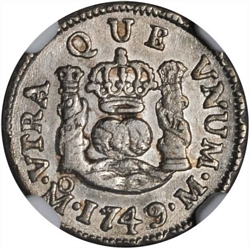
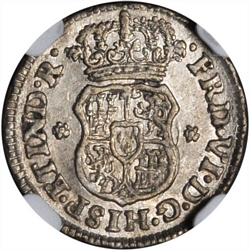
KM-67.1 ½r 1749/8/7 M (Stack’s Bowers auction, 7 August 2017, lot 22715)
| Date | Asssayer | Comment |
| 1747 | M | |
| 1747/6 | M | also an apparent extra pellet after R in obverse legend, a possible misplaced R for E in ET, and repunched S in HISP |
| 1748 | M | |
| 1748 | M | no pellet between date and assayer initial |
| 1748/7 | M | |
| 1749 | M | |
| 1749/8/7 | M | additional to Yonaka. illustrated below |
| 1750 | M | |
| 1750 | M | prominent knobs on pillar crowns |
| 1751 | M | |
| 1752 | M | |
| 1753 | M | |
| 1753 | M | no pellet between VI and D on obverse legend |
| 1753/2 | M | |
| 1754 | M | |
| 1754/3 | M | |
| 1755 | M | |
| 1755/4 | M | |
| 1755/6 | M | reverse overdate |
| 1756 | M | |
| 1757 | M | |
| 1757/6 | M | |
| 1757/47 | M |
KM-67.1 ½r 1749/8/7 M (Stack’s Bowers auction, 7 August 2017, lot 22715)
In 1757 the standard design was altered to include an imperial crown on top of the left pillar.
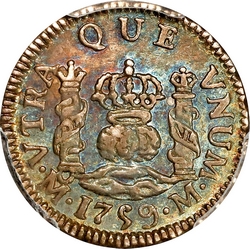
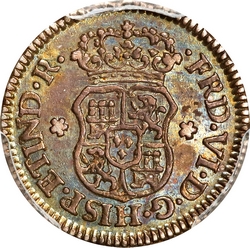
KM-67.2 ½r 1759 Mo M (Stack’s Bowers auction, 16 May 2023, lot 70057)
| Date | Asssayer | Comment |
| 1757 | M | |
| 1758 | M | |
| 1758/7 | M | |
| 1759 | M | since Ferdinand VI died in August of 1759 many of the strikes this year are posthumous |
| 1760 | M | |
| 1760/59 | M | addition to Yonaka, illustrated below |
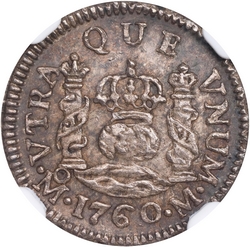
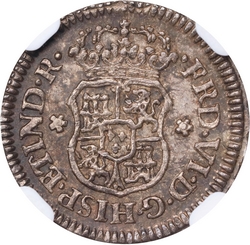
KM-67.2 ½r 1760/59 Mo MM (Stack’s Bowers auction, 22 October 2025, lot 72415)
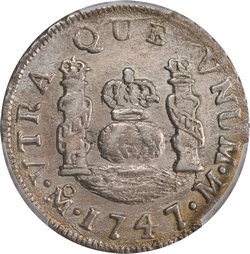
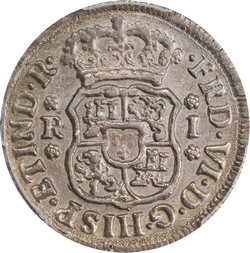
KM-76.1 1r 1747 Mo M (Stack’s Bowers auction, 24 February 2026, lot 76421)
| Date | Asssayer | Comment |
| 1747 | M | |
| 1748 | M | |
| 1748 | M | FRD/PHS over-king. Letter P apparent under F, and trace of S below D |
| 1748/5 | M | illustrated below |
| 1748/7 | M | |
| 1748/7 | M | FRD/PHS over-king. Letter P apparent under F, and trace of S below D |
| 1749 | M | |
| 1750 | M | |
| 1750/40 | M | |
| 1750/49 | M | |
| 1751 | M | |
| 1751 | M | 'unbarred' H punch, giving the appearance of IIISP |
| 1751/41 | M | |
| 1752 | M | |
| 1752 | M | unbarred' H punch, giving the appearance of IIISP |
| 1752/42 | M | |
| 1753 | M | |
| 1754 | M | |
| 1754/3 | M | |
| 1755 | M | |
| 1756 | M | |
| 1757 | M | |
| 1757/6 | M | |
| 1758 | M | |
| 1758/7 | M |
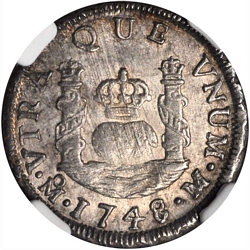
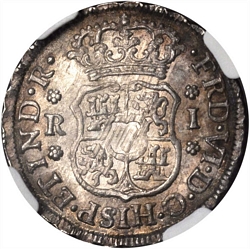
KM-76.1 ½r 1748/45 Mo M (Stack’s Bowers auction, 15 August 2016, lot 22687)
In 1758 an imperial crown replaced the royal crown on top of the left pillar.
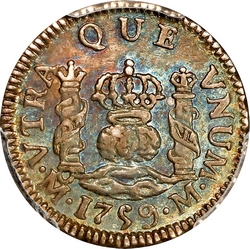
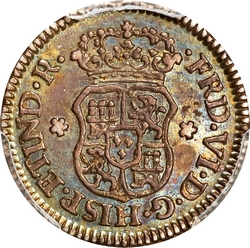
KM-76.2 1r 1759 M Mo
| Date | Asssayer | Comment |
| 1757 | M | |
| 1758 | M | |
| 1758/7 | M | |
| 1759 | M | |
| 1759/8 | M | |
| 1760 | M |
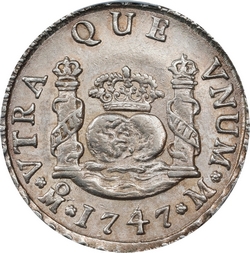
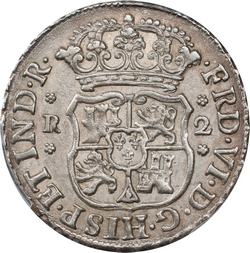
KM-86.1 2r 1747 Mo M (Stack’s Bowers auction, 24 February 2026, lot 76409)
| Date | Asssayer | Comment |
| 1747 | M | |
| 1747 | M | pellets replacing cinquefoils at beginning and end of obverse legend |
| 1748 | M | |
| 1748 | M | pellets replacing cinquefoils at beginning and end of obverse legend |
| 1748 | M | FRD punched over PHS, clearly visible on the F and D |
| 1748/7 | M | |
| 1749 | M | |
| 1749 | M | pellets replacing cinquefoils at beginning and end of obverse legend |
| 1749 | M | rosettes replacing cinquefoils bracketing R and denomination, pellets replacing cinquefoils at beginning and end of obverse legend |
| 1749 | M | FRD punched over PHS, evidence for correction mainly in and to the right of the D |
| 1750 | M | |
| 1750 | M | pellets replacing cinquefoils at beginning and end of obverse legend and rosettes at all stops on reverse |
| 1750 | M | pellets replacing cinquefoils at beginning and end of obverse legend and cinquefoils at all stops on reverse |
| 1750 | M | cinquefoils at beginning and end of obverse legend and rosettes at all stops on reverse |
| 1750 | M | mule with obverse die from Philip V |
| 1751 | M | |
| 1751/41 | M | decade overdate |
| 1752 | M | |
| 1753 | M | |
| 1753/2 | M | |
| 1754 | M | |
| 1754/3 | M | |
| 1755 | M | |
| 1755/4 | M | |
| 1756 | M | |
| 1757/6 | M | |
| 1757 | M |
In 1757 the imperial crown replaced the royal crown on the left pillar.
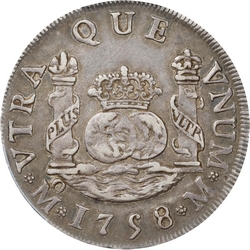
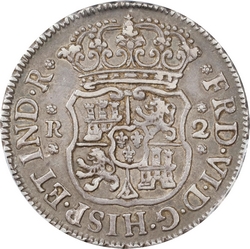
KM-86.2 2r 1758 Mo M (Stack’s Bowers auction, 24 February 2026, lot 76420)
| Date | Asssayer | Comment |
| 1757 | M | |
| 1758 | M | |
| 1758 | M | cinquefoil stops, obverse, crosses reverse |
| 1758 | M | very small R on obverse, taken from punch set for a smaller denomination coin. |
| 1758/7 | M | |
| 1759/8 | M | |
| 1759 | M | |
| 1759 | M | no stop after HISP |
| 1759 | M | cinquefoils bracketing R, denomination, and at start and end of legend obverse. Crosses as stops reverse |
| 1759 | M | cinquefoils for all major stops on both sides |
| 1759 | M | crosses for major stops obverse, and cinquefoils for major stops reverse |
| 1759/8 | M | |
| 1760 | M | all posthumous |
| 1760 | M | cinquefoils bracketing R, denomination, and at start and end of legend obverse. |
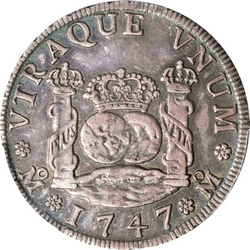
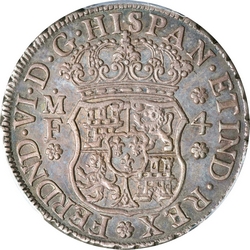
KM-95 4r 1747 Mo MF (Stack’s Bowers auction, 26 August 2022, lot 34158)
| Date | Asssayer | Comment |
| 1747 | MF | |
| 1748 | MF | |
| 1748/7 | MF | |
| 1749 | MF | |
| 1750/40 | MF | decade digit overdate |
| 1750/40 | MF | variety with a second change to the pillar design. Introduction of echinus with crowns sitting flat upon without lower arcs |
| 1751 | MF | |
| 1751/41 | MF | decade digit overdate |
| 1752 | MF | |
| 1752 | MF | variety with a second change to the pillar design. Introduction of echinus with crowns sitting flat upon without lower arcs |
| 1753 | MF | Introduction of echinus with crowns sitting flat upon without lower arcs. This design type became the standard |
| 1754 | MF | |
| 1754/44 | MF | decade digit overdate |
In 1755 the design was changed, with the left pillar topped by an imperial crown. The imperial crown was not used on the ½r, 1r or 2r until 1757.
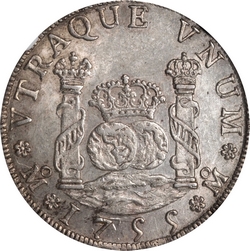
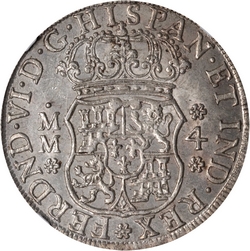
KM-95 4r 1755 Mo MM (Stack’s Bowers NYINC auction, 15 January 2022, lot 2078)
| Date | Asssayer | Comment |
| 1754 | MM | |
| 1755 | MM | |
| 1756 | MM | |
| 1757 | MM | |
| 1758 | MM | first version of imperial crown on left pillar, with 'open wings' |
| 1758 | MM | second version of imperial crown on left pillar, with 'closed wings' |
| 1759 | MM | |
| 1760 | MM | |
| 1760/59 | MM |
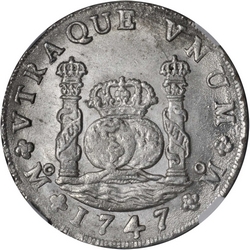
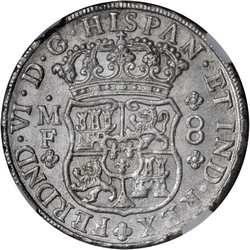
KM-104.1 8r 1747 Mo MF (Stack’s Bowers ANA auction, 4 August 2017, lot 21170)
| Date | Asssayer | Comment |
| 1747 | MF | |
| 1748 | MF | |
| 1748/7 | MF | |
| 1749 | MF | |
| 1749/8 | MF | |
| 1750 | MF | |
| 1750/40 | MF | decade digit overdate |
| 1751 | MF | |
| 1751/0 | MF | |
| 1752 | MF | |
| 1752/1 | MF | |
| 1753 | MF | |
| 1753/2 | MF | |
| 1754 | MF | |
| 1754/3 | MF | |
| 1754 | MM |
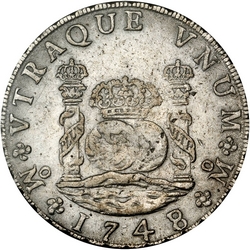
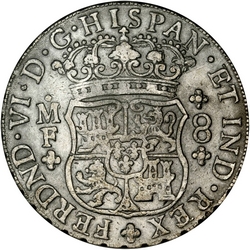
KM-104.1 8r 1748/7 Mo MF (Ponterio NYINC auction, 8 January 2013, lot 1520)
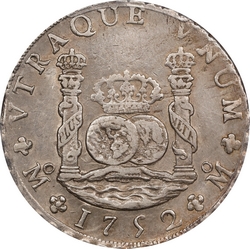
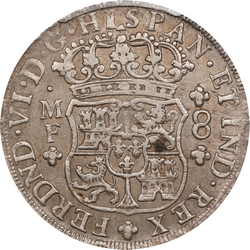
KM-104.1 8r 1752/1 Mo MF (Stack’s Bowers auction, 29 October 2024, lot 72373)
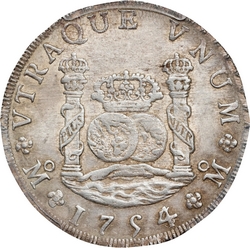
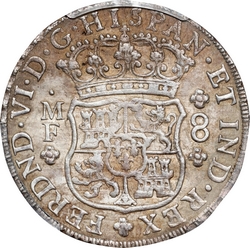
KM-104.1 8r 1754/3 Mo MF (Stack’s Bowers auction, 17 August 2024, lot 44153)
In 1754 the design was changed to imperial crown on the left pillar.
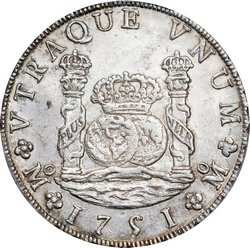
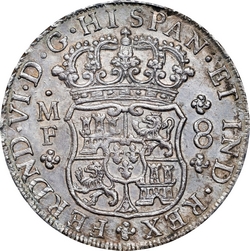
KM-104.1 8r 1751 Mo MF (Stack’s Bowers auction, 17 August 2024, lot 44152)
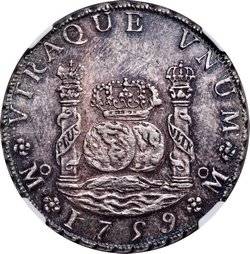
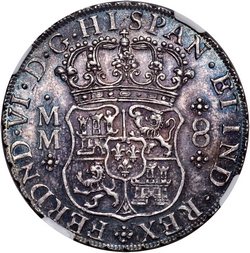
KM-104.2 8r 1759 Mo MM (Stack’s Bowers NYINC auction, 15 January 2022, lot 2292)
| Date | Asssayer | Comment |
| 1754 | MM | |
| 1754 | MF | |
| 1755 | MM | |
| 1755/4 | MM | |
| 1756 | MM | |
| 1756/5 | MM | |
| 1757 | MM | |
| 1757/6 | MM | |
| 1758 | MM | |
| 1759 | MM | |
| 1760 | MM |
The milled columnario half real is one of five denominations of silver coinage produced by the Mexico City mint from 1732 to 1771. It was the smallest silver coin for its time from that mint, the quarter real only being struck for the first time in 1796. The milled half real was preceded by cob coinage (which overlaps to 1733), and followed by portrait-type milled coinage in 1772. The famous and symbolic pillar and globe design makes it highly collectible, at least as a type coin. Despite this, there is little information on mintages and an incomplete accounting of major varieties for the forty year span of issue.
In general, it can be said that production of half reales was for the most part stable, but fluctuated over periods of five or more years. An early pulse of mintage from 1734 to 1740 was followed by less production from 1741-1745. Then a period of increasing mintage from 1746-1758 (with the stark exception of 1756) and gradual decrease to very low mintages in 1766. Thereafter occurred another gradual increase to the end of the series.
The following table was compliled by Brad Yonaka.
The alpha-numeric sequence assigned to each type is per the system created by Gilboy{footnote}Frank F. Gilboy, The Milled Columnarios of Central and South America. Regina, Canada: Prairie Wind Publishing, Inc., 1999.{/footnote}), as this is by far the most comprehensive of all references. Cases where Gilboy) does not report the variety, I have assigned suffixes starting with the letter u, v, etc, and show the number sequence in red. I also show (where applicable) the number assigned by Cayon{footnote} Adolfo Cayon, Clemente Cayon, and Juan Cayon, Las Monedas Espanoles Volumen I – Del tremis al euro. Madrid, Spain: Cayon-Jano S.L., 2005{/footnote}.
Rarity is taken from personal data on abundance of specimens. In most cases it correlates well with Gilboy in a relative sense, given that his database must have been many times larger. Where Brad Yonaka has not observed the variety, rarity is per that of Gilboy.
| Gilboy # or (added) | Cayon# | Date | Assayer's Initial |
Mint mark |
Rarity* | Variety |
| Philip V died in July 1746 and Ferdinand VI took the throne, but this news did not reach the Mexico City mint until 1747. Thus, all coins from 1746 are in the name of Philip, and coins with both names appear in 1747. | ||||||
| M-05-21 | 10152 | 1747 | M | N | FRD VI | |
| Less common date and type. At least one reverse die shared with M-05-20 (the posthumous issue for Philip V). | ||||||
| M-05-21a | 10151 | 1747/6 | M | RRR | one year OD, 2 pellets after obverse R | |
| Extremely rare variety, only one die pair observed. Gilboy, however, notes it as 'rare'. | ||||||
| M-05-22 | 10158 | 1748 | M | C | ||
| Common date. Numerous fakes observed. | ||||||
| M-05-22a | (10157) | 1748/7 | M | S | one year OD | |
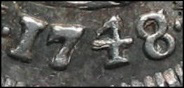 |
Relatively common overdate, with many different reverse dies. Some sharing of obverse dies with M-05-22. Cayon lists this variety as also being FRD/PHS, but this has not been observed. | |||||
| (M-05-22u) | - | 1748 | M | RRR | No pellet to right of date | |
| Variety unlisted in references. Similar to M-05-19a. Two die pairs observed. | ||||||
| M-05-23 | 10165 | 1749 | M | C | ||
| Common date. No listed or observed varieties for year. | ||||||
| M-05-24 | 10170 | 1750 | M | C | ||
| Common date. | ||||||
| M-05-24a | - | 1750 | M | RR | Knobs on crowns flanking globes | |
| Gilboy lists this variety as 'rare'. Only one die pair observed. | ||||||
| M-05-25 | 10177 | 1751 | M | C | ||
| Common date. No listed or observed varieties for year. | ||||||
| M-05-26 | 10185 | 1752 | M | C | ||
| Common date, 30 die pairs observed. Gilboy lists this date as 'less common'. No listed or observed varieties. | ||||||
| M-05-27 | 10192 | 1753 | M | C | ||
| The most common date of Ferdinand VI half reales, over 40 die pairs observed. Some dies show repunched 3/3 in date. | ||||||
| M-05-27a | - | 1753/1 | M | RRRR | two year OD | |
| Very rare variety. Difficult to distinguish 3/1. | ||||||
| (M-05-27u) | - | 1753 | M | RRRR | no pellet between VI and D | |
| Variety not noted in references. One cdie pair observed. | ||||||
| (M-05-27v) | - | 1753/2 | M | RRRR | one year OD | |
| Very rare variety. Only one die pair observed. | ||||||
| M-05-28 | 10199 | 1754 | M | C | ||
| Very common date, over 40 die pairs observed. | ||||||
| M-05-28u | - | 1754/3 | M | RRRR | one year OD | |
| Very rare variety. One die pair observed, need better example to confirm. | ||||||
| M-05-29 | 10208 | 1755 | M | C | ||
| Common date. Two obversed strongly clashed reverse dies. Numerous fakes observed. | ||||||
| (M-05-29u) | - | 1755/6 | M | R | one year revese OD | |
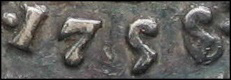 |
Unusual reverse OD, only occurrence in series. Noted in SCWC but not in Gilboy. Only two die pairs observed. Gilboy may have classified this OD as 1756/5. | |||||
| M-05-30 | 10215 | 1756 | M | N | ||
| Scarce date. | ||||||
| M-05-30a | 10214 | 1756/5 | M | (R) | one year OD | |
| M-05-31 | 10223 | 1757 | M | C | both pillar crowns royal | |
 |
Common date. To left is example of royal crown, which up to this date was placed ontop both reverse pillars. | |||||
| M-05-31a | 10222 | 1757/6 | M | N | one year OD, both pillar crowns royal | |
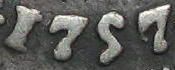 |
Very common overdate, ten die pairs observed. | |||||
| (M-05-31u) | - | 1757/47 | M | S | decade OD | |
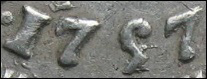 |
Not noted in references. Two reverse dies observed. A case could be made that one of the dies (shown) is merely cracked and rusted, giving the appearance of 5/4. | |||||
| M-05-32 | 10224 | 1757 | M | S | left pillar crown imperial | |
 |
Gilboy notes this variety as common. Four die pairs observed. To left is example of early-style imperial crown. | |||||
| M-05-33 | 10230 | 1758 | M | (R) | both pillar crowns royal | |
| Gilboy notes this variety as rare. No observed examples. | ||||||
| M-05-34 | 10232 | 1758 | M | C | left pillar crown imperial | |
| Common date. | ||||||
| M-05-34a | 10231 | 1758/7 | M | S | one year OD | |
| Scarce variety. One obverse die shared with M-05-34. | ||||||
| M-05-35 | 10241 | 1759 | M | C | ||
| Common date. No listed or observed varieties. From this year onward, imperial crown (see photo insert at M-05-32) tops left pillar in all examples. | ||||||
Rarity scale used, with the exception of those by Gilboy (shown in paratheses in table)
| rarity | Number of coins |
| RRRR | 1 |
| RRR | 2-3 |
| RR | 4-5 |
| R | 6-7 |
| S | 8-10 |
| N | 11-20 |
| C | 20+ |
There were four types of gold coins: The first, which apparently was coined only during 1747, has on the obverse the armored and peruked bust of the king, whose features are not so full as in the second and third types. These were struck using locally engraved dies, as those that depicted the new king would not arrive from Madrid until late in 1747. The reverse is similar in design and inscription (INITIUM SAPIENTIAE TIMOR DOMINI (Beginning of Wisdom is Fear of the Lord)) to those of Philip V.
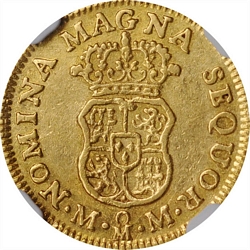
The gold coins of the second type show a smaller, draped portrait of the king with more rotund features than the first type. The inscription around the margin of the obverse side reads: F E R D N D . VI . D . G . HISPAN . E T . IND . R E X . [date]. The reverse presents the same coat of arms as found on the gold coins of Philip V of the eight escudos denomination, but the assayers' initials have been removed from the left of the shield and placed on the margin. The value, in Arabic numerals, appears on the left of the shield between rosettes, one above and one below the figure; on the right of the shield one finds the letter S (Latin for escudos) also between rosettes. The collar of the Order of the Golden Fleece has the Grand Cross suspended below the Fleece. The inscription reads: NOMINA MAGNA SEQUOR (I succeed great names). In the center, below, on either side of the Grand Cross appear the mint mark and the assayers' initials.
The third type presents a similar bust, slightly more ornamented. The initial date of mintage is 1753. On the reverse one finds the same arrangement as described for the third type except that the value does not appear anywhere. The initials * M * M * are found on either side of the Fleece, on the margin.
The fourth type, minted from 1757 to 1759, presents on the obverse the heavily armored bust of the monarch, less rotund, with curlier peruke, and the name appears as FERDIND. The reverse is the same as in the third type, except that the Grand Cross does not appear suspended below the Golden Fleece.
The four, two and one escudos bear the same variations as explained when dealing with similar coins of Philip V, that is, the coat of arms is simplified and is not surrounded by the collar of the Golden Fleece. In some of the two, and in all the one escudo coins, only the head and neck, with a draped base, appear, Some of the one-escudo coins do not have the value shown on either side. The edge milling varies, being either transverse, wreath or twisted cord-like.
This was an imaginary bust design struck before the Madrid Mint delivered definitive standard portrait punches of the new monarch. The reverse is similar in design and inscription (INITIUM SAPIENTIAE TIMOR DOMINI (Beginning of Wisdom is Fear of the Lord)) to those of Philip V.
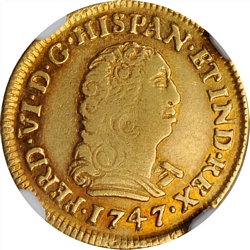
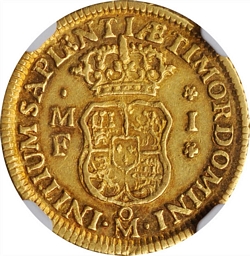
KM-114 1E 1747 Mo MF (Stack’s Bowers auction, 16 January 2021, lot 22202)
| Date | Asssayer | Comment |
| 1747 | MF |
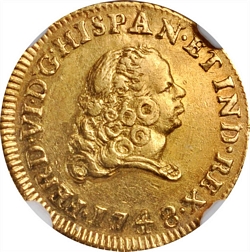
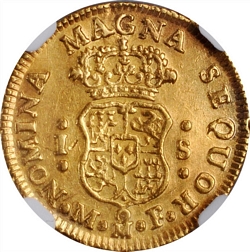
KM-115.1 1E 1748 Mo MF (Stack’s Bowers auction, 19 January 2021, lot 24156)
| Date | Asssayer | Comment |
| 1748 | MF | |
| 1749 | MF | |
| 1750 | MF | |
| 1751 | MF |
The third type presents a similar bust, slightly more ornamented.
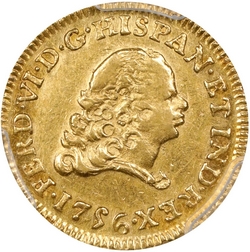
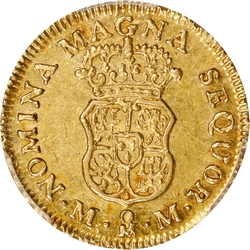
KM-115.2 1E 1756 Mo MM (Stack’s Bowers auction, 26 August 2025, lot 41307)
| Date | Asssayer | Comment |
| 1752 | MF | |
| 1753 | MF | |
| 1754 | MF | |
| 1755 | MM | |
| 1756 | MM |
The fourth type, minted from 1757 to 1759, presents on the obverse the heavily armored bust of the monarch, less rotund, with curlier peruke, and the name appears as FERDIND.
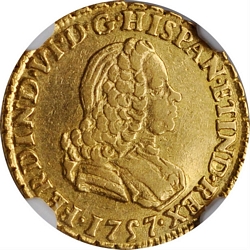
KM-A116 1E 1757 Mo MM (Stack’s Bowers auction, 16 January 2021, lot 22212)
| Date | Asssayer | Comment |
| 1757 | MM | |
| 1758 | MM | |
| 1759 | MM |
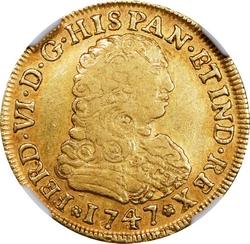
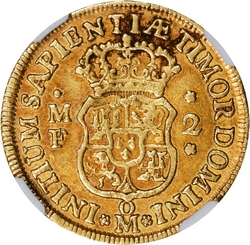
KM-125 2E 1747 Mo MF (Stack’s Bowers auction, 28 February 2024, lot 73013)
| Date | Asssayer | Comment |
| 1747 | MF | |
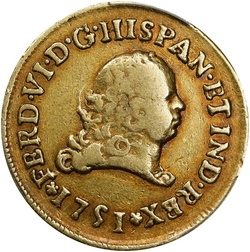
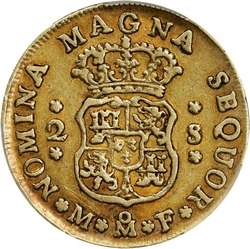
KM-126.1 2E 1751 Mo MF (Stack’s Bowers auction, 24 February 2026, lot 76383)
| Date | Asssayer | Comment |
| 1748 | MF | |
| 1749/8 | MF | illustrated below |
| 1750 | MF | |
| 1751 | MF |
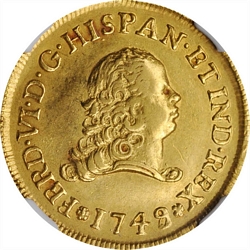
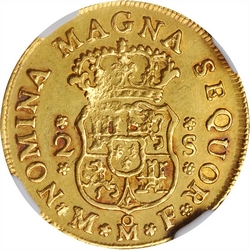
KM-126.1 2E 1749/8 Mo MF (Stack’s Bowers auction, 16 January 2021, lot 22205)
The third type presents a similar bust, slightly more ornamented.
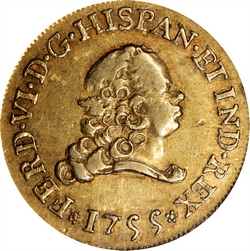
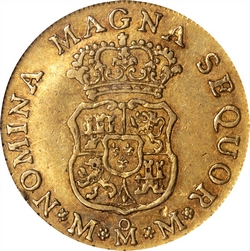
KM-126.2 2E 1755 Mo MM (Stack’s Bowers auction, 15 January 2022, lot 2291)
| Date | Asssayer | Comment |
| 1752 | MF | |
| 1753 | MF | |
| 1754 | MF | |
| 1755 | MF | |
| 1755 | MM | |
| 1756 | MF | |
| 1756 | MM |
The fourth type, minted from 1757 to 1759, presents on the obverse the heavily armored bust of the monarch, less rotund, with curlier peruke, and the name appears as FERDIND.
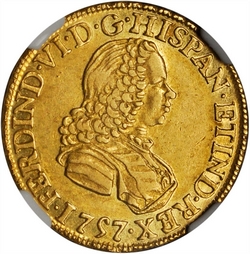
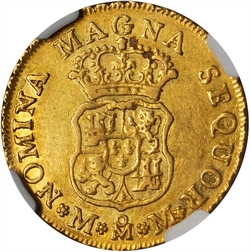
KM-127 2E 1757 Mo MM (Stack’s Bowers ANA auction, 16 August 2018, lot 21338)
| Date | Asssayer | Comment |
| 1757 | MM | |
| 1758 | MM | |
| 1759 | MM |
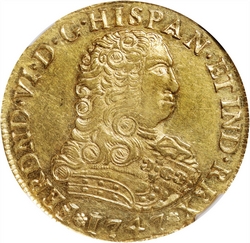
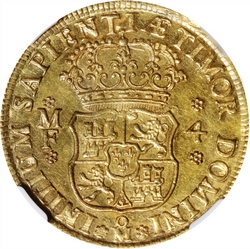
KM-136 4E 1747 Mo MF (Stack’s Bowers, NYINC auction, 15 January 2022, lot 2082)
| Date | Asssayer | Comment |
| 1747 | MF |
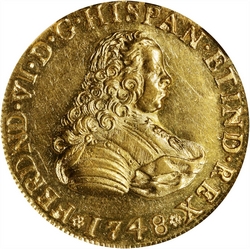
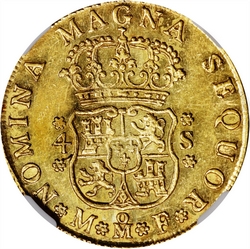
KM-137 4E 1748 Mo MF (Stack’s Bowers NYINC auction, 15 January 2022, lot 2083)
| Date | Asssayer | Comment |
| 1748 | MF | |
| 1749 | MF | |
| 1750 | FM | |
| 1751 | FM |
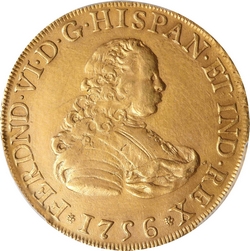
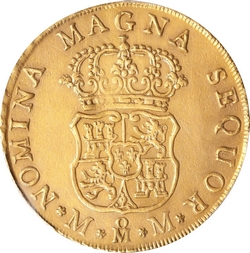
KM-138 4E 1756 Mo MM (Stack’s Bowers auction, 26 August 2022, lot 34157)
| Date | Asssayer | Comment |
| 1752 | MF | |
| 1753 | MF | |
| 1754 | MF | |
| 1755 | MM | |
| 1756 | MM |
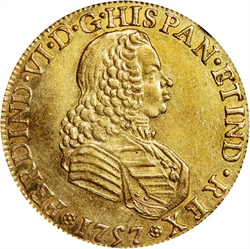
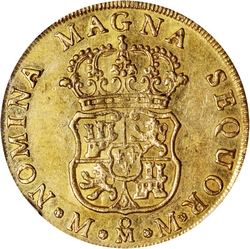
KM-139 4E 1757 Mo MM (Stack’s Bowers NYINC auction, 15 January 2022, lot 2085)
| Date | Asssayer | Comment |
| 1757 | MM | |
| 1758 | MM | |
| 1759 | MM |
The first, which apparently was coined only during 1747, has on the obverse the armored and peruked bust of the king, whose features are not so full as in the second and third types. These were struck using locally engraved dies, as those that depicted the new king would not arrive from Madrid until late in 1747. The reverse is similar in design and inscription (INITIUM SAPIENTIAE TIMOR DOMINI (Beginning of Wisdom is Fear of the Lord)) to those of Philip V.
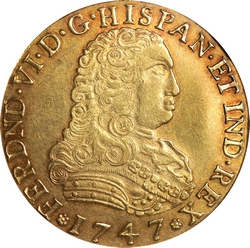
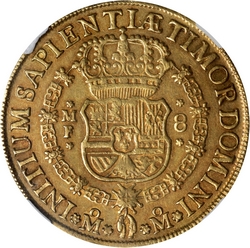
KM-149 8E 1747 Mo MF (Stack’s Bowers, NYINC auction, 15 January 2022, lot 2290)
Unlike most survivors that show incompleteness in Ferdinand's hair, the reverse shield or both, the strike on this piece is even and virtually full, with all intended details being clear for the viewer to observe.
| Date | Asssayer | Comment |
| 1747 | MF |
The gold coins of the second type show a smaller, draped portrait of the king with more rotund features than the first type. The inscription around the margin of the obverse side reads: F E R D N D . VI . D . G . HISPAN . E T . IND . R E X . [date]. The reverse presents the same coat of arms as found on the gold coins of Philip V of the eight escudos denomination, but the assayers' initials have been removed from the left of the shield and placed on the margin. The value, in Arabic numerals, appears on the left of the shield between rosettes, one above and one below the figure; on the right of the shield one finds the letter S (Latin for escudos) also between rosettes. The collar of the Order of the Golden Fleece has the Grand Cross suspended below the Fleece. The inscription reads: NOMINA MAGNA SEQUOR (I succeed great names). In the center, below, on either side of the Grand Cross appear the mint mark and the assayers' initials.
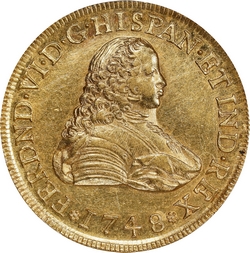
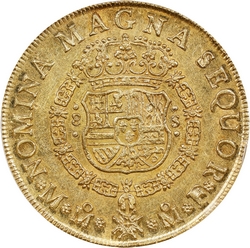
KM-150 8E 1748 Mo MF (Stack’s Bowers NYINC Auction 13 January 2024,lot 53123)
| Date | Asssayer | Comment |
| 1748 | MF | |
| 1749 | MF | |
| 1750 | MF | |
| 1751 | MF |
The third type presents a similar bust, slightly more ornamented. The initial date of mintage is 1753. On the reverse one finds the same arrangement as described for the third type except that the value does not appear anywhere. The initials * M * M * are found on either side of the Fleece, on the margin.
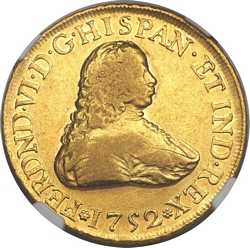
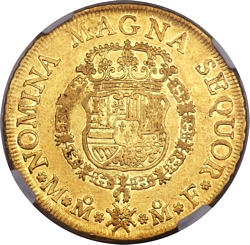
KM-151 8E 1752 Mo MF (Heritage sale 3037,January 2015, lot 30311)
| Date | Asssayer | Comment |
| 1752 | MF | |
| 1753 | MF | |
| 1754 | MF | |
| 1755 | MM | |
| 1756 | MM |
The fourth type, minted from 1757 to 1759, presents on the obverse the heavily armored bust of the monarch, less rotund, with curlier peruke, and the name appears as FERDIND. The reverse is the same as in the third type, except that the Grand Cross does not appear suspended below the Golden Fleece.
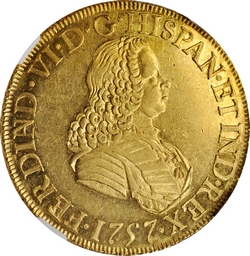
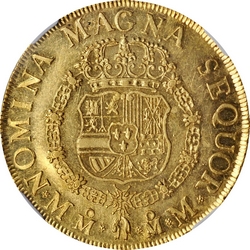
KM-152 8E 1757 Mo MM (Stack’s Bowers auction, 16 January 2021, lot 22209)
| Date | Asssayer | Comment |
| 1757 | MM | |
| 1758 | MM | |
| 1759 | MM | illustrated below |
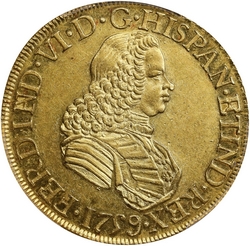
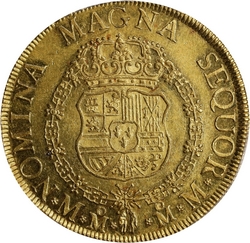
KM-152 8E 1759 Mo MM (Stack’s Bowers auction ,26 August 2025, lot 41305)
The amounts coined were:
| Gold | Silver | Total | |
| 1747 | 370,842.00 | 12,083,668.31¾ | 12,454,510.31¾ |
| 1748 | 327,582.00 | 11,644,788.25 | 11,972,370.25 |
| 1749 | 315,756.00 | 11,898,590.37½ | 12,214,346.37½ |
| 1750 | 476,294.00 | 13,228,030.25 | 13,704,324.25 |
| 1751 | 255,592.00 | 12,657,275.25 | 12,912,867.25 |
| 1752 | 267,724.00 | 13,701,532.87½ | 13,969,256.87½ |
| 1753 | 452,404.00 | 11,607,974.12½ | 12,060,378.12½ |
| 1754 | 309,974.00 | 11,608,024.00 | 11,917,998.00 |
| 1755 | 418,696.00 | 12,606,339.75 | 13,025,035.75 |
| 1756 | 759,796.00 | 12,336,732.50 | 13,096,528.50 |
| 1757 | 555,486.00 | 12,550,035.37½ | 13,105,521.37½ |
| 1758 | 173,080.00 | 12,733,187.25 | 12,906,267.25 |
| 1759 | 450,322.00 | 13,031,336.62½ | 13,481,658.62½ |
| 5,133,548.00 | 161,687,514.93¾ | 166,821,062.93¾ |