The milled columnario half real is one of five denominations of silver coinage produced by the Mexico City mint from 1732 to 1771. It was the smallest silver coin for its time from that mint, the quarter real only being struck for the first time in 1796. The milled half real was preceded by cob coinage (which overlaps to 1733), and followed by portrait-type milled coinage in 1772. The famous and symbolic pillar and globe design makes it highly collectible, at least as a type coin. Despite this, there is little information on mintages and an incomplete accounting of major varieties for the forty year span of issue.
In general, it can be said that production of half reales was for the most part stable, but fluctuated over periods of five or more years. An early pulse of mintage from 1734 to 1740 was followed by less production from 1741-1745. Then a period of increasing mintage from 1746-1758 (with the stark exception of 1756) and gradual decrease to very low mintages in 1766. Thereafter occurred another gradual increase to the end of the series.
The following table was compliled by Brad Yonaka.
The alpha-numeric sequence assigned to each type is per the system created by Gilboy{footnote}Frank F. Gilboy, The Milled Columnarios of Central and South America. Regina, Canada: Prairie Wind Publishing, Inc., 1999.{/footnote}), as this is by far the most comprehensive of all references. Cases where Gilboy) does not report the variety, I have assigned suffixes starting with the letter u, v, etc, and show the number sequence in red. I also show (where applicable) the number assigned by Cayon{footnote} Adolfo Cayon, Clemente Cayon, and Juan Cayon, Las Monedas Espanoles Volumen I – Del tremis al euro. Madrid, Spain: Cayon-Jano S.L., 2005{/footnote}.
Rarity is taken from personal data on abundance of specimens. In most cases it correlates well with Gilboy in a relative sense, given that his database must have been many times larger. Where Brad Yonaka has not observed the variety, rarity is per that of Gilboy.
| Gilboy # or (added) | Cayon# | Date | Assayer's Initial |
Mint mark |
Rarity* | Variety |
| M-05-1var | 1732 | S | no assayer's initial | |||
| Type struck without placing assayer initials or mintmark on coin. Gilboy postulates that this type was struck from trial matrices sent from Spain. A significant number of examples have been observed, many more than would be expected for a type considered to be extremely rare. The importance and novelty of the coin may explain why so many are preserved and have appeared in auction. Three of the obverse dies, and two reverse dies, are exhibited solely by examples residing in the Banco de Mexico collection. | ||||||
| M-05-1 | 8229 | 1732 | F | (R5) | chief assayer's initial only | |
| ype not observed. Gilboy classifies type as extremely rare. | ||||||
| M-05-2 | 8230 | 1732 | MF | RRRR | ||
| One die pair observed. A curious variety, considering that the assayer M (Manuel de León) only began work at the mint in 1733. | ||||||
| M-05-3 | 8237 | 1733 | F | (R5) | chief assayer's initial only | |
| Type not observed. Gilboy classifies type as extremely rare. | ||||||
| M-05-4 | 8236 | 1733 | F | M-X | (R5) | MX mintmark, chief assayer's initial only |
| Type not observed. Gilboy classifies type as extremely rare. | ||||||
| M-05-5 | 8239 | 1733 | MF | M·X | N | MX mintmark |
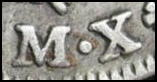 |
Most abundant type for year, with three different reverse dies observed. Gilboy rates these as much more rare than I have observed. | |||||
| M-05-6 | 8240 | 1733 | MF | RRRR | ||
| Only two die pairs observed. One of the obverse dies is shared with M-05-5. | ||||||
| (M-05-6u) | - | 1733/2 | MF | RRR | one year OD | |
| Type noted in SCWC, not in Gilboy. Only one die pair observed. | ||||||
| M-05-7 | 8246 | 1734 | MF | S | ||
| Abundant die pairs. Many well struck examples observed. | ||||||
| M-05-7a | 8245 | 1734/3 | MF | N | None year OD | |
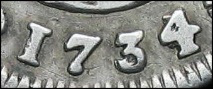 |
Relatively common overdate, with many different reverse dies. Some sharing of obverse dies with M-05-7. | |||||
| M-05-7b | - | 1734 | MF | RRR | cinquefoil below assayers' initials | |
| Very rare variety for year with only two die pairs observed. | ||||||
| M-05-8 | 8253 | 1735 | MF | C | ||
| Common issue, with over 15 observed die pairs. | ||||||
| M-05-8a | 8252 | 1735/4 | MF | RRR | one year OD | |
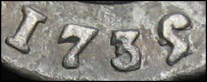 |
Rare OD, only three die pairs observed. | |||||
| (M-05-8u) | - | 1735/3 | MF | RR | two year OD | |
| Not noted in references. Rare OD, only two die pairs observed. Higher grade examples needed to confirm 5/3 designation. | ||||||
| M-05-9 | 8260 | 1736 | MF | C | ||
| Most common date and type for Philip V. | ||||||
| M-05-9a | 8259 | 1736/5 | MF | RRR | one year OD | |
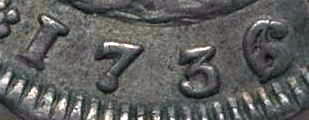 |
Very rare OD, one die pair observed. | |||||
| (M-05-9u) | (8258) | 1736 | F | RRRR | chief assayer's initial only | |
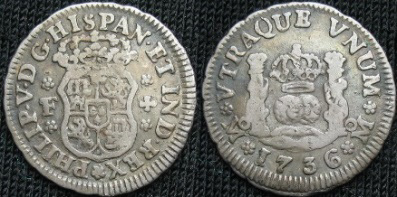 |
Variety discussed by Gilboy in footnote as being exceedingly rare, but type is not listed in text of book. Must have been produced using obverse die from 1733. Cayon lists type as a 1736/3 OD, but this is not exhibited on only observed example, nor could the obverse die be matched with any known example from 1733. | |||||
| FM-05-10 | 8269 | 1737 | MF | C | ||
| (M-05-10u) | 8268 | 1737/6 | MF | RRRR | one year OD | |
| Variety noted in SCWC and Cayon, not in Gilboy. Only one die pair observed. | ||||||
| (M-05-10v} | - | 1737 | MF | RRRR | large F in assayer's initials | |
| Variety not noted in references. F punch may have been taken from set for one real dies. Commonly seen fake exists, all examples have been from same die pair. | ||||||
| M-05-11 | 8276 | 1738 | MF | C | ||
| Common type, over 15 die pairs observed. | ||||||
| M-05-11a | - | 1738/7 | MF | RR | one year OD | |
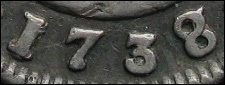 |
Very rare variety. Only one die pair observed. | |||||
| M-05-11b | - | 1738/5 | MF | RRRR | three year OD | |
| Very rare variety. Only one die pair observed. | ||||||
| M-05-11c | - | 1738 | MF | RR | cinquefoil below assayer's initials | |
| Rare variety, only two die pairs observed. Shares one reverse die with M-05-11. | ||||||
| M-05-12 | 8282 | 1739 | MF | C | ||
| Second most common type for Philip V. No obversed or listed varieties for this date. Some reverse dies show repunching of 7 and 3. Cayon notes variety with pellet between 3 and 9 (not observed). | ||||||
| M-05-13 | 8289 | 1740 | MF | C | ||
| Common date, over 15 die pairs observed. | ||||||
| M-05-13a | 8288 | 1740/30 | MF | R | decade OD | |
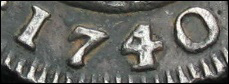 |
Listed as extremely rare by Gilboy, but five die pairs observed | |||||
| (M-05-13u) | - | 1740/39 | MF | RRR | one year OD | |
| Unlisted in references, only one die pair observed. All examples have numerous die cracks. | ||||||
| M-05-14 | 8294 | 1741 | MF | C | ||
| No listed or observed varietites for this year. | ||||||
| Beginning in 1742, coin obverse design changed, shortening legend and moving shield upward. Chief assayer initial moved to reverse, at right of date. | ||||||
| M-05-15 | 8298 | 1742 | M | C | ||
| Common date. | ||||||
| (M-05-15u) | - | 1742 | M | RRR | No pellet to right of date | |
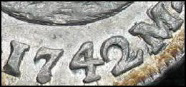 |
Unlisted in references, only one die pair observed. This design variety is, however, listed for 1746 (M-05-19a). | |||||
| M-05-16 | 8302 | 1743 | M | N | ||
| Scarce date. | ||||||
| (M-05-16u) | - | 1743/2 | M | RRR | one year OD | |
| Unlisted in references. Only one die pair observed. Difficult to see in lower grades, due to similarity of 3 and 2. | ||||||
| M-05-17 | 8307 | 1744 | M | N | ||
| Relatively uncommon date | ||||||
| M-05-17a | 8306 | 1744/3 | M | S | one year OD | |
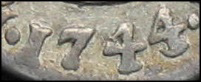 |
Rare overdate, only two die pairs observed. | |||||
| M-05-18 | 8312 | 1745 | M | C | ||
| Common date. | ||||||
| M-05-18a | - | 1745 | M | (R) | legend has EST IND instead of ET IND | |
| Variety listed in Gilboy, has not been observed. | ||||||
| M-05-19 | 8317 | 1746 | M | C | ||
| Common date. | ||||||
| M-05-19a | - | 1746 | M | R | No pellet to right of date | |
| Very rare variety. Only one die pair observed. Gilboy, however, lists it as 'scarce'. | ||||||
| (M-05-19u) | - | 1746/5 | M | N/A | ||
| M-05-20 | 8321 | 1747 | M | N | PHS V | |
| Posthumous issue for Philip V. About same abundance as M-05-21. Less common date. | ||||||
Rarity scale used, with the exception of those by Gilboy (shown in paratheses in table)
| rarity | Number of coins |
| RRRR | 1 |
| RRR | 2-3 |
| RR | 4-5 |
| R | 6-7 |
| S | 8-10 |
| N | 11-20 |
| C | 20+ |
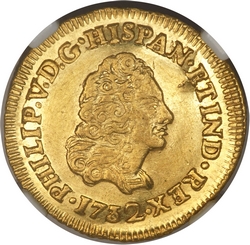
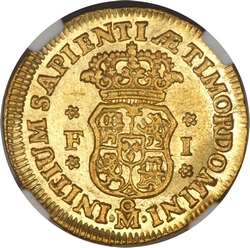
KM-113 1E 1732 Mo F (Heritage sale 3041, August 2015, lot 31001)
| Date | Asssayer | Comment |
| 1732 | No assayer or denomination | |
| 1732 | F | |
| 1733 | F | |
| 1734 | MF | |
| 1734/3 | MF | |
| 1735 | MF | |
| 1735/4 | MF | illustrated below |
| 1736 | MF | |
| 1736/5 | MF | |
| 1737 | MF | |
| 1738 | MF | |
| 1739 | MF | |
| 1740 | MF | |
| 1741 | MF | |
| 1742 | MF | |
| 1743 | MF | |
| 1744 | MF | |
| 1745 | MF | |
| 1746/5 | MF | illustrated below |
| 1747 | MF |
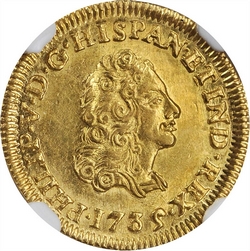
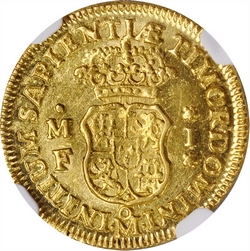
KM-113 1E 1735/4 Mo MF (Stack’s Bowers auction, 16 January 2021, lot 22198)
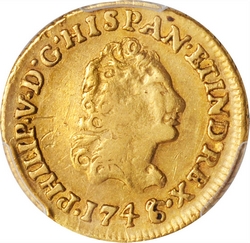
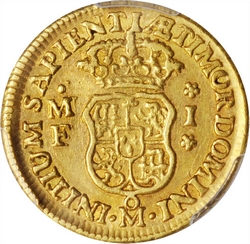
KM-113 1E 1746/5 Mo MF (Stack’s Bowers auction, 13 October 2021, lot 71399)
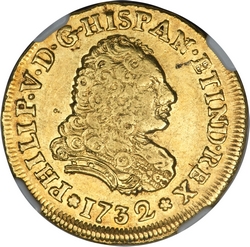
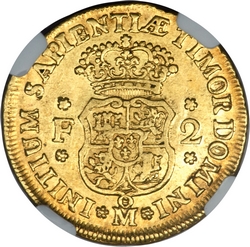
KM-124 2E 1732 Mo F (Heritage sale 3041, August 2015, lot 31021)
| Date | Asssayer | Comment |
| 1732 | No assayer or denomination | |
| 1732 | F | |
| 1733 | F | |
| 1734 | MF | |
| 1736 | MF | |
| 1736/5 | MF | |
| 1737 | MF | |
| 1738 | MF | |
| 1739 | MF | |
| 1740 | MF | |
| 1740/4 | MF | |
| 1741 | MF | |
| 1742 | MF | |
| 1743 | MF | |
| 1744 | MF | |
| 1744/3 | MF | |
| 1745 | MF | |
| 1746 | MF | |
| 1747 | MF |
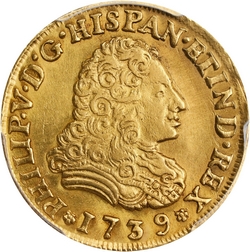
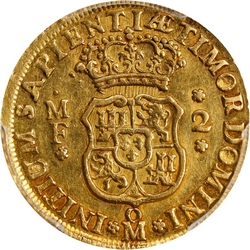
KM-124 2E 1739 Mo MF (Stack’s Bowers auction, 24 February 2026, lot 76299)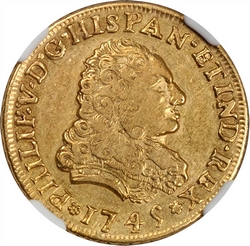
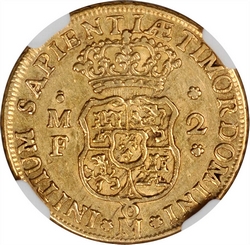
KM-124 2E 1745 Mo MF (Stack’s Bowers Baltimore auction, November 2015, lot 39352)
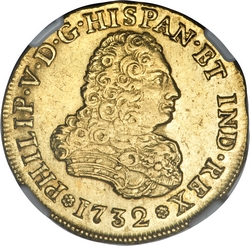
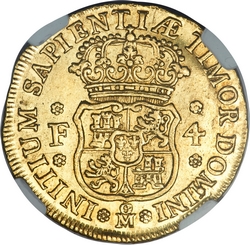
KM-135 4E 1732 Mo F (Stack’s Bowers NYINC auction, January 2015, lot 1257)
| Date | Asssayer | Comment |
| 1732 | No assayer or denomination | |
| 1732 | F | |
| 1733 | F | |
| 1734 | MF | |
| 1734/3 | MF | illustrated below |
| 1735 | MF | |
| 1736 | MF | |
| 1737 | MF | |
| 1738 | MF | |
| 1738/7 | MF | |
| 1739 | MF | |
| 1740 | MF | |
| 1740/30 | MF | decade digit overdate, illustrated below |
| 1741 | MF | |
| 1743 | MF | |
| 1744 | MF | |
| 1745 | MF | |
| 1746 | MF | |
| 1747 | MF |
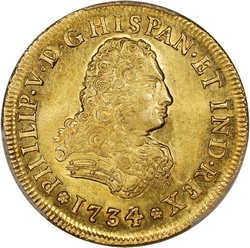
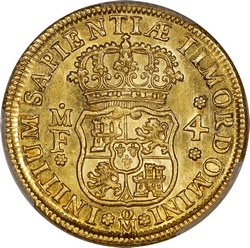
KM-135 4E 1734/3 Mo MF (Stack’s Bowers auction, 26 August 2025, lot 41287)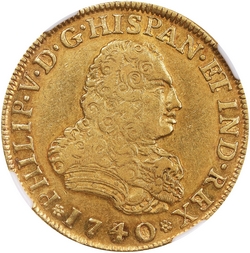
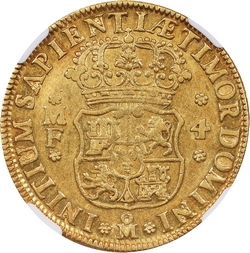
KM-135 4E 1740/30 Mo MF (Stack’s Bowers auction, 13 January 2024, lot 53120)
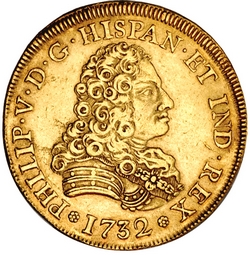
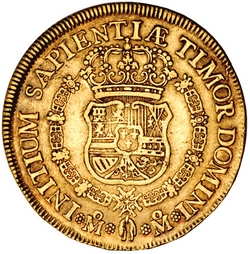
KM-148 8E 1732 Mo (Stack's Bowers Eliasberg Collection, 15 April 2005, lot 3083)
| Date | Asssayer | Comment |
| 1732 | No assayer or denomination | |
| 1732 | F | |
| 1733 | F | |
| 1734 | MF | |
| 1734/3 | MF | |
| 1735 | MF | |
| 1736 | MF | |
| 1737 | MF | |
| 1738/7 | MF | illustrated below |
| 1738 | MF | |
| 1739 | MF | |
| 1740 | MF | |
| 1741 | MF | |
| 1742 | MF | |
| 1743 | MF | |
| 1743/2 | MF | illustrated below |
| 1744 | MF | |
| 1745 | MF | |
| 1746 | MF | |
| 1747 | MF |
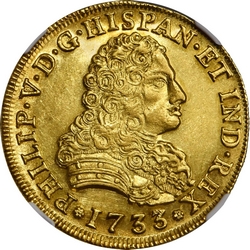
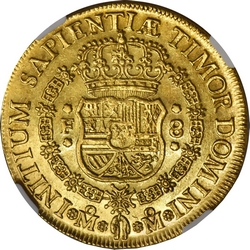
KM-148 8E 1733 Mo F (Stack’s Bowers auction, 16 January 2021, lot 21058)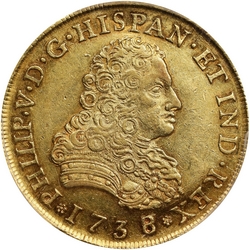
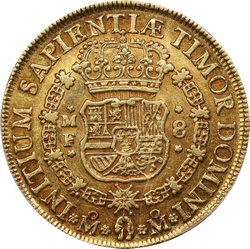
KM-148 8E 1738/7 Mo MF (Stack’s Bowers auction, 26 August 2025, lot 41286)
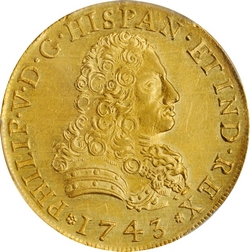
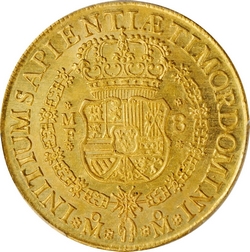
KM-148 8E 1743/2 Mo MF (Stack’s Bowers auction, 6 August 2020, lot 21467)
While faint, a small curvature at the top of 3 in the date confirms the 3/2 overdate.
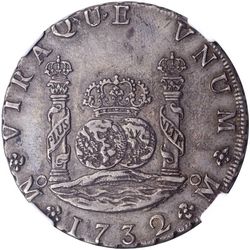
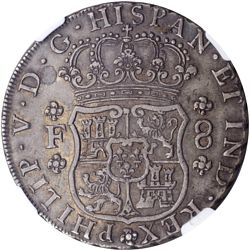
KM-103; Cal-type-146 #774; Gil M-8-1; FC-1 8 Reales 1732 Mo F (Stack's Bowers ANA Auction, 20 August 2021, lot 41138)
The aim of this work is to provide collectors with a better understanding of Philip V 8 reales coinage and the relative rarities of dates and varieties. It is based on Freeman L. Craig’s Spanish Colonial Eight Reales{footnote}Freeman L. Craig, Spanish Colonial Eight Reales, 19 {/footnote}” supplemented by my knowledge of shipwreck and land finds which in several cases have drastically changed the populations of certain dates.
Freeman Craig developed a unique numbering system where dates and major types are assigned a unique number with sub-letter for major variants.. In the following table these are cross referenced to Carlos Elizondo’s Eight Reales and Pesos of the New World{footnote}Carlos Elizondo, Eight Reales and Pesos of the New World{/footnote}.
| Freeman Craig No. |
Elizando | Date | Assayer's Initials |
Mint mark |
Rarity | |
| 1 | 1 | 1732 | F | Mo | 3 | Minor variants exist |
| Most surviving examples are recovered from shipwreck finds, predominantly from wrecks such as the Rooswijk, Reijgersdaal, Holandia and 1733 Plate Fleet. Although not particularly rare as a date, 1732 Pillar 8 Reales are ever popular with collectors as they are the first dated milled 8 Reales of Mexico. Non sea salvaged examples are very rare and command a large premium. | ||||||
| 2 | 2 | 1733 | F | Mo | 5 | Small crown only |
| Most examples are recovered from the 1733 Plate Fleet with a smaller amount from other wrecks. Non sea salvaged examples are very rare and command a large premium. It is interesting to note that the 1733 Plate Fleet contained only coinage with the single letter “F” assayer’s letter. | ||||||
| 3a | 3 | 1733 | MF | Mo | 3 | Small crown |
| This is the most frequently encountered of any variant of 1733 8 Reales. Examples appear on the market on a semi regular basis, both from shipwreck and non-shipwreck sources. Variants exist with and without dot above the assayer’s letter. The variant without dot is exceedingly rare. | ||||||
| 3b | 4 | 1733 | MF | Mo | 7 | Large crown |
| Elusive and very underrated, much rarer than the small crown variety. Examination of shipwreck finds supports this. For example, the original sale of coins recovered from the Rooswijk contained 12 of the small crown variety, yet only 1 of the large crown. The rarest variant of 1733 8 Reales. The “Large crown” can also be referred to as the “MX” crown. | ||||||
| 4 | 5a | 1733/2 | F | MX | 7 | Large crown |
| An extremely rare over date produced from re-cutting an unused 1732 MX die. The 1732 MX dies are not known to have been used during that production year. It is likely that dies for this were produced late in 1732 and never used for regular coinage production. The date was then re-cut in 1733 creating this rare over date. | ||||||
| 4b | 6 | 1733 | F | MX | 5 | Large crown |
| Most surviving examples are recovered from the shipwrecks of the 1733 Plate Fleet with a handful of specimens from other wrecks. Non sea salvaged examples are very rare and command a large premium. | ||||||
| 5 | 7 | 1733 | MF | MX | 6 | Large crown |
| Quite a bit rarer than the single letter assayer. On rare occasions shipwreck examples appear on the market, predominantly recovered from Dutch wrecks such as the Rooswijk. Non sea salvaged examples are very rare and command a large premium. Exists with and without dot above assayer’s letter. The variant without dot is exceedingly rare. | ||||||
| 6b | 8 | 1734/3 | MF | Mo | 2 | Small crown, over date |
| Among the more common over dates of Philip V, made more so by the numerous high grade examples recovered from the wreck of the Rooswijk | ||||||
| 6a | 9 | 1734 | MF | Mo | 1 | Small crown, clean date |
| Common as a date and available in most grades approaching uncirculated. | ||||||
| 7a | - | 1735/4 | MF | Mo | 9 | Over Date |
| The existence of this over date was confirmed in the 2006 auction of coins recovered from the Dutch wreck of the Rooswijk. Of the 67 pieces dated 1735 offered in the original catalogue only one was confirmed as an over date. Prior to this discovery the over date was unknown. | ||||||
| 7 | 10 | 1735 | MF | Mo | 1 | Clean date |
| Common as a date and available in most grades approaching uncirculated. | ||||||
| 8b | - | 1736/5 | MF | Mo | 7 | Over date |
| There were a total of 80 pieces dated 1736 offered in the original Rooswijk catalogue of 2006, of that number only one was confirmed as an over date. The existence of this extremely rare over date was previous confirmed by the examination of two highly advanced collections. Still it remains extremely rare. | ||||||
| 8a | 11 | 1736 | MF | Mo | 1 | Clean date |
| Common as a date and available in most grades approaching uncirculated. | ||||||
| 9 | 12 | 1737 | MF | Mo | 1 | Clean date |
| Common as a date and available in most grades approaching uncirculated. Two major varieties with die cutting error exist for this date. The first has inverted “A”s in place of “V”s in the obverse legend “VTRAQUE” and “VNUM”. The second uses an inverted “A” in place of the “V” in the word “VNUM” only. Both varieties are quite rare. | ||||||
| 10b | 14 | 1738/7 | MF | Mo | 5 | Over date |
| This over date is relatively scarce in comparison to the clean date on an average of 20-1. | ||||||
| 10a | 15 | 1738 | MF | Mo | 1 | Clean date |
| Common as a date and available in most grades approaching uncirculated. | ||||||
| 11d | - | 1739/6 | MF | Mo | 5 | Over date |
| Quite rare as an over date. Most known examples are as a result of the salvage of the Dutch shipwreck of the Reijgersdaal. | ||||||
| 11c | - | 1739/7 | MF | Mo | 6 | Over date |
| The rarest of the 1739 over dates. | ||||||
| 11b | - | 1739/8 | MF | Mo | 4 | Over date |
| The most frequently encountered of the 1739 over dates, still much scarcer than the clean date. | ||||||
| 11a | 16 | 1739 | MF | Mo | 1 | Clean date |
| Common as a date and available in most grades approaching uncirculated. | ||||||
| 12b | 17 | 1740(4/3) | MF | Mo | 2 | Over date |
| This over date is a result of pre-prepared dies from the previous decade. I.E. during the 1730s dies would be made ahead of time dated “173” with the final digit blank. The logic in this was that at the beginning of each year the dies would already be made, all you would have to do would be to add the final digit. At the end of the 1730s some of these unfinished dies were left, hence they were recut with an over date for only the third digit of the date. Occasionally this over date is mistakenly catalogued as 1740/39. | ||||||
| 12a | - | 1740 | MF | Mo | 1 | Clean date |
| Common as a date and available in most grades approaching uncirculated. | ||||||
| - | - | 1741/36 | MF | Mo | 9 | Over date |
| A single example of this over date has been confirmed, appearing in a Ponterio & Associates auction in the mid 1990s. | ||||||
| - | - | 1741(4/3) | MF | Mo | 5 | Over Date |
| This over date is a result of pre-prepared dies from the previous decade, similar to the 1740(4/3). I.E. during the 1730s dies would be made ahead of time dated “173” with the final digit blank. Several examples came to light as a result of the salvage of the Dutch shipwreck Reijgersdaal. | ||||||
| 13 | 18 | 1741 | MF | Mo | 1 | Clean date |
| Common as a date and available in most grades approaching uncirculated. | ||||||
| 14b | - | 1742/1 | MF | Mo | 4 | Over date |
| Quite scarce as an over date. Most known examples are as a result of the salvage of the Dutch shipwreck of the Reijgersdaal. | ||||||
| 15b | - | 1743/2 | MF | Mo | 3 | Over date |
| Although much scarcer than the clean date this is one of the more frequently encountered over dates for Philip V. | ||||||
| 15a | 20 | 1743 | MF | Mo | 1 | Clean Date |
| Common as a date and available in most grades approaching uncirculated. | ||||||
| 16c | - | 1744/3 | MF | Mo | 5 | Over date |
| Quite rare as an over date. Most known examples are as a result of the salvage of the Dutch shipwreck of the Reijgersdaal. | ||||||
| 16a | 22 | 1744 | MF | Mo | 1 | Wide date |
| Common as a date and available in most grades approaching uncirculated. | ||||||
| 16b | 21 | 1744 | MF | Mo | 4 | Closed date |
| Much scarcer than the wide date variety. | ||||||
| 17 | 23 | 1745 | MF | Mo | 1 | Clean date |
| Common as a date and available in most grades approaching uncirculated. | ||||||
| - | - | 1746/4 | MF | Mo | 9 | Over date |
| Example cited in Ponterio & Associates February 2002 auction lot#332. | ||||||
| 18b | - | 1746/5 | MF | Mo | 6 | Over date |
| Quite rare as an over date. | ||||||
| 18b | 24 | 1746 | MF | Mo | 1 | Clean Date |
| Common as a date and available in most grades approaching uncirculated. | ||||||
| - | - | 1746 | MF | Mo | 8 | Spelling error |
| Extremely rare spelling error where “VRTAQUE” is spelled “VTRUQUE”. Currently only three examples are confirmed to exist. Highly desirable and one of the rarest 8 Reales of Philip V. | ||||||
| 19 | 25 | 1747 | MF | Mo | 2 | Clean date |
| Posthumous issue of Philip V. Although common as a date the 1747 issues of Philip V are slightly scarcer as they were only struck for a portion of the year before being replaced by coinage bearing the name of Ferdinand VI. | ||||||
The rarity scale is
| Rarity scale | |
| R1 | 1000+ pieces exist |
| R2 | 500-1000 pieces exist |
| R3 | 100-500 pieces exist |
| R4 | 50-100 pieces exist |
| R5 | 20-50 known |
| R6 | 10-20 known |
| R7 | 5-10 known |
| R8 | 5 or less known |
| R9 | Research could locate only one example |
The following listings (½r to 4r) are from Brad Yonaka's A Variety Guide to the Fractional Pillage Coinage of Mexico City 1732-1771.
For further information on Brad Yonaka's classification of the half reales see here.
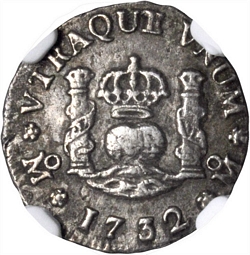
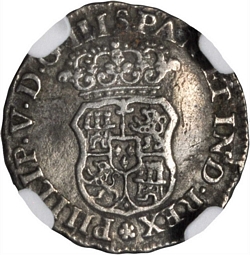
KM-65 ½r 1732 (Stack’s Bowers NYINC auction, 14 January 2017, lot 3121)
| Date | Asssayer | Comment |
| 1732 | no assayer or denomination. Pradeau{footnote}{/footnote} thought that these were struck as trial pieces with matrices sent from Spain, but Yonaka writes that "the large number of dies and observed examples might lead one to speculate that they were struck for circulation, perhaps as a stop gap measure until other dies were ready". | |
| 1732 | MF | |
| 1733 | F | |
| 1733 | MF | M.X For an explanation for the MX mintmark see Jorge Proctor's article here |
| 1733 | MF | |
| 1733/2 | MF | |
| 1734 | MF | |
| 1734/3 | MF | |
| 1734 | MF | cinquefoil below assayers' initials |
| 1735 | MF | |
| 1735/3 | MF | |
| 1735/4 | MF | |
| 1736 | MF | |
| 1736/5 | MF | |
| 1736 | F | |
| 1737 | MF | |
| 1737 | MF | F in assayer's initials is noticeably larger |
| 1737/6 | MF | |
| 1738 | MF | |
| 1738 | MF | cinquefoil below assayers' initials |
| 1738/7 | MF | |
| 1739 | MF | |
| 1740 | MF | |
| 1740/30 | MF | only the 4 was punched over the 3. It is possible that these dies were prepared for use in the 1730s by leaving the year digit blank. Hence only the decade digit needed to be overstruck. |
| 1741 | MF |
1742 saw a new obverse, in which the shield is moved up and marginal legend shortened (PHILIP V D G HISPAN EF IND REX shortened to PHS V D G HISP ET IND R). Only one assayer initial used, which is moved to reverse, right of date.
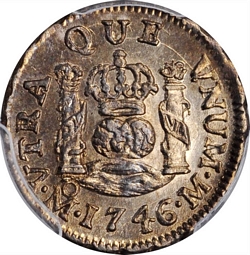
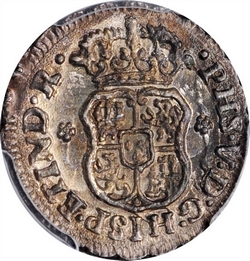
KM-66 ½r 1746 Mo M (Stack’s Bowers auction, 16 January 2021, lot 22257)
| Date | Asssayer | Comment |
| 1742 | M | |
| 1742 | M | no pellet to right of date |
| 1743 | M | |
| 1743/2 | M | |
| 1744 | M | |
| 1744/3 | M | |
| 1745 | M | |
| 1746 | M | |
| 1746 | M | no pellet to right of date |
| 1747 | M |
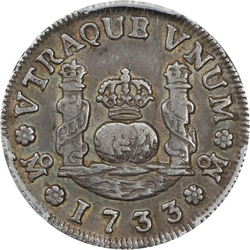
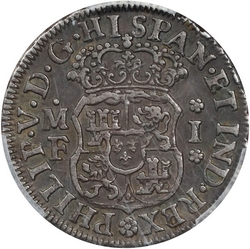
KM-75.1 1r 1733 Mo M (Stack’s Bowers auction, 24 February 2026, lot 76350)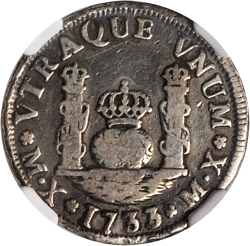
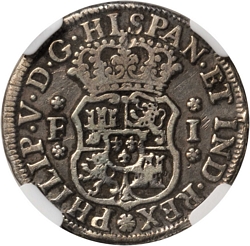
KM-75.1 1r 1733 MX F (Stack’s Bowers NYINC auction, January 2015, lot 1250)
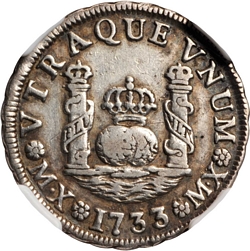
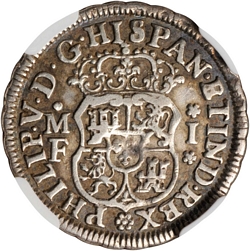
KM-75.1 1r 1733 MX MF (Stack’s Bowers Baltimore auction, winter 2014, lot 443)
Six petal rosette stops on reverse.
| Date | Asssayer | Comment |
| 1732 | No assayer or denomination | |
| 1732 | F | |
| 1733 | F | |
| 1733 | F | M.X cinquefoil stops both sides. For an explanation for the MX mintmark see Jorge Proctor's article here. |
| 1733 | MF | M.X cinquefoil stops both sides |
| 1733 | MF/F | M.X cinquefoil stops both sides |
| 1733 | MF | M.X rosette stops on reverse and 6 o'clock reverse |
| 1733 | MF | |
| 1733/2 | MF | |
| 1734 | MF | |
| 1734/3 | MF | |
| 1735 | MF | |
| 1735/3 | MF | |
| 1736 | MF | |
| 1736/5 | MF | |
| 1737 | MF | |
| 1737 | MF | cinquefoil under assayers' initials |
| 1737 | MF | large F in assayers' initials |
| 1738 | MF | |
| 1739 | MF | |
| 1739 | MF | appears to be an incorrectly punched E after the P of PHILIP, then corrected to H |
| 1740 | MF | |
| 1740 | MF | rosettes rather than cinquefoils bracketing denomination |
| 1740/30 | MF | only the 4 was punched over the 3. It is possible that these dies were prepared for use in the 1730s by leaving the year digit blank. Hence only the decade digit needed to be overstruck. |
| 1740/39 | MF | |
| 1741 | MF |
1742 saw a new obverse, in which the shield is enlarged and moved upwards and marginal legend shortened (PHILIP V D G HISPAN EF IND REX shortened to PHS V D G HISP ET IND R). Only one assayer initial (M) used, which is moved to reverse, right of date. In its place on the obverse was placed R (for real). Pellets replace rosettes at all stops on reverse.
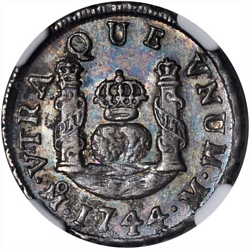
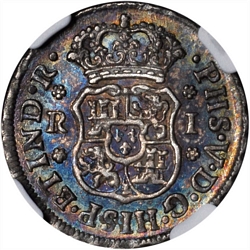
KM-75.2 1r 1744 Mo M (Stack’s Bowers auction, 7 August 2017, lot 22694)
| Date | Asssayer | Comment |
| 1742 | M | |
| 1743 | M | |
| 1744 | M | |
| 1744/3 | M | |
| 1745 | M | |
| 1745 | M | extremely weak or poorly placed crossbar on H of PHS and HISP. It appears that the H punch lost the crossbar portion and had to be crudely improvised |
| 1746 | M | |
| 1746 | M | no pellet after R in peripheral legend on obverse |
| 1746 | M | H punch appears to be unbarred in the words PHS and HISP |
| 1746/5 | M | |
| 1746/6 | M | repunching of year digit |
| 1747 | M | |
| 1747/6 | M |
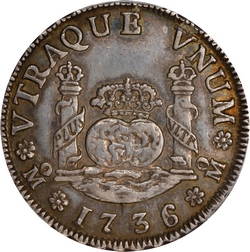
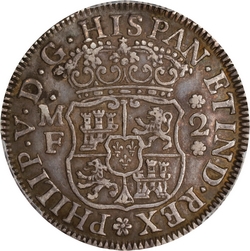
KM-84 2r 1736/3 Mo MF (Stack’s Bowers auction, 24 February 2026, lot 76630)
| Date | Asssayer | Comment |
| 1732 | No assayer or denomination | |
| 1732 | F | |
| 1733 | F | |
| 1733 | MF | M.X For an explanation for the MX mintmark see Jorge Proctor's article here. |
| 1733 | MF | pellet above and cinquefoil below assayers' initials. rosettes bracket denomination |
| 1733 | MF | pellets bracket assayers' initials. cinquefoils bracket denomination |
| 1734 | MF | |
| 1734/3 | MF | |
| 1734/3 | MF/F | |
| 1735 | MF | |
| 1735/3 | MF | |
| 1735/4 | MF | cinquefoils bracket denomination |
| 1735/4 | MF | rosettes bracket denomination |
| 1736 | MF | rosettes below assayers' initials and bracketing denomination |
| 1736 | MF | cinquefoil below assayers' initials and rosettes bracketing denomination |
| 1736 | MF | nothing below assayers' initials and rosettes bracketing denomination |
| 1736/3 | MF | rosettes below assayers' initials and bracketing denomination |
| 1736/3 | MF | cinquefoil below assayers' initials and bracketing denomination |
| 1736/4 | MF | rosettes below assayers' initials and bracketing denomination |
| 1736/4 | MF | cinquefoil below assayers' initials and rosettes bracketing denomination |
| 1736/4 | MF | cinquefoil below assayers' initials and bracketing denomination |
| 1736/5 | MF | rosettes below assayers' initials and bracketing denomination |
| 1736/5 | MF | nothing below assayers' initials and rosettes bracketing denomination |
| 1736/5/3 | MF | cinquefoil below assayers' initials and rosettes bracketing denomination |
| 1736/5/3 | MF | cinquefoil below assayers' initials and bracketing denomination |
| 1737 | MF | |
| 1737 | MF | V in PHILIP V is inverted A |
| 1737 | MF | A in VTRAQUE is inverted V |
| 1737/3 | MF | |
| 1737/6 | MF | |
| 1738 | MF | |
| 1738/7 | MF | |
| 1739 | MF | |
| 1739 | MF | IHILIP. now recognised as a struck counterfeit, possibly contemporary |
| 1740 | MF | |
| 1740 | MF | rosette below assayers' initials |
| 1740/30 | MF | decade overdate. nothing below assayers' initials |
| 1740/30 | MF | decade overdate. rosette below assayers' initials |
| 1741 | MF | |
| 1741/31 | MF | decade overdate. nothing below assayers' initials |
| 1741/31 | MF | decade overdate. V of PHILIP V is inverted A. rosette below assayers' initials |
1742 saw a new obverse, in which the shield is enlarged and moved upwards and marginal legend shortened (PHILIP V D G HISPAN EF IND REX shortened to PHS V D G HISP ET IND R). Only one assayer initial (M) used, which is moved to reverse, right of date. In its place on the obverse was placed R (for reales). Cinquefoils now become the standard for bracketing of R and denomination, as well as replaxing the rosettes on reverse stops.
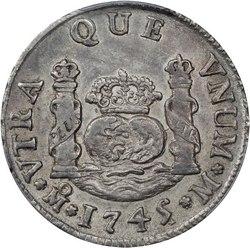
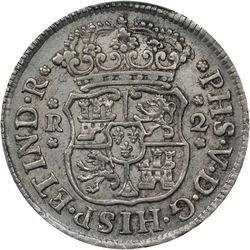
KM-85 2r 1745/4 Mo M (Stack’s Bowers auction, 24 February 2026, lot 76347)
| Date | Asssayer | Comment |
| 1742 | M | |
| 1743 | M | |
| 1744 | M | |
| 1744 | M | large 2 in denomination |
| 1744/3 | M | |
| 1744/3 | M | large 2 in denomination |
| 1745 | M | |
| 1745 | M | large 2 in denomination |
| 1745 | M | HIP for HISP large 2 in denomination (illustrated below) |
| 1745/4 | M | |
| 1746 | M | |
| 1746 | M | pellet to right of assayer's initial rather than cinquefoil |
| 1746/5 | M | |
| 1747 | M |
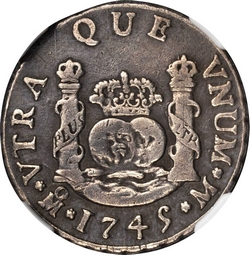
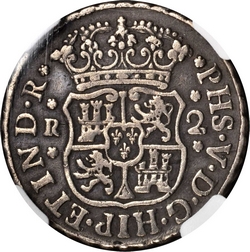
KM-85 2r 1745 Mo M (Stack’s Bowers NYINC auction, 8 January 2016, lot 42675)
Rare variety. HIP instead of HISP in legend.
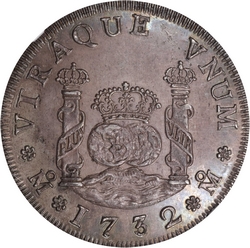
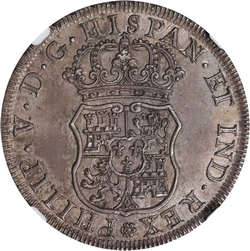
KM-94 4r 1732 (Stack’s Bowers NYINC auction, 15 January 2022, lot 2075)
Variety with wide date. Gilboy states that this type which lacks the assayer's initials and denomination may be considered "trial pieces struck directly from the matrix sent from Madrid". Whether this is true or not remains a mystery, but is believed to be the case by leading experts in the field. Brad Yonaka in his book A Variety Guide to the Fractional Pillar Coinage of Mexico City 1732-1771 states "It is thought that these coins were struck from dies sent directly from Spain, to serve as examples of how the coin layout should look".
| Date | Asssayer | Comment |
| 1732 | No assayer or denomination | |
| 1732 | F | |
| 1733 | F | |
| 1733 | F | M.X For an explanation for the MX mintmark see Jorge Proctor's article here |
| 1733 | MF | |
| 1733 | MF | cinque replacing rosette below assayers' initials |
| 1733/2 | MF | |
| 1733 | MF | M.X |
| 1733 | MF | second M.X right of date punched over X.M. presumably placed in error |
| 1734/ | MF | |
| 1734/3 | MF | |
| 1735 | MF | |
| 1735 | MF | rosette replacing pellet above assayers' imitials |
| 1735/3 | MF | |
| 1735/3 | MF | different reverse and obverse dies |
| 1735/4 | MF | |
| 1736 | MF | |
| 1736 | MF | osette replacing pellet above assayers' imitials |
| 1736/3 | MF | |
| 1736/5 | MF | |
| 1737 | MF | |
| 1737/3 | MF | |
| 1737/6 | MF | |
| 1738 | MF | |
| 1738 | MF | no neckmould at top of one or both pillars. This design change appears occasionally until 1743, at which point it becomes the dominant type |
| 1738/7 | MF | |
| 1739 | MF | |
| 1740 | MF | |
| 1740 | MF | no neckmould at top of one or both pillars. |
| 1740/30 | MF | decade overdate |
| 1741 | MF | |
| 1741 | MF | no neckmould at top of one or both pillars. |
| 1742 | MF | |
| 1742 | MF | no neckmould at top of one or both pillars. |
| 1742/1 | MF | |
| 1742/1 | MF | no neckmould at top of one or both pillars. |
| 1742/32 | MF | decade overdate |
| 1743 | MF | |
| 1743 | MF | no neckmould at top of one or both pillars. |
| 1444 | MF | |
| 1744/3 | MF | |
| 1745 | MF | |
| 1746 | MF | |
| 1747 | MF |
For an analysis of the transition from 8 reales cobs to milled coins in 1732 to 1734 see Kent Ponterio's article here.
For a checklist of the relative rarities of dates and varirties, from Freeman Craig and Kent Ponterio, see here.
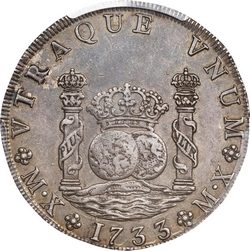
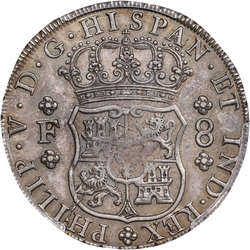
KM-103 8r 1733 MX F (Stack’s Bowers auction, 17 August 2024, lot 44143)
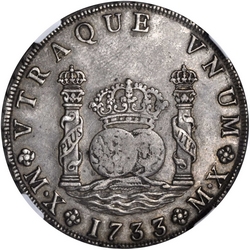
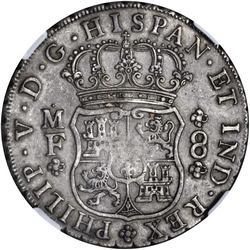
KM-103 8r 1733 MX MF (Stack’s Bowers ANA auction, 4 August 2017, lot 21160)
Large crown, dot above assayer's letters with rosette below.
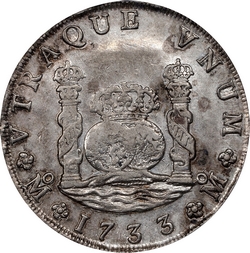
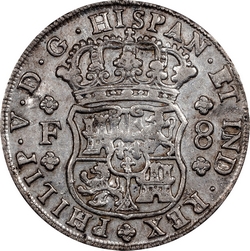
KM-103 8r 1733 Mo F (Stack’s Bowers NYINC auction, 13 January 2023, lot 21149)
| Date | Asssayer | Comment |
| 1732 | No assayer or denomination | |
| 1733 | F | Mo small crown only |
| 1733 | F | M.X large crown. For an explanation for the MX mintmark see Jorge Proctor's article here. |
| 1733/2 | F | M.X large crown |
| 1733 | MF | Mo small crown |
| 1733 | MF | Mo large crown |
| 1733 | MF | M.X large crown |
| 1734 | MF | |
| 1734/3 | MF | |
| 1735 | MF | |
| 1735/4 | MF | |
| 1736 | MF | |
| 1736/5 | MF | |
| 1737 | MF | |
| 1737 | MF | inverted A in place of V in VTRAQUE and VNUM |
| 1737 | MF | inverted A in place of V only in VNUM |
| 1738 | MF | |
| 1738/7 | MF | |
| 1739 | MF | |
| 1739/6 | MF | |
| 1739/7 | MF | |
| 1739/8 | MF | |
| 1740 | MF | |
| 1740/30 | MF | decade overdate |
| 1741 | MF | |
| 1741/31 | NF | decade overdate |
| 1742 | MF | |
| 1742/32 | MF | decade overdate |
| 1742/1 | MF | |
| 1743/2 | MF | |
| 1743 | MF | |
| 1744 | MF | |
| 1744/3 | MF | |
| 1745 | MF | |
| 1746 | MF | |
| 1746 | MF | VTRUQUE error |
| 1746/4 | MF | |
| 1746/5 | MF | |
| 1747 | MF | |
| 1747/6 | MF | illustrated below |
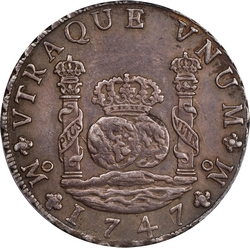
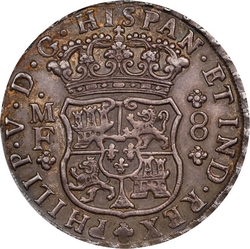
KM-103 8r 1747/6 Mo MF (Stack’s Bowers auction, 29 October 2024, lot 72357)
A very rare overdate, difficult to see, on this posthumous issue of Philip V.
| Gold | Silver | Total | |
| 1701 | 200,000.00 | 4,019,093.81¼ | 4,219,093.81¼ |
| 1702 | 200,000.00 | 5,022,650.12½ | 5,222,650.12½ |
| 1703 | 200,000.00 | 6,076,254.18¾ | 6,276,254.18¾ |
| 1704 | 200,000.00 | 5,827,027.43¾ | 6,027,027.43¾ |
| 1705 | 200,000.00 | 4,747,175.89½ | 4,947,175.89½ |
| 1706 | 200,000.00 | 6,172,037.66 | 6,372,037.66 |
| 1707 | 200,000.00 | 5,735,029.30 | 5,935,029.30 |
| 1708 | 200,000.00 | 5,737,610.23 | 5,937,610.23 |
| 1709 | 200,000.00 | 5,214,143.18¾ | 5,414,143.18¾ |
| 1710 | 200,000.00 | 6,710,587.83¾ | 6,910,587.83¾ |
| 1711 | 200,000.00 | 5,666,085.68¾ | 5,866,085.68¾ |
| 1712 | 200,000.00 | 6,663,425.44⅜ | 6,863,425.44⅜ |
| 1713 | 200,000.00 | 6,487,872.15¾ | 6,687,872.15¾ |
| 1714 | 200,000.00 | 6,220,822.87½ | 6,420,822.87½ |
| 1715 | 200,000.00 | 6,368,918.37½ | 6,568,918.37½ |
| 1716 | 200,000.00 | 6,527,728.35 | 6,727,728.35 |
| 1717 | 200,000.00 | 6,750,734.78¼ | 6,950,734.78¼ |
| 1718 | 200,000.00 | 7,173,590.40 | 7,373,590.40 |
| 1719 | 200,000.00 | 7,258,706.90 | 7,458,706.90 |
| 1720 | 200,000.00 | 7,874,342.56½ | 8,074,342.56½ |
| 1721 | 200,000.00 | 9,460,734.81¼ | 9,660,734.81¼ |
| 1722 | 200,000.00 | 8,823,932.90 | 9,023,932.90 |
| 1723 | 200,000.00 | 8,107,348.47 | 8,307,348.47 |
| 1724 | 200,000.00 | 7,872,822.60 | 8,072,822.60 |
| 1725 | 200,000.00 | 7,369,815.84 | 7,569,815.84 |
| 1726 | 200,000.00 | 8,466,146.30 | 8,666,146.30 |
| 1727 | 200,000.00 | 8,133,088.85 | 8,333,088.85 |
| 1728 | 200,000.00 | 9,228,545.47 | 9,428,545.47 |
| 1729 | 200,000.00 | 8,814,970.18¾ | 9,014,970.18¾ |
| 1730 | 200,000.00 | 9,745,870.50 | 9,945,870.50 |
| 1731 | 200,000.00 | 8,439,871.00 | 8,639,871.00 |
| 1732 | 200,000.00 | 8,726,465.50 | 8,926,465.50 |
| 1733 | 151,702.00 | 10,024,193.00 | 10,175,895.00 |
| 1734 | 385,878.00 | 8,522,782.18¾ | 8,908,660.18¾ |
| 1735 | 422,576.00 | 6,937,259.81¼ | 7,359,835.81¼ |
| 1736 | 787,556.00 | 11,033,511.62½ | 11,821,067.62½ |
| 1737 | 313,870.00 | 8,209,685.31¼ | 8,523,555.31¼ |
| 1738 | 468,802.00 | 9,502,205.50 | 9,971,007.50 |
| 1739 | 311,148.00 | 8,694,108.18½ | 9,005,256.18½ |
| 1740 | 316,770.00 | 9,589,268.31¼ | 9,906,038.31¼ |
| 1741 | 606,264.00 | 8,655,415.06¼ | 9,261,679.06¼ |
| 1742 | 625,836.00 | 8,235,390.43¾ | 8,861,226.43¾ |
| 1743 | 804,846.00 | 8,636,013.18¾ | 9,440,859.18¾ |
| 1744 | 819,380.00 | 10,303.735.31¼ | 11,123,115.31¼ |
| 1745 | 509,818.00 | 10,428,354.68¾ | 10,938,172.68¾ |
| 1746 | 428,356.00 | 11,524,179.75 | 11,952,535.75 |
| 13.352,802.00 | 355,739,552.02¾ | 369,092,354.02¾ |